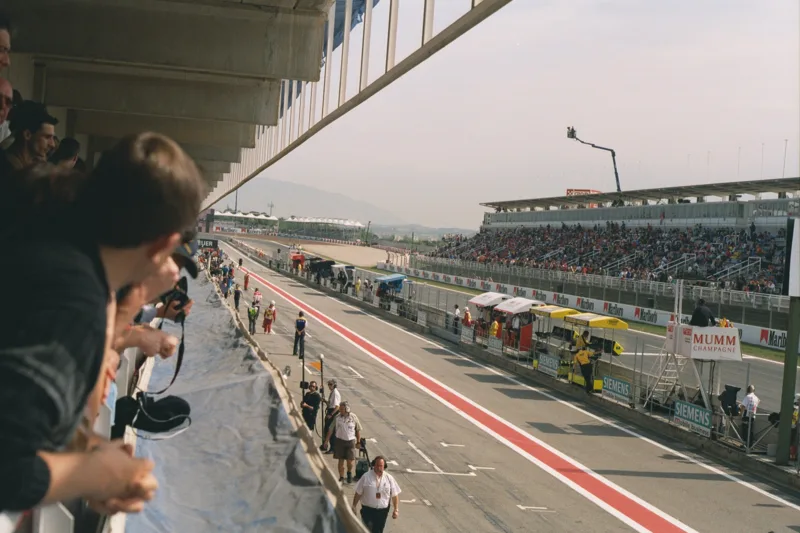
David Coulthard inherited the lead after Montoya and Verstappen collided on lap 39, then pulled clear to win by 16.1 seconds at Sao Paulo.
David Coulthard won the 2001 Brazilian Grand Prix at Sao Paulo on 1 April 2001, starting fifth and finishing 16.1 seconds ahead of Michael Schumacher. Nick Heidfeld took third for Sauber after Montoya and Verstappen collided on lap 39 and retired.
Coulthard's 2001 Brazilian Grand Prix win came from fifth on the grid, and it was the McLaren driver's tenth Formula One victory. The race was held at Sao Paulo on 1 April 2001 and was the only South American round of the season.
How did Montoya's early lead end?
Juan Pablo Montoya took the lead from Michael Schumacher at the end of lap two, when the safety car was withdrawn, and he held it for 36 laps. He was then struck by Arrows driver Jos Verstappen on lap 39, and both cars were forced out of the race.
The race had begun behind a safety car, because Mika Hakkinen's McLaren stalled on the grid. Once the safety car was withdrawn, Montoya went past Schumacher for the lead. His 36 laps in front were the longest spell of the race by any driver.
Coulthard took the lead after the collision and kept it through the stops for wet-weather tyres as the rain intensified. Schumacher then led for two laps until Coulthard passed him on lap 50, and Coulthard led the rest of the race.
Ending Schumacher's early-season run, Coulthard's Sao Paulo win opened the 2001 title race a little wider.
The championship before Sao Paulo
Schumacher led the drivers' championship with 20 points, ahead of his Ferrari team-mate Rubens Barrichello and McLaren's David Coulthard, who were tied on ten points each. Jordan's Heinz-Harald Frentzen was fourth with five points, and Sauber's Nick Heidfeld was fifth on three.
Ferrari led the constructors' championship with 30 points. McLaren were second with 11, Jordan third on five and Sauber fourth on four, while Williams were fifth with two.
Schumacher had won the season's first two races, in Australia and Malaysia, and the bookmakers made him the favourite for Sao Paulo. McLaren's co-ordinator, Jo Ramirez, admitted the team felt lost because its car had been slower than Ferrari's in the opening rounds. Hakkinen said winning in Brazil was the team's primary goal, and Coulthard hoped McLaren could keep up its record of success there.
The Grand Prix was the third round of seventeen, and the third race in a row held outside Europe. Eleven teams with two drivers each took part, and Bridgestone and Michelin brought two dry compounds and three wet-weather tyres to the event.
Testing at Catalunya before the race
Nine of the eleven teams tested at the Circuit de Catalunya in Spain from 20 to 23 March, in preparation for Sao Paulo. Ferrari's Luca Badoer was quickest on the first day, with McLaren's test driver Alexander Wurz close behind, and Badoer stayed on top on the second day.
Marc Gene stopped on track with a mechanical failure, which briefly halted the running. Seven suspensions were needed as drivers ran into trouble or spun off the circuit. Michael Schumacher was fastest on the third day and stayed at the top on the final day, while Minardi and Sauber did no testing at all.
What did the teams change for the race?
Most teams made few significant changes, saving their larger updates for the San Marino Grand Prix, two weeks after Brazil. The exceptions were McLaren, Williams, BAR, Sauber, Jaguar and Prost, each of which made smaller changes for Sao Paulo. Waiting was the sensible course for most, since the first European race came only two weeks later.
McLaren introduced four front wing specifications in an effort to reduce the understeer of its MP4-16, before settling on a new front wing profile. Trying four specifications in a single weekend showed how hard the team was working on its handling. Williams debuted a new rear wing for the event.
Benetton held back the debut of its lower front side appendages, which had slowed its B201 during practice. BAR tested two rear wing configurations and a modified upswept exhaust, while Sauber added two new sidepod winglets in front of the air extractor chimneys.
Jaguar reduced the size of the R2's bargeboards and extended the front wing endplates, and Prost added updated aerodynamic profiles to the AP04's front wishbones.
Why did the drivers criticise the track?
Barrichello was critical of the Grand Prix, citing the displeasure of some drivers in earlier years and the quality of the local facilities. The event's director, Carlos Roberto Montagne, disagreed and said two British engineers had approved the road surface, but several drivers still found it bumpy.
Hakkinen called the track very bumpy indeed and said it seemed to get worse every year. Minardi's Fernando Alonso went further and claimed the bumping was so bad that a driver could lose the view of the circuit.
The organisers had spent the year since the last race on safety work. After the death of marshal Graham Beveridge at the Australian race, 21 cabins were erected to protect marshals across the track. Animals roaming near the boundaries were rounded up, and the drainage system was repaired.
A guard rail was built at the Bico do Pato turn, because car speeds had risen sharply since 2000. The gravel trap on the Reta Oposta straight was made stronger, and construction work continued until just before the first practice session.
Practice sessions and the early pace
The weekend offered four sessions: a pair of hour-long outings on Friday, then two 45-minute runs on Saturday. Schumacher led the first session at 1:16.832 with 23 minutes left, while Hakkinen was second and fastest for the first quarter until he spun off midway through.
On new tyres, Coulthard posted 1:15.520 in the second session, a second better than Trulli. A second attempt went wrong when he overshot the braking point for the Curva do Sol and ended up in the gravel, and Schumacher had meanwhile suffered a puncture from a nail.
Ralf Schumacher ran wide at turn ten and damaged the front aerodynamic devices on his car, while Frentzen's engine cut out at Subida do Lago with more than 20 minutes remaining. Barrichello's engine lost oil pressure and he stalled, and because the sporting regulations barred him from the backup car he had little running to set up for the race.
Hakkinen led the third session at 1:14.503, with Coulthard second. In the final session Montoya was quickest at 1:13.963, faster than the 2000 pole time, and the two McLarens sat between Montoya and Ralf Schumacher, with Hakkinen second and Coulthard third.
Frentzen's engine failed before the pit lane on his final lap, with smoke billowing from the rear. Villeneuve and Irvine stopped their BAR and Jaguar close to each other in the grass with gearbox hydraulic trouble.
Who took pole, and how close was the front row?
Michael Schumacher took pole for Ferrari at 1:13.780 in the one-hour session, his seventh straight pole and the 35th of his career. He was one short of matching Ayrton Senna's eight straight poles, which came in 1988 and 1989. The pole lap was only three-tenths of a second faster than the 2000 race.
His brother Ralf was 0.310 seconds slower in second, and the pair became the first siblings to share a front row in a world championship event. Hakkinen took third and Montoya fourth, after he lost the rear of his Williams at Mergulho and hit the barrier on his first quick lap.
Coulthard was fifth, although his first run ended early when Villeneuve slowed him at the Juncao corner. Trulli and Frentzen were seventh and eighth, both with race-specification engines fitted between the final practice and qualifying.
Barrichello was sixth, four-tenths of a second slower than his team-mate, and complained of excess understeer on new tyres. Irvine and Burti were 13th and 14th, Alesi 15th, Bernoldi 16th and Verstappen 17th.
Fisichella and Button took 18th and 20th, with Alonso between them in 19th. Mazzacane and Marques filled 21st and 22nd, and Marques had the lowest grid slot.
Both BAR drivers said the car lacked grip in the slow corners. Panis went off early in qualifying, and on his first run Villeneuve hit the kerb inside turn eight and lost control.
After the session, scrutineers examined Ralf Schumacher's car for a fuel irregularity, because the first fuel sample differed from the one the FIA had approved. Williams, the FIA technical delegate and the FIA fuel analyst agreed to test a second sample, and the stewards let Ralf start from second rather than last once the fuel was declared legal that night.
Warm-up, weather and the start
The 30-minute warm-up gave every team a last check before the race. Schumacher set the fastest time at 1:15.971, the only lap under 1:16. He had a full tank of fuel and an old set of tyres, and he drove both his race car and the spare. Barrichello and Hakkinen were second and third, while Alonso crashed into the gravel and broke his front wing.
Some 70,000 people watched the 71 laps get under way at 14:00 local time. Dark grey clouds hung over the circuit even though the conditions were dry. The air stood at 30 C (86 F) and the track between 36 and 40 C (97 and 104 F), with a 50% probability of rain forecast.
Hakkinen's McLaren had stalled on the grid, so the safety car led the field out. Barrichello, racing at home, said he knew what a win would mean to the fans, and Schumacher had warned that the warm weather could make the race hard on drivers and cars.
How did Coulthard hold on to win?
Coulthard led for most of the race after Montoya and Verstappen were out of it, apart from the two laps Schumacher spent in front. The wet-weather tyres brought in at the pit stops changed the order, and Coulthard finished 16.1 seconds clear of Schumacher, the only other driver on the lead lap.
Schumacher had taken the lead for two laps when the rain became heavier and the pit stops for wet tyres were made. Coulthard then passed him on lap 50 and never gave the lead back.
Heidfeld finished third behind the two leaders, and the race ended with Coulthard's margin at 16.1 seconds. Montoya and Verstappen had been the early casualties after their collision on lap 39.
The first half of the race belonged to Williams and Ferrari: Montoya's lead came first, then a brief spell for Schumacher, before Coulthard's long run at the front carried him to the flag.
Final result
| Position | Driver | Note |
|---|---|---|
| Winner | David Coulthard (McLaren) | From fifth on the grid, 16.1 seconds clear |
| Second | Michael Schumacher (Ferrari) | Only other driver on the lead lap |
| Third | Nick Heidfeld (Sauber) | Podium finish |
| Retired | Juan Pablo Montoya (Williams) | Collision with Verstappen on lap 39 |
| Retired | Jos Verstappen (Arrows) | Collision with Montoya on lap 39 |
The effect on the championship
Coulthard's win reduced Schumacher's championship lead to six points, with Coulthard moving up to second place, 10 points ahead of Barrichello in third.
McLaren cut Ferrari's constructors' lead to 15 points, with 14 races remaining in the season. Schumacher had won the first two races, so Brazil was the first win for a driver other than Schumacher that year. The title race now had a clear shape, with Schumacher leading and Coulthard and Barrichello in pursuit.