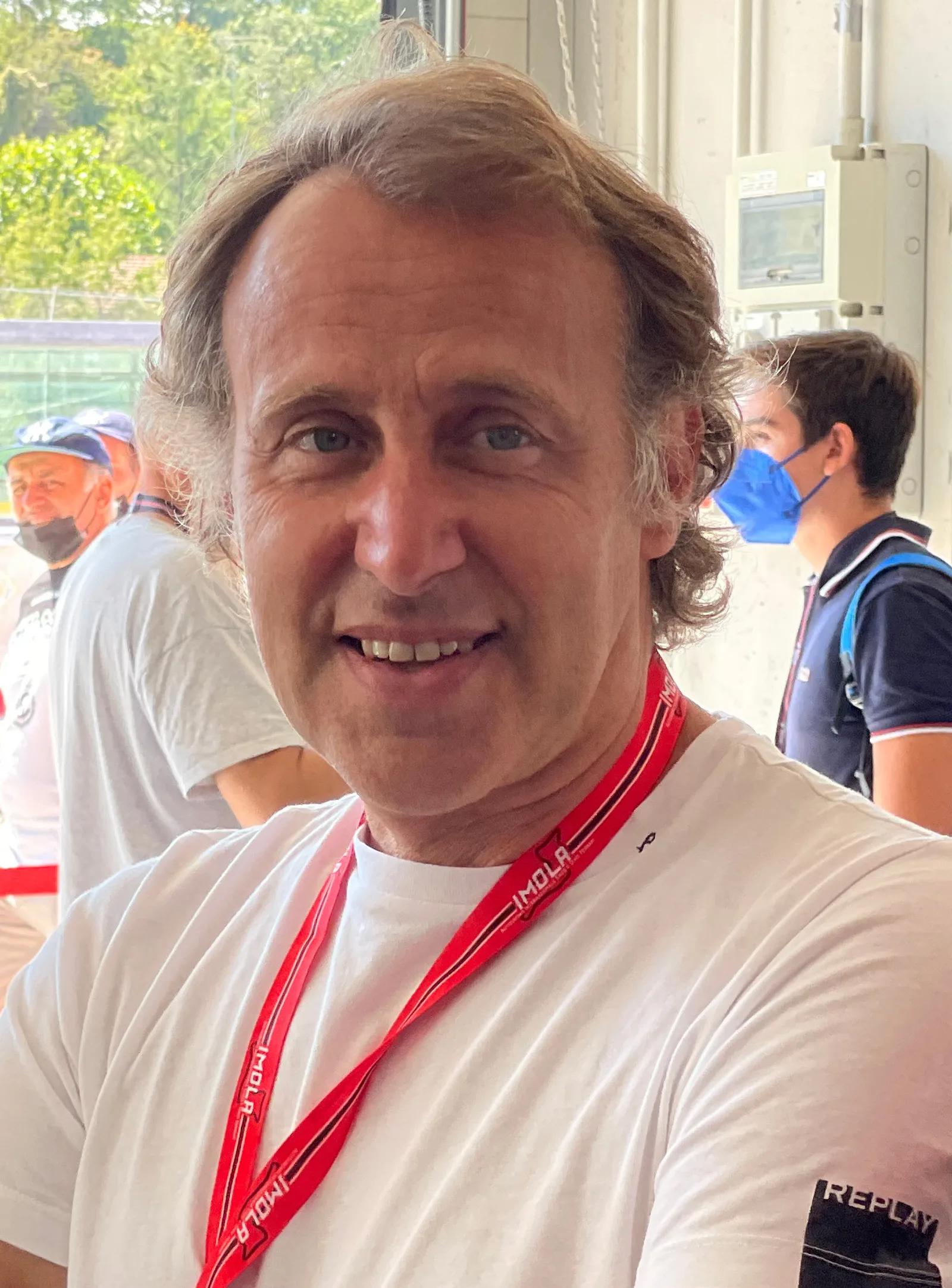
A Veneto driver who won the Formula 3000 title at his first attempt, raced for three backmarker teams and spent over a decade testing for Ferrari before a sudden return in 2009.
Italian driver Luca Badoer raced in Formula One from 1993 to 2009 with small teams and then with Ferrari. Before that he took the 1992 Formula 3000 crown at his first try, and later served as Ferrari's test driver for more than a decade.
Luca Badoer is an Italian driver from Veneto whose Formula One career ran from 1993 to 2009, with long gaps between grands prix. He won the 1992 Formula 3000 title at his first attempt, raced for three small teams in the 1990s, and then spent more than a decade as Ferrari's test driver before returning to race for the team in 2009.
Who is Luca Badoer?
Luca Badoer was born on 25 January 1971 in Montebelluna, Veneto. He was an Italian racing driver who raced in Formula One between 1993 and 2009, and he is best known outside Italy for his brief race return with Ferrari and for his years as a test driver.
His Formula One career was a series of modest teams and difficult machinery, interrupted by long stretches away from the grid. Those years gave him a reputation for hard work and patience that came up again when Ferrari called on him in 2009.
A Formula 3000 champion at his first attempt, Badoer's later years were defined by testing for Ferrari, and one brief, difficult return.
How did Badoer start out in racing?
Badoer began kart racing at a young age and scored two wins in his first season, starting in 1985. In 1986 he won the 100cc category to become karting champion of Venice, and the following year he became national champion. He took the Italian 100cc international class title in 1988.
In 1989 he moved into single-seaters, joining Trivellato for the Italian Formula Three series in a Dallara fitted with Alfa Romeo power. A year later he joined the MRD team, and he won the final race of the 1990 season ahead of Alex Zanardi and Roberto Colciago.
Although he finished 10th in the 1990 championship, the race win was a sign of his pace. In 1991 he moved to the Supercars team in a Dallara 391 Alfa Romeo and won four races in succession, but he was disqualified after a technicality about his tyres. He still finished fourth overall in the championship, with 33 points.
What did Badoer's Formula 3000 title involve?
Badoer won the Formula 3000 Championship in 1992 at his first attempt, driving for Crypton Engineering. He took four race wins over the season, and a dominant performance at Pergusa, where he finished 21 seconds clear of Emanuele Naspetti, was among the highlights.
The title put him in a select group. Only four drivers had won the series at the first attempt, and he joined Stefano Modena, Christian Fittipaldi and Jorg Muller in that list. He did so against a field that included Rubens Barrichello and David Coulthard.
How did the 1993 Formula One debut go?
Badoer turned down a long-term contract offer from Tyrrell and signed with BMS Scuderia Italia instead. His debut season was held back by the team's Lola chassis, which had Ferrari engines but was the slowest car in the championship on qualifying pace.
He retired at South Africa after 20 laps with a gearbox failure, and at Brazil he qualified 21st and finished 12th after a nose cone change. At Donington a rule that cut the qualifying field to the quickest 24 cars left him out, because his time was only good enough for 26th.
Imola was the high point. He ran as high as sixth and finished seventh, which remained his best result in Formula One. He finished 15th in Canada, 13th at Spa, tenth at his home race in Monza and 14th at Estoril after starting last there.
What did Badoer do after the Lola team folded?
Lola skipped the final races in Japan and Australia after announcing a merger with Minardi for 1994, which left Badoer without a seat for the next season. Benetton tested him and Michele Alboreto as possible partners for Michael Schumacher, but the team picked JJ Lehto.
Alboreto joined Minardi, and Badoer became Minardi's test driver. That role kept him close to the team while he waited for the chance to race.
How did Badoer's mid-1990s seasons unfold?
In 1995 he took over Alboreto's seat at Minardi after Alboreto retired. The underfunded team ran a Ford V8 after a planned deal with Mugen-Honda fell through, and his top finishes came in Canada and Hungary, where he was eighth, and in Japan, where he was ninth.
He also ran into the rear of Mika Salo's Tyrrell in Brazil, which left him without a spare chassis to make the restart. In 1996 he moved to Forti Corse alongside Andrea Montermini, and the team could only qualify for six of the ten races it entered.
The Argentine Grand Prix that year was a difficult one. Pedro Diniz's Ligier struck his Forti from behind and flipped it, and Badoer was unhurt, but the marshals were criticised for delaying his rescue. At Imola he outqualified Montermini by more than a second and finished tenth, the last of the runners, and Forti folded after the British Grand Prix.
What did Badoer do in sports car racing?
The 1997 season saw him switch to the newly created FIA GT Championship, where he shared a Lotus Elise GT1 entered by GBF Engineering with Mimmo Schiattarella. The pair finished 20th at Helsinki and 12th at Donington, where they completed 151 laps, and a retirement at Mugello ended one weekend early.
While driving for GBF he was also hired as a Scuderia Ferrari test driver, a role he kept until 2010. That job would define the next decade of his career.
Why did Badoer become a Ferrari test driver?
After 1999 Badoer could not find a satisfactory Formula One race seat, so he focused on being Ferrari's permanent test driver. He covered thousands of kilometres each year at the Mugello and Fiorano test circuits, and he is credited with a vital contribution to Ferrari's first Drivers' Championship for 21 years in 2000.
In 2006 he drove a 2005 Ferrari into the middle of the stadium at the opening ceremony of the Turin Winter Olympics, performing doughnuts that left tyre smoke and black marks on the platform.
What happened in Badoer's 1999 Formula One return?
He returned with Minardi in 1999. At Melbourne he ran as high as fifth before gearbox problems ended his race with 15 laps to go, and a testing accident before Brazil left him with a broken hand. Stephane Sarrazin took his seat for that race.
In July, Michael Schumacher broke his leg at the British Grand Prix. Badoer, as Ferrari's test driver, expected a promotion to the race seat, but the team chose Mika Salo instead, which drew criticism from Jean Alesi, who had himself declined the job.
His best chance to score came at the 1999 European Grand Prix, when a gearbox failure ended his race 13 laps from the finish while he was running fourth. Teammate Marc Gene was promoted to sixth and took the point, which is widely seen as decisive in the title race that year. He was visibly upset and wept after leaving the cockpit.
How did the 2009 return at Valencia go?
In August 2009 Ferrari confirmed that Badoer would return to racing after almost ten years, replacing the injured Felipe Massa at the European Grand Prix in Valencia. Massa had been struck on the helmet by a piece of suspension during qualifying in Hungary, and Michael Schumacher withdrew after a neck injury from a superbike test.
Before the call-up he had last tested the Ferrari F2008 at the Portimao circuit in Portugal in December 2008. He had never driven the F60 before Valencia, which made the short notice a real challenge.
In his first practice session at the Valencia Street Circuit, Badoer came last, three seconds off Rubens Barrichello's pace. He qualified 20th and last, and he was caught speeding in the pit lane four times on Friday, which earned him a reprimand and fines totalling 5,400 euros.
Some drivers defended his effort, pointing out how hard it is to return after such a long gap. Martin Brundle wrote in The Sunday Times that putting him in the car was risky, because the testing ban meant that the drivers had little chance to prepare for racing. Brundle suggested Ferrari should have picked another tester, Marc Gene, who had once stood in successfully at Williams.
In the race he made up six places at the start and ran 14th on the opening lap before Romain Grosjean hit him from behind. He finished 17th of 18 finishers, and his fastest lap was quicker than both Toro Rossos. He was also the first Italian to drive for Ferrari in 15 years.
How did the 2009 Belgian Grand Prix go?
At Spa he qualified last after a spin on his final lap of the first qualifying session. He avoided the first-lap accidents and finished 14th, the last driver to complete the full race distance, and he was replaced by Giancarlo Fisichella from the Italian Grand Prix onwards.
In the last five races of the year he did not score a point. Badoer later blamed negative media coverage of his driving for Ferrari's decision.
How did Badoer's career end?
At the end of 2010 he retired as Ferrari's test driver after a 12-year association, and Jules Bianchi took over the role. His farewell with the team was a demonstration of the F60 at Bologna's motor show on 8 December 2010.
He had said his only regret was that he was able to race for the team only twice. In January 2011 he drove the F60 on the ice at Madonna di Campiglio for a final act with the team.
How do Badoer's career highlights compare across periods?
Badoer's record is best read in stages, from junior single-seaters and his 1992 title to the backmarker years and the long test-driver spell. The table below summarises each stage.
| Period | Series and team | Highlight |
|---|---|---|
| 1990 | Italian Formula Three, MRD | Final race win of the season, 10th in the championship |
| 1991 | Italian Formula Three, Supercars | Four wins in succession, then disqualified; fourth overall with 33 points |
| 1992 | Formula 3000, Crypton Engineering | Champion at first attempt, four race wins |
| 1993 | Formula One, BMS Scuderia Italia | Seventh at Imola, his best Formula One result |
| 1995 | Formula One, Minardi | Eighth in Canada and Hungary |
| 1996 | Formula One, Forti Corse | Tenth at Imola, team folded after the British Grand Prix |
| 1997 to 2010 | Ferrari test driver | Testing at Mugello and Fiorano, role ended after 2010 |
| 2009 | Formula One, Ferrari | Replacement at Valencia, 17th of 18 finishers |