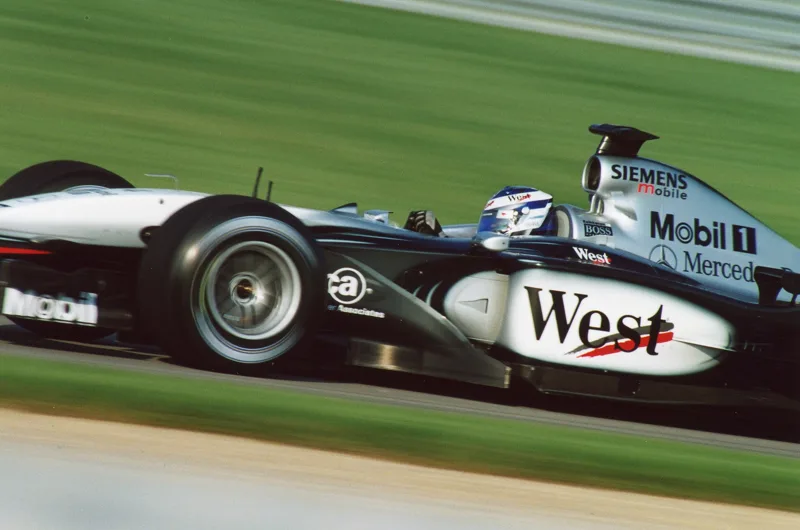
Pole, fastest lap, every lap led and the win: Michael Schumacher's Grand Slam came amid a Minardi withdrawal, a pit-lane injury and a stalled Ferrari on the grid.
The 2002 Spanish Grand Prix was the fifth round of the 2002 Formula One World Championship, held at the Circuit de Catalunya in Montmelo on 28 April 2002. Michael Schumacher won from pole, Juan Pablo Montoya was second and David Coulthard third, extending Schumacher's championship lead to 21 points.
The 2002 Spanish Grand Prix was a Michael Schumacher exercise from start to finish. He took pole, set the fastest lap, led every lap and won, which is a full Grand Slam. The race was otherwise eventful, with a Ferrari stuck on the grid, a Minardi withdrawal after repeated wing failures and an injury to a mechanic at a pit stop.
Where did Spain sit in the 2002 standings?
Schumacher arrived at Montmelo leading the drivers' championship with 34 points, ahead of the Williams pair of Ralf Schumacher on 20 and Juan Pablo Montoya on 17. Ferrari led the constructors' table with 40 points, three ahead of Williams. Schumacher had won three of the previous four races and had taken the Spanish Grand Prix three times in ten starts.
Renault's Jenson Button was fourth on eight points and Ferrari's Rubens Barrichello fifth on six. McLaren and Renault each had nine constructors' points, with Jaguar on three. Montoya was 17 points behind the leader but refused to give up, saying the contest was about who could develop the car faster and that he did not know if he could beat Schumacher at the track.
Schumacher said Ferrari would take things one race at a time, and that the F2002 would show more of its potential in Spain. David Coulthard, sixth at the San Marino Grand Prix, was looking forward to racing after three days of testing at Mugello.
Pole, fastest lap, every lap led and the win: Schumacher's Grand Slam at Montmelo.
What changed on the cars before Spain?
Ferrari updated the F2002 with new torsion bars, modified screens behind the front wheels and new front and rear wings. McLaren revised the rear suspension of the MP4-17, and Williams fitted a stronger BMW unit and reworked its rear wing. Cosworth and Honda both brought upgraded engines, while Jaguar ran the stronger Cosworth unit and Arrows stayed with the older specification.
Testing after the San Marino Grand Prix on 14 April was spread across Europe. Eight teams spent three days at Silverstone, McLaren and Toyota spent three days at Mugello, and Ferrari used four days at Mugello, three days at Monza and a day at its Fiorano facility.
How did practice shape the weekend?
Michael Schumacher topped the Friday sessions, setting 1:20.681 in the first and 1:20.380 in the second, and Barrichello led the Saturday morning running with 1:18.048. Takuma Sato never set a lap in the first session after an electrical connection failure, and spare cars were banned before qualifying, so he could not continue.
Friday's first session saw Schumacher 0.061 seconds ahead of Barrichello, with Massa, Raikkonen, Trulli and Frentzen in the leading group. In the second session Frentzen finished second, 0.070 seconds behind Schumacher. Several drivers went off the circuit, and Trulli had to use opposite lock in the second sector to save his Renault from the barrier.
On Saturday morning Schumacher was 0.386 seconds behind Barrichello in the third session. Minardi's Mark Webber struck a small bump on the main straight, and the front wing assembly attached to the nose cone came apart, folding under his car and leaving carbon fibre across the track. The session was halted for eight minutes while marshals cleared the debris. In the final session Sato spun backwards through the gravel and touched the barrier head-on, and Montoya lost control under braking for La Caixa.
How was pole position decided?
Schumacher took pole with a new track record of 1:16.364, his third pole position from five races in the season and the 46th of his career. The lap was almost two seconds quicker than his pole time from 2001, and he set it shortly before qualifying ended, after changing his Ferrari in the garage following his first two runs.
Barrichello led after his first two runs and held pole until his team-mate's final lap, which meant he started second. Ralf Schumacher led early on before dropping to third after Williams made changes to his car. Montoya had an ignition misfire in his race car, so he switched to the spare and still took fourth. Raikkonen was fifth, Button sixth and Coulthard seventh. Heidfeld took eighth, Trulli ninth in the spare Renault and Frentzen tenth.
After qualifying the stewards deleted all of Eddie Irvine's times. The FIA's technical delegate had found that the fuel in his car did not match a control sample approved two weeks before the event, so Irvine was sent to the back of the grid.
What stopped Barrichello and Minardi before the start?
Barrichello's Ferrari stopped on the grid as the formation lap began, with a gearbox selection fault to blame. The marshals pushed it into the pit lane, but the team could not fix it, and switching to a spare car was not allowed once the race had started. He never took the start.
The Minardi team had a worse weekend. Both of its cars suffered wing failures, and after the warm-up the team's owner, Paul Stoddart, withdrew both drivers on safety grounds. The wings were sent back to Faenza, and there was not enough time or equipment to check the remaining ones for manufacturing defects. The race started with 20 cars.
How did the race unfold?
Michael Schumacher had switched to the spare Ferrari after a hydraulic problem in the warm-up. He held the lead into the first corner, where Ralf Schumacher challenged on the inside. Schumacher led his brother by 1.5 seconds after the first lap, with Montoya, Raikkonen, Button and Coulthard following. Trulli moved from ninth to seventh on the opening lap, and Massa passed Frentzen for ninth.
De la Rosa lost the rear of his Jaguar under braking on lap three and became stuck in the gravel at turn seven. Raikkonen's rear wing failed on the pit straight on lap four because of a fatigue-related failure in a lower element. He pulled into the pits and retired, narrowly missing Button, who had to dodge the wing. Fisichella lost hydraulic pressure and retired in the garage on lap six.
By lap 12 Schumacher's lead over Ralf Schumacher had grown to 10.4 seconds, and before the first stops it was more than 20 seconds. The first pit stops came on lap 24, when Trulli came in from sixth and rejoined in 11th. Ralf Schumacher and Button stopped the next lap, and Montoya followed on lap 26. Schumacher stopped at the end of that lap, took 9.4 seconds and came back out 11 seconds ahead of Montoya.
On lap 29 Ralf Schumacher drifted onto the grass at Campsa. He damaged his front wing and the left-hand bargeboard, and he needed a new front wing and tyre. He was stationary for 28.3 seconds, which dropped him from third to 13th and handed Montoya second and Button third. Coulthard had pitted from second on the same lap, and he later passed Button on the inside into turn one on lap 34 to take third.
Panis retired on lap 45 with an exhaust failure. Montoya made his second stop on lap 46, and the stop went wrong when the car stalled. The chief mechanic, Carl Gaden, had signalled Montoya on the front-left side, and the car ran over his foot. Gaden was not seriously injured, and Montoya kept second despite the delay. Coulthard came in on lap 47, and Schumacher followed the same lap on the advice of Ross Brawn to avoid traffic, keeping his lead of 41.8 seconds over Montoya.
Massa passed Button at Elf corner two laps later, but Button took the place back at Seat corner. Button ran wide at turns seven and eight on lap 57, and Massa went ahead. Button then stopped at the trackside on lap 63. Schumacher eased off in the final laps but kept his lead to take the win, his fourth of the season and 57th of his career. Montoya was second, 35.630 seconds behind, and Coulthard third, another 6.993 seconds back.
Top ten classification
| Position | Driver | Team | Notes |
|---|---|---|---|
| 1 | Michael Schumacher | Ferrari | Grand Slam: pole, fastest lap, every lap led |
| 2 | Juan Pablo Montoya | Williams | 35.630 seconds behind |
| 3 | David Coulthard | McLaren | 6.993 seconds further back |
| 4 | Nick Heidfeld | Sauber | Pit lane duel with Button |
| 5 | Felipe Massa | Sauber | Both Sauber drivers scored |
| 6 | Heinz-Harald Frentzen | Arrows | First point of 2002 for Arrows |
| 7 | Jacques Villeneuve | BAR | Unhappy with the feel of his car |
| 8 | Allan McNish | Toyota | Eighth at the flag |
| 9 | Mika Salo | Toyota | Stopped on the final lap |
| Tenth | Jarno Trulli | Renault | Classified despite retiring |
Why did Frentzen's sixth place matter for Arrows?
Frentzen finished sixth, scoring the team's first championship point of 2002 and his own first since the 2001 San Marino Grand Prix. He crossed the line 1.4 seconds behind Massa. Arrows had last scored when Jos Verstappen finished sixth at the 2001 Austrian Grand Prix, so the point ended a long wait for the team.
Frentzen was delighted, saying the team had done a superb job all weekend and deserved the reward. Arrows' team principal Tom Walkinshaw said the result showed why the team had invested in Frentzen.
What did the result change in the championships?
Schumacher's victory raised his lead in the drivers' championship to 21 points. Montoya's second place moved him ahead of his team-mate Ralf Schumacher for second overall. Coulthard's third place lifted him to fourth, and Button dropped to fifth after his retirement.
In the constructors' table Ferrari extended their lead over Williams to seven points, with twelve races remaining. McLaren and Renault kept third and fourth, and Sauber moved into fifth.
How did the Montoya pit stop incident affect the race?
Montoya's second stop turned into an accident when his front-left wheel ran over the foot of chief mechanic Carl Gaden. Gaden was not badly hurt, but the incident ended with Montoya's apology and a short delay. Montoya said Williams had struggled for pace all weekend, but he was pleased to keep second.
Patrick Head, Williams' technical director, joked that Gaden was tough and would survive, adding that his pride was more hurt than his body.