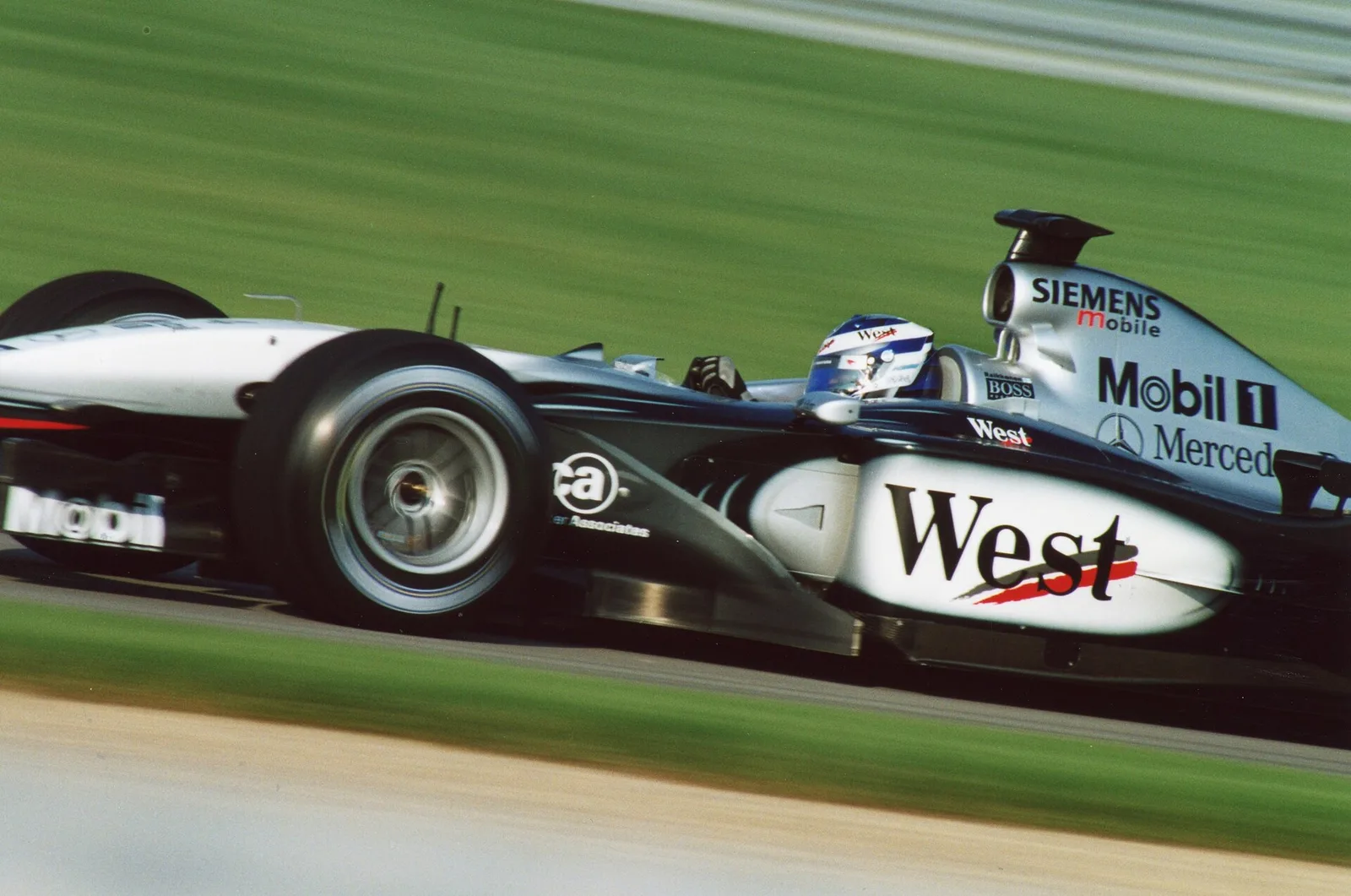

Rubens Barrichello beat Michael Schumacher by 0.011 seconds at Indianapolis after a final-corner finish that became one of the closest in Formula One history.
Rubens Barrichello won the 2002 United States Grand Prix for Ferrari at Indianapolis on 29 September 2002, finishing 0.011 seconds ahead of Michael Schumacher. It was his fourth win of the season and his fifth in Formula One. David Coulthard completed the podium for McLaren.
Ferrari's two drivers almost crossed the line together at the 2002 United States Grand Prix, which was held at Indianapolis on 29 September 2002. Rubens Barrichello came from second on the grid, but the margin over Michael Schumacher was only 0.011 seconds. David Coulthard finished third, and the race was the 16th and penultimate round of the season in front of about 125,000 spectators.
The race took place on the 4.192 km (2.605 mi) Indianapolis Motor Speedway road course in Speedway, Indiana. This was the third American race at Indianapolis since the event came back to the calendar in 2000, following nine years away. The Porsche Supercup and the Ferrari Challenge supported the weekend, and Mandy Williams Reimert became the first woman to race on the infield road course.
Michael Schumacher had already secured the drivers' title at the French Grand Prix, five rounds earlier, and Ferrari had taken the constructors' championship at the Hungarian Grand Prix. Barrichello needed to score three points at Indianapolis to take second place in the drivers' table, and he had little else to play for.
Who won the 2002 United States Grand Prix?
Barrichello started second, while Michael Schumacher had overshot his grid slot before reversing back into place. Barrichello held off Coulthard's challenge on the outside for second. Schumacher had led from pole, and he only ceded the lead during the two pit stop cycles.
On the final lap Schumacher still led Barrichello by half a second, but he allowed his team-mate to catch him through the last corner and drew alongside. Barrichello passed him to win by 0.011 seconds. It was his fourth win of the season and his fifth in Formula One, and he did not realise he had won until his crew told him over the radio on the cool-down lap.
Two Ferraris crossed the line 0.011 seconds apart at Indianapolis, and the finish still divides opinion.
Testing, rules and the new parts
After the Italian Grand Prix on 15 September, several teams tested at European circuits. McLaren and Williams spent four days at Catalunya, joined for three of those days by BAR and Jaguar, while Renault and Sauber tested at Silverstone. Ferrari completed four days of tyre and electronics testing at Mugello, and its test driver Luciano Burti ran three F2002 cars at Fiorano on 19 September.
The Indianapolis asphalt was diamond ground to smooth out bumps and improve grip, and a pit wall was built to separate the circuit from the pit lane entry. The FIA kept the energy-absorbing SAFER barrier at turn 13, expanding it to cover clockwise running. Part of the kerb at turn one was removed to widen the opening corner.
Ten constructors entered two drivers each. Arrows did not enter because of financial problems, which was its third absence in succession that year. Sauber brought in Heinz-Harald Frentzen in place of Massa, who would otherwise have had to serve a grid penalty after his collision with De la Rosa in Italy. Renault's Jenson Button was cleared to race, despite dizzy spells caused by an inner ear infection.
Almost every team brought developments for its 2003 cars. McLaren introduced a new front suspension, BAR used lighter Brembo calipers, and Honda supplied an advanced qualifying engine to BAR and Jordan. Toyota tried a new front aerodynamic layout but reverted to its previous configuration for the race.
Practice and qualifying
Two one-hour practice sessions were held on Friday, followed by two 45-minute sessions on Saturday. Heavy rain had fallen overnight, and the circuit was still damp in the first session. Michael Schumacher was fastest there at 1:15.188, and he improved to 1:13.548 with 17 minutes remaining in the second session.
Barrichello crashed at turn 13 after 29 minutes of practice, when a left-rear tyre lost pressure. He hit a concrete wall, and the session was stopped while marshals cleared the debris. Because the rules did not allow him to use the spare Ferrari, he missed the rest of Friday. Ralf Schumacher then hit the turn eight tyre wall with ten minutes left, and Sato spun into the same barrier in the second session.
The third session was held in thick fog, and Michael Schumacher set 1:11.262 in it. Sato's engine failed at low speed and his car caught fire, so Jordan moved the engine from its backup car into Sato's race car. Michael Schumacher went quickest in the final session too, with 1:11.158, and that gave him the top time in every practice session.
Michael Schumacher took pole with 1:10.790, a new track record set on his second quick lap. It was his sixth pole of the season and the 49th of his career. Barrichello was nearly 0.3 seconds slower after struggling to balance his Ferrari, and he made a mistake at turn one on his opening lap of qualifying.
Coulthard took third from Montoya on his final lap, while Montoya and Ralf Schumacher filled fourth and fifth on the Williams cars. Raikkonen was sixth in the spare McLaren after his crash in practice, with Villeneuve seventh, Trulli eighth, Fisichella ninth and Heidfeld tenth. Frentzen was 11th after Sauber fixed the oversteer on his car, and Panis took 12th.
Further down, Irvine was 13th, Button 14th and Sato 15th, with McNish 16th and De la Rosa 17th. Webber recovered from a gearbox input shaft failure in the last practice session to qualify 18th, while Salo took 19th and Yoong 20th.
What happened on the opening lap?
Michael Schumacher led into the first corner, and Barrichello held off Coulthard for second. Ralf Schumacher passed his slow-starting team-mate Montoya for third. Salo had the sharpest getaway, climbing from 19th to 16th on the first lap, whereas Panis slipped five places in the same stretch.
At the end of lap one Michael Schumacher led Barrichello by 0.9 seconds, with Coulthard third. On lap two Montoya and Ralf Schumacher ran side by side as they left the banked turn 13, and Ralf lost the rear under braking. The two Williams cars collided and went onto the grass, and Montoya fell to seventh. Ralf's rear wing was removed in the contact, forcing a 69-second pit stop that left him a lap down.
Sato got past Button into 11th, and Salo went by Irvine for 16th. The two Ferraris then opened up on the rest, trading new lap records as they caught slower traffic. On lap seven Sato locked his front-right wheel, but he managed to pass Frentzen on the inside at turn three.
A spark plug failure left Raikkonen's V10 misfiring from lap 13, so he had nine cylinders. He lost fifth to Villeneuve on the next lap, and Montoya passed him on the inside for sixth on lap 17.
How did the pit stops shape the race?
Ferrari ran two stops while the Michelin-shod teams planned one, which suited its lighter fuel loads. Michael Schumacher made the first of his stops at the end of lap 27, taking eight seconds. Barrichello took the lead and set the race's fastest lap, 1:12.754, on the same lap.
Panis was the first to stop, on lap 22, and he took 8.4 seconds. Villeneuve stopped four laps later in 9.4 seconds, and he was the first of the leaders to pit. Trulli made his only stop on lap 29, dropping to seventh, and Montoya misread a pit board and stopped ten laps early on lap 33. He stood still for 11.2 seconds and dropped to sixth, carrying more fuel than he needed.
De la Rosa's Jaguar caught fire on lap 29 after its gearbox stuck in fifth, and he climbed out over the Armco. He then fell 6 ft (1.8 m) into a river that runs beneath the circuit at that point. Coulthard made his only stop on lap 42, taking 10.8 seconds, and he rejoined behind Raikkonen. Michael Schumacher made his second stop on lap 49, taking 7.8 seconds.
Coulthard was told to drive cautiously over the final 20 laps to protect his engine, after McLaren changed its plan. Michael Schumacher then led Barrichello by 3.4 seconds by the 64th lap, while Coulthard began to close on both Ferrari drivers.
How did the finish become so close?
On the final lap Michael Schumacher was half a second ahead of Barrichello, but he slowed in the final corners to let his team-mate draw level. Barrichello, unsure at first, drew alongside and won by 0.011 seconds. It was the second-closest finish in Formula One history, after Peter Gethin's 0.01-second win over Ronnie Peterson in 1971.
Schumacher had been instructed otherwise, but he slowed anyway, and Ferrari maintained that team orders had not been enforced. Barrichello later said nothing had been said to him, and that he had simply entered the last corner unsure of what to do.
Results at a glance
| Position | Driver | Team | Note |
|---|---|---|---|
| 1 | Rubens Barrichello | Ferrari | Fourth win of the season and fifth of his career |
| 2 | Michael Schumacher | Ferrari | 0.011 seconds behind after the final-lap move |
| 3 | David Coulthard | McLaren | Drove cautiously over the final 20 laps to protect his engine |
| 4 | Juan Pablo Montoya | Williams | Finished where he had started |
| 5 | Jarno Trulli | Renault | Only pit stop on lap 29 |
| 6 | Jacques Villeneuve | BAR | The last points position |
Fisichella was seventh, Button eighth, and Heidfeld and Irvine completed the top ten. Sato was 11th with blistered tyres, Panis 12th after mechanical problems and Frentzen 13th after oversteer. Ralf Schumacher was the final classified finisher.
How did the team bosses react?
Schumacher was reportedly angry about finishing second, but he praised the strategy and the car. Eddie Jordan likened the staged finish to the way golf's Ryder Cup had ended, and BAR's David Richards called it covering up a mistake and showmanship. Ferrari's Jean Todt insisted that team orders had not been enforced.
Schumacher said the two drivers had always supported each other, and that a dead heat would have been a good moment to finish together. Bernie Ecclestone believed Schumacher should have admitted his error at the press conference. IMS president Tony George hoped that the finish would raise interest in Formula One in the United States.
Williams's technical director Patrick Head did not assign blame for the lap-two collision between his drivers, but he criticised both of them. Montoya said Ralf had made an error that forced him off, while Ralf argued there had not been room to pass on the outside. Trulli was delighted with his fifth place, and Villeneuve said that BAR had been competitive all weekend.
What did the result mean for the championship?
Michael Schumacher kept his lead in the drivers' table with 134 points. Barrichello's victory took him to second on 71 points, and Montoya remained third while extending his gap over Ralf Schumacher in fourth by three points. Coulthard closed the gap to four points in fifth place.
In the constructors' table Ferrari reached 205 points, breaking McLaren's 1988 record for the most points scored in a season. Williams stayed second and McLaren third, while Renault and Sauber continued their battle for fourth with one round remaining.