A 1909 banked oval that became the home of the Indianapolis 500, with infield road courses, a Formula One past and safety changes made after a run of early crashes.
The Indianapolis Motor Speedway is a motor racing circuit in Speedway, Indiana, built in 1909 and best known as the home of the Indianapolis 500. Its 2.500 mile oval and infield road course have also hosted Formula One and motorcycle Grand Prix racing.
Sitting six miles (9.7 km) west of downtown Indianapolis, the speedway opened in 1909 as a banked oval for testing and racing. Its 4.023 km (2.500 mi) oval is the third-oldest permanent automobile race track in the world, and it has staged the Indianapolis 500 each year since 1911, with breaks during the two world wars.
Where was the speedway built, and why?
Carl G. Fisher, an Indianapolis entrepreneur, built the track in 1909 as a proving ground for the car industry. He had seen the banked Brooklands circuit in England in 1907 and bought 328 acres (133 ha) of farmland, Pressley Farm, for $72,000 in December 1908.
Fisher wanted a track where manufacturers could test cars at sustained speed. The first plan was cut to a 4.023 km (2.500 mi) oval so that grandstands could fit around it. Construction began in March 1909 with 500 laborers and 300 mules, and the company was incorporated on 20 March 1909 with $250,000 of capitalisation.
A 1909 banked oval whose 500-mile race, road courses and safety changes have shaped more than a century of American motorsport.
What surface did the track use before the bricks?
The first surface was packed soil covered by gravel, limestone and a tar-and-oil solution, topped with crushed stone. After the early races the owners looked for something harder, and traction tests showed that bricks could hold up under racing conditions.
While the paving went on, a concrete wall 33 in (840 mm) tall was built in front of the main grandstand and around the corners to protect spectators. The bricks were laid by hand over a 2 in (51 mm) sand cushion, and crushed stone chips soaked in the tar-and-oil mix were placed on top of the earlier layers.
Why is the track called the Brickyard?
Locals gave the track its nickname because of its surface. Five Indiana manufacturers supplied 3.2 million bricks, each weighing 10 pounds (4.5 kg), and the paving was still going on when the nickname took hold.
The final brick was gold-plated brass and was laid by Governor Thomas R. Marshall. In October 1961 asphalt covered the rest of the brick surface, which left one yard of original bricks at the start-finish line, still exposed today.
What happened at the first races in 1909?
The speedway's first event was a helium balloon competition on 5 June 1909, which drew a reported 40,000 people. The winning balloon stayed aloft for more than a day and came down 382 miles (615 km) away in Alabama. Seven motorcycle races followed on 14 August, and Louis Schwitzer won the first car race, a five-mile, two-lap event.
The opening days were deadly. William Bourque and Harry Halcomb died on the first racing day after a suspected rear-axle failure. On the third day a tyre failure toppled dozens of spectators, and two spectators and mechanic Claude Kellum were killed. The American Automobile Association then boycotted future events until safety improved.
The owners did not give up. Fisher promised that the track would be repaired by the next day and persuaded officials that the show should go on, and the second day passed without major incidents.
How did the Indianapolis 500 become the centrepiece?
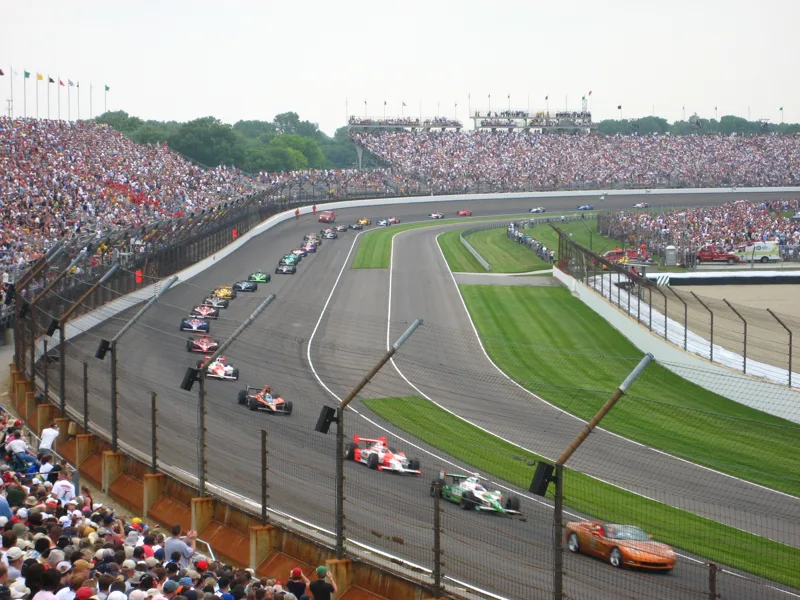
The speedway moved to a single annual race in 1911, the 500-mile event held on Memorial Day. Forty cars took part in the first race, watched by an estimated 80,000 spectators, and Ray Harroun won at 74.602 mph (120.060 km/h) in the No. 32 Marmon Wasp.
Harroun drove alone rather than carry a riding mechanic, and he fitted a rear-view mirror so he could watch the cars behind him. It was a first in an automobile. The field has been set at 33 drivers since 1933, with three exceptions.
A. J. Foyt won in 1964, the last win for a front-engine car. Jim Clark's 1965 victory started a run in which every winner has driven a rear-engine car. Janet Guthrie became the first woman to qualify, in 1977.
Who has won the Indianapolis 500 most often?
Four drivers have won the race four times: A. J. Foyt, Al Unser Sr., Rick Mears and Helio Castroneves. Louis Meyer and Wilbur Shaw were the first three-time winners, and Shaw was also the first back-to-back winner, taking the race in 1939 and 1940.
Some finishes were decided by tiny margins. Al Unser Jr. won in 1992 by 0.043 seconds, a margin that stood as the closest finish for 34 years. In 2006 Sam Hornish Jr. became the first driver to pass for the lead on the final lap, beating Marco Andretti by 0.0635 seconds.
Which drivers from abroad have won the 500?
Scott Dixon became the first New Zealander to win, in 2008, and Takuma Sato became the first Japanese winner in 2017. Will Power was the first Australian winner in 2018, and Simon Pagenaud was the first French winner since 1920 when he won in 2019.
Helio Castroneves also became a three-time winner in 2009, the centenary year of the speedway, and he later joined the four-time winners.
How fast have the cars raced at Indianapolis?
The race average has climbed from 74.602 mph (120.060 km/h) in 1911 to over 187 mph (301 km/h). Pete DePaolo was the first to average 100 mph in 1925, at 101.13 mph (162.75 km/h).
Arie Luyendyk averaged 185.981 mph (299.307 km/h) in the early 1990s, and that record held until Tony Kanaan averaged over 187 mph (301 km/h) to win in 2013.
What layouts does the speedway use?
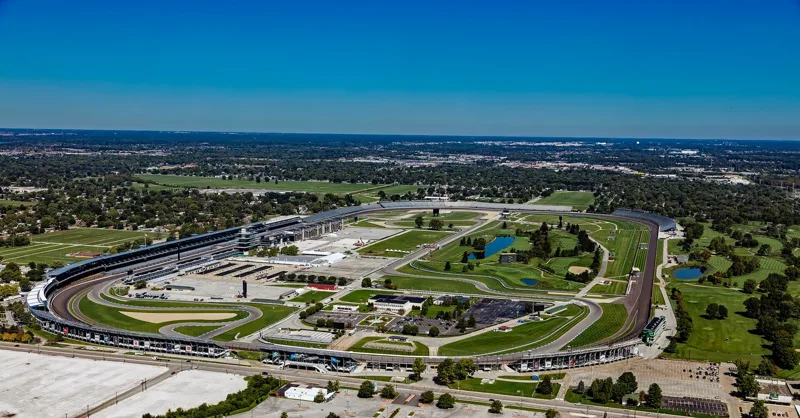
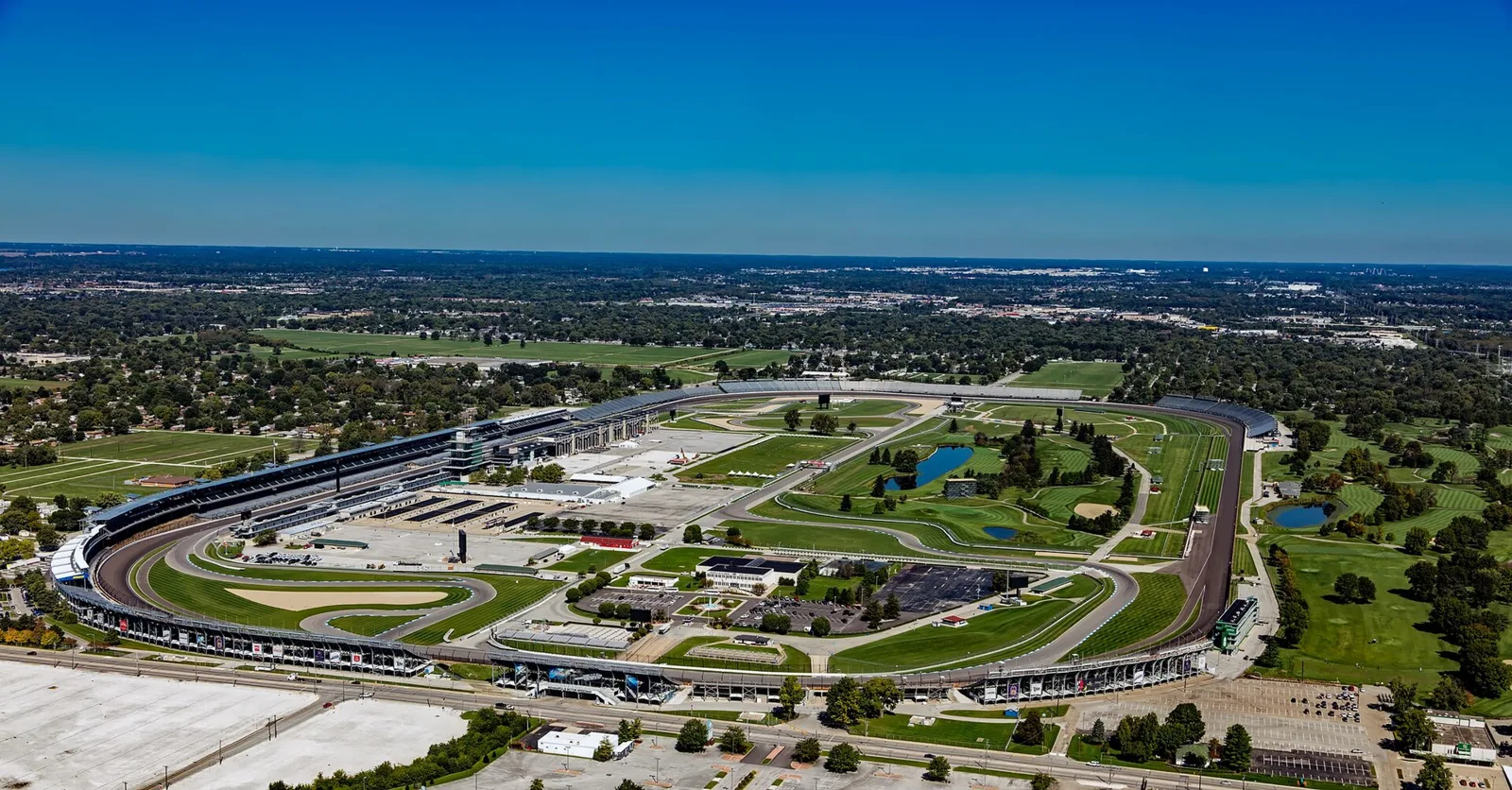
The oval is 4.023 km (2.500 mi) long, with two 1.006 km (0.625 mi) straights, four 0.402 km (0.250 mi) turns and two short chutes of 0.201 km (0.125 mi). A separate infield road course of 4.192 km (2.605 mi) has been used for Grand Prix, sports car and motorcycle racing.
| Layout | Length | Key details |
|---|---|---|
| Oval | 4.023 km (2.500 mi) | Four 0.402 km (0.250 mi) turns; two 1.006 km (0.625 mi) straights; banking of 9 degrees 12 minutes |
| Infield road course | 4.192 km (2.605 mi) | FIA Grade One circuit completed in 2000; incorporates part of the oval; modified in 2008 and 2014 |
| Motorcycle course | Run on the road course | 16 turns; the Snake Pit Complex bypasses the banking of turn one |
The grounds have grown from an original 320 acres (1.3 km2) to more than 559 acres (2.3 km2).
The infield road course was completed in 2000 as an FIA Grade One circuit, and it incorporates part of the main straight and the southwest turn of the oval. Changes made in 2008 and 2014 adapted the course for motorcycle racing and aimed to improve the competition.
Which other events have been held at the track?
NASCAR's Brickyard 400 has run here since August 1994, and Formula One's United States Grand Prix ran from 2000 to 2007. Grand Prix motorcycle racing took place from 2008 to 2015, and the 1987 Pan American Games opened on the grounds with 80,000 spectators.
The Brickyard 400 debuted with the largest crowd and purse in NASCAR history. The Formula One race drew over 200,000 spectators in 2000, but later races brought controversy. In 2002 Barrichello finished 0.011 seconds ahead of teammate Michael Schumacher at the line, and in 2005 the Michelin teams withdrew before the start, leaving six Bridgestone-shod cars to race. The U.S. Grand Prix moved to the Circuit of the Americas in 2012.
In October 2021 the track hosted the Indy Autonomous Challenge, and the $1 million prize went to TUM Autonomous Motorsport.
How has safety improved at the speedway?
After 15 fatalities between 1931 and 1935, tarmac replaced the bricks in parts of the track, the inside corner wall was removed and the outside wall was realigned. Hard crash helmets became mandatory, and a yellow light system was installed in the 1935-36 seasons.
Later changes were more radical. The 2002 Grand Prix was the first grand prix to use SAFER barriers, and by 2017 the speedway had gone more than 20 years without a fatality. The barriers and the enhanced cars were credited with absorbing more of the violent impacts.
What interrupted racing at the speedway?
Racing paused in 1917 and 1918 and again from 1942 to 1945. During the Second World War the track was largely abandoned and fell into disrepair, and its owner, Eddie Rickenbacker, held it until 1945, when the track changed hands and reopened as a public venue.
Many locals had expected the speedway to be sold for housing after the war. The post-war sale set the track on its path back to racing, and the new owner had to carry out major repairs before the speedway could host the 500 again.
What else happens on the speedway calendar?
The Pennzoil 250 supports NASCAR's July weekend, and the IMSA SportsCar Championship's Battle on the Bricks is held in September. The Brickyard Vintage Racing Invitational takes place in mid-June on the road course, sanctioned by the Sportscar Vintage Racing Association.
The feature race of the vintage weekend is the Indy Legends Charity Pro-Am. The IndyCar Grand Prix, run on the combined road course since 2014, takes place about two weeks before the 500 and serves as a lead-in to the main event.
Who owns the speedway today?
Penske Entertainment bought the speedway in 2020, and the Penske Corporation controls 67% of the company. Fox Corporation has held a 33% stake since July 2025.
Carl Fisher and his partners founded the company, and Eddie Rickenbacker owned the speedway from 1927 to 1945. Tony Hulman bought it on 14 November 1945 for a reported $750,000, and the Hulman and George family ran the track for three generations until 2019.
What can visitors see at the grounds?
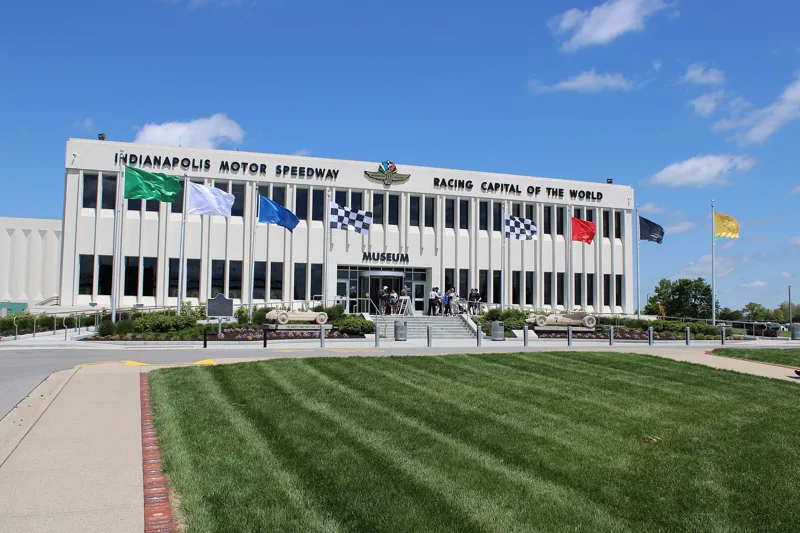
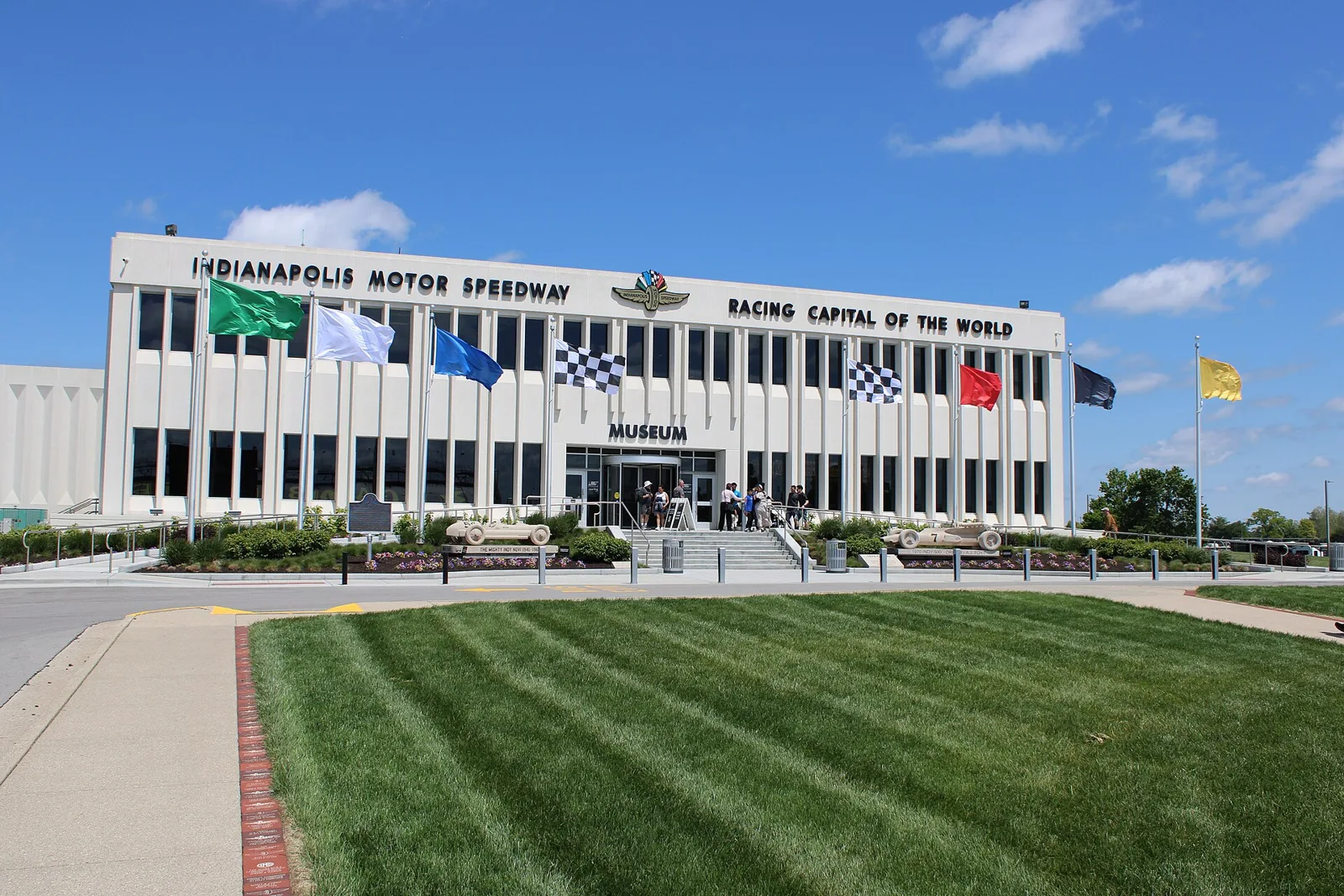
The grounds include the Indianapolis Motor Speedway Museum, which opened in 1956 and moved into its infield building in 1976. About 1 million guests visit each year, which makes the site one of the most visited attractions in the Indianapolis area.
The track has been a National Historic Landmark since 1987, after being placed on the National Register of Historic Places in 1975. Visitors can also see the start-finish line, where one yard of original bricks remains exposed, and the grounds around the infield road course.