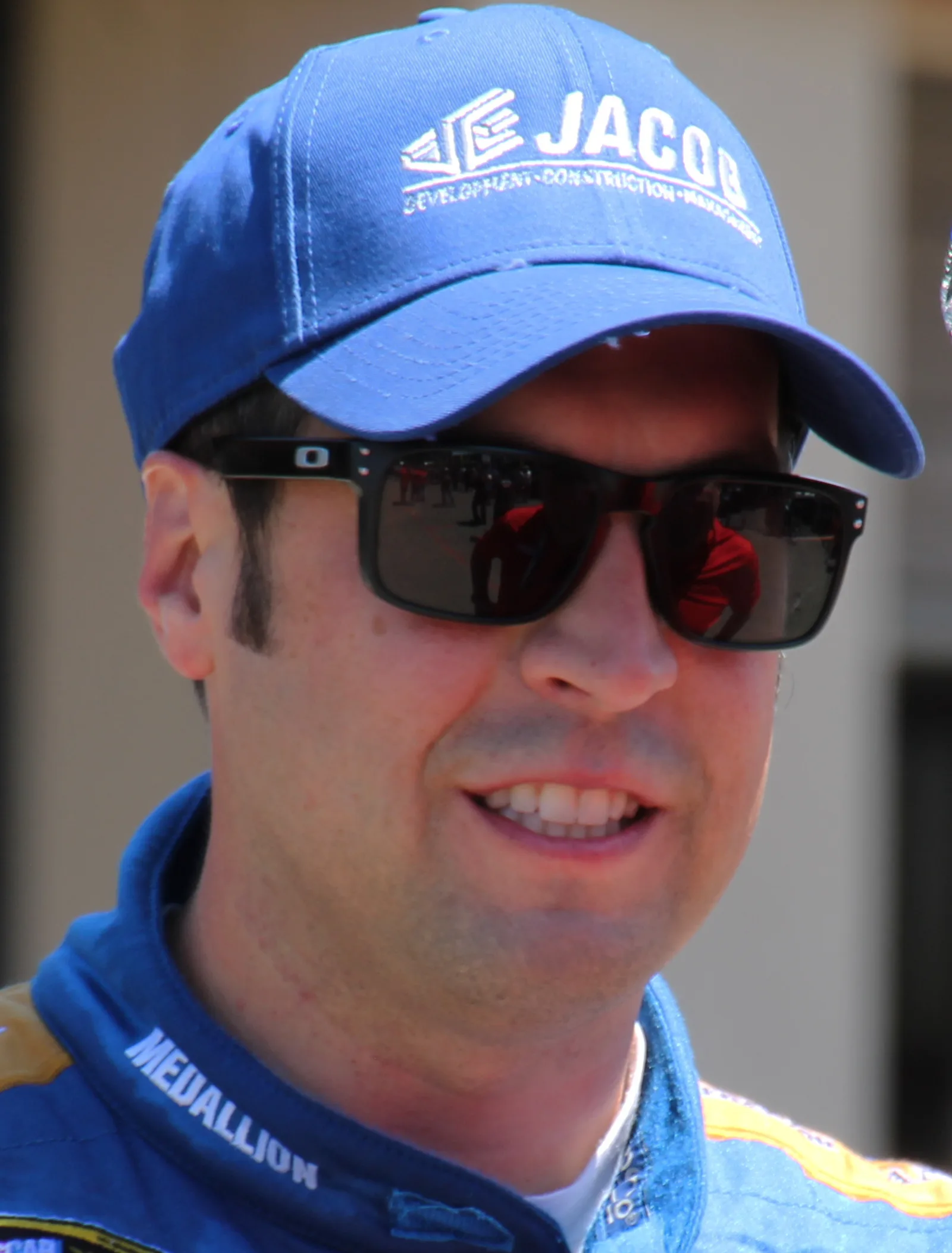
From Panther Racing's back-to-back championships to a dramatic Indianapolis 500 pass, then a stock car career that took in Penske, Joe Gibbs Racing and Richard Petty Motorsports.
Sam Hornish Jr. is a semi-retired American driver who won three IndyCar championships and the 2006 Indianapolis 500. He later raced in NASCAR's Cup and Xfinity Series, winning in the Nationwide division at Phoenix in 2011 and Iowa in 2016.
Sam Hornish Jr. was born on July 2, 1979, and is a semi-retired American driver. He won three IndyCar championships and the 2006 Indianapolis 500 before turning to NASCAR, where he raced in the Cup and Xfinity Series. He is best known in open-wheel racing for a run of titles with Panther Racing and Penske.
How did Hornish's racing begin?
Hornish started in go-karts at eleven and claimed a WKA U.S. Grand National title in under four years of karting. Between 1996 and 1998 he took part in 32 races of the U.S. F2000 series, with a career-best second place at Pikes Peak in his last season there.
In 1999 he drove for Mike Shank's Atlantic team and won at Chicago Motor Speedway. That same year he also took part in the Rolex 24 at Daytona with Intersport Racing, retiring on lap 400 with a gearbox failure.
Three IndyCar titles, a last-lap Indianapolis 500 pass and a stock car career that never quite matched the open-wheel peak.
How did his first IndyCar seasons go?
Hornish made his IndyCar debut in 2000 with PDM Racing, finishing 20th at Walt Disney World Speedway. His first podium came at the Vegas Indy 300, where he finished third, and he qualified 14th for his first Indianapolis 500.
At Kentucky Speedway he led 38 laps, the most of his IndyCar career, and finished ninth, a sign of the speed that would come. His rookie season ended 21st in the points with 110 points. In 2001 he moved to Panther Racing, opening the season with wins at Phoenix and Homestead-Miami.
Why was the 2001 title so significant?
Hornish had the 2001 title sewn up before the last race of the season, finishing with 503 points, 105 ahead of Buddy Lazier. At age 22 he became the youngest champion in the series' history.
What made his 2002 season stand out?
In 2002 Hornish won the season-opening race at Homestead-Miami from pole, leading 166 of 200 laps. He followed with the Yamaha Indy 400 at California Speedway, beating Jaques Lazier by 0.028 second, and later won at Chicagoland by just 0.0024 second over Al Unser Jr.
The final race at Texas was decided by 0.0096 second, and it gave him a second consecutive championship, a season in which he collected five wins and eleven finishes in the top five.
At Indianapolis in 2002 he qualified seventh, brushed the wall on lap 78 and finished 25th after the damage. The Indy 500 was the one race in that otherwise dominant season where he did not finish near the front.
How did his 2003 season compare?
The 2003 season started badly. At the Indianapolis 500 his engine gave out after 195 of the 200 laps, and he finished fifth in the final standings with 461 points.
Results improved as the season went on. At Chicagoland he took the win by 0.01 second, ahead of Scott Dixon and Bryan Herta, while at Texas a spray problem hit his car after 176 of 195 laps, which ruined his title chance.
What did his years at Team Penske bring?
Hornish began driving for Marlboro Team Penske in 2004 and won the opening race at Homestead-Miami on his debut for the team. His Indianapolis 500 that year ended at 26th after a collision with Darren Manning and Greg Ray, and he finished seventh in the championship with 387 points.
In 2005 he won at Phoenix from second place and at Milwaukee, where he passed Dario Franchitti with nine laps left. He finished third in the standings with 512 points.
His 2004 Indianapolis 500 ended after contact with a lapped car, but before that he had led nine laps, the first of his Indy career. In 2005 he flipped in practice and then qualified second, leading a race-high 77 laps before crashing out to finish 23rd.
How did Hornish win the 2006 Indianapolis 500?
The 2006 Indianapolis 500 was his high point. On the final lap he went around Marco Andretti to take the lead, and the finish was the second-narrowest in the race's history.
His 2006 season produced four wins, including Richmond, Kansas and Kentucky. The championship then came down to wins. He and Dan Wheldon finished level on points, and Hornish won the tie-break with four wins to Wheldon's two. The title was his third and Penske's first.
What were his final IndyCar seasons like?
In 2007 Hornish started fifth at Indianapolis and finished fourth when rain halted the race after 166 laps. His only win of the season came at Texas Motor Speedway in the Bombardier Learjet 550, where he led 159 of 228 laps.
Earlier in 2007 he had finished second at Watkins Glen. He left IndyCar after that season holding its record for career wins, with 19, a mark that Scott Dixon would later break. He ended his IndyCar career with third place at Chicagoland and finished fifth in the points.
How did his NASCAR career begin?
Hornish moved into NASCAR through Penske's programme. He began in the Busch Series in 2006 in the No. 39 Dodge, and in 2007 drove nine races in the No. 12. At Atlanta his best finish came in the Nicorette 300, where he started fifth and finished fifteenth.
In mid-2007 he drove a Penske ARCA car at Michigan International Speedway, starting from pole and leading the first 29 laps before finishing second. He called the move to stock cars a challenge, mainly because of the limited practice time.
How did his full-time Cup years go?
In 2008 he ran the full Cup schedule for Penske in the No. 77 car. He finished 15th in the Daytona 500 after starting 19th, but at the Auto Club 500 he was caught in a collateral crash and finished 43rd.
His best finish that season was 13th at the Coca-Cola 600, and he finished 35th in the standings. He finished seventh in the All-Star race and was second in the rookie standings behind Regan Smith. He had a strong day in the Sprint Showdown at Lowe's, where he finished second.
The 2009 season ended 28th in the standings with 3,203 points. A career-best fourth at Pocono came that year, but a violent crash at Watkins Glen, after contact with Kasey Kahne, sent his car spinning across the track. In 2010 he finished 37th at the Daytona 500 and 29th in the standings with 3,214 points. His only top-ten finish that season came at New Hampshire, where he was tenth.
In 2008 he also drove a Nationwide season for Penske. He led eight laps at Lowe's Motor Speedway, and his best finish was eleventh at Darlington. That same year his win in the Sprint Showdown at Lowe's, a non-points exhibition, carried him into the All-Star race, where he finished 16th in 2009.
What did his Nationwide Series years bring?
Penske moved Hornish to the Nationwide Series in 2011, and he took his first career win in the series at Phoenix. Earlier that season at Iowa he had started third, led from lap thirteen through lap 51 and finished 24th. He led the final 61 laps there after passing Ricky Stenhouse Jr.
In 2012 he ran a full season without a win, but three second-place finishes kept him in contention. After a Talladega race in which Danica Patrick spun his car into the wall, he finished fourth in the points with 1,146. He also made a Cup start that year, taking a season-best fifth at Watkins Glen in the No. 22 car.
The 2013 campaign was the strongest of his Nationwide career so far, with sixteen top fives and 25 top 10s. He won at Las Vegas, leading 114 laps, and finished second in the points with 1,177. Roger Penske said he would be let go because sponsorship was lacking.
What came after Penske?
In 2014 Joe Gibbs Racing used him on a limited schedule, and he won at Iowa Speedway after starting second and leading 167 laps. He finished the season 27th with 242 points.
In 2015 he returned full-time to the Cup Series in the No. 9 Ford for Richard Petty Motorsports, replacing Marcos Ambrose. He finished 12th at the Daytona 500 after starting 38th, and took a season-best sixth at Talladega. In the Coke Zero 400 at Daytona that year, a single-car accident on lap 155 sent him into the infield and ended his race. On November 14, 2015, the team said it did not expect him back for 2016.
He returned to the Xfinity Series in 2016 for Richard Childress Racing and Joe Gibbs Racing. He won at Iowa for Joe Gibbs, replacing the injured Matt Tifft. In 2017 he won the Mid-Ohio race from pole in the No. 22 Mustang, leading 61 of 75 laps.
How did Hornish work in broadcasting and media?
Hornish narrated the American dub of the children's series Roary the Racing Car, replacing Stirling Moss.
In 2012 he became co-host of SPEED Center, the racing news and highlight show. In 2014 he was a colour commentator for NBCSN's IndyCar broadcast at Sonoma and an analyst for Fox Sports 1 during the NASCAR season.
How is his career best remembered?
Hornish is remembered first for three IndyCar championships and the 2006 Indianapolis 500. When he left the series after 2007 he held its career wins record with 19, a mark that Scott Dixon later broke in 2009, and his title years with Panther and Penske remain the core of his reputation.
His Nationwide career added five wins, at Phoenix, Las Vegas, Iowa twice and Mid-Ohio, and his broadcasting work included co-hosting SPEED Center and serving as a NASCAR analyst for Fox Sports 1.
What was his international racing like?
Hornish was invited to take part in the International Race of Champions in 2002, 2003 and 2006, with his best points finish in the series being eighth. He also raced in the Rolex 24 at Daytona, returning in 2007 for Michael Shank Racing, where his car finished ninth in its class and completed 628 laps.