A 1997 quad-oval built by Speedway Motorsports to fill a Texas gap, with a naming lawsuit, a difficult debut and later years of falling attendance and repaving.
Texas Motor Speedway is a 1.5 mi quad-oval in Fort Worth, Texas, that opened to racing in 1997. Speedway Motorsports built it to fill a gap left after the earlier Texas track declined. Its capacity is 75,000 as of 2021.
Texas Motor Speedway is a 1.5 mi (2.4 km) quad-oval in Fort Worth, Texas, that began racing in 1997. It was built by Speedway Motorsports and its founder, Bruton Smith, to fill a gap left by the decline of an earlier Texas track. Its first years included a naming lawsuit, rain, a surface complaint and a disputed IndyCar finish, and its later years brought repaving and a shift in management.
Why was a major track needed in Texas?
The first major track in Texas was the Texas International Speedway, later Texas World Speedway, which opened in 1969 and held its first NASCAR race that December. The 1973 oil crisis halted major racing for nearly three years, and NASCAR left in 1981, citing a poor surface and amenities. For more than a decade afterwards, Texas had no track hosting a major series.
Speedway Motorsports, which was rising fast in the early 1990s, wanted a major racetrack west of the Mississippi River. Smith sought a site that could take a large stock car crowd, and the Dallas-Fort Worth metroplex was chosen in 1994 as the location.
A 1997 Fort Worth oval that started with rain, a naming lawsuit and a disputed IndyCar finish.
How was the site chosen and planned?
Smith and Eddie Gossage, then Charlotte Motor Speedway's vice president of public relations, weighed three markets: Las Vegas, Dallas-Fort Worth and St. Louis. In Las Vegas the pair found that Ralph Engelstad was scouting the same land, so they stepped back and let him take it, and the site became the Las Vegas Motor Speedway. St. Louis was ruled out after the land they saw was flooded.
In Dallas-Fort Worth, the pair met businessman Ross Perot Jr., who flew them by helicopter to scout a piece of his land. By 30 November 1994 the plan was for a 150,000-capacity speedway costing around $75,000,000. The first plan called for 70,000 seats, but the capacity grew quickly during planning. Gossage later recalled stopping the increases when the figure reached about 155,000 seats.
| Date | Milestone |
|---|---|
| 1969 | Texas International Speedway opens, later Texas World Speedway |
| 1981 | NASCAR leaves the earlier Texas track |
| 30 November 1994 | Planned 150,000-capacity speedway reported |
| 11 April 1995 | Groundbreaking for the new track |
| 3 August 1996 | Track opens to the public with a charity open house |
| 1997 | First NASCAR and IndyCar races |
| 2014 | Big Hoss TV completed as the largest HD LED screen |
| 2021 | Gossage retires; Rob Ramage promoted |
| 2023 | IndyCar races end at the track |
How did the dual-banked design work?
The track was built with a dual-banking system, a higher bank of 24 degrees for stock cars and a lower bank of 8 degrees for open-wheel cars. For open-wheel races a temporary wall was planned to slow the cars, but the idea was dropped in favour of a painted line marking the change in banking. Open-wheel figures including Cary Agajanian and Jimmy Vasser had doubted that the system would work.
In its current form the track has 20 degrees of banking in the first two turns, 24 in the last two and five degrees on the front and back straights. From 1998 to 2017 all four turns were banked at 24 degrees, and the racing surface was 58 feet wide. A repave later widened it to 80 feet.
How did the track open and get its name?
The speedway opened to the public for the first time on 3 August 1996, with a charity open house. NASCAR races were announced in July 1996, and IndyCar races followed on 7 August, with a night race that was an IndyCar first.
The naming was disputed almost at once. In August 1996 a quarter-mile dirt track in Alvin, Texas, sued over the name Texas Motor Speedway. Gossage and Bruton countersued on 9 September, claiming that the majority owner of the dirt track was trying to extort money from them. The speedway changed its name to Texas International Raceway on 11 September, and the dispute was settled out of court on 2 December, when the dirt track agreed to change its own name.
What happened in the first races?
The first major race, the 1997 Interstate Batteries 500, was hit by heavy rain. Qualifying was cancelled and the grass parking lots were soaked, and buses were used to move fans. Drivers then complained about the surface, and a major first-lap pileup followed.
Two months later the speedway held its first IndyCar Series race. A scoring dispute followed between Billy Boat and Arie Luyendyk, who went to victory lane to contest the win. A. J. Foyt, Boat's team owner, slapped Luyendyk and pushed him to the ground before security intervened. The win went to Luyendyk on the following day, once the scoring had been rechecked.
After both 1997 races, the speedway reprofiled the fourth turn. Complaints about the corner continued into 1998, when a new bump and water leakage caused problems. The dual-banking system was then removed in a complete repave.
What were the early safety problems?
In 1999, during the final practice session for the Mall.com 500, eleven people were injured in a pit road crash. Niclas Jonsson lost control while leaving pit road and hit the parked car of Tyce Carlson while Carlson's crew was working on it.
In 2000 a NASCAR Craftsman Truck Series driver, Tony Roper, died after crashing on the frontstretch and suffering a basilar skull fracture. The death renewed controversy within NASCAR over driver safety. In 2001 a planned CART race was cancelled after it was found that drivers could be exposed to extreme vertical g-loads in the turns that could have led to death, and the track was repaved that year to remove bumps.
Gossage later said the track would need to be repaved every couple of years to maintain it, a point that would return in the late 2010s.
How did attendance and promotion develop?
By the early 2000s the track had some of the biggest attendances in NASCAR history, with races in 1999 and 2000 drawing 221,861 and 223,000 people. In 2002 a minority shareholder in SMI, Francis Ferko, sued NASCAR and the International Speedway Corporation for antitrust violations. A settlement in 2004 secured a second NASCAR weekend for Texas, taken from Rockingham Speedway, and it was enforced in 2005.
Gossage became known for stunts and campaigns. The track trained monkeys to sell souvenir programs, started a victory lane tradition of firing blank six-shooters, hired an all-female pit crew for a car, and let the British television show Top Gear and presenter Richard Hammond film a segment. The 2010 No Limits campaign aimed at a younger, edgier audience.
How did the track change in the late 2010s?
By mid-2016 drivers and fans had complained that the surface took too long to dry, and rain at the 2016 AAA Texas 500 caused a delay of seven hours. Under SMI chief executive Marcus Smith, the track announced a repave. The banking in the first two turns was lowered from 24 to 20 degrees, and the racing surface was widened from 60 to 80 feet.
The late 2010s were a period of decline. In November 2019 Gossage proposed modernising the speedway by cutting capacity from 135,000 to between 80,000 and 90,000, with better internet, a wider concession range and more suites. In 2020 Marcus Smith moved the NASCAR All-Star Race from Charlotte to Texas to try to lift attendance.
Gossage announced his retirement on 13 May 2021, effective after that year's All-Star Race. Rob Ramage, a Texas Motor Speedway executive and counsel, was promoted to general manager in August 2021. He promised more emphasis on technology and wider fan diversity. In August 2022, Ramage was moved to a corporate role after only one year, and Mark Faber, previously of the T-Mobile Arena in Las Vegas, took over.
What races are held there now?
The track holds one annual NASCAR weekend, headlined by the Wurth 400 Cup race. Support races include the Andy's Frozen Custard 340 for O'Reilly Auto Parts Series cars and the SpeedyCash.com 250 for trucks. The All-Star Race was held at Texas in 2021 and 2022, before it moved to North Wilkesboro Speedway.
IndyCar raced at the track from 1997 to 2023, and it did not return in 2024 because of an NBC conflict with the Summer Olympics. The Grand Prix of Texas, a sports car race, was run by the American Le Mans Series in 2000 and 2001 on a roval layout that used the infield road course. The infield course, completed in August 2000, has four variations and is mainly used for sports car racing.
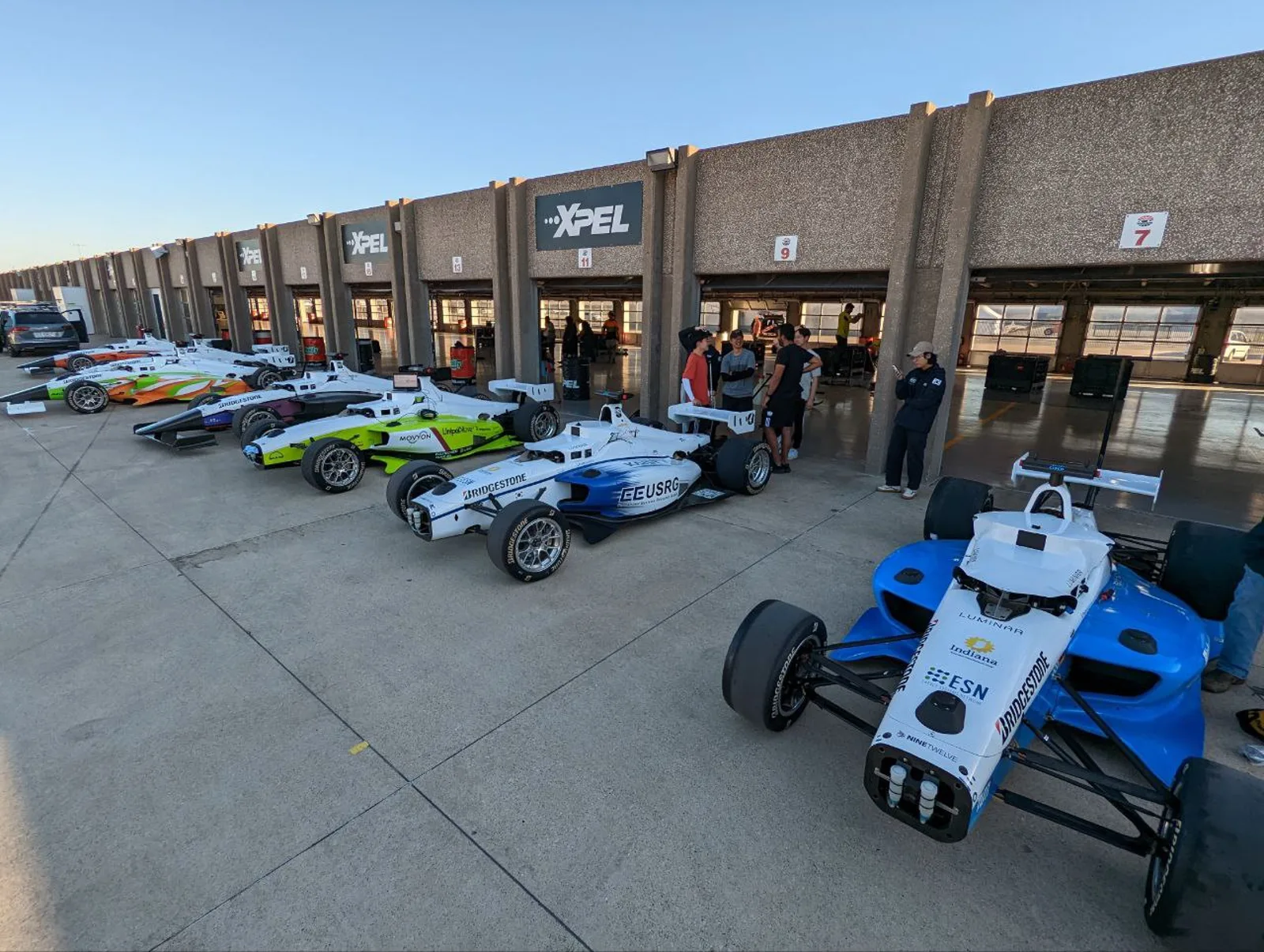
Other events have included the Solar Car Challenge for high school students, held since 1998, and a Red Bull Air Race round in 2015 that was the season finale in 2018. Stadium Super Trucks raced there annually from 2017 to 2019, the Indy Autonomous Challenge was held in 2022, and the second round of the SuperMotocross World Championship came in 2024.
How big have its festivals been?
The speedway has held numerous festivals, some of them drawing very large crowds. In 1997 a two-day country music festival, Country Fest, attracted 260,000 people, and RockFest '97 drew around 400,000 a week later. Gossage later described the rock festival as chaotic.
Later festivals were smaller. FortyFest, a Christian rock festival, was held in 2010, and a second location of the HWY30 Music Fest, which began in Filer, Idaho, took place in 2023. During the COVID-19 pandemic the track held 23 high school graduation ceremonies in Denton County, and in September 2022 it became a shelter for victims of Hurricane Ida.
What is on the site besides the track?
The Lone Star Tower, a 10-story building overlooking the second turn, broke ground in 1996 and was completed in early 1998 at a cost to the track of about $25 million in taxes. Its first four floors are offices and the rest are condominiums. The nine-story Speedway Club, overlooking the first turn, was completed in March 1999 at a cost of $35 million.
In 2013 Gossage announced Big Hoss TV, and roughly 10,000 backstretch grandstand seats were removed to build it. The screen was completed in March 2014 and certified by Guinness World Records as the largest HD LED television screen in the world. In 2023 the screen was due to be expanded by 10 per cent.