A 1947 North Carolina short track born in moonshine country, left to decay for most of two decades and revived by Speedway Motorsports for NASCAR's return in 2023.
Built in moonshine country, the short track hosted NASCAR Cup races until a 1996 ownership feud ended them. It then sat largely abandoned for two decades before Speedway Motorsports brought Cup racing back in 2023.
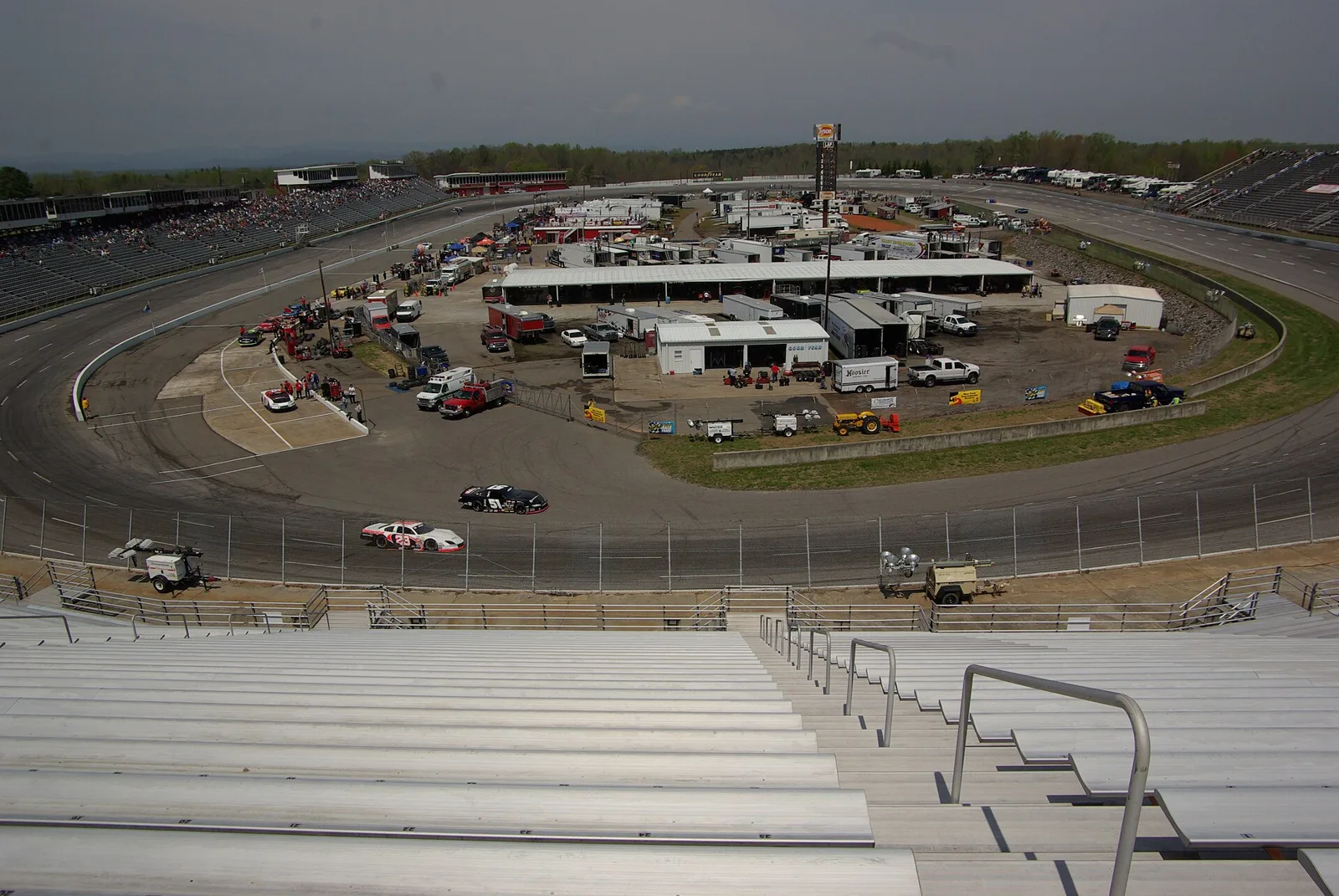
North Wilkesboro Speedway is a short track in North Carolina with a 1.006 km (0.625 mi) paved oval, and it held its first official race in 1947. Built in moonshine country, it became a fixture of NASCAR's early years before the sport's growth left it behind in the 1990s.
The track has had a long and uneven story: a shaky start, a golden era of Cup racing, a bitter ownership dispute, two decades of neglect and a revival led by Speedway Motorsports. This article covers its origins, its design, its moonshine connections, the years of decline and the return of racing.
When did North Wilkesboro Speedway open?
In the mid-1940s Enoch Staley put up the speedway by the Brushy Mountains, backed by Lawson Curry, John Mastin and the Combs clan. Bill France Sr., the founder of NASCAR, invested alongside him, and the first official race was promoted by France on 18 May 1947.
Staley had come to racing by chance. In 1945 he and his friend John Mastin went to a stock car event in Spartanburg, and Staley came away hooked. Soon afterwards he bought a plot of land from Lawson Curry, and the partners set about building the facility.
Money was tight from the start. Enoch and France each put in $1,500, roughly $26,825 in today's money, but the cost of grading ran through the funds. The result was a track shorter than planned and uneven in elevation. The surface was dirt, treated with a mixture of calcium chloride and salt to keep the dust down, and Staley himself thought the place might not outlast its first year.
The first official race drew a crowd of about 10,000, and Fonty Flock won the modified feature. Two years later the NASCAR Strictly Stock Series, the forerunner of the Cup Series, ran its first races at the track.
A 1947 short track born in moonshine country, abandoned after 1996, revived by Speedway Motorsports and back on NASCAR's calendar.
How long is the track and how is it shaped?
The speedway measures 1.006 km (0.625 mi) and is banked at 13 degrees in the turns and 3 degrees on the straightaways. The frontstretch slopes downhill while the backstretch climbs uphill, a quirk attributed to the funding shortfall during construction.
The layout is asymmetrical, and the facility was dirt until 1957. Paving was announced in June 1957 and finished by September of that year, and the surface was repaved for the first time a few years later.
The track sits right beside U.S. Route 421. Its capacity has been reported at 19,800 as of 2023, while The Sporting News gave a figure of 25,000 for the same period. At its peak, a 1996 Herald-Sun report put the capacity at 55,000.
What made the track famous?
North Wilkesboro became known for its link to moonshine. Local lore holds that moonshiners held the first unofficial races here, while the town earned the nickname Moonshine Capital of the World during the 1950s. Many people who ran moonshine went on to shape stock car racing, which in turn gave rise to NASCAR.
The track's most famous local figure was Junior Johnson, a former moonshine runner from North Wilkesboro. In 1965 Tom Wolfe wrote an Esquire article that featured Johnson and the track, and the piece is widely seen as a key step in taking NASCAR beyond the Southeast.
The track also sat close to Bristol Motor Speedway and Martinsville Speedway, both of which expanded in the 1990s while North Wilkesboro fell behind.
How did the facility develop in its early decades?
Upgrades were slow for most of the track's life before the 1980s. A concrete grandstand of about 5,200 seats was built in 1955 and completed by April 1956, replacing the original wooden stands.
Four years after the 1957 paving, the infield was renovated and 3,500 seats were added. By 1963 the facility had 8,500 permanent seats and a total capacity of 15,000. A repave followed soon after, and the 1976 additions brought a 3,500-seat stand named for Junior Johnson, along with a quarter-mile concrete retaining wall in place of a guardrail.
Eight years after the 1980 repave, a roofed infield garage and a multi-purpose building were added which meant crews no longer stopped work when rain fell. In 1990 an electronic scoring pylon replaced the last manual scoreboard on the Cup schedule, and 3,100 seats were added the same year.
The West Grandstands were enlarged and refurbished in 1992, when chairs took the place of bare concrete, and additional suites followed in 1995.
Why did NASCAR leave North Wilkesboro in 1996?
The sport's boom in the 1990s put older venues under pressure. By 1996 Rusty Wallace was publicly arguing that teams needed tracks with better pit facilities and bigger purses. Track officials and drivers alike wanted newer, larger facilities, and a wave of new high-capacity tracks in fast-growing markets made the old circuits look dated.
Bruton Smith's Speedway Motorsports bought the Combs family's half-interest for $6.05 million after Enoch Staley died on 20 May 1995. Bob Bahre then bought the Staley half-interest for $8 million on 2 January 1996, and the two men soon fell out over control of the track.
The feud decided the track's fate. Bahre was willing to sell his share back to the Staley family only if Smith agreed to do the same, and that condition was never met. In July 1996 NASCAR moved the spring Cup race to Texas and the fall race to New Hampshire, ending Cup racing at North Wilkesboro. The last points race was held in September 1996.
The track had been criticised for its amenities for years. A 1990s press room had only four telephones, three of them rotary dials, which captured the decline in a single detail. Bahre later conceded that it was profitable, but he said it could not keep up with rising purses, and the grandstands held only 34,000 seats against a reported peak crowd of 60,000.
What happened during the years of abandonment?
After a failed stockholders' meeting, the speedway closed on 3 January 1997 and its employees were laid off. Only one worker, Paul Call, was allowed to stay on as a caretaker, and he lived on the property to look after it. A windstorm damaged parts of the facility in March 1997, and the deterioration that followed gathered pace.
Efforts to sell or reopen the facility came and went. In 1999 both owners asked for a lower tax value because the track was outdated. and Smith said he would not invest in a facility he owned only half of. In 2003 a petition gathered 3,312 signatures to condemn the track, but it was rejected.
The track hosted a private test for Roush Racing in October 2004, its first activity in more than eight years. Plans to place the NASCAR Hall of Fame there in 2005 went nowhere, and a Save the Speedway group drew about 2,000 online signatures.
Smith took full control in 2006 as part of a package deal to buy the New Hampshire International Raceway. Two years after the 2006 purchase, Charles Collins leased the track, and Speedway Associates ran a short series of events in 2009 and 2010 before it closed again on 10 May 2011.
Neglect took its toll. Paul Call mowed the grass and showed visitors around, but by 2015 buildings had caved in and the Junior Johnson grandstands had collapsed. The track's abandoned look inspired Thomasville Speedway in the 2017 film Cars 3.
How was the track revived?
In September 2019 Dale Earnhardt Jr. talked with Marcus Smith about digitally preserving the track. Earnhardt organised a clean-up of weeds so that iRacing could scan the surface, and the scan was added to the simulator by May 2020.
Governor Roy Cooper proposed $10 million for repairs in 2021, which rose to $20 million, and the final state package came to $18 million. Speedway Motorsports began demolishing dilapidated buildings after the funding was secured, and Barry Braun, who owned a racing streaming service, had already proposed dirt racing there. Camping World's chief executive, Marcus Lemonis, pledged $1 million toward the revival, and Smith unveiled revitalisation plans in January 2022.
On 16 April 2022 Smith announced that racing would resume. The first event on 2 August 2022 drew an estimated 9,000 people, with limited amenities. That September NASCAR said the All-Star Race would move there from Texas Motor Speedway. By February 2023 SMI said the renovations were ahead of schedule.
The top series returned in 2023, after nearly three decades away. Later in 2023, SMI announced the first repave since 1981, which was finished by March 2024. In 2024 a sinkhole turned up under one grandstand. A moonshine-cave explanation from the 1940s was floated, but it was disputed given the site's long-standing drainage problems.
What races does North Wilkesboro host now?
The speedway hosts a non-points exhibition for the Cup Series known as the All-Star Race, along with an O'Reilly Auto Parts Series race called the Coca-Cola 300 and a Craftsman Truck Series race called the FaithFest 250. Two former Cup points races, the Window World 450 and the Tyson Holly Farms 400, no longer appear on the calendar.
Ronald Queen was named director of operations in May 2023, as the track prepared for its first Cup races in decades. Tire tests in the spring of 2023 and 2024 helped the teams prepare for the reopened facility. Most of the structures built before 1996 were kept during the renovation, including the suites and a tower with a Winston Cigarettes mural.
What are the key figures for North Wilkesboro Speedway?
| Measure | Figure |
|---|---|
| Length | 1.006 km (0.625 mi) of paved oval |
| Banking | 13 degrees in the turns, 3 degrees on the straightaways |
| First official race | 18 May 1947 |
| Capacity, 2023 report | 19,800 (track figure), 25,000 (The Sporting News) |
| Peak capacity | 55,000, according to a 1996 Herald-Sun report |
| Last points-paying Cup race | Tyson Holly Farms 400, 29 September 1996 |
| Owner since 2007 | Speedway Motorsports, SMI |
| Revival race | 2 August 2022, with about 9,000 attending |
| Cup return | Late May 2023, first Cup races in 27 years |