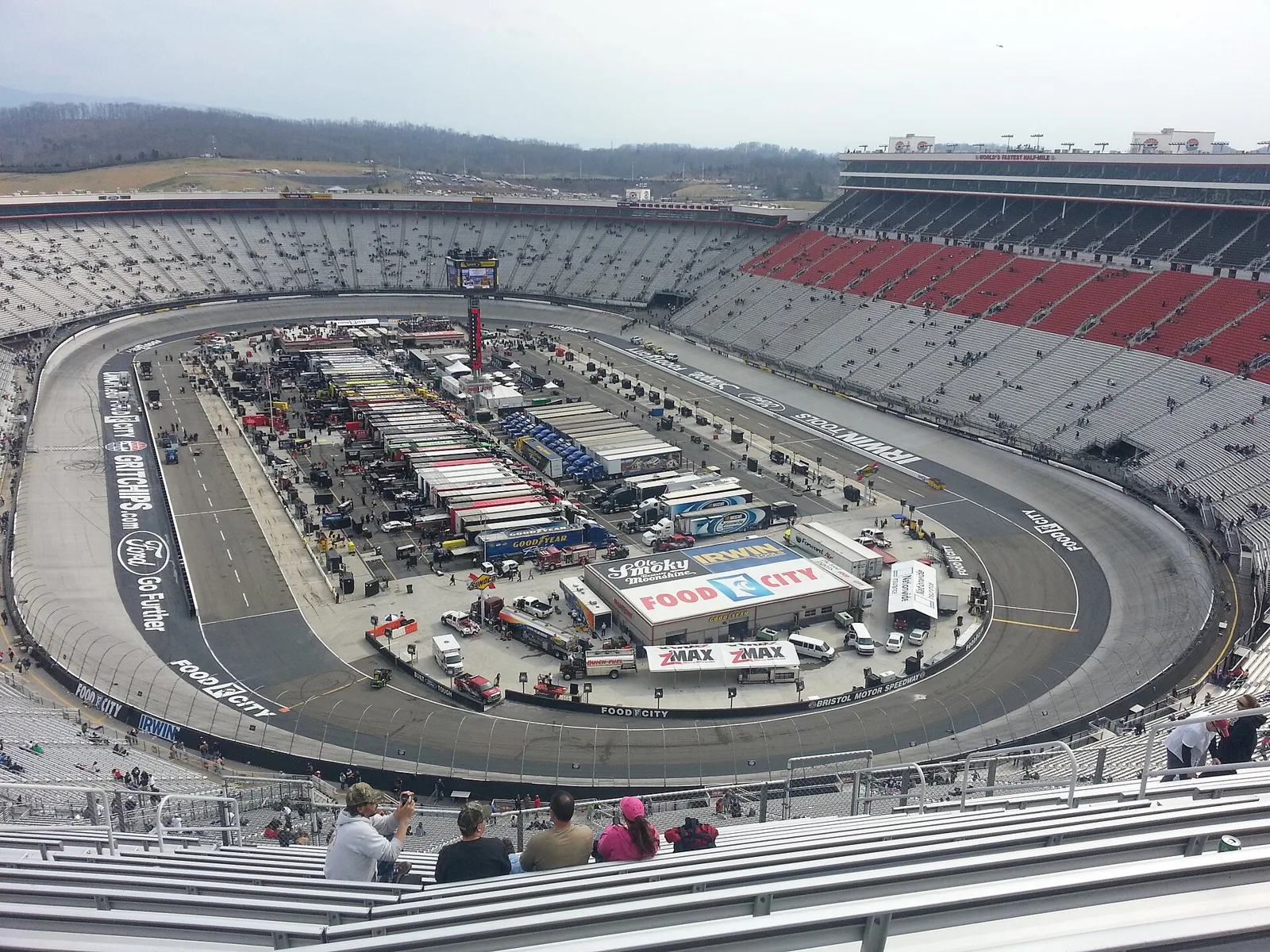
A Tennessee half-mile from 1961 that grew into one of NASCAR's most packed venues, with changing owners, surfaces and banking along the way.
Opened in July 1961 in Tennessee, the venue runs a 0.533 mi (0.858 km) short track. It holds NASCAR races, college football games and a 2025 Major League Baseball game, with a capacity of 146,000 as of 2024. The turns sit at 24 to 28 degrees of banking.
Bristol Motor Speedway is a 0.533 mi (0.858 km) oval in Tennessee that has grown from a small 1961 track into one of the largest venues in American sport. It has held NASCAR races since its first season, along with football games, sprint car events and a Major League Baseball game in 2025. Its history is a story of owners, surface changes and steady expansion.
Where is Bristol Motor Speedway and how big is it?
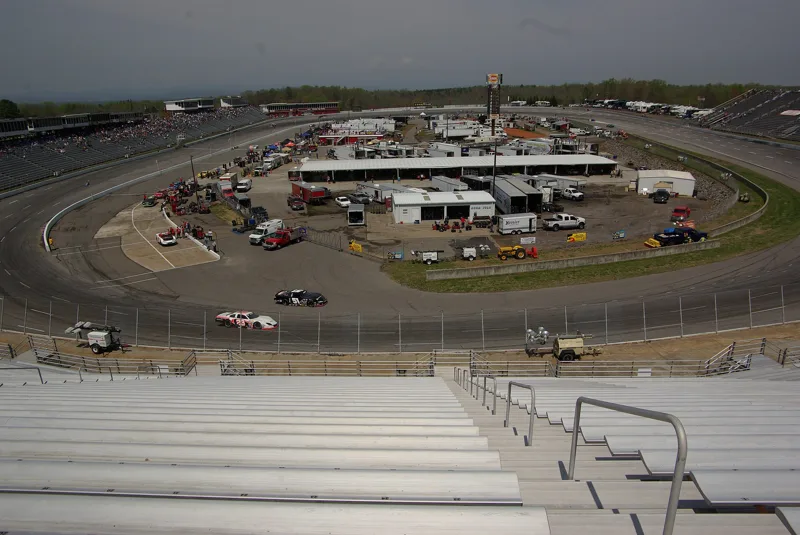
Bristol Motor Speedway is a short track in Bristol, Tennessee, and it is owned by Speedway Motorsports, LLC with Jerry Caldwell serving as general manager. The complex also includes a two-lane, 0.250 mi (0.402 km) drag strip, and the speedway holds 146,000 spectators as of 2024.
A half-mile track that began on paper bags now seats more people than most American stadiums.
From a paper-bag plan to a 1961 opening
Larry Carrier, a Tennessee recreation businessman, announced on January 17, 1961 that he would build a track in Bristol. He first wanted a site in Piney Flats, but local ministers rejected it, so he moved the plan five miles south to a former dairy farm. The early designs were sketched on paper bags.
The track opened to the public in July 1961 with a paved half-mile speed record attempt, and NASCAR activity followed two days later. The plan called for a 20,000-seat, 100-acre facility on a budget of $750,000 to $1,000,000. Tennessee Governor Buford Ellington declared a Volunteer 500 week, and local media quickly praised the track as the best and fastest half-mile in the world.
Who owned Bristol Motor Speedway before Bruton Smith?
Carrier ran the track until 1977, when he sold it to Nashville businessmen Lanny Hester and Gary Baker for $1 million. They renamed it Bristol International Raceway and planned a return to the traditional 500-lap NASCAR distance. Warner W. Hodgdon later bought the track in 1983 for $2 million, but he filed for Chapter 11 bankruptcy in 1985.
Carrier bought the company back in January 1986 for $4.5 to $5 million. In 1996 the track was sold to Bruton Smith for $26 million, and Smith renamed it Bristol Motor Speedway that March. Within a few years, the track had grown past Neyland Stadium as the largest sports arena in Tennessee by capacity.
How steep is the banking at Bristol?
The turns are banked between 24 and 28 degrees, while the straightaways run from four degrees at the bottom to eight degrees at the top. The track was originally built with 27 degrees of banking. It also once marketed itself as 36 degrees, a figure later found to be incorrect, with the true banking at 30 degrees.
Banking has changed over time. In 1969 Carrier repaved the track with progressive banking of 31 to 35 degrees, and two years after 2010 the progressive system was eliminated after criticism from fans and from Smith. The table below sets out the main surface and banking changes.
How did expansion change the track?
Smith's investment transformed the facility. In 1996 he expected to increase capacity to 120,000, and by April 1997 the track had passed Neyland Stadium as Tennessee's largest sports arena. Kulwicki Tower was built in 1999, adding 12,000 seats and lifting capacity to 147,000.
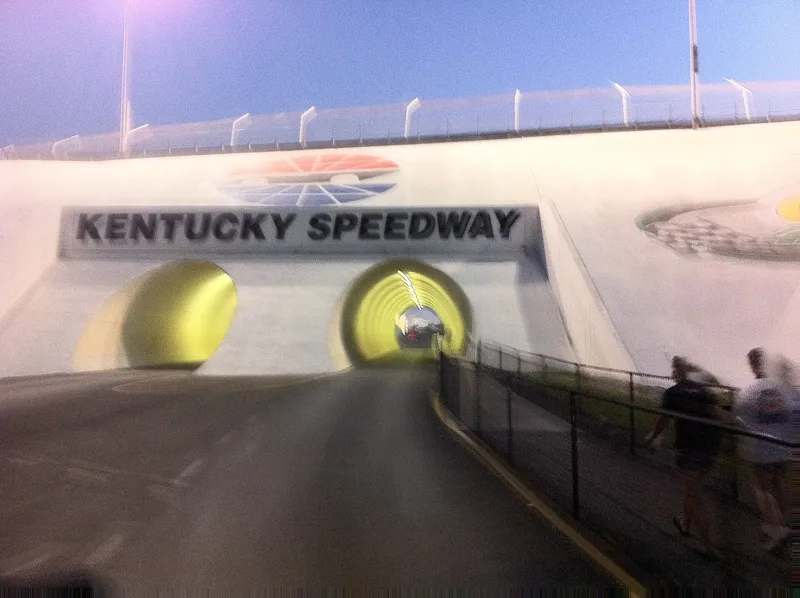
A pedestrian tunnel linking the grandstands to the infield was built in 2002, and seating was expanded again with an intent to reach 160,000. The track also held a run of 55 consecutive sellouts, which ended in 2010, and the track's older surface was replaced in 2007 after complaints about the one-lane racing style.
What NASCAR races are held at Bristol?
Bristol hosts two annual Cup Series weekends. The Food City 500 was first held on October 22, 1961, and the Bass Pro Shops Night Race began on July 30, 1961 as the track's first major event. The night race became a nighttime format in 1978.
Smaller NASCAR series, including the O'Reilly Auto Parts Series and the Truck Series, race there as support events. In 2020 the Cup race moved to a temporary dirt surface to address falling attendance, and after three years the event returned to concrete. That same year BMS held a one-off All-Star Race, which later moved to Texas Motor Speedway.
Did Bristol host a Major League Baseball game?
Yes. The Atlanta Braves and Cincinnati Reds played a Major League Baseball game at Bristol on August 2-3, 2025, and the Braves won 4-2. The contest was a regular-season game, the first of its kind held in Tennessee, and it made use of the speedway's grounds for a sport far removed from its usual racing calendar.
The track has also hosted college football, with the Battle at Bristol on September 10, when Tennessee beat Virginia Tech 45-24. A week later East Tennessee State beat Western Carolina 34-31 in another football game at the track.
How has the track served its community?
The speedway has repeatedly stepped in during local emergencies. In 2002 the track hosted pupils from Sullivan East High School in a temporary school, after mould forced their own building to close. In the early 2010s Remote Area Medical held a clinic at the track.
It has served as an evacuee centre for several hurricanes, including Irma in 2017, Florence in 2018 and Dorian in 2019, and it was also used as a COVID-19 vaccine distribution centre. In 1968 it hosted a campaign rally for George Wallace during his presidential run.
What is Colossus TV?
Colossus TV is a 30 by 63 foot digital screen that hangs over the middle of the track. Bristol announced the display in October 2015, and construction began that November and finished in April 2016. Officials presented it as one of the largest screens of its kind.
In that same year the track also began applying a traction compound called PJ1 TrackBite to its lower groove, in an effort to create multi-groove racing on a track known for one-lane passing.
How did Bristol change its banking and surface over time?
| Year | Change | Detail |
|---|---|---|
| 1961 | Original banking | 27 degrees in the turns |
| 1969 | Repave and progressive banking | 31 to 35 degrees in the turns, 20 degrees on straights |
| 1992 | Concrete surface | Repaved in concrete instead of asphalt |
| 2007 | Variable banking system | Turns varied from 24 to 30 degrees; racing surface widened from 40 to 43 feet |
| Early 2010s | Progressive banking removed | Track returned to a simpler banking profile |
How did leadership change after Bruton Smith bought the track?
Smith's purchase was met with suspicion, because he had a record of building bigger tracks and taking race weekends from smaller ones. In February 1996 Smith denied rumours that the spring race would move to the new Texas Motor Speedway, and he announced plans to raise capacity to 120,000.
Jeff Byrd, an executive in the sports marketing division of R. J. Reynolds Tobacco Company, replaced Ron Scalf as general manager. By the end of 1996 Byrd estimated that the track had spent $20 million on renovations. After Byrd died in October 2010, the track promoted Jerry Caldwell from vice president of corporate sales to general manager.
What kind of businessman built the track?
Larry Carrier ran a recreation business across the Tri-Cities area of Tennessee, and his real-estate agent father had bought land that the family later used for the track. When Carrier first planned the speedway at Piney Flats, local ministers rejected the site, and he chose a former dairy farm further south instead.
Carrier's plans grew over the years. He ran the track until 1977, when it passed to Lanny Hester and Gary Baker, and his later efforts focused on the drag racing side of his business, including the International Hot Rod Association. He returned to the speedway in 1986 after Warner Hodgdon's financial troubles.
Did Bristol ever race on dirt?
Yes, though only briefly. The track held its first dirt races in 2000 and 2001 on a temporary surface, but those races were scrapped after 2001 because cleanups took too long. Dirt returned only in 2020, as the next paragraph explains.
In 2020, to address declining attendance, the Cup race was run on dirt, and the Truck Series also raced on that surface. The concrete surface came back after three years of dirt racing, and the track had earlier used PJ1 TrackBite on its lower groove in an attempt to create multi-groove racing.
How did the drag strip develop?
The quarter-mile drag strip was planned in 1964 with National Hot Rod Association officials, and it was finished by May 1965 in time for its early June opening. The following year, when Carrier created the International Hot Rod Association, he set its headquarters at the track.
Ownership of the strip changed along with the speedway. Baker and Hodgdon bought the dragstrip from Carrier in May 1982, and in 1986 Carrier sold it to Jim Ruth to help finance his purchase of the speedway. The strip received an $18 million renovation in 1997.
Who first praised the track and bought its tickets?
The track drew early attention from the region's sports figures. In March 1961 Tennessee Ernie Ford bought the first ticket. Team owner Bud Moore, driver Cotton Owens and Washington Redskins public relations director Dave Slattery all praised the layout and amenities.
Local writers were pleased as well. Johnson City Press writer Jimmy Smyth praised residents of the Tri-Cities area for now having a track nearby, instead of driving hundreds of miles to reach another one. The earlier Redskins exhibition, however, had cost the track money, and Pope left the venture soon after.