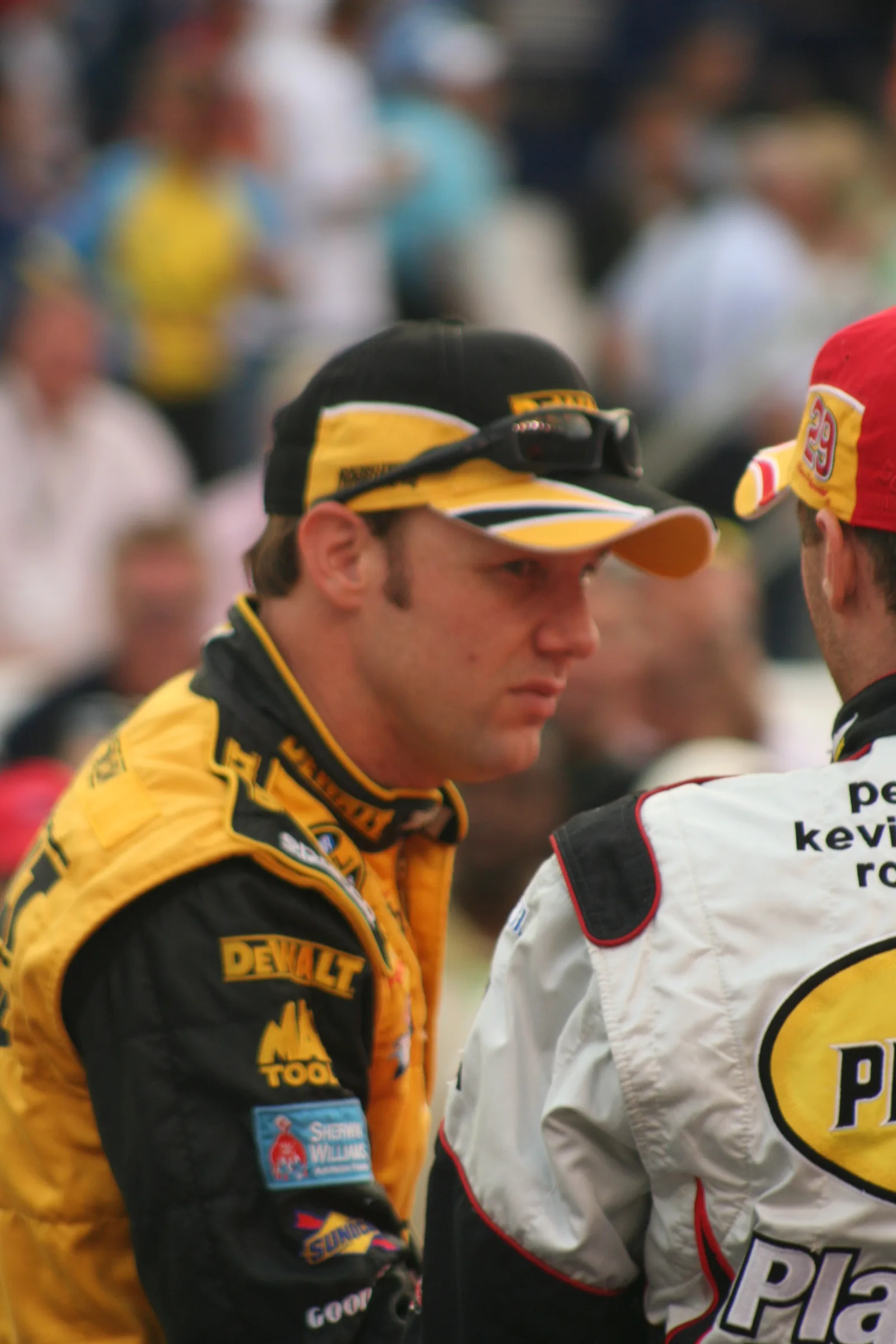
Matt Kenseth won the championship with a single victory after a record 33 weeks at the top of the standings, as the Winston era closed at Homestead.
Matt Kenseth of Roush Racing won the 2003 Winston Cup title with one race victory, finishing 90 points ahead of Jimmie Johnson. He led the standings for 33 consecutive weeks, and the year closed the Winston era at Homestead, the final race under that name.
The 2003 NASCAR Winston Cup Series ran from February 8 to November 16 and ended with Matt Kenseth of Roush Racing as champion. He won only one race all season, yet he took the title by 90 points over Jimmie Johnson. The year also closed the Winston era, after the brand had been the series' title sponsor for 33 years.
How did Matt Kenseth win the 2003 title with one win?
Matt Kenseth won the championship despite winning only one race, the UAW-DaimlerChrysler 400 at Las Vegas, which came early in the year. He finished consistently throughout the year, and he claimed his only championship by 90 points over Jimmie Johnson at the Homestead finale.
Kenseth's season was built on steady finishing. He ended the year with 31 finishes on the lead lap, a NASCAR record, and his fourth-place result at Atlanta in March gave him the points lead for the first time.
Kenseth clinched his title at North Carolina Speedway a week before the finale. A fourth-place finish in the Pop Secret Microwave Popcorn 400 gave him a 226-point lead over Johnson, which was enough to lock up the championship. The finale at Homestead then became a formality for him.
At Homestead Kenseth finished 43rd after a blown engine on lap 29, the second DNF of his season. Johnson finished third and collected five bonus points, which cut the final margin to 90 points.
One win and a record 33 weeks at the top of the standings gave Matt Kenseth the 2003 title.
Why did Kenseth hold the points lead for so long?
Kenseth held the points lead for 33 consecutive weeks from March, a record in NASCAR's history, and the lead was built on consistency rather than wins. He had taken the lead with his fourth-place finish at Atlanta, and the margin grew to 436 points after Dover in September.
The Coca-Cola 600 in May was the only race that season in which Kenseth led the most laps. He earned 10 bonus points for that result, and Dale Earnhardt Jr., who finished 41st, fell further behind. The lead rose to 160 points and stayed above that level for the next 24 weeks.
The margin fell in late September and early October. Kenseth finished 33rd at Talladega after an engine failure 30 laps from the finish, and 36th at Kansas after a crash with Michael Waltrip. Together those two results cost him 177 points, which cut his lead from 436 to 259 points.
Earnhardt Jr. then took Kenseth's lead down to 228 points after his win at Phoenix in early November. The gap at Rockingham was still wide enough to let Kenseth clinch the title before the finale.
Who was the main challenger?
Jimmie Johnson was the closest challenger, and he finished the season second in the standings behind the champion, Matt Kenseth. Dale Earnhardt Jr. was also a contender, and he was second in the points at Phoenix before the late-season results moved the order again.
Johnson's pursuit was strong but never quite enough. He trailed by 90 points at the end, and his third-place finish in the finale earned five bonus points that narrowed the gap to the final figure.
Ryan Newman won eight races in 2003, more than any other driver, yet he finished sixth in the points. It was the second straight season that the driver with the most wins finished outside the top five in the standings, after Kenseth's own five wins in 2002 left him eighth.
How did the early season unfold?
Michael Waltrip won the rain-shortened Daytona 500, and the early months were shaped by a few unusual finishes and a fast start for Bobby Labonte. Kenseth's Las Vegas victory in March was his only win of the year, and Labonte won at Atlanta a week later.
The Daytona 500 included a violent accident involving Ryan Newman. Ken Schrader clipped Newman coming off turn four, and his car slid down the front straight and flipped in the tri-oval before coming to rest upside down. The race covered 109 laps, the fewest in Daytona 500 history, which equalled 272.5 miles (438.5 km).
Waltrip's win was his second in the Great American Race and the third of his four career victories. His first three career wins had all come at Daytona, in February 2001, July 2002 and February 2003, and his older brother Darrell, an analyst for FOX, was part of that team.
The Subway 400 at North Carolina Speedway on February 23 had Dave Blaney on the pole, but Dale Jarrett won the race. It was Jarrett's only victory of 2003, and his next win would not come until Talladega in October 2005.
Bobby Labonte won the Bass Pro Shops MBNA 500 at Atlanta on March 9, and Kenseth's fourth-place finish there moved him to the top of the standings for the first time.
What rule and format changes shaped the season?
NASCAR made two significant changes in 2003. Under the new rule the running order was locked as soon as a caution flew, so racing back to the yellow was no longer allowed, and a Lucky Dog was introduced for the highest-placed car a lap down. Both changes first took effect at Dover in September.
Running order under caution was fixed with video replay and scoring loop data. NASCAR made these changes to remove the advantage that drivers gained by racing back to the caution, which had been controversial all season.
The Chase for the Cup was announced for 2004, and it would reset the points after 26 races for the top ten and any driver within 400 points of the lead. NASCAR made that change mainly because of Kenseth's large early lead, which had been built despite a single win.
The Budweiser Shootout also changed. It ran at night for the first time, the 70-lap event was split into two segments with a 10-minute break, and every driver had to make at least one green-flag pit stop.
Mid-season races and off-track news
At Infineon Raceway on June 22, Robby Gordon won the Dodge/Save Mart 350 after a pass on Kevin Harvick in the keyhole turn that happened under a caution. Harvick called it a chicken move, but the pass was legal under the rules of the time.
At Michigan on August 17, Kurt Busch and Jimmy Spencer threw punches after the GFS Marketplace 400. A police report was filed, Spencer was suspended for the next race at Bristol, and Busch was placed on probation.
At Bristol on August 23, Kurt Busch won the Sharpie 500, and the fans booed him in victory lane. The race's sponsor, Sharpie, began phasing itself out of the #97 car soon afterwards.
The Sharpie 500 also introduced the Victory Lap tribute, in which a former champion and an active champion each took a ceremonial lap. Alan Kulwicki, as a former champion, and Rusty Wallace, as the active champion, were honoured that day.
Bill France Jr. stepped down as NASCAR's chief executive on September 16 because of ailing health. His son Brian France made his first Cup race as CEO at Dover, where Ryan Newman won.
Michael Waltrip's last career victory came at the EA Sports 500 at Talladega on September 28. He celebrated by climbing out through the car's new emergency hatch after circling the infield in donuts.
Jeff Gordon swept both Martinsville races in 2003, and the feat had last been achieved by Rusty Wallace in 1994.
The end of the Winston era
Winston had been NASCAR's title sponsor since 1971, and 2003 was its final year after 33 seasons. The brand's last race as sponsor was the Ford 400 at Homestead-Miami Speedway on November 16, and it closed the Winston Cup name.
NASCAR announced on June 19 that Nextel would become the title sponsor from 2004. Sunoco replaced Unocal 76 as the official fuel, ending a relationship that had begun in 1948, the year the sport started.
Pontiac's full-time run also ended in 2003. Benson was the top-placed Pontiac at Homestead, finishing fourth, which gave the brand its final top-five result.
Selected race results
| Race | Track | Winner | Notable detail |
|---|---|---|---|
| UAW-DaimlerChrysler 400 | Las Vegas Motor Speedway | Matt Kenseth | His only win of 2003 |
| Samsung/Radio Shack 500 | Texas Motor Speedway | Ryan Newman | Lap 169 restart controversy |
| Aaron's 499 | Talladega Superspeedway | Dale Earnhardt Jr. | Fourth straight Talladega win |
| Coca-Cola 600 | Lowe's Motor Speedway | Jimmie Johnson | Shortened to 276 laps by weather |
| Pocono 500 | Pocono Raceway | Tony Stewart | First win in a Chevrolet Monte Carlo |
| Pepsi 400 | Daytona International Speedway | Greg Biffle | First career Cup victory |
| Brickyard 400 | Indianapolis Motor Speedway | Kevin Harvick | Won from the pole |
| Sirius at The Glen | Watkins Glen International | Robby Gordon | His final Cup victory |
| MBNA America 400 | Dover Downs International Speedway | Ryan Newman | Field frozen at the start of cautions |
| EA Sports 500 | Talladega Superspeedway | Michael Waltrip | His last career victory |
| Banquet 400 | Kansas Speedway | Ryan Newman | Eighth and final win of the season |
| Subway 500 | Martinsville Speedway | Jeff Gordon | Season sweep at Martinsville |
| Pop Secret Microwave Popcorn 400 | North Carolina Speedway | Bill Elliott | His 44th and final career win |
| Ford 400 | Homestead-Miami Speedway | Bobby Labonte | Kenseth 43rd, title by 90 points |
Rookies and the final races
Jamie McMurray was the favourite for Rookie of the Year, and he did not disappoint. He posted thirteen top-ten finishes and a pole position, although he did not win again after his earlier victory the year before.
Biffle ran well early, placing inside the top 25 in the season's first two races. He then missed the field at Las Vegas before taking the Pepsi 400 at Daytona in July. Tony Raines managed a single top-ten result for BACE Motorsports, which fielded him for its only full campaign.
Casey Mears finished no higher than 15th in his debut season. Jack Sprague was released from his ride after eighteen races, and Larry Foyt's best result in twenty starts was 16th at Homestead.
Bobby Labonte won the final race of the Winston era, which was also the 21st and last of his Cup victories, and Bill Elliott's last full-time start came at Homestead.