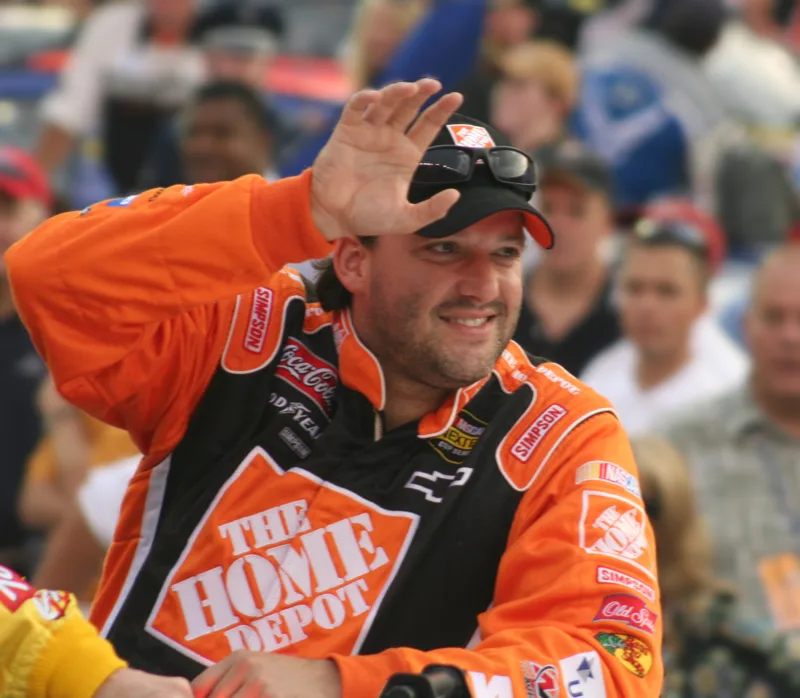
Tony Stewart clinched the 2002 title with an 18th-place finish at Homestead, after a late penalty to Mark Martin and a rookie season from Jimmie Johnson that nearly topped the standings.
The 2002 title went to Tony Stewart after an 18th-place finish at Homestead. The result followed a 25-point penalty to Mark Martin at Rockingham and an 89-point lead Stewart had built at Phoenix, while Jimmie Johnson's rookie year nearly took the standings lead.
The 2002 NASCAR Winston Cup Series ran from February 10 to November 17, and Tony Stewart of Joe Gibbs Racing won the title even though he finished 18th in the final race. The season introduced a one-engine rule for race weekends, and it was the last year for the non-common template bodies. Ford won the manufacturers' championship with 14 wins.
How did Tony Stewart win the 2002 title?
Stewart went into the finale at Homestead with an 89-point lead after Phoenix. Mark Martin had been penalised 25 driver points at Rockingham, and his appeal was denied during qualifying. Stewart needed a finish of 22nd or better only if Martin won and led the most laps.
Kurt Busch won the race from the pole, but the result that mattered was Stewart's 18th place. It was the lowest finish by a driver who went on to win the championship in the finale since Jeff Gordon's 32nd in 1995.
Stewart's title also had an unusual start. He finished 43rd in the Daytona 500, the season's opener, and no other champion has won after finishing that far back in the first race.
He was also the final champion crowned in a season finale before playoffs were introduced.
An 18th-place finish at Homestead was enough for Tony Stewart to win the 2002 title after a season of late swings.
Who else challenged for the championship?
Sterling Marlin, Mark Martin and Jimmie Johnson all led the standings at different points, and the title race had several turns. Marlin took the points lead at the Subway 400 in February and held it for 25 consecutive weeks, a streak that was the longest in the sport's history for a driver who never won the title.
Marlin's season was the story of the spring. He won at Las Vegas on March 3 and at Darlington on March 17, and the Darlington win was his last career Cup victory.
Martin was the main rival through the summer. He had taken the points lead after the New Hampshire race in September and stayed close for much of the autumn, but a 25-point deduction at Rockingham cut into his total. Without the penalty, the gap at Homestead would have been 64 points.
Johnson took the points lead in late September at Kansas, after Martin finished 25th with a blown engine. It was the first time a rookie had led the standings in NASCAR history, and Johnson finished the year with three wins, which matched the rookie-season mark set by Tony Stewart.
Dale Earnhardt Jr. won at Talladega twice, in April and October. His October victory in the EA Sports 500 came in a race where every Hendrick Motorsports engine failed.
Why did Ryan Newman win Rookie of the Year?
Ryan Newman was named Rookie of the Year over Jimmie Johnson, even though Johnson had more wins and a higher points position. The award uses its own system, which counts only a driver's best 15 finishes, and Newman's 15 best results were better than Johnson's.
Johnson had been the favourite because of his victories, his points position and his mentor, Jeff Gordon, who was also his team-mate. Newman had one win, at New Hampshire in September, but he set a record for pole positions during the season.
Shawna Robinson and Carl Long were the only other declared candidates, and neither ran enough races to remain eligible for the award. The contest was therefore a choice between the two leading drivers.
How did the rule changes affect the season?
The one-engine rule was the most significant change for 2002. Cars had to practise, qualify and race with the same engine, and unapproved changes brought a penalty that sent the car to the rear of the grid. The rule aimed to cut costs and save crews time over a race weekend.
The season was also the final one for the non-common template bodies, and the following year every manufacturer used the same roofline. That change made the cars look more alike and ended a period in which each brand's body shape was distinct.
Pit road penalties changed in March after a spin by Sterling Marlin at Las Vegas. Speeding on the approach to a pit stall now carried a pass-through penalty, which replaced a 15-second penalty that had been in place for 11 years. Speeding on exit also brought a pass-through, and a stop-and-go was kept for repeat violations.
At Daytona the restart rules were tested in the Daytona 500. A five-car accident came at the start-finish line with five laps to go, and the race was red-flagged after the penalty to Sterling Marlin handed the lead to Ward Burton.
Ward Burton's Daytona 500 win was the first for Dodge since Richard Petty's in 1974. The race also featured two family groups: the Wallace brothers and the Bodine brothers. Geoff Bodine finished third, Brett 16th and Todd 31st, while Rusty Wallace was 18th, Mike 21st and Kenny 30th. Dave Marcis made his final start there, finishing 42nd with a blown engine in his 33rd Daytona 500.
Selected race results
| Date | Race | Track | Winner | Notable detail |
|---|---|---|---|---|
| February 17 | 2002 Daytona 500 | Daytona International Speedway | Ward Burton | First Dodge win since 1974 |
| March 10 | MBNA America 500 | Atlanta Motor Speedway | Tony Stewart | Pit speeding rule changed |
| April 21 | Aaron's 499 | Talladega Superspeedway | Dale Earnhardt Jr. | The Big One took at least 24 cars |
| April 28 | NAPA Auto Parts 500 | California Speedway | Jimmie Johnson | First career Cup win |
| May 26 | Coca-Cola Racing Family 600 | Lowe's Motor Speedway | Mark Martin | First win in 73 races |
| June 23 | Dodge/Save Mart 350 | Infineon Raceway | Ricky Rudd | Rudd's last Cup victory |
| August 4 | Brickyard 400 | Indianapolis Motor Speedway | Bill Elliott | First race with the SAFER barrier there |
| August 24 | Sharpie 500 | Bristol Motor Speedway | Jeff Gordon | Bump and run past Rusty Wallace |
| September 15 | New Hampshire 300 | New Hampshire International Speedway | Ryan Newman | First points victory |
| October 6 | EA Sports 500 | Talladega Superspeedway | Dale Earnhardt Jr. | Every Hendrick engine failed |
| November 3 | Pop Secret Microwave Popcorn 400 | North Carolina Speedway | Johnny Benson | His only Cup victory |
| November 17 | Ford 400 | Homestead-Miami Speedway | Kurt Busch | Stewart 18th, title clinched |
Races from spring through autumn
Kurt Busch won his first career race at Bristol on March 24, the first of four wins in five Bristol Cup races for him. His rivalry with Jimmy Spencer had begun at Phoenix in 2001 and carried on through the year.
Earnhardt Jr.'s season included a serious hidden injury. At California on April 28, Kevin Harvick cut a tyre and hit his car, sending it into the outside wall. He suffered a serious head injury and kept it quiet for several months.
At Daytona on July 6, Michael Waltrip won the Pepsi 400 in a race that ended in chaos. With 25 laps to go, Dale Jarrett spun back into traffic and blocked the track, collecting 13 other cars.
At Bristol on August 24, Jeff Gordon used a bump-and-run move to pass Rusty Wallace, ending a winless run that had lasted since the end of 2001. Ward Burton threw heel pads at Earnhardt Jr. after a wreck, and Robby Gordon was penalised two laps for spinning Jimmie Johnson on a restart.
The Brickyard 400 on August 4 was the first race at Indianapolis to use the SAFER barrier, which was built to make wrecks less severe. Tony Stewart started from the pole, a double that no other driver has matched, but Bill Elliott won the race. Elliott had also swept the qualifying and the race at Pocono in July, when two lengthy red flags shortened the event to 175 laps because of darkness.
Ryan Newman held off Earnhardt Jr. to win The Winston all-star race on May 18. He had won the qualifying sprint for the No Bull 5 program earlier in the same day.
Rudd made his 656th consecutive start at Charlotte in May, passing Terry Labonte's record of 655. At New Hampshire in September, Newman won a race that rain shortened to 207 laps, which gave him his first points-race victory.
At Kansas on September 29, Gordon won while Sterling Marlin crashed hard on lap 148. Marlin was diagnosed with a neck injury that kept him out for the rest of the season.
At Talladega on October 6, Mark Martin lost steering on the pace laps and collided with Jimmie Johnson, and neither driver recovered. The race ran caution-free, and every Hendrick Motorsports engine failed during it.
The UAW-GM Quality 500 at Lowe's on October 13 was delayed by rain for more than three hours, and NASCAR ran the first five laps under yellow as the track dried. Jamie McMurray won in his second career start, subbing for an injured Sterling Marlin.
The Martin penalty and the Phoenix swing
Mark Martin's penalty came at Rockingham after his car failed post-race inspection because of an illegal left front spring. NASCAR docked him 25 driver points, and Jack Roush lost 25 owner points. Martin's appeal to recover them was denied, and the decision stood through the finale.
Johnny Benson's victory at Rockingham was the only Cup win of his career, and it was the first win for MB2 Motorsports. It came in the same race that cost Martin his deduction, which made the event one of the most talked-about of the autumn.
Stewart's position at Phoenix was the key result. He left the race with an 89-point lead over Martin, and the gap was enough to make the finale manageable even if Martin finished ahead of him.