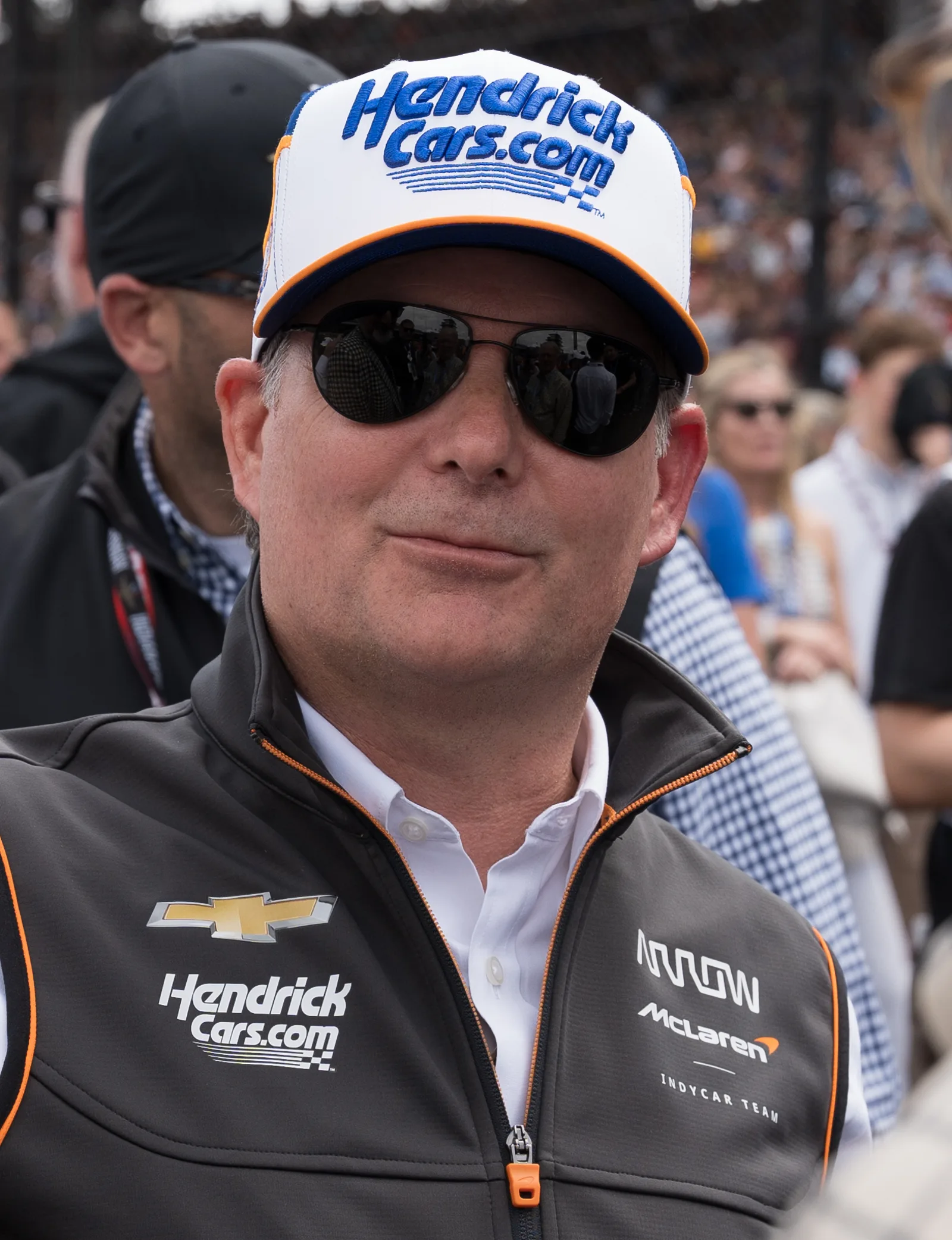
Four Cup Series championships, three Daytona 500s, a modern-era record of thirteen wins in one season and a long run as a broadcaster after 2015.
Jeff Gordon is an American former stock car driver who competed full-time in NASCAR's top series from 1993 to 2015. He won four Cup Series championships in 1995, 1997, 1998 and 2001. He retired from full-time driving with 93 career wins and is now vice chairman of Hendrick Motorsports.
Jeff Gordon is one of the most influential drivers in NASCAR history. He won four Cup Series championships and the Daytona 500 three times, and in 1998 he set a modern-era record with thirteen wins in a single season. Today he is vice chairman of Hendrick Motorsports, the team that gave him his full-time break.
Who is Jeff Gordon?
Jeffery Michael Gordon was born on 4 August 1971 in Vallejo, California. His family moved to Pittsboro, Indiana, where there were more opportunities for young racers. He raced full-time in the NASCAR Cup Series from 1993 to 2015, driving the No. 24 Chevrolet for Hendrick Motorsports, and he is widely regarded as one of the sport's greatest drivers.
His influence reached beyond results. Gordon helped NASCAR reach mainstream popularity in the 1990s and 2000s, and his name appears on roads, a grandstand and a raceway. Few drivers have shaped the sport's public image so visibly.
Four championships, three Daytona 500s and a modern-era record of thirteen wins in one season.
How did Gordon start racing before NASCAR?
Gordon began racing quarter midgets at the age of five, and by six he had won 35 main events. He won 51 quarter midget races in 1979 and all 25 karting races he entered when he was eleven. At sixteen he was awarded a USAC licence, the youngest driver to receive one at that time.
He raced sprint cars in the late 1980s, and in 1989 he was named USAC Midget Car Racing Rookie of the Year. In 1990 he won the USAC national Midget title, and in 1991 he took the USAC Silver Crown title at the age of 20, the youngest driver to win the season championship.
How did Gordon break into NASCAR?
Gordon made his first Busch Series start on 20 October 1990 at North Carolina Motor Speedway, driving an Outback Steakhouse Pontiac for Hugh Connerty. He qualified on the front row and was involved in a wreck on lap 33, finishing 39th. He moved to Bill Davis Racing full-time in 1991, when he was named Rookie of the Year.
In 1992 Gordon set a NASCAR record by winning eleven poles in one Busch Series season. Later that year Rick Hendrick saw him race at Atlanta Motor Speedway, and Gordon joined Hendrick Motorsports two days later. He made his Winston Cup debut in the season-ending Hooters 500 at Atlanta, finishing 31st after a crash.
What was Gordon's rookie season like in 1993?
Gordon began his full-time Winston Cup career in 1993 in the No. 24 car, a number he took after licensing complications connected with Days of Thunder. He opened the season with a win in the Gatorade Twin 125s, recorded his first pole at the fall Charlotte race and finished fourteenth in the points, earning Rookie of the Year.
His early years brought doubts about his tendency to push cars too hard. His last-place finish at the 1993 First Union 400 was an example, and Darrell Waltrip later wrote that Gordon had hit almost everything that year. Gordon's early success nonetheless opened the door for younger drivers in NASCAR.
How did Gordon's 1994 season build his reputation?
In 1994 Gordon won the Busch Clash exhibition race at Daytona. In May he won the pole for the Coca-Cola 600 and then the race, after choosing to take two tyres on a green-flag pit stop. By August he had won at home in the inaugural Brickyard 400, taking advantage of Ernie Irvan's tyre failure late in the race.
The Brickyard win became one of the most meaningful of his career. The track in Indiana was close to the home base he had built in the Midwest, and the result showed how quickly he had adapted to the bigger tracks of the Cup circuit.
How did Gordon win his first Cup Series title in 1995?
Gordon won the 1995 Winston Cup Series championship after a rough start at the Daytona 500. He then won three of the following six races at Rockingham, Atlanta and Bristol, and he also won the Winston Select in dominating fashion. He took the title as the youngest modern-era champion at 24.
The season was not without trouble. NASCAR officials found unapproved wheel hubs on his car after a pole at Charlotte, and the team was fined $60,000 while crew chief Ray Evernham was placed on probation. Gordon's consistency carried him through, and his team had three DNFs that year compared with 21 in his previous two seasons combined.
Why did Gordon fall short in 1996?
Gordon's title defence in 1996 was remarkable on the track, with ten wins including two sweeps at Darlington and Dover. He held a 111-point lead late in the season but finished second to his teammate Terry Labonte, losing the title by 37 points. It was a painful result for the Hendrick team.
The 1996 season showed how close the championship race could be even for a dominant driver. His wins were spread across the calendar, and his finishes in the final rounds were not enough to overcome a late surge by Labonte.
What made the 1997 and 1998 seasons historic?
Gordon won his second championship in 1997, and he took his first Daytona 500 that year, becoming the youngest driver at the time to win the race. He also became the first driver since Bill Elliott in 1985 to win the Winston Million, and he finished the season with ten victories.
In 1998 he won a modern-era record thirteen races, at tracks including Charlotte, Sonoma, Pocono, Indianapolis and Daytona. He clinched his third title with a 364-point lead over Mark Martin and set further records with four consecutive wins and seventeen consecutive top-five finishes.
How did the Chase change Gordon's championship results?
The Chase for the Cup reset the points at the end of the season, and it cost Gordon in 2004 and 2007. In 2004 he finished third, 16 points behind champion Kurt Busch. Without the Chase, he would have won that championship by 47 points.
In 2007 he finished the regular season 312 points ahead of second place, but as Jimmie Johnson had more wins he started the Chase behind him. Gordon finished second by 77 points. Without the Chase he would have won the title by 353 points, a result many fans still discuss.
Why was Gordon's 2001 title significant?
Gordon's fourth championship in 2001 made him the third driver in Winston Cup history to win four titles. He finished 344 points ahead of Tony Stewart. Only Richard Petty and Dale Earnhardt, who each won seven, had more championships at that point.
His 1999 and 2000 seasons had their own story. He won the 1999 Daytona 500 for his second win in that race, and Ray Evernham left Hendrick to form his own team. Gordon signed a lifetime contract with Hendrick starting in 2000, which gave him an equity stake in the No. 24 team.
How did Gordon's later Cup seasons go?
Gordon won his third Daytona 500 in 2005, but inconsistency plagued that season. He won twice in 2006, and in 2007 he won six races and seven poles, setting a modern-era record with 30 top-ten finishes. From 2008 to 2010 he struggled, with a single win at Texas, before a resurgence began.
In 2011 he won at Phoenix for the first time in 66 races and reached his 85th career win at Atlanta. He won his 87th Cup victory in 2012 at the season finale, after a suspension, and he won at Martinsville in 2013 for his first win of that season.
What records did Gordon set over his career?
Gordon has 93 career Cup wins, which places him third on the all-time list and first for the modern era. He also holds 81 pole positions, the most among active drivers at the time of his retirement, and the record for restrictor plate track wins with twelve.
His other records include nine road course wins and a consecutive pole streak across 23 seasons, a NASCAR record. He also has three career Grand Slam achievements and sixteen Crown Jewel race wins, including three Daytona 500s, four Talladega 500s, three Coca-Cola 600s and six Southern 500s.
| Season | Championship result | Note |
|---|---|---|
| 1993 | 14th | Rookie of the Year |
| 1995 | Champion | Youngest modern-era champion at 24 |
| 1996 | Second, 37 points behind Terry Labonte | Ten wins |
| 1997 | Champion | Ten wins, first Daytona 500 |
| 1998 | Champion | Thirteen wins, modern-era record |
| 2000 | Ninth | Fiftieth career win at Talladega |
| 2001 | Champion | 344-point margin over Tony Stewart |
| 2004 | Third, 16 points behind Kurt Busch | Chase points reset |
| 2007 | Second, 77 points behind Jimmie Johnson | Six wins, seven poles |
| 2009 | Third | Behind Mark Martin and Jimmie Johnson |
| 2015 | Final full-time season | 93rd and final win at Martinsville |
What was Gordon's consecutive-start streak?
Gordon never missed a Cup race in more than 24 consecutive seasons, a streak that began with his debut at Atlanta in 1992. On 27 September 2015 he started his 789th consecutive race at New Hampshire, passing Ricky Rudd to become NASCAR's iron man. He finished his career with 797 consecutive starts.
Standby drivers covered him in three races, in 2007, 2010 and 2014, so that the streak continued. Its length made him one of the most durable competitors in the sport's history.
Did Gordon race outside NASCAR?
Gordon raced in the International Race of Champions from 1995 to 2000 and won one race at Daytona in 1998. He also took part in the Race of Champions three times, including a Nations Cup win with Team USA at the 2002 event in Gran Canaria. He finished third at the 2007 Rolex 24 with Wayne Taylor Racing.
In 2017 he won the overall class at the Rolex 24, making him the fourth driver to win both the Daytona 500 and the Rolex 24. In 2003 he tested an F1 car for the first time, driving Juan Pablo Montoya's Williams at Indianapolis Motor Speedway, though he went off course on his first lap.
How did Gordon's final full-time years unfold?
On 22 January 2015 Gordon announced that the season would be his last as a full-time driver, although he left the door open to occasional races. He started the 2015 Daytona 500 from pole but crashed on the final lap. He won his final career race at Martinsville in November 2015 and finished sixth in his last full-time event at Homestead.
In 2016 he returned to the Cup Series as a substitute for the injured Dale Earnhardt Jr. in the No. 88 car. His final NASCAR race came at Martinsville, where he finished sixth. Since 2016 he has worked as a full-time analyst for Fox Sports.
How is Gordon remembered in NASCAR?
NASCAR named Gordon to its 50 Greatest Drivers list in 1998, and ESPN ranked him tenth in its 25 Greatest Drivers of All-Time in a 2008 article. He was inducted into the NASCAR Hall of Fame in 2019. Forbes listed him as the highest-paid NASCAR driver of all time as of 2016, with $515 million in career earnings.
His charitable work is also part of his legacy. In 1999 he established the Jeff Gordon Children's Foundation for children facing life-threatening and chronic illnesses. He co-founded Athletes for Hope in 2007 and was a Clinton Global Initiative member.