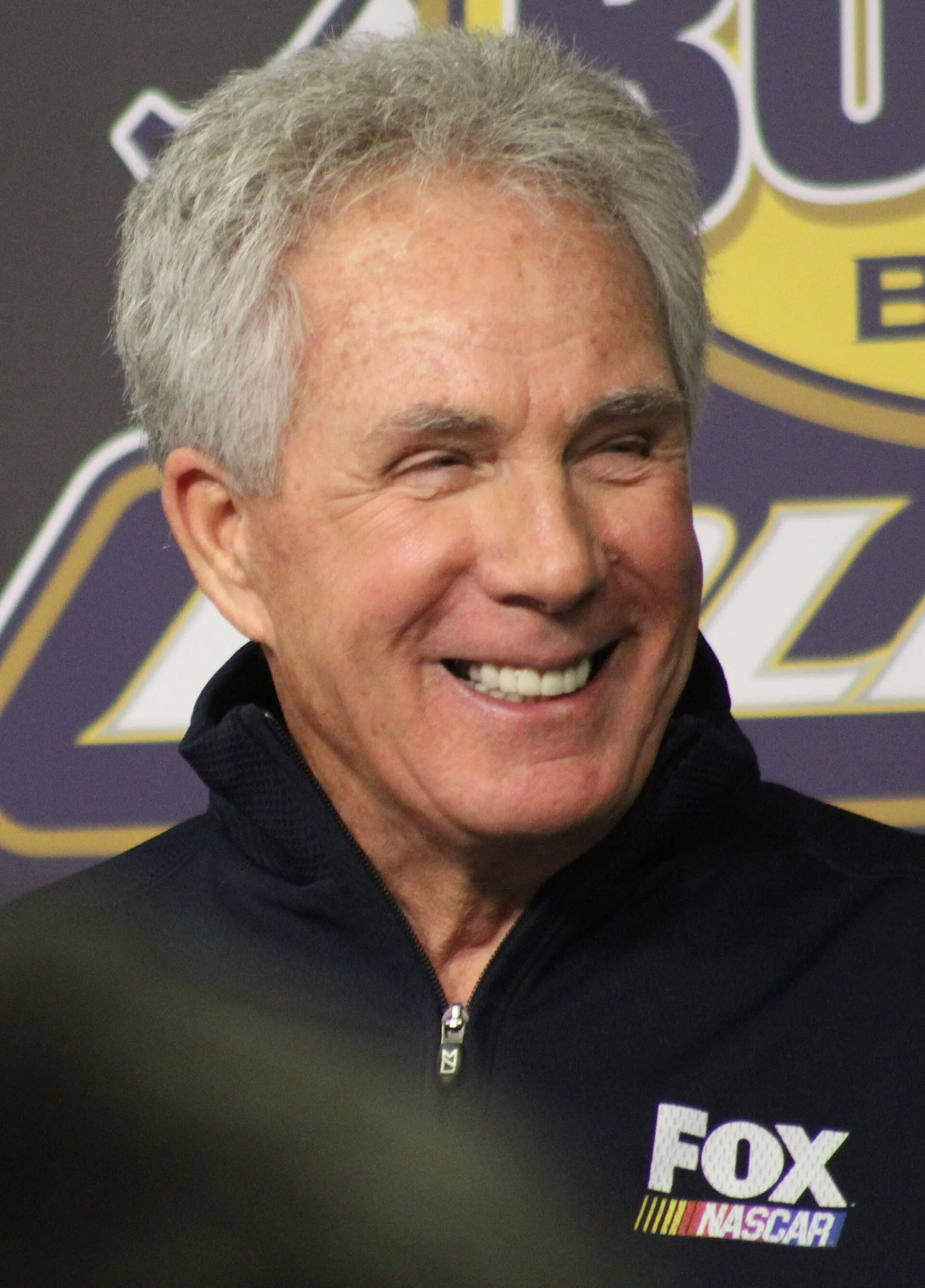
From Owensboro karts to 84 Cup Series wins, two titles in a row with Junior Johnson and a long run on Fox, the career of a driver nicknamed Jaws.
Darrell Waltrip, born in 1947, is a former NASCAR driver with three titles, earned in 1981, 1982 and 1985. He raced from 1972 to 2000, won 84 Cup races and later worked as a Fox broadcaster from 2001 until 2019.
Darrell Waltrip is an American former stock car driver who won three Cup Series championships, in 1981, 1982 and 1985. He raced in the top series from 1972 to 2000 and later became one of the best-known voices in NASCAR broadcasting, first on Fox from 2001.
Where did Darrell Waltrip's career start?
He came into the world on February 5, 1947, in Owensboro, Kentucky. He began driving go-karts at twelve, and about four years later he was in his first stock car race, which he entered in a 1936 Chevrolet coupe that he had built with his father. That first night on a local dirt track ended with the coupe badly damaged against the wall.
He soon found that the smoothness he had learned in karts worked well on asphalt. He graduated from Daviess County High School in 1965, and he raced at Kentucky Motor Speedway and at Ellis Raceway before a Nashville owner, P. B. Crowell, urged him to move to the Tennessee State Fairgrounds track.
A driver nicknamed Jaws who won three Cup titles and later became one of the best-known voices in NASCAR.
How did his early Nashville years prepare him?
At the Fairgrounds Speedway he won two track championships, in 1970 and 1973. He drove Crowell's No. 48 Ford and was not shy about promoting the weekly races. He appeared on local television to hype the shows, and he traded good-natured jabs with other local drivers, which helped fill the grandstands.
When did Waltrip reach NASCAR's top series?
He started in the NASCAR Winston Cup Series at age 25, on May 7, 1972, at the Winston 500 at Talladega. Driving a 1969 Mercury Cyclone bought from Holman-Moody, he retired on lap 69 with engine failure and still finished 38th. The car had originally been the Ford Fairlane that Mario Andretti drove to victory in the 1967 Daytona 500.
The car, a spare engine and several spare parts cost him $12,500, and he raced it in five Cup events until mid-1973. Terminal Transport of Owensboro sponsored the car, his first major sponsor. He still owns it today as part of his collection.
His first Winston Cup win as an owner-driver came at Nashville on May 10, 1975, in the Music City 420, a race he won by two laps in the No. 17 Terminal Transport Chevrolet he owned.
How did the DiGard years build his reputation?
In 1975 Waltrip signed a multi-year contract with DiGard, replacing Donnie Allison in the No. 88 Chevrolet. His first DiGard race was at Talladega, where he finished 42nd after an engine failure, and he won his second Winston Cup race that October at Richmond in the Capital City 500.
He used the short tracks to build his name. He holds the Bristol record with twelve wins, and he took eight Martinsville poles. In 1976 Gatorade became his primary sponsor, and in 1977 and 1978 he won six races each year with crew chief Buddy Parrott. The pair won 21 races together between 1977 and 1980.
The 1979 Daytona 500 is one of the best-known races in NASCAR history. Waltrip was a pre-race favourite, but Cale Yarborough and Donnie Allison crashed hard on the last lap, and Richard Petty took the win. Waltrip finished second after losing horsepower to a dropped cylinder, which kept him from drafting past Petty on the final lap.
That season he won seven races and was a serious title contender despite engine failures and tension with DiGard management. At Martinsville he took pole, led 184 laps and then lost an engine, though the team's record eleven-minute engine change got him back to finish 11th. He went into the final race of the year only a couple of points behind Petty, but Petty finished fifth and took the title by eleven points, the third-closest finish in the history of the points battle.
Where did the nickname Jaws come from?
By the end of the 1970s Waltrip had 22 Winston Cup wins from 149 starts, and he was ranked as NASCAR's No. 2 driver. His hard-charging style and blunt manner led to the nickname Jaws, after the 1975 shark film.
The name came from Cale Yarborough after a 1977 Southern 500 incident in which Waltrip took out Yarborough and D. K. Ulrich. When Ulrich questioned Yarborough about the wreck, Yarborough replied that Jaws had run into him. He preferred D. W. or D-Dubya, yet he played along by bringing an inflatable shark to his pit at the following race.
Why was Waltrip unpopular with some fans in the early 1980s?
At the height of his success, fans often booed him. Part of it came from defeating established drivers with large followings, and part from his open criticism of NASCAR and his admission that he tolerated cheating. His take-no-prisoners driving also rubbed people the wrong way.
He had a public falling-out with DiGard and said he would not win a championship while driving for them. He tried to get out of his contract in 1980, a year in which he still won five races. Even so, he had a large and loyal following, and commentators often said that fans either hated him or loved him.
Cale Yarborough, then driving for Junior Johnson, told Waltrip privately that he planned to cut back and leave the team at the end of 1980. That opened a seat for Waltrip, but only if he could end his DiGard deal early, which he did. He took over the No. 11 for 1981.
How did the Junior Johnson years go?
His results with Junior Johnson's cars were even better than at DiGard. In his first two years in the Mountain Dew Buick Regal he won twelve races each season and took back-to-back Cup titles in 1981 and 1982. The Buick brand later used throwback paint schemes to recall those years.
He first worked with Jeff Hammond at Johnson's team, and their partnership lasted most of their careers. Hammond initially doubted Waltrip's style, which was very different from Yarborough's. Waltrip wanted the car set up around his driving, and Hammond eventually came to value the smoothness of his approach. The two later worked together at Fox Sports too.
In 1981 Waltrip won the Rebel 500, along with the Food City 500 and Riverside 400, within a total of twelve wins. At Talladega he nearly won the race but lost it on the final lap to rookie Ron Bouchard, in what is often called the biggest upset in the sport's history. He ended the season with twelve wins, eleven poles and 21 top-five finishes, and he overturned a deficit of nearly 300 points by midsummer to beat Bobby Allison by 53 points.
The 1982 title came by 72 points, after another late-season charge past Allison. In 1983 the Daytona 500 ended in a serious accident, in which his car spun and was thrown back into traffic. He was taken to Halifax Medical Center for observation. Afterwards he realised how unpopular he had become, and he set about rebuilding his image with fans and rivals.
He won the 1985 championship, his third, and the inaugural All-Star race that year, and he finished his time with Johnson with 43 wins. In 1986 Johnson's team and Waltrip's wishes began to diverge, and he made a final start for Johnson at Riverside in November that year.
What did he achieve at Hendrick Motorsports?
After Johnson, Waltrip joined Hendrick Motorsports, where his new car was the No. 17 Tide Chevrolet. The move came after a long friendship with Rick Hendrick, and it was the result of a contract dispute that Waltrip resolved by asking for a raise, something his old team had forbidden drivers to discuss.
His first year at Hendrick, 1987, brought one win at Goody's 500 and six top-five finishes. In 1988 he won twice, including his fourth Coca-Cola 600 victory.
The high point came at the 1989 Daytona 500, his seventeenth attempt. Crew chief Jeff Hammond planned a fuel-conserving run, with Waltrip making a final stop 53 laps from the finish when most rivals had to pit again. Waltrip drafted and throttled back to save fuel, and the strategy gave him the track position he needed to win. The victory also gave him a fame that still follows his name.
That same year he won six races for Hendrick, his best season with the team, and he took a fifth Coca-Cola 600 win in May. He was leading The Winston all-star race at Charlotte in May 1989 with two laps to go when Rusty Wallace hit him exiting the fourth turn, and Wallace went on to win the $200,000 purse. The crowd booed Wallace, and the crews argued in the pits afterwards.
The 1990 season was harder. Waltrip finished second at North Wilkesboro in the First Union 400, after a pace-car error handed Brett Bodine the lead, but he failed to win a race. It was the first winless season since 1974, and he won only five more times in his career, never again after 1992. In the same season, he was injured in a crash during practice for the Pepsi 400 at Daytona, leaving him with a fractured arm and leg and a concussion.
How did Waltrip run his own team in the 1990s?
In 1991 Waltrip formed his own team and bought its assets from Rick Hendrick. He kept Jeff Hammond as crew chief, and with Western Auto as the main sponsor he drove a Chevrolet Lumina. He won twice that year, at North Wilkesboro in April and at Pocono in June, and he finished eighth in the points.
A serious crash at the summer Daytona race later that year showed the risks he was taking. His car tumbled after a collision that started with Sterling Marlin, and the car came to rest upside down. He was only lightly injured, but the crash revived concern over the leg injuries he had suffered earlier at the track.
In 1992 he won three races, one of them the Southern 500 at Darlington, the major prize that had long escaped him. That was his final Cup win, which gave him 84 in all. He finished ninth in the points. In 1994 he made his last appearance in the championship top ten, finishing ninth.
His results slowly declined. He won his last pole at the NAPA 500 in 1995, and in 1997 he failed to qualify for the UAW-GM Quality 500 for the first time in more than twenty years. A sponsorship deal for 1998 fell through, and the team passed to Tim Beverly.
His last race as an owner-driver was the TranSouth Financial 400, where he drove a Tim Flock Special in support of the former two-time Grand National champion, who was ill and uninsured. Flock died nine days later at age 73. In 2008 Waltrip said his problem as an owner-driver had been that he thought like a driver rather than an owner.
What were his final years in the car?
Later in 1998 Waltrip drove the No. 1 Pennzoil Chevrolet for Dale Earnhardt Inc., filling in for the injured Steve Park. He also drove for Tyler Jet Motorsports and then for Haas-Carter Motorsports, but he struggled, and at the Brickyard 400 he was not competitive.
On August 5, 1999, he announced that he would retire at the end of the 2000 season after a farewell tour. His best run that year came at the Brickyard 400, where he started on the outside pole and finished eleventh. His last NASCAR race was the NAPA 500 at Atlanta in November 2000, where he finished 34th. He had failed to qualify six times that season.
How did his broadcasting career begin?
Before he retired from driving, Waltrip commented on several IROC broadcasts for ABC and from 1994 to 1998 he worked on Busch Series coverage on TNN. In 2001 he joined Fox as the lead NASCAR analyst, working alongside Mike Joy and Larry McReynolds.
He began at the 2001 Daytona 500, where his younger brother Michael won but the race was overshadowed by Dale Earnhardt's fatal crash on the final lap. Darrell called the finish with obvious joy, then turned his attention to the crash replays. He had been a bitter rival of Earnhardt in the 1980s, but the two had become close, and he gave the invocation at Earnhardt's funeral.
At the next race he interviewed NASCAR president Mike Helton about the deaths of several drivers in the previous ten months, all from basilar skull fractures, and pressed him for answers. He then campaigned for mandatory head-and-neck restraints and showed the device during a broadcast at Atlanta. NASCAR made the devices mandatory seven months later, after a driver died in an ARCA race.
What made his broadcast style distinctive?
His catchphrase became one of the most recognised lines in motorsport. As the cars took the green flag, he would shout, "Boogity, boogity, boogity, let's go racing boys!" The phrase came from his frustration as a driver with hearing "green, green, green" from his crew at every start, and he wanted something different.
He also developed his own vocabulary. He spoke of coop-petetion, where rivals work together but keep watch on each other, of s'perince for a veteran's driving skill, and of using the chrome horn, a deliberate bump with a car in the way. In early 2007 he was nominated for an Emmy in the Outstanding Event Analyst category.
In March 2011 Fox gave him a two-year contract extension through 2014. Later that year he flew to Australia to present Speed's Bathurst 1000 coverage at Mount Panorama, a trip where he was helped by Marcos Ambrose and where he was taken around the circuit by Jason Bright.
He announced at Bristol Motor Speedway on April 4, 2019, that he would leave the booth to spend more time with his family. His final race in the booth was the Toyota/Save Mart 350 at Sonoma Raceway in 2019.
How has he been recognised for his career?
He won the NASCAR Most Popular Driver award in 1989 and 1990, and was named American Driver of the Year in 1979, 1981 and 1982. He was also named the sport's Driver of the Decade for the 1980s and was among its 50 Greatest Drivers in 1998. In 2000 he received the Bill France Award of Excellence.
The Motorsports Hall of Fame of America honoured him in 2003. The NASCAR Hall of Fame named him to its 2012 class on June 14, 2011.
What were his records across the Cup Series?
His career total of 84 Cup wins places him fifth on NASCAR's all-time list, one behind Bobby Allison. Only Jeff Gordon has won more races in the modern era, and Waltrip posted 809 Cup starts over his career, with 271 top-five finishes and 390 top tens.
His record at the Coca-Cola 600 was five wins, and he holds the Bristol track record with twelve. He earned nearly $19.9 million in posted winnings, making him the first driver to pass $10 million in career race earnings.
How did his career look season by season?
| Season | Team and car | Key result |
|---|---|---|
| 1975 | DiGard, No. 88 Chevrolet | Second Winston Cup win at Richmond |
| 1979 | DiGard, No. 88 Chevrolet | Second in the Daytona 500; seven wins; second in the title race |
| 1981 | Junior Johnson, No. 11 Buick | Champion; twelve wins |
| 1982 | Junior Johnson, No. 11 Buick | Champion; twelve wins |
| 1985 | Junior Johnson, No. 11 Buick | Champion; inaugural All-Star race winner |
| 1989 | Hendrick Motorsports, No. 17 Tide | Daytona 500 winner; six wins for the season |
| 1990 | Hendrick Motorsports, No. 17 Tide | Winless season, first since 1974 |
| 1991 | Own team, Western Auto | Two wins; eighth in points |
| 1992 | Own team, Western Auto | Three wins; Southern 500 at Darlington; ninth in points |
| 1998 | Dale Earnhardt Inc., No. 1 Pennzoil | Fill-in driver for Steve Park |
| 2000 | Haas-Carter, No. 66 Big K Ford | Final race at Atlanta; 36th in points |