From a 1960 opening marred by unfinished work to a 2021 repave and a 2025 rename, the Hampton quad-oval has rarely stood still.
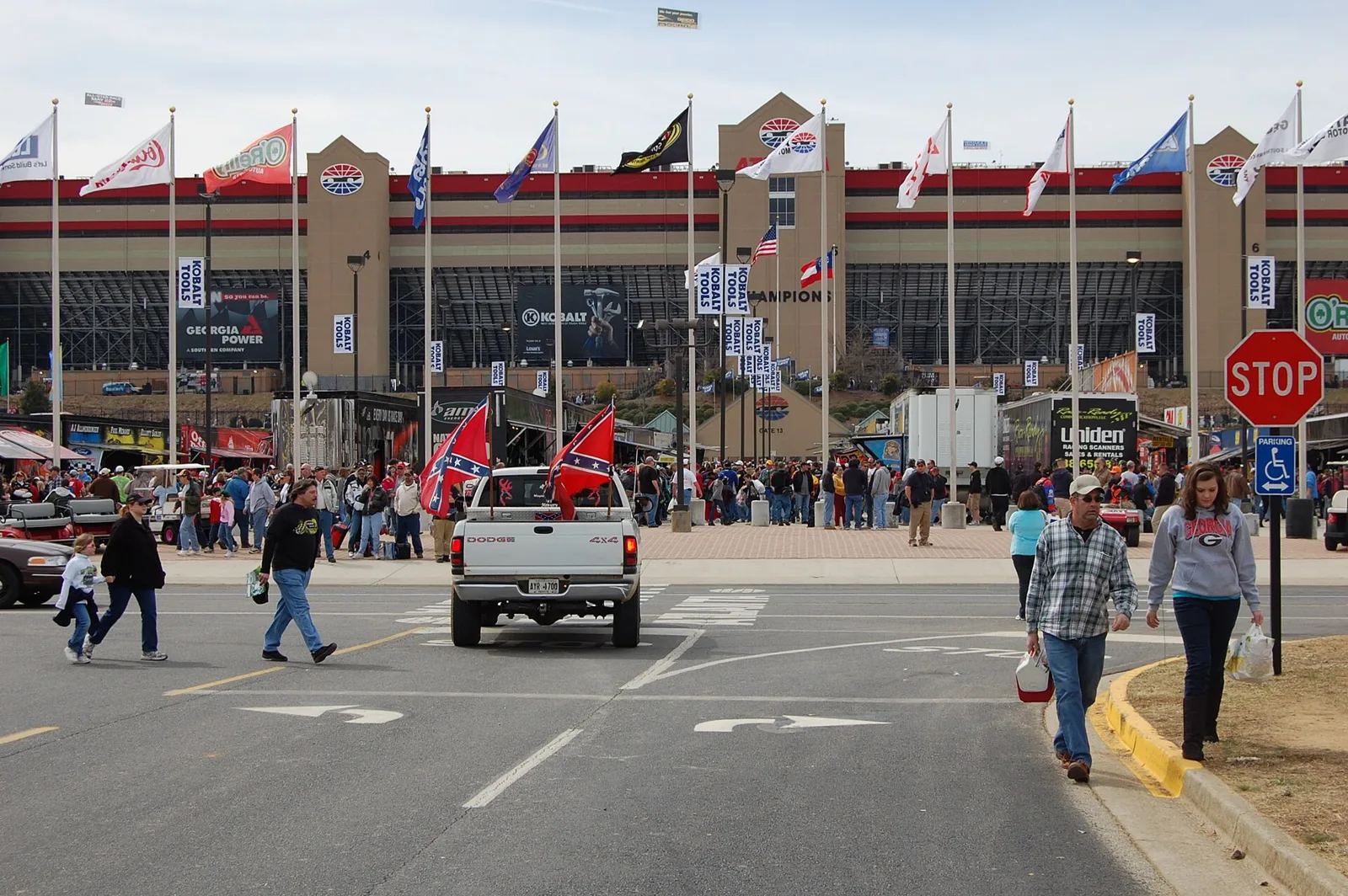
Atlanta Motor Speedway is a quad-oval track in Hampton, Georgia, that opened in 1960 as Atlanta International Raceway. It is now called EchoPark Speedway after a 2025 sponsorship rename, and it hosts NASCAR Cup Series weekends alongside a roval road course built in 1992.
Hampton, Georgia, is home to a superspeedway that has hosted racing since 1960. Its oval and roval road course give it a blend of superspeedway and road racing, and since June 3, 2025 it has carried the name EchoPark Speedway.
What is the layout of Atlanta Motor Speedway?
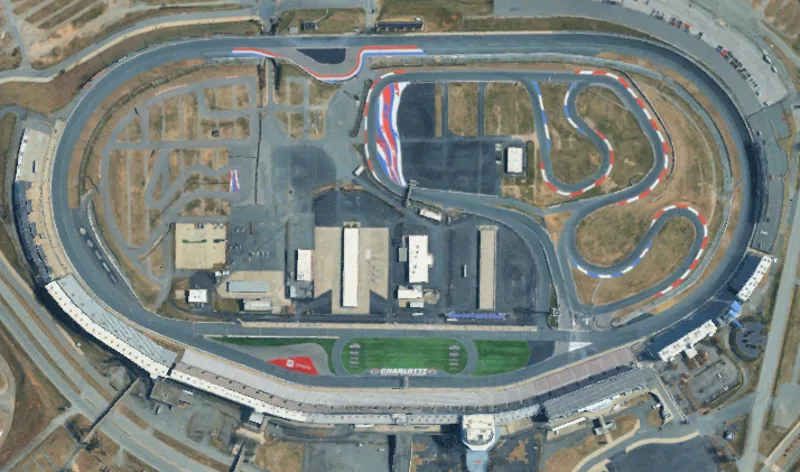
The main oval is 2.478 km (1.540 mi) long, with turns banked at 28 degrees and straights at five degrees. A 4.059 km (2.522 mi) roval, first raced in 1992, joins the oval to an infield course, and a 0.402 km (0.250 mi) legends car oval sits on the frontstretch.
The steep turns define the oval. Drivers carry speed through the banking, and the style of racing the track produces has changed more than once as its surface and banking were reworked over the decades.
The quad-oval shape dates from 1997. Before then the track was a true oval of 2.45 km (1.52 miles), and the reconfiguration stretched it to 2.48 km (1.54 miles) with a new shape. The legends oval was added at the same time so that smaller cars could race on the same site.
A track built to rival Indianapolis has spent more than six decades reinventing itself, from bankruptcy court to pack racing.
How did the speedway come to be built?
Plans for the facility were announced in 1958 by the First Georgia Securities Corporation, which wanted a track that could rival the Indianapolis Motor Speedway. The site was 32 km (20 miles) south of Atlanta, and the first races were held in 1960 after a long series of delays.
The first budget was $1 million for a 50,000-seat facility on 400 acres. Stock sales were slow, and by the end of July only $40,000 worth of shares had been sold. Racing directors Curtis Turner and Joe Weatherly joined the leadership in August, and the stock problem became a source of friction inside the company.
Construction ran late through the autumn and winter. A NASCAR date set for November 22, 1959 never happened, and a race planned for March 27 was postponed indefinitely while the track was still being built. Art Lester took over as president after raising more than $1 million in financial aid, and the company signed a $636,000 contract with E. Jack Smith Construction Company to finish the job.
Jack Smith ran the first tests on July 10, and the track officially opened to teams on July 25, 1960. Alf Lester, the track's executive, brought in 17 high school football players to help run the event. The inaugural race, the 1960 Dixie 300, drew a crowd of 25,000 and was won by Edwin 'Fireball' Roberts. Runner-up Cotton Owens disputed the scoring, and the first weekend exposed unfinished work, including a guardrail that was not installed until late October.
Why did the track enter bankruptcy?
Atlanta International Raceway struggled through its first decade with rain delays, management disputes and poor surfaces that had been building for years. After a failed merger with Charlotte Motor Speedway, the company entered Chapter 10 proceedings on January 19, 1971, with debts of about $1,400,000.
Rain delays hit most of the early NASCAR events, and the leadership was divided by power struggles. Nelson Weaver succeeded Lester as president and used his own money to keep the business going until his death on February 16, 1968. Afterwards the company lost its stability, and the Internal Revenue Service demanded a $35,000 partial payment on tax debts that had passed $58,000.
In December 1968 the company merged with Michigan International Speedway, which was owned by Lawrence LoPatin and had opened the same year. The merger promised $1 million of renovations, but the company was later renamed American Raceways in 1969 and fell into serious financial trouble after its operations director left.
Furman Bisher, writing for The Atlanta Journal, later argued that people with no racing background were running the events and that stockholders with no track experience were telling professionals how the job should be done. That criticism summed up the atmosphere before the bankruptcy filing.
The 1971 Atlanta 500 drew a crowd of about 57,000, below the 65,000 that had been called the minimum for survival. A trustee ran the track for the court, and a reorganisation plan that dragged on for five years followed. On March 10, 1976, the track passed to a board of five directors, closing the bankruptcy.
Safety was a continuing problem through the late 1970s and 1980s. The first fatality at the track came during the 1979 Atlanta 500, when a mechanic named Dennis Wade, aged 18, was struck after Dave Watson spun on pit road. In 1984 driver Terry Schoonover was killed in a crash, and track management announced new walls in response. The track was repaved in 1978, and a second repave came within ten years.
How did Bruton Smith change the speedway after 1990?
Bruton Smith bought the speedway in October 1990 for $19.8 million and renamed it Atlanta Motor Speedway. His company, Speedway Motorsports, then invested in new grandstands, a roval road course and the Tara Place condominium complex as part of a plan to spend $75 million on renovations.
The purchase was confirmed on October 24, 1990, after months of talks in which Walter Nix repeatedly denied that a sale was close. Smith's company moved quickly afterwards, and the track's leadership was reshaped around his plans for promotions and expansion.
The first major project was a new 21,000-seat grandstand, completed by November 1991, which also tackled traffic flow, a long-standing problem since the track opened. A roval road course that used both the oval and an infield section was completed in 1992, and Ed Clark took over as general manager that year after Bob Marcum resigned.
Clark announced a three-year plan to lift capacity to 180,000, and the Tara Place condominium complex was built next to the track. Its groundbreaking started on June 1, and the nine-story building with 46 units and a ballroom was completed in November 1994, although early sales had been weak.
The 1997 work came to $30 million and brought 37,000 more seats, along with 44 luxury suites and upgraded garages. The change from a true oval into a quad-oval drew criticism from drivers such as Dale Earnhardt and John Andretti, as well as Johnny Benson Jr. Testing on the new surface began in September, and the first races followed in November 1997.
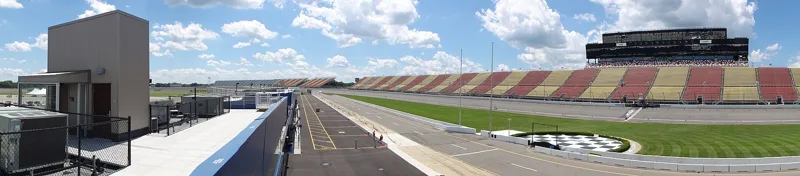
Capacity has moved steadily over the years. The track reached 113,000 seats after the expansion that followed the 2005 tornado, and it peaked at 124,000 in a 2010 report, but it fell to 71,000 by 2015. In 2018 more seats were torn down to make room for a hospitality area.
Why did the track change its racing surface in 2021?
In July 2021 the owners announced a repave and a reconfiguration that raised the banking in the turns by four degrees to 28 degrees. The narrower racing surface was designed to produce pack racing similar to superspeedways, and drivers including Denny Hamlin, Kevin Harvick and Kyle Busch criticised the decision.
Much of the criticism focused on a lack of driver input, since the decision came from the company's management. The repave was completed in late December 2021, and tyre tests on the new surface followed the next month.
The reconfiguration was linked to a much larger plan. Ed Clark had proposed a $1 billion entertainment complex that required Georgia to legalise gambling, and SMI chief executive Marcus Smith hinted that a return to an oval layout could follow if the plan went ahead. Support for the complex stagnated by 2022, although Hutchison and Clark said they were still campaigning for legalisation.
Clark's retirement took effect in March 2020, after a 27-year reign, leaving Brandon Hutchison, who had become general manager in 2018, in full control of the track.
Track specifications and milestones
| Specification | Detail |
|---|---|
| Opened | 1960 as Atlanta International Raceway |
| Length | 2.478 km (1.540 mi) quad-oval |
| Banking | 28 degrees in the turns; five degrees on the straights |
| Roval | 4.059 km (2.522 mi), first raced in 1992 |
| Legends oval | 0.402 km (0.250 mi) on the frontstretch |
| Bankruptcy filing | January 19, 1971 |
| Purchase by Bruton Smith | October 24, 1990 for $19.8 million |
| Capacity | 124,000 at its peak; 71,000 as of 2015 |
| Repave and reconfiguration | July 6, 2021, banking raised to 28 degrees |
| Renamed | EchoPark Speedway on June 3, 2025 |
Which NASCAR and IndyCar races run at Atlanta today?
Atlanta hosts two NASCAR Cup Series weekends a year, with the Autotrader 400 plus the Dollar Tree 400 as the headline races. The track also runs an O'Reilly Auto Parts Series race and two Craftsman Truck Series races as support events for the Cup Series.
The track's IndyCar history is less settled. In 1961 the United States Auto Club cancelled a planned July race after tire tests produced average lap speeds above 150 mph, saying the track had not been modified for its cars.
Open-wheel racing returned in the late 1990s. The Indy Racing League announced a 500 km (310 mi) race for 1998, and the event ran for four years before it was removed from the schedule by the 2002 season.
Atlanta also hosted the one-off 1986 running of The Winston, which had been planned to rotate among venues. Poor attendance meant the race moved to Charlotte Motor Speedway, where it stayed until 2020.
Other events, films and emergency shelter
The complex has often served the community beyond racing. Storms including Irma in 2017, Florence and Michael in 2018, Dorian in 2019, Ian in 2022 and Idalia in 2023 led to its use as an evacuee shelter.
During the COVID-19 restrictions in 2021 the Atlanta Marathon was moved onto the speedway and its perimeter roads. The same year, the crew behind America's Got Talent: Extreme shot its first season at the facility.
Film makers have used the track for decades. Thundering Wheels in 1962 featured driver Jack Smith, and later productions included Smokey and the Bandit II in 1980, Six Pack in 1982 and Stroker Ace in 1983. In 2017 Logan Lucky used the track as a stand-in for Charlotte Motor Speedway.
Taken together, the unfinished opening, the bankruptcy and the later rebuilds show how much a superspeedway depends on its owners and on the local market around it.