A bankrupt speedway, a promoter who sold condominiums at a racetrack and a $600 satellite feed that earned a genius label.
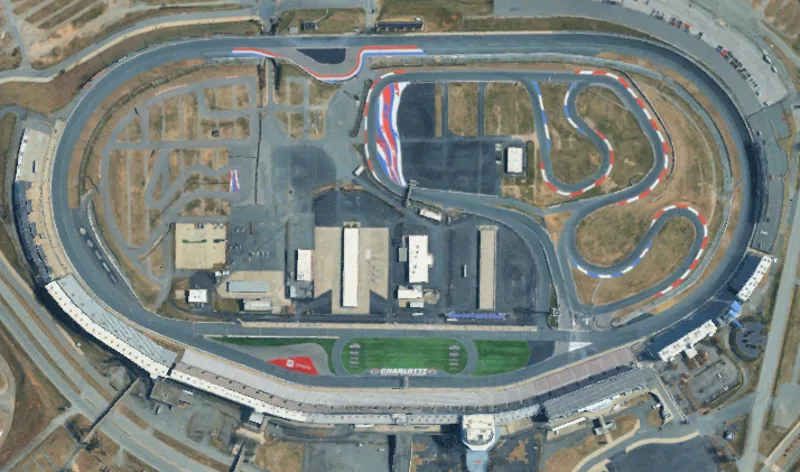
Bruton Smith built Charlotte Motor Speedway and grew Speedway Motorsports, which now owns nine facilities. Humpy Wheeler ran Charlotte and made its promotions famous, and his protege Eddie Gossage built and ran Texas Motor Speedway, where events drew crowds of over 200,000.
When the pyrotechnics on a prop switch malfunctioned at the 1992 unveiling of Charlotte Motor Speedway's new lights and sparks burned Bruton Smith's head, Eddie Gossage assumed he was about to be fired. He was not. Smith, who had been treated as an outpatient and had told him the promotion went a little too far, later rang to ask how friends in Hawaii had seen the footage on television. Gossage told him he had sent it out by satellite for $600, and Smith called him a genius.
That small story captures a partnership that built much of NASCAR's modern race-weekend business. Smith built and bought the tracks, Humpy Wheeler taught the sport how to sell them, and Gossage, who learned from Wheeler, took the formula to Texas. The company that tied them together is Speedway Motorsports.
Bruton Smith, the farm boy who built Charlotte Motor Speedway
Ollen Bruton Smith was born near Oakboro, North Carolina, on 3 March 1927, the youngest of nine children on a farm where there was enough to eat but little money. By nine he had decided to leave. At 11 he started boxing on a home-made punching bag, dreaming of the middleweight crown, and kept at it for five years. He saw his first race at eight at Charlotte Speedway and began selling used cars from his front yard in 1946.
A teenage promoter takes on NASCAR
Smith bought his first race car at 17 for $700 and gave up driving when his mother prayed that he would stop. He began promoting stock-car races at 17 on a Midland cornfield he nicknamed the Dust Bowl. In 1949 he took over the National Stock Car Racing Association, a rival body to NASCAR, and announced a Strictly Stock division of newer cars. NASCAR president Bill France Sr. then created his own Strictly Stock division and ran its first event on 19 June 1949, the same day the NSCRA planned its race. Some NASCAR reporters see that as the start of the rivalry between the Smith and France families.
In 1951 Smith took over the lease of Charlotte Speedway and discussed a merger with France. The Korean War intervened: he was drafted in January 1951 and became a paratrooper, and the NSCRA collapsed during his two years away. Back in the Carolinas from 1953, he sold cars and promoted short tracks, and by 1955 he was earning $128,050 a year. Wheeler later said Smith turned stock-car racing into a more professional business, making drivers pose for publicity photos in a suit and tie, and that Smith would argue and sometimes fight drivers because he knew he could not back down.
The speedway that went bankrupt
By the late 1950s Smith wanted a big modern track like Darlington. After his first partner backed out following a heart attack in 1958, he turned to Curtis Turner, who was also planning a speedway. Turner refused to join him, so Smith announced a rival track and pledged to sell 100,000 of the 300,000 shares Turner had been struggling to place, becoming vice president. Construction began in summer 1959 and finished in mid-June 1960, in time for the World 600 on 19 June.
The opening race suffered from incomplete facilities and a poor surface, and creditors went unpaid. Smith said it was a miracle the place got built, and admitted he lost more than $150,000. In 1961 a contractor owed $90,000 forced the speedway into bankruptcy court, a Teamsters loan fell through, and the track was found to be more than $500,000 in debt and facing a federal investigation of its original stock sale. Smith and Turner were both removed from the board. A year later Smith was indicted over his 1955 and 1956 tax returns, and in 1963 he was fined $4,000 and given a suspended one-year prison term. He left the speedway, and when his name went forward to rejoin the board, the response was boos and chants.
Cars first, then the track again
Smith turned to his other dream, a new-car dealership. He started as a Ford salesman in 1966 and was sold a dealership in Rockford, Illinois, in 1968, where he was known as an extravagant spender. By March 1980 he had ten dealerships and chose to keep only two, in Houston and Charlotte, after a turbulent flight in 1979 made him realise he was really working for his employees.
Meanwhile his profits went into the speedway. His holding grew from about 40,000 shares in 1973 to almost 500,000 of 1,884,723 shares, and in February 1974 he was elected chairman, replacing Richard Howard, who stayed as president. He and Howard clashed over spending, since Howard wanted to be conservative while Smith dreamed of a world-class facility. By October 1975 Smith held nearly 800,000 shares. On 30 January 1976, the day of the annual stockholders' meeting, Howard confirmed that he was stepping down and Humpy Wheeler would replace him.
Gossage spent $600 on a satellite feed of his boss's accident and was called a genius for it.
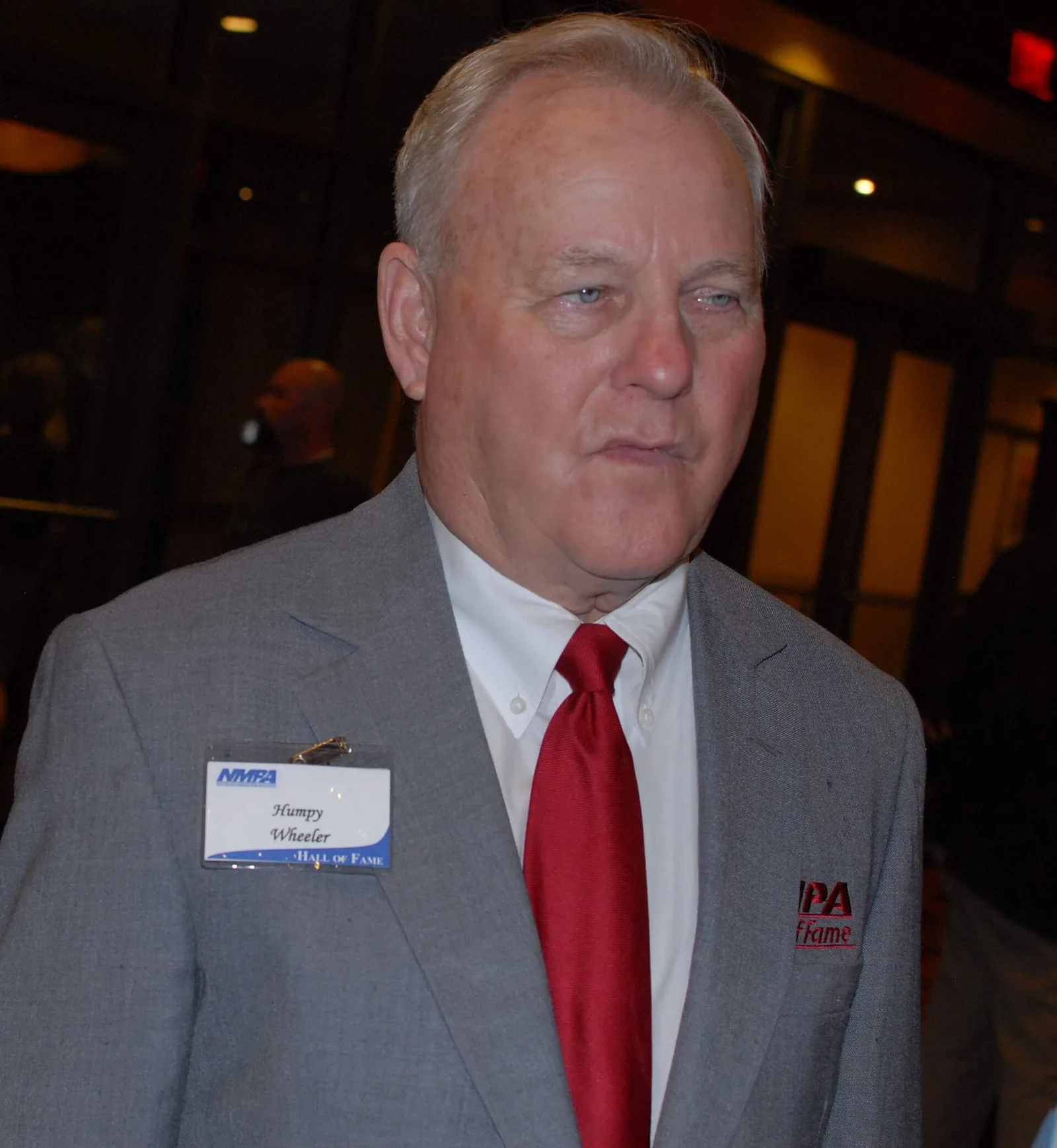
Humpy Wheeler, the promoter who tried everything
Howard Augustine Wheeler Jr. was born in Belmont, North Carolina, on 23 October 1938. His father was athletic director and football coach at Belmont Abbey College, and the boy imagined how to improve the games he watched. The nickname Humpy came from his father, and Wheeler fought it for years because some employers would not hire him with it. When his father fell seriously ill, he realised how much the name meant to him and accepted it.
Bicycles, boxing and a broken back
At 13 he opened the town's only bicycle repair shop, hoping teenagers would break their bikes, and he soon promoted weekly bicycle races. He watched his first race at 11 at Charlotte Speedway, and at 15 he worked in a garage for the owner of a 1937 Ford coupe. He drove at Newberry Speedway in South Carolina until the promoter banned him in 1960.
He aimed to box for the 1960 Olympic team, but his Michigan State scholarship vanished when the Big Ten dropped boxing after a boxer died. He fought 42 amateur bouts, winning 40, before deciding that at his weight he might meet Joe Frazier or Muhammad Ali. He turned to football at the University of South Carolina, where a back injury left him temporarily paralysed for nine months and ended his career. He graduated in 1961 with a double major in journalism and political science.
From Firestone to Charlotte
His first publicity job came in 1956 with the Allstate Racing Association, and he went on to work for Darlington Raceway and a Charlotte television station. In 1961 he leased the run-down Robinwood Speedway in Gastonia and spent around $20,000 on it. Lack of insurance and judgements against him in accidents left him with heavy debts, and Robinwood closed in 1963. Looking back he called himself a loose cannon.
Firestone hired him in 1964 as public relations representative for its racing programme. When Firestone closed its Charlotte office in 1970 and he declined a move to Washington, D.C., he spent the early 1970s promoting North Carolina tourism, serving as public service director for Charlotte, working for a real estate developer and helping run the city's Bicentennial celebration, which drew President Gerald Ford. Smith hired him as development director at the speedway on 29 August 1975, and he succeeded Howard as president.
Wheeler's promotions
In his first year he announced a renovation costing $3 million to $5 million. By the start of the 1980s his promotions had made the World 600 the second most-attended race in the United States, behind the Indianapolis 500. He also wanted to take NASCAR beyond its Southeastern market.
Not everything worked. In 1982 he arranged a world featherweight title fight between Bernard Taylor and Eusebio Pedroza, the first world championship boxing match in Charlotte, but it was postponed, then rescheduled, and he swore off promoting boxing in the city, saying the boxing commission demanded too much money. His condominiums at the track, built for its 25th anniversary, were mocked, yet sold out in 1983. In 1985, working with R. J. Reynolds, he created The Winston, now the NASCAR All-Star Race. In 1987 he opened a private club and restaurant, The Speedway Club, and by the end of the 1980s the track held 170,922 spectators. In January 1989 he launched the NASCAR Sportsman Division to give short-track drivers experience on superspeedways.
He retired abruptly in May 2008 after disagreements with Smith. For twelve years he criticised both NASCAR and Smith, until the two ended the rivalry in 2020 after Wheeler reached out. He died on 20 August 2025. After leaving the speedway he ran the Wheeler Company, whose projects included the failed Grand Prix of America proposal and Speedway Benefits, an alliance for American short tracks.
Eddie Gossage, the last old-school promoter
William Edgar Gossage was born in Nashville on 15 October 1958 and idolised Muhammad Ali and Evel Knievel, whom he watched on Wide World of Sports. He staged events in his parents' backyard. At Middle Tennessee State University he studied journalism and edited the sports pages of the student paper, and in April 1980 he took a $9,000-a-year public relations job at the Nashville speedway, where he was also janitor, grass-keeper, chef and pace car driver.
Bristol, Miller and Charlotte
In 1981 owner Gary Baker moved him to Bristol International Raceway as assistant general manager and public relations director. Renovations there brought over $20 million a year to the Tri-Cities area, and Gossage helped negotiate live television for Bristol races. He resigned in 1983 after a new owner took control, and joined Miller Brewing's racing programme, spending 40 weekends a year at CART, IMSA, NHRA, hydroplane and tractor-pull events. In February 1989 Wheeler hired him as vice president of public relations at Charlotte Motor Speedway, a job so pressured that many had quit quickly. He stayed longer than anyone before him and argued often with Wheeler, who he said had nine personalities, though he credited Wheeler with making everyone do better than they thought they could.
His signature at Charlotte was One Hot Night in 1992, when The Winston ran under lights that made night racing possible on a track of that size for the first time. It was during the first public test of the lights that Smith was burned by the malfunctioning switch.
Building Texas Motor Speedway
In 1994 Smith wanted a new track west of the Mississippi and told Gossage to scout it in secret, with the instruction not to tell Humpy. A North Las Vegas site went to Ralph Engelstad, who was eyeing the same land. St. Louis land had recently flooded. In Dallas-Fort Worth the pair flew in Ross Perot Jr.'s helicopter over a parcel he owned, and Gossage mouthed to Smith that this was the place. Reports in November 1994 described a 150,000-capacity speedway costing around $75,000,000. Ground was broken on 11 April 1995, and in late May Smith offered Gossage the job of running it.
The early years were rough. A NASCAR date moved from North Wilkesboro to Texas, which caused considerable controversy. Heavy rain at the first Cup weekend cancelled qualifying and soaked the grass parking lots, drivers complained about the surface and a major first-lap pile-up followed. At the 1997 True Value 500 Billy Boat was first declared the winner, but Arie Luyendyk disputed it, A. J. Foyt slapped Luyendyk in victory lane and a recheck, which blamed a computer glitch, made Luyendyk the winner. Gossage announced that the speedway would reprofile turn four. In 1998 drivers complained of a new bump, a NASCAR t-shirt reading "Shut Up and Race" made him look dismissive, and he offered his resignation. Smith refused it.
Crowds were enormous. Days after the IRL race a country festival drew about 260,000 people, and a week later RockFest '97 drew about 400,000. The 1999 and 2000 Cup races attracted 221,861 and 223,000, some of the largest crowds on record for NASCAR. Gossage retired in 2021 to become a motivational speaker, and he died on 16 May 2024.
Speedway Motorsports and the race for dates
Speedway Motorsports, headquartered at Charlotte Motor Speedway, did not formally incorporate until December 1994, though Smith had been building it since the 1950s. In 1990 he bought Atlanta Motor Speedway, added seating there, and put lights on Charlotte in 1992, making it one of the first speedways to offer night racing. On 24 February 1995 the company went public at $18 a share. The next year it bought Bristol and Sonoma, and in 1997 it finished the $250 million, 150,000-seat Texas Motor Speedway. Between 1993 and 1998 total seating rose from 176,000 to 551,000.
The ISC rivalry
In 1999 SMI outbid International Speedway Corporation by $15 million for Las Vegas Motor Speedway, paying $215 million, and sold the naming rights to Charlotte to Lowe's for $35 million. That same year ISC bought Penske Motorsports for $623 million, overtaking SMI as the top track owner. Smith then went after two NASCAR dates for each of his tracks.
SMI repeatedly bought tracks in order to get dates. In 1996 it took half of North Wilkesboro with Bob Bahre and moved a date to Texas. The Ferko lawsuit, in which a Texas shareholder sued NASCAR, led SMI to take ownership of North Carolina Speedway in 2004, close it and move its date to Texas. It sold the track at auction in October 2007 for $4.4 million. SMI also bought New Hampshire Motor Speedway in 2007, giving it full ownership of North Wilkesboro, and Kentucky Speedway in 2008, which got its first Cup race in 2011, an arrival that appears to have cost Atlanta one of its two dates. Kentucky lost its race after 2020.
Dover and the private era
On 8 November 2021 SMI agreed to buy Dover Motorsports at $3.61 a share, a deal worth about $131.5 million, which gave it Dover International Speedway, a 1-mile (1.6 km) concrete oval with 95,500 seats, and Nashville Superspeedway, which reopened that year. SMI also managed the NASCAR weekend at Circuit of the Americas from 2021. It was taken private in September 2019 after 25 years on the New York Stock Exchange and now belongs to Sonic Financial Corporation, owned by Smith family members. In 2026 it bought into the ownership group of the CARS Tour. Smith died on 22 June 2022.
Smith, Wheeler and Gossage compared
| Name | Role | Best-known project | Track |
|---|---|---|---|
| Bruton Smith | Builder and owner; chief executive of Speedway Motorsports | Charlotte Motor Speedway in 1959 to 1960; taking SMI public in 1995 | Charlotte, then eight more |
| Humpy Wheeler | President and general manager, 1976 to 2008 | The Winston; World 600 promotions; track condominiums | Charlotte Motor Speedway |
| Eddie Gossage | Vice president at Charlotte, then Texas general manager | One Hot Night in 1992; building Texas Motor Speedway | Texas Motor Speedway |
What SMI looks like now
Speedway Motorsports owns nine racing facilities, eight of them used for major series including NASCAR, IndyCar and NHRA, with combined seating of roughly 885,000 as of December 2009. Its tracks host 13 of the 36 NASCAR Cup Series races, including four in the playoffs, plus the All-Star Race. It also owns the Performance Racing Network and U.S. Legend Cars International, and co-owns Motorsports Authentics. As of 2026, it owns the second most racetracks used by NASCAR, behind NASCAR itself.