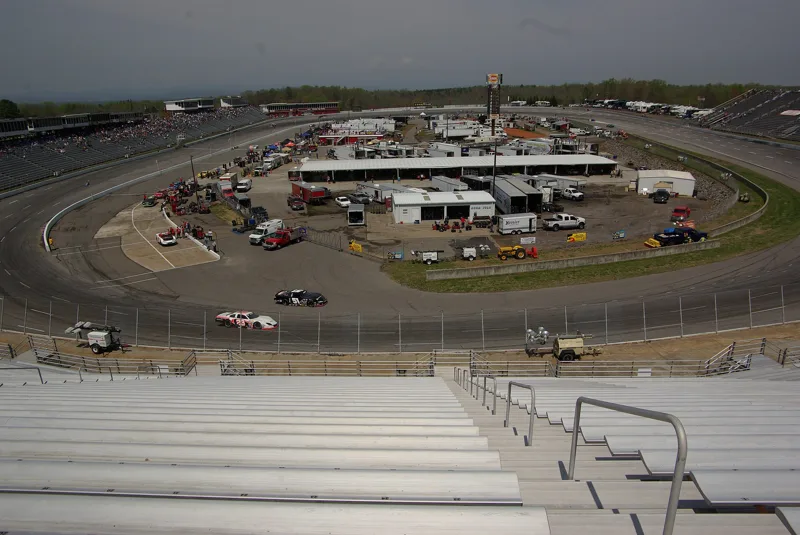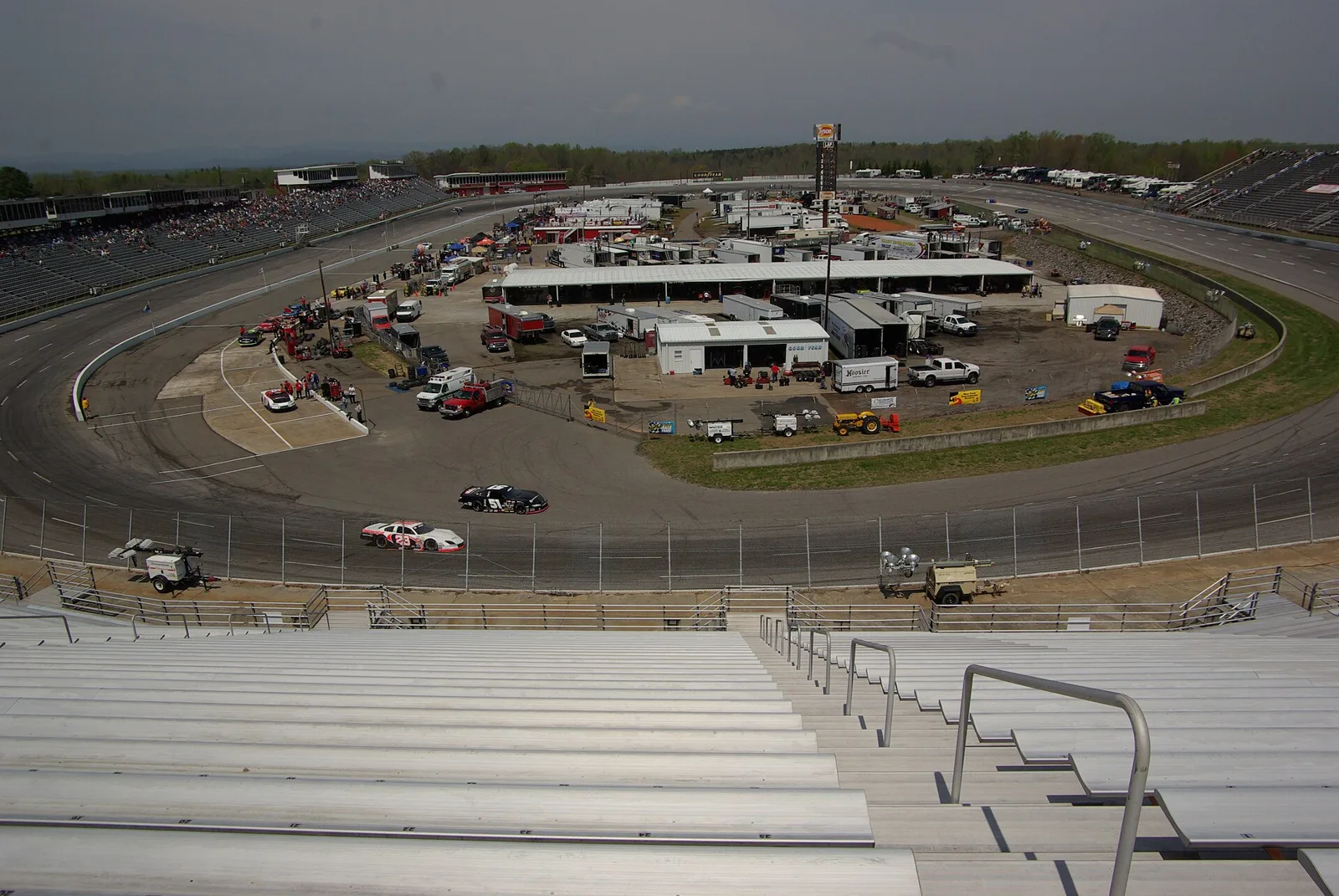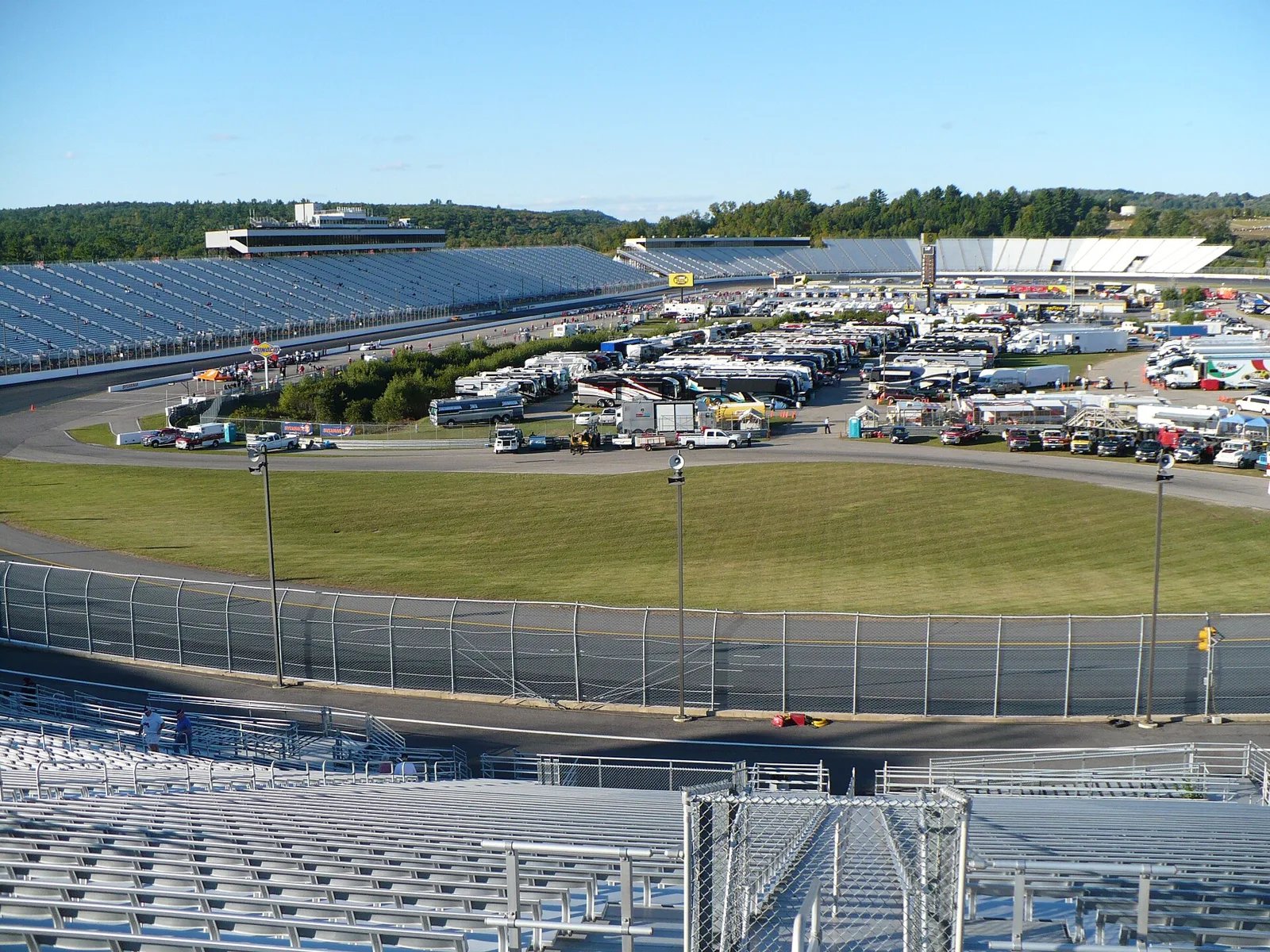
A Loudon track that began as a dirt oval, gained a Cup date under Bob Bahre and later cut its capacity by more than half.
Begun as a 1961 dirt track, the Loudon venue now runs a 1.058 mi (1.703 km) oval. It gained Cup Series racing under Bob Bahre and is owned by Speedway Motorsports, with a capacity of 44,000 as of 2024. The venue also has a 1.600 mi (2.575 km) road course used mainly for motorcycle racing.
New Hampshire Motor Speedway is a 1.058 mi (1.703 km) oval in Loudon, New Hampshire, with a history that runs from a small dirt track in 1961 to a major NASCAR venue. It has held Cup Series, IndyCar and motorcycle races and was owned by Speedway Motorsports, LLC from 2008. Its story includes ambitious expansion, a run of tragic crashes and a sharp decline in capacity.
Where is New Hampshire Motor Speedway and how long is it?
The venue sits in Loudon, New Hampshire, with access from New Hampshire Route 106. The oval is measured at 1.058 mi (1.703 km), with progressive banking of 2 to 7 degrees in the turns and one degree on the straights. The venue also has a 12-turn road course of 1.600 mi (2.575 km), mostly used by motorcycles.
A dirt oval from 1961 that became a Cup venue, then shrank by more than half in its later years.
How did the track start as a dirt oval?
Keith Bryar opened 106 Midway Raceway in 1961, named after its location beside New Hampshire Route 106. The original dirt oval measured 0.250 mi (0.402 km), and it was described by the Concord Monitor as a surface of cement-hard clay that turned slick when wet.
In 1964 Bryar began negotiations to build a road course that would host the Laconia Classic motorcycle race. The 10-turn, 1.600 mi road course, named Bryar Motorsports Park, was completed by June 1965, and the first race was held on June 17 that year.
When did Bob Bahre buy the track?
Maine businessman Bob Bahre bought the venue from Bryar in December 1988 for $950,000, after the Loudon Planning Board approved plans to lengthen the inner oval to 1.000 mi (1.609 km) and expand seating to 55,000. Bahre wanted both NASCAR Cup and CART races, and he set about winning them.
The project faced opposition from environmental groups and a lawsuit from Concerned Racetrack Neighbors. A settlement was reached in May, and the complex was renamed New Hampshire International Speedway (NHIS). The construction cost was about $25 million by the end of the build. Bahre later said he had not known the true cost, because his son kept asking him for another million.
How quickly did the track win major races?
The oval opened with a Busch Series race in July 1990, won by Tommy Ellis. The next year CART scheduled a race for 1992, and Bobby Rahal won the event on July 5. In October 1992 the track announced a Cup Series race for 1993.
The first Cup race was held on July 11, 1993, and Rusty Wallace won the event. In 1996 Bahre bought a half interest in North Wilkesboro Speedway, which gave NHIS one of that track's two Cup dates from 1997 onwards.
What safety changes followed the 2000 deaths?
In May 2000 Busch Series driver Adam Petty died after his car's throttle stuck in the third turn, and two months later Cup driver Kenny Irwin Jr died in almost the same way. The sharp radius and flat banking of that turn drew criticism, so the track was smoothed and sealed the following year.
The 2002 repave made the turns 12 feet (3.7 m) wider and reduced the banking from 12 degrees to 6-7 degrees. SAFER barriers were installed in 2003, after a surface that had drawn heavy backlash from drivers was repaved again in time for that year's race.
How did SMI change the track?
In July 2006 Bahre said he was not seeking a sale, though he allowed that one might happen someday. By 2007 he had talked with eight groups about a deal, and on November 1 the Globe reported that Speedway Motorsports, Inc. and Bruton Smith had bought the venue for $340 million.
The sale was finalised on January 11, 2008, and the track was renamed New Hampshire Motor Speedway, with Jerry Gappens as general manager. A $4 million infield project in 2009 removed wetlands and trees to create more space.
Why did New Hampshire's seating shrink?
Capacity had grown steadily under Bahre, to 80,000 by July 1997 and 91,000 after an expansion finished in 2001. Attendance then fell, and SMI reduced seating in stages. In 2018 capacity was cut to 74,000, and three years later it was cut again to 44,000.
The changes reflected weaker demand for the Cup weekend. The current Cup race is the Dollar Tree 301, and a NASCAR Truck Series race, the Team EJP 175, is run as a support event.
What were the leadership changes at the track?
The track had several leaders over the years. Jerry Gappens was general manager after the 2008 purchase, and he resigned as president in October 2015. Vice president of corporate sales David McGrath replaced him, and McGrath is the current general manager.
Which races and motorcycle events have been held?
New Hampshire has hosted several classes of racing. The Loudon Classic, a motorcycle competition, has been held there since 1965, and AMA Superbike races ran during the event until 2001. From 1966 to 1972 the then-named Bryar Motorsports Park also ran Trans-Am Series races.
An annual Indy car race ran at the track from 1992, initially under CART, and moved to the Indy Racing League in 1996. It was taken off the IRL schedule after the 1998 season because of poor attendance. IndyCar made a one-off return in 2011, but it did not renew the race.
How fast is the track's lap record?
The fastest lap on record at the venue is 0:21.466 seconds, posted by Andre Ribeiro's Reynard 95I during qualifying for the 1995 New England 200. Lap records are listed by series in the track's official records, and the table below sets out the main figures for the venue's racing history.
| Item | Detail | Year |
|---|---|---|
| All-time outright record | 0:21.466 seconds, Andre Ribeiro, Reynard 95I | 1995 |
| First Cup Series race | Rusty Wallace won | 1993 |
| Loudon Classic motorcycle race | Held annually since 1965 | 1965 onward |
| First CART Indy car race | Bobby Rahal won the event | 1992 |
| Bob Bahre purchase | $950,000 from Keith Bryar | 1988 |
What non-racing events are held there?
The venue has held a drive-through Christmas lights show since 2011, featuring more than 3.5 million LED lights according to WMUR. The speedway has also sought to host standalone concerts, which a 1989 decision had banned. The lights display is a winter feature of the complex, running alongside the racing calendar.
The festival was challenged by three Merrimack County residents, who argued that a 1989 decision still applied. The New Hampshire Supreme Court ruled in favour of the speedway in February 2019, and the festival was delayed to 2020 before COVID-19 caused a further postponement.
What was the road course like when it opened?
The road course opened on June 15, 1990, in time for that year's Loudon Classic weekend. It was the first road course built under Bahre's ownership. Motorcycle racers found it too dangerous because it lacked adequate run-off areas, and the criticism was consistent from the start.
The first fatality at the facility came in October 1992, when Fred Clarke spun during a go-kart race at nearly 80 mph. The road course has continued to host motorcycle racing, and it combines parts of the oval with specialised road sections outside it.
How did the wetlands and infield projects shape the facilities?
The track won approval in 1994 to remove 8 acres (3.2 ha) of wetlands from the infield. The land made room for two 52-car garages, a modernised media centre and a daycare centre, and 6,000 more grandstand seats were added to the venue at the same time.
The 2009 infield project, costing $4 million, removed more wetlands and trees to create still more space.
What racing took place before NASCAR arrived?
Between 1966 and 1972 the Bryar-era venue hosted Trans-Am Series races. The series then left the venue off its schedule, and Bryar had already admitted that the races made just barely enough to cover expenses. That year Bryar also ran a one-off IMSA GT Championship race.
Motorcycle racing was the constant. The Loudon Classic, first held in 1965, became the complex's most successful and most profitable event once roadside camping was banned, and AMA Superbike Championship races ran during the event until 2001.
How did the speedway expand through the 1990s?
The 1990s brought a series of seating additions. Track officials repaved the venue in the winter of 1994, and 4,000 more seats were added with the new surface. Bahre's purchase of a half interest in North Wilkesboro Speedway in 1996 then brought a share of that track's Cup schedule to Loudon from 1997.
To meet the new demand, Bahre planned a 4,000-seat grandstand that lifted capacity to 76,000, and by July 1997 it had reached 80,000 according to the Globe. A further 13,000-seat expansion was planned for 1998, but after 4,000 seats were added, residents of Canterbury appealed the approval, and work paused.
The Loudon Planning Board eventually approved the rest of the expansion, after a study found it would not raise noise in surrounding towns. The work was completed by 2001 after a lawsuit delayed it further, raising capacity to 91,000.
How did the track's name change over time?
The earliest name, 106 Midway Raceway, dates from the venue's 1961 opening to the public. Keith Bryar's later venture was called Bryar Motorsports Park, which hosted the road course and its motorcycle programme from the mid-1960s.
After Bob Bahre bought the venue in 1988, it became New Hampshire International Speedway, a name it kept until 2008. The current name has been in use since the Speedway Motorsports era began, and each rename followed a change in ownership or a new phase of development.