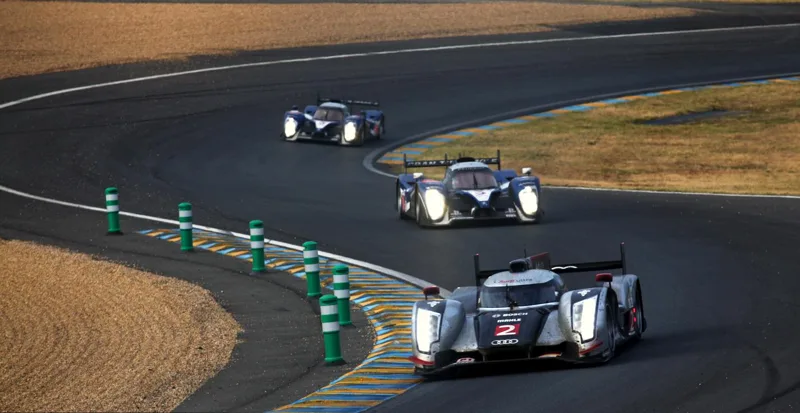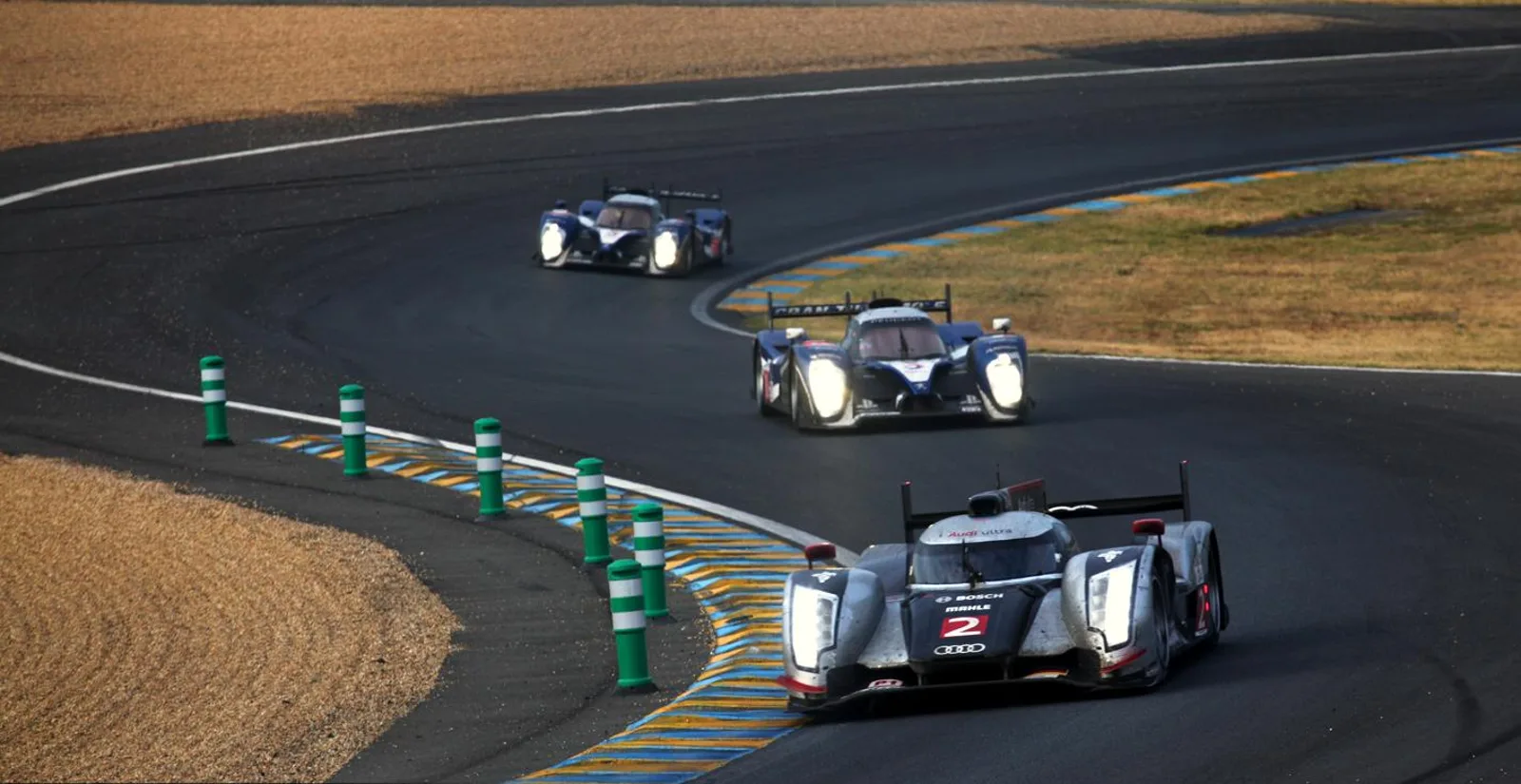
Audi's R15 TDI plus No. 9 covered 397 laps to win, completing a podium sweep, after Peugeot took pole and led for much of the race.
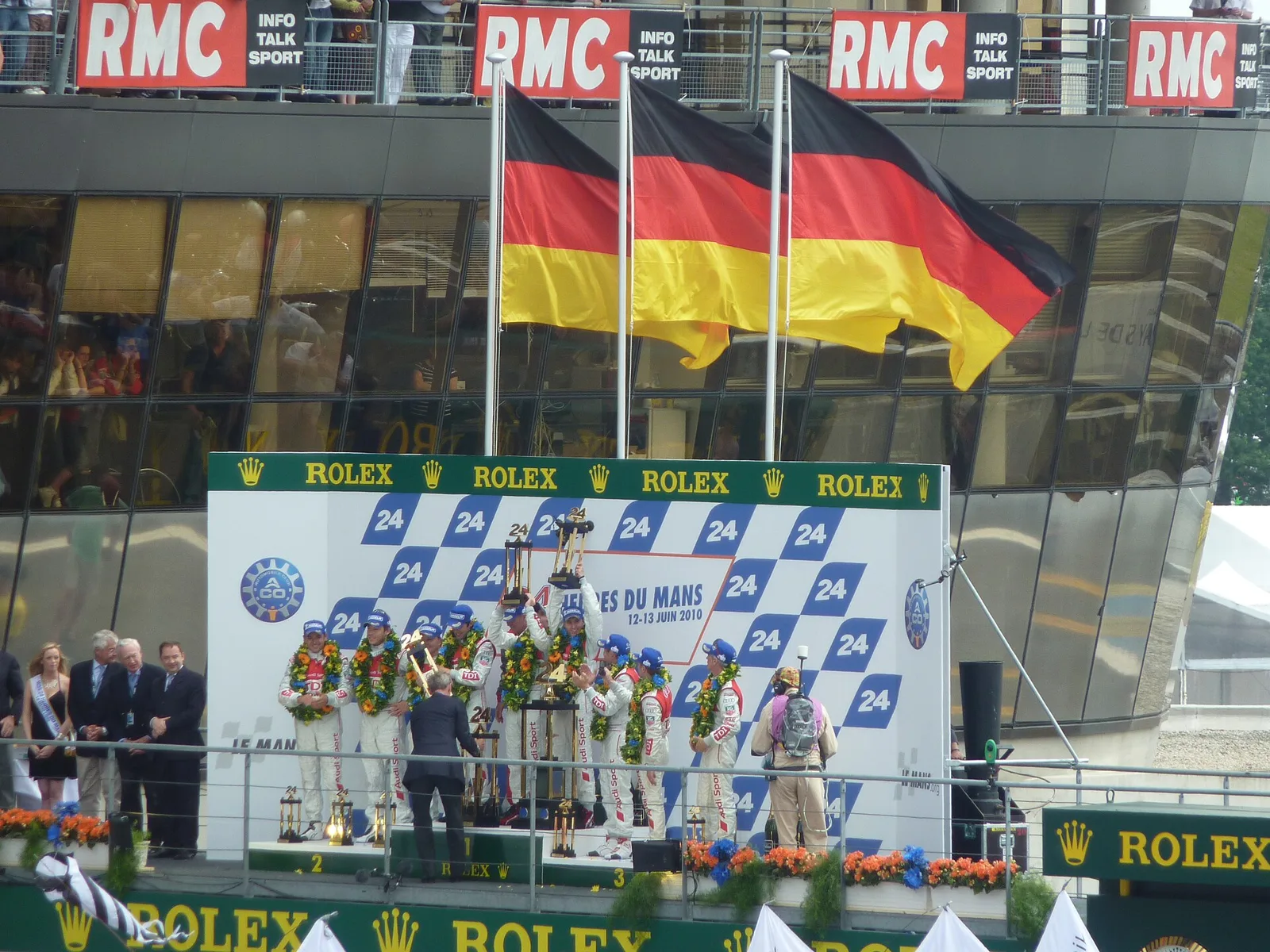
The 2010 race went to an Audi, number 9, crewed by Bernhard, Dumas and Rockenfeller. The car completed 397 laps, and the other two Audi entries took the remaining podium places in a sweep that was Audi's fourth at Le Mans.
The 2010 24 Hours of Le Mans was the 78th running of the race, held at the Circuit de la Sarthe near Le Mans on 12-13 June 2010. Audi's R15 TDI plus No. 9 won after 397 laps, and two more Audis completed a podium sweep, even though Peugeot had taken pole and led for much of the race.
When and where was the 2010 24 Hours of Le Mans held?
Running over the 12th and 13th of June 2010, the event used the Circuit de la Sarthe, a 13.629 km (8.469 mi) road course near Le Mans in France. The start was at 15:00 local time on 12 June, and 238,150 spectators watched the event, which the Automobile Club de l'Ouest (ACO) organised as a non-championship race.
The event traces back to 1923, when Charles Faroux, Georges Durand and Emile Coquile agreed to test vehicle reliability and durability. It is widely regarded as the most prestigious sports car race in the world and forms part of the Triple Crown of Motorsport.
Audi's R15 TDI plus No. 9 covered 397 laps and completed a podium sweep, after Peugeot had taken pole and led for much of the race.
What rule changes applied to the 2010 race?
The ACO's 2009 changes allowed cars eligible for the FIA GT1 World Championship to enter if they were running in an ACO-run series. The race also added a third safety car for accidents, mandated illuminated number panels for night running and introduced new tyre switching rules, while an August 2009 rewrite aimed to level diesel and petrol cars.
Pit stops became longer because of the tyre switching rules, which were designed to stop open-cockpit cars gaining an advantage. The technical rules resized several restrictors to narrow the gap between the two fuel types.
Diesel LMP1 cars also gained 30 kg (66 lb) of ballast compared with petrol cars, taking their minimum weight to 930 kg (2,050 lb). No other class had its minimum weight changed, so the adjustment was targeted at the top prototype category alone.
How was the 2010 entry list assembled?
The ACO received 84 entry requests between 21 December 2009 and 20 January 2010, and it gave priority to manufacturers and full-time teams in Le Mans-based championships. It first planned 55 entries across four categories, but extra pit space allowed 56 cars.
Automatic entries went to class winners at the 2009 race and to champions in other Le Mans-based series and events, including the LMS, ALMS, ASLMS, FIA GT Championship and Petit Le Mans. Automatic entrants were limited to two cars and could not change car or class from one year to the next. On 19 November 2009 the ACO published a final list of 29 teams, but five invited teams turned their places down.
The full list of 55 cars and ten reserves was announced on 4 February 2010. Dome withdrew its S102 LMP1 coupe on 5 April after its partnership with OAK Racing ended. PK Carsport pulled its Corvette C6.R after a fire at Silverstone, and AF Corse filled the gap with a second Ferrari F430 GT2. Pescarolo Sport withdrew amid failed investment talks, which marked its first non-entry at Le Mans since 2000.
Felbermayr-Proton gained a second Porsche 911 GT3 RSR after Modena Racing Group did not confirm its Ferrari F430 GT2 entry, and Pegasus Racing Norma moved up from the reserve list. In June the ACO confirmed that the first reserve, a Race Performance Radical SR9-Judd, would take the 56th place to keep the balance between prototype and GT entries.
How did practice and the warm-up go?
All teams had one four-hour free practice session on 9 June, and Peugeot led from the start, with Franck Montagny's No. 2 car fastest at 3:20.034. A 45-minute warm-up on the morning of 12 June ran on intermediate tyres because of overnight rain, and McNish's No. 7 Audi set the quickest time at 3:51.401.
Sebastien Bourdais' No. 3 Peugeot was second quickest in practice, and Loic Duval's No. 4 Oreca Peugeot was third. Gene's No. 1 Peugeot was fourth, and McNish's Audi was the fastest of the Audis in fifth. Darren Turner's No. 009 Lola-Aston Martin was the quickest petrol-powered LMP1 car, in eighth.
David Brabham was fastest in LMP2 at 3:38.691 despite a fuel system problem. Romain Grosjean damaged the rear of a Matech Ford against the barriers at the Porsche Curves, which stopped running for thirty minutes. Frey, his team-mate, lost control of a sister Ford in the same corners, and both cars were repaired in time for qualifying.
Who took pole and how did qualifying go?
Sebastien Bourdais took pole for Peugeot in the No. 3 908 HDi FAP, with a best lap of 3:19.711 set in the final half hour of the first of three two-hour sessions. It was Peugeot's fourth successive pole at Le Mans, and the Audis finished 2.2 seconds behind the four Peugeots.
The first session began late on 9 June in dry, cool conditions. Nicolas Lapierre set 3:21.192 in the No. 4 Oreca Peugeot before a fuel pick-up problem stopped him at Arnage. Bourdais then took the lead on the timing sheets. His best in the final session was 3:20.212, which did not beat his pole time.
The second session was held on a track that had been damp after earlier rain but dried as the session progressed. Wurz led it with 3:23.238, and the sister Peugeots of Sarrazin and Pagenaud were second and third. Matias Russo's AF Corse Ferrari crashed, and the car was withdrawn because it was badly damaged and spare parts were short.
Class poles went to Danny Watts in the Strakka HPD, at 3:33.079 in LMP2, and to Tomas Enge's Young Driver AMR Aston Martin in LMGT1, his sixth class pole in eight years. The LMGT2 pole initially belonged to the Risi Competizione Ferrari until scrutineers found its rear gurney flap 2 mm (0.079 in) too low, which sent it to the back and handed pole to Olivier Beretta's No. 64 Corvette.
How did the race unfold?
Peugeot led early and through the night, but a run of mechanical failures opened the door for Audi. The race began at 15:00 on 12 June, and the lead changed hands when Montagny's No. 2 Peugeot was abandoned with a connecting rod failure, leaving Bernhard's No. 9 Audi to hold it for the final 133 laps.
Nigel Mansell crashed the Beechdean Ginetta at high speed between the Mulsanne and Indianapolis corners after about 18 minutes. A slow left-rear puncture had gone unnoticed because telemetry did not cover that stretch of track. Safety cars ran for 31 minutes while the barriers were repaired, and Mansell was taken to hospital. The field was then split, leaving the three factory Peugeots 57 seconds ahead of the Audis.
Several cars fell early. Peugeot No. 3 retired in the third hour after its front-right suspension mounting pulled out of the chassis, and the No. 1 Peugeot led with Anthony Davidson, Marc Gene and Alexander Wurz until a failed alternator sent it to the garage. The No. 2 Peugeot of Nicolas Minassian, Franck Montagny and Stephane Sarrazin then led 144 laps, while Dirk Muller's BMW was damaged by kerbstones after a right-rear puncture.
The evening brought more trouble. Kristensen's No. 7 Audi spun after closing on a slow Priaulx BMW that had a puncture, and the pit stop to replace its rear bodywork cost three laps and dropped the car to seventh. Dumas' No. 9 Audi struck a television camera operator working for Speed during a pit stop, and the operator suffered a broken shoulder and a gashed leg. Bryce Miller then crashed the JMW Aston Martin at the Porsche Curves, bringing out the safety cars for the second time.
Just before half distance Sarrazin's No. 2 Peugeot led, followed by Dumas' No. 9 Audi and Lotterer in the No. 8 Audi. Minassian took over the leading Peugeot and extended its advantage after a right-rear tyre went down on the out-lap and an airjack leaked during a routine stop. Later Yvon's OAK Pescarolo was damaged against the barriers at the Ford Chicane, which brought the third safety car period, lasting nine minutes.
Early in the morning, Montagny's No. 2 Peugeot suffered a connecting rod failure, with smoke and fire at Tertre Rouge. It was abandoned on the Mulsanne Straight, and the lead passed to Bernhard's No. 9 Audi. Davidson then collided with Collard's Corvette while lapping it, which badly damaged the Corvette and required a fourth safety car period of nine minutes.
Wurz's Peugeot retired later with another connecting rod failure, and Duval's Oreca was lost in a major oil fire at Indianapolis corner. At the finish, the No. 9 Audi had covered 397 laps, the No. 8 Audi was one lap behind, and the No. 7 Audi was two laps further back. The result completed an Audi podium sweep, the fourth at Le Mans.
Who won the 2010 24 Hours of Le Mans?
Audi's R15 TDI plus No. 9, driven by Timo Bernhard, Romain Dumas and Mike Rockenfeller, won the 2010 race after 397 laps and 5,410.713 km (3,362.061 mi). It was the crew's first Le Mans victory and Audi's ninth overall win since 2000.
The record distance reflected reliability, which the winning crew stressed afterwards. Dumas said the car kept running without mistakes, while Rockenfeller thanked Audi, the Joest team and the crew. Bernhard said the three drivers had talked about what it would feel like to stand on the podium, and that it came true a few days later.
What were the class results?
Audi filled the top three overall places, Strakka won LMP2, Larbre Competition won LMGT1 and Felbermayr-Proton won LMGT2. The table lists the winner and the next two finishers in each category, with the laps or margin shown for each winner.
| Category | Winner | Second | Third |
|---|---|---|---|
| Overall | Audi R15 TDI plus No. 9 (Bernhard, Dumas, Rockenfeller), 397 laps | Audi R15 TDI No. 8 (Fassler, Lotterer, Treluyer), one lap behind | Audi R15 TDI No. 7 (Capello, Kristensen, McNish), two laps behind |
| LMP2 | Strakka HPD ARX-01C No. 42 (Kane, Leventis, Watts), six laps ahead | OAK Pescarolo 01-Judd (Charouz, Lahaye, Moreau) | RML Lola No. 25, nine laps down |
| LMGT1 | Larbre Competition Saleen S7-R No. 50 (Berville, Canal, Gardel) | Luc Alphand Aventures Corvette C6.R No. 72 (Hart, Gregoire, Policand) | Young Driver AMR Aston Martin DBR9 No. 52 (Enge, Kox, Nygaard) |
| LMGT2 | Felbermayr-Proton Porsche 997 GT3-RSR No. 77 (Henzler, Lieb, Lietz) | Team Farnbacher Ferrari F430 GT2 (Farnbacher, Keen, Simonsen), two laps behind | BMS Scuderia Italia Porsche 997 GT3-RSR (Holzer, Scheider, Westbrook) |
In LMP2, Strakka's HPD led the final 267 laps and finished six laps ahead of the OAK Pescarolo, with the RML Lola nine laps down in third. In LMGT1, Larbre Competition held a four-lap lead at the finish, which gave the team its fifth class victory at Le Mans. In LMGT2, the Felbermayr-Proton Porsche took the lead after the No. 64 Corvette retired, and Lieb and Lietz won their second category wins while Henzler took his first.
How did the drivers and teams react?
The winning crew credited reliability. Tom Kristensen said he forgave Andy Priaulx after their collision, while Peugeot's Simon Pagenaud said the team would return to win in 2011. Strakka's Piers Phillips called the LMP2 win a platform for the future.
Priaulx admitted he had been a contributing factor and said he felt responsible, while Kristensen said he had not expected a BMW carrying three professional drivers to change its line in front of him. Peugeot's Anthony Davidson said he was inspired by the chance of winning, and Audi chairman Rupert Stadler praised Peugeot as a formidable rival that had forced Audi to give everything.
Audi technical director Ralf Juettner said reliability had not been a factor for the winning car, and that the result came down to who was fastest. Larbre's Julien Canal admitted the team did not expect to win LMGT1, and owner Jack Leconte said the win as a privateer felt special after the team had previously received manufacturer support.