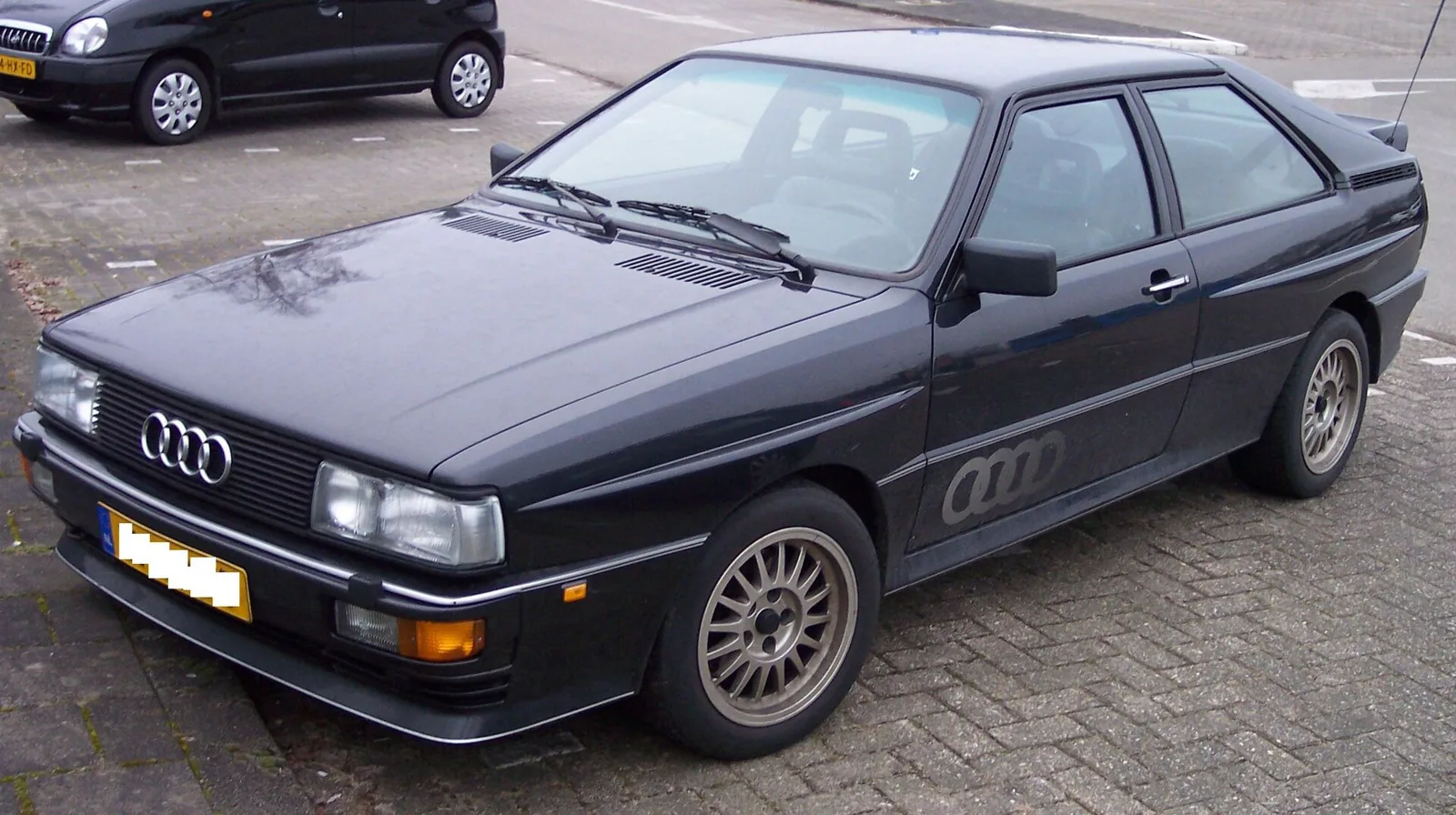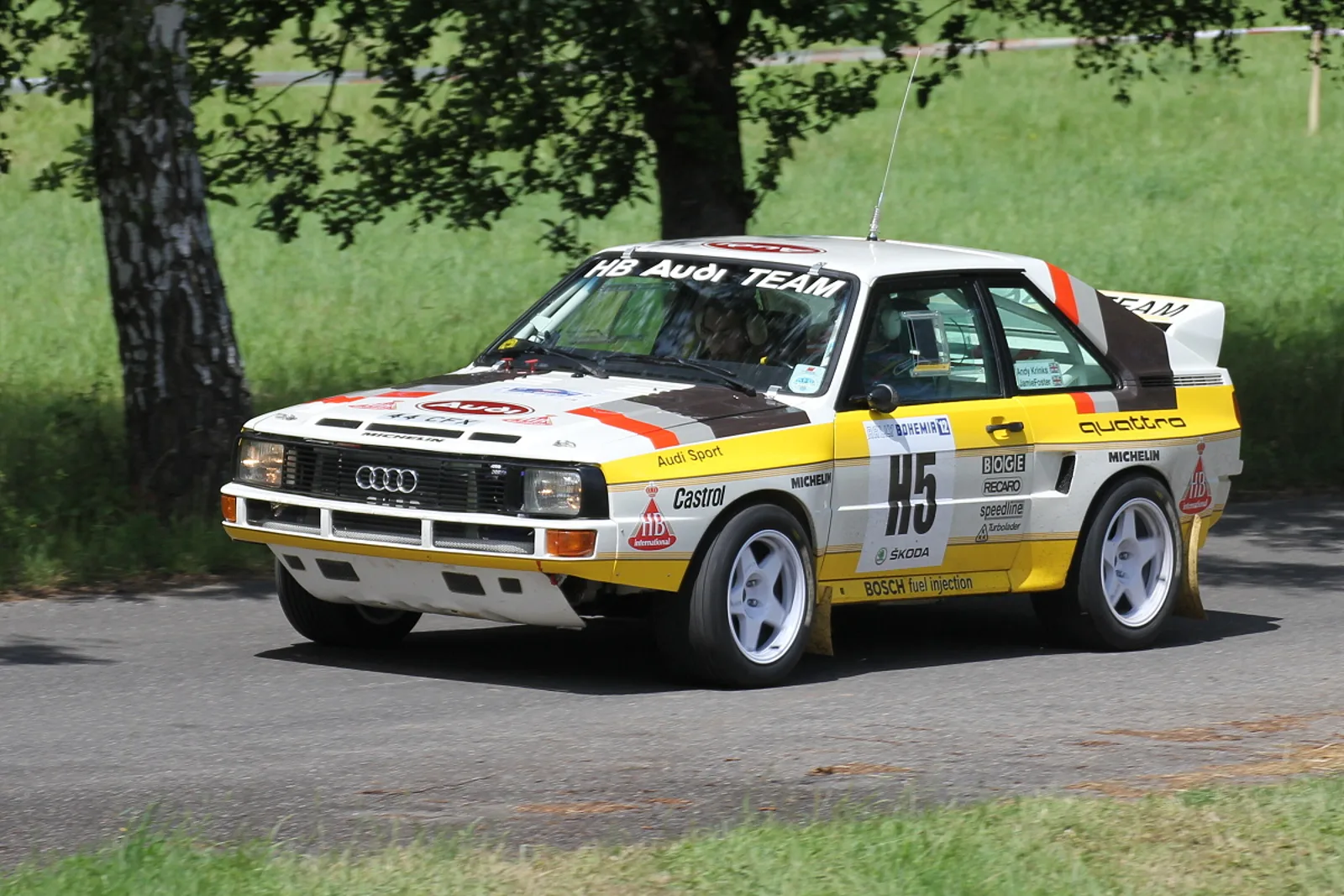
From the 1980 Quattro and its turbo five-cylinder engine to the S1 E2 homologation special, the four-wheel-drive family that reshaped rallying.
The Audi Sport quattro traces back to the 1980 Quattro, a turbocharged four-wheel-drive rally car from Audi that won consecutive competitions. Its origins lie in the 1977 proposal by Jorg Bensinger, and the family was produced until 1991.
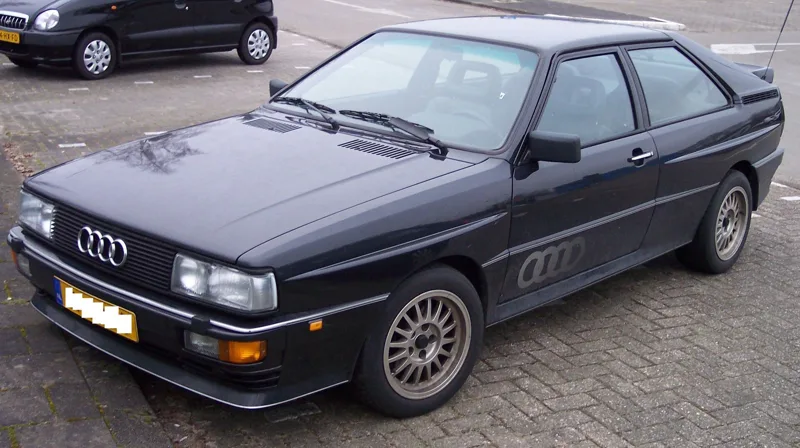
The Audi Sport quattro grew out of the Quattro, a road and rally car that Audi first showed at the Geneva Motor Show in March 1980. Its four-wheel drive and turbocharged five-cylinder engine won rallies, and the Sport quattro S1 and S1 E2 carried that story into the final years of Group B.
What was the Audi quattro?
The Audi Quattro was a road and rally car from Audi, part of the Volkswagen Group. It was first shown in 1980 and built until 1991, and its name reflects power being sent to all four wheels. The name later described the four-wheel-drive system itself and its variants across Audi's range.
The model name quattro comes from the Italian word for four. The original car is commonly called the Ur-Quattro, where Ur is German for primordial or original, and over time the name came to describe the system itself and any Audi fitted with it.
The idea came from Audi engineer Jorg Bensinger, who proposed a high-performance four-wheel-drive car in 1977. He had seen the Volkswagen Iltis military vehicle outperform others in snow tests.
Walter Treser, who ran pre-development at Audi, worked with the team on an Audi 80-based variant.
A four-wheel-drive turbo rally car that won consecutive titles and then became the basis of Audi's Group B homologation specials.
Why was the Quattro important in rallying?
The Quattro was the first rally car to use four-wheel drive under rule changes that had recently allowed it in competition. It won consecutive competitions over the next two years, and Audi later badged every four-wheel-drive production car with a lower-case quattro.
The Quattro shared many parts and its platform with the Coupe version of the Audi 80, and its flared wheel arches were styled by Martin Smith. Its independent front and rear suspension was part of the package.
How was the Quattro built and engineered?
Internally the car was known as Typ 85, the same production code used for the Coupe's quattro versions. It was partially hand-built on a dedicated line, and its independent suspension sat at both ends. The platform was shared, which linked the Quattro to a more familiar Audi model.
The original engine was a 2,144 cc (2.1 L) turbocharged inline five with a 10-valve SOHC layout, rated at 147 kW (200 PS; 197 hp). Torque reached 285 N m (210 lbf ft) at 3,500 rpm.
The car's 0-100 km/h (62 mph) time was 7.1 seconds, and its top speed was over 220 km/h (137 mph). Those figures made the Quattro a fast road car as well as a competitive rally car.
For rallying, the engine was reduced to 2133 cc, with 79.3 mm bores and 86.4 mm strokes, to fit the 3-litre class under the 1.4 multiplier for turbo engines. Rally versions made 306 PS (302 hp; 225 kW), peaking at 6,700 rpm, with 258 lbf ft (350 N m) of torque at 3,700 rpm.
By 1989 the engine had grown to 2,226 cc with 20 valves and DOHC heads, rated at 162 kW (220 PS; 217 hp), and top speed rose to 230 km/h (143 mph).
What changed during the production run?
The Quattro changed little on the outside. Its four headlamp lenses gave way to combined units in 1983, and the 1985 facelift brought a sloping grille and new headlights. The interior changed more, from an analogue cluster to a green LCD in 1983.
The 1984 facelift also moved the wheels up from 6x15-inch to 8x15-inch, and the suspension dropped 20 mm, with stiffer springs. The Torsen centre differential arrived in 1987, replacing the manual centre differential lock.
Production totalled 11,452 units from 1980 to 1991. The last car came off the line on 17 May 1991, after the 8B Coupe range had been on sale for two years.
What did the Quattro look like in North America?
Sales in the US and Canada began in the 1983 model year, entering a market that the AMC Eagle had opened. North American cars were built to the same design as the previous European model year, with larger impact bumpers and no ABS, and US sales totalled 664 units.
Canadian sales reached 99 cars, spread across 1983 to 1986, with the peak year being 1983 at 61. Canadian cars were identical to the US version except for a metric speedometer.
The US and Canadian engine was the 2.1-litre WX unit, with lower boost pressure, a different camshaft and catalytic control, rated at 160 hp (119 kW; 162 PS). A 1988 run of 200 special-edition cars used the WX engine with an analog dial cluster.
How did the press judge the Quattro?
Autocar road tested a left-hand-drive Quattro in May 1981, one of the first magazines to do so. Its road test editor raved about the car's traction and acceleration on wet and slippery surfaces, and felt that only the 911 could keep up in such conditions.
The 60/40 front/rear weight split could make the Quattro tricky in extremis, yet the magazine concluded that it was a vastly satisfying car to drive once its ways were learned. The price in 1981 was GBP 14,500, which the test judged very good value next to rivals costing about GBP 5000 more.
What was the quattro Spyder concept?
The quattro Spyder was a mid-engined concept coupe with a 2.8-litre V6 taken from the Audi 100, rated at 174 PS (128 kW; 172 hp). Audi unveiled it at the 1991 Frankfurt Motor Show as a rolling test bed for a future mid-engined sports car.
It had a 5-speed manual, a modified quattro four-wheel-drive system, aluminium panels on a tubular steel space frame, and a weight of 1,100 kg (2,425 lb). The car was production-ready, but Audi shelved it because demand would not outweigh development costs in the 1990s downturn.
What was the 2010 quattro concept?
Audi showed the quattro concept at the 2010 Paris Motor Show to mark 30 years since the original Audi Quattro. Based on the RS5, it used a modified 2.5-litre five-cylinder TFSI engine shared with the TT, producing 408 PS (300 kW; 402 hp).
Aluminium and carbon fibre kept the concept at 1,300 kg (2,866 lb) dry, and even the seats, at 18 kg (40 lb) apiece, were kept light. Its wheelbase was shorter than the RS5, and its roofline was 30 mm shorter.
The rear-biased four-wheel-drive system used a two-stage differential, and Audi claimed 3.8 seconds from 0 to 97 km/h (0 to 60 mph). A limited run of 200 to 500 cars was considered, but the plan was scrapped in favour of expanding the crossover range.
What was the 2013 Sport quattro concept?
Audi revealed the Audi Sport quattro concept at the 2013 Frankfurt show, marking 30 years since the original car. It was a show car rather than a production model. Its styling included angular C-pillars and Matrix LED headlights, with 21-inch wheels, ceramic-carbon brakes and bucket seats.
Under the bonnet sat a 4.0 TFSI V8 making 552 hp (412 kW; 560 PS), alongside a disc-shaped electric motor of 150 PS. Combined output reached 700 PS (515 kW; 690 hp) with 800 N m (590 lb ft) of torque, and power went through an eight-speed tiptronic.
A 14.1 kWh battery sat at the rear, with an electric range of up to 50 km (31 mi). At the 2014 Geneva Motor Show, the TT Quattro Sport concept followed with a 2.0-litre TFSI producing 420 PS (309 kW; 414 hp).
How did the Quattro compete in rallying?
The competition Quattro made its first appearance in 1980 as a development car on the Rali Urbibel Algarve, then ran formally at the 1981 Janner Rallye in Austria. Its engine made about 304 PS (224 kW; 300 hp), and in 1981 Michele Mouton became the first woman to win a world championship rally.
Over the next three years Audi introduced the A1 and A2 evolutions for the new Group B rules, lifting the turbo five to roughly 355 PS (261 kW; 350 hp). The A1 made its debut at the 1983 Monte Carlo Rally, and Hannu Mikkola later took it to Swedish and Portuguese wins.
Across 1983 and 1984 the A2 evolution took eight world rally wins, with three in the first year and five in the second. In South Africa, two examples of the car ruled the national rally championship from 1984 to 1988.
In 1988 the Ur-Quattro took a classic-event win, with Luciano Viaro at the wheel, at the 13th Silvretta Classic Montafon.
What was the Sport quattro S1?
The Sport quattro S1 was built to homologate the car for Group B rallying in 1984, and only a small run went on sale to the public. The all-aluminium inline five had DOHC heads with four valves per cylinder, Bosch LH Jetronic injection and a KKK K27 turbocharger.
On the road the engine was rated at 302 hp (306 PS; 225 kW), with 258 lb ft of torque at 3,700 rpm. Competition engines started out near 331 kW (450 PS; 444 hp).
The competition car had a carbon-kevlar body shell, wider wheel arches and nine-inch wheels, plus a 320 mm (12.6 in) shorter wheelbase. In 1985 the car also took a record at the Pikes Peak hill climb, with Michele Mouton at the wheel.
The short-wheelbase version totalled 224 cars, offered for DM 203,850 each, and the car's place in Audi history rests on that small run.
How did the Sport quattro S1 E2 develop?
The S1 E2 appeared at the end of 1985 with a 2,110 cc inline five, a bore and stroke of 79.5 mm x 85.0 mm, and an officially quoted 480 PS (353 kW; 473 hp). Its turbo used a recirculating air system to keep spinning on the closed throttle, which cut lag on the next throttle press.
Real output was said to be above 500 PS, around 368 kW (493 hp), at 8,000 rpm. Aerodynamic wings and spoilers added downforce, and the weight came down to 1,090 kg (2,403 lb).
The S1 reached 100 km/h in 3.1 seconds. A few cars came with a power-shift gearbox that foreshadowed DSG. The S1 E2 debuted at the 1985 Rally Argentina with Stig Blomqvist.
Walter Rohrl and Christian Geistdorfer won the 1985 San Remo Rally, and Hannu Mikkola and Michele Mouton also drove a modified S1 E2. Factory cars in the last year of 1986 were quoted at 600 PS (441 kW; 592 hp).
Audi's works team withdrew from the championship after the 1986 Portugal rally, making the S1 E2 the final Group B car. In 1987 the car won the Pikes Peak hill climb, driven by Walter Rohrl.
What was the RS 002?
The Audi Sport Quattro RS 002 was a Group S prototype built for 1987 regulations, and it never raced. Walter Rohrl tested it, but the Group S rules were scrapped along with Group B after a run of fatal accidents in 1986.
The RS 002 used a longitudinal mid-engine layout with four-wheel drive. It weighed 1,000 kg (2,205 lb) with a 2,100 cc inline five making 700 PS (515 kW; 690 hp), and its top speed was listed at 300 km/h (186 mph).
The car measured 4,500 mm long, 1,900 mm wide and 1,020 mm high, figures that set it apart from the road-going Quattro.
How did the Quattro enter popular culture?
In the BBC drama Ashes to Ashes, DCI Gene Hunt drove a red 1983 car of this model, shown from 2008 to 2010. Two cars were used through the run of the series, and the stunt car was written off during the run.
In the run-up to the 2010 general election, a Labour poster placed David Cameron on a red Quattro with Gene Hunt's pose, and the Conservatives answered with a Quattro slogan of their own.
Audi Sport quattro specifications
| Specification | Detail |
|---|---|
| Production | 11,452 units, 1980 to 1991 |
| Original engine | 2,144 cc turbocharged inline five, 147 kW (200 PS; 197 hp) |
| Original torque | 285 N m (210 lbf ft) at 3,500 rpm |
| 0-100 km/h | 7.1 seconds, original Quattro |
| Rally engine | 2133 cc, 225 kW (306 PS; 302 hp) at 6,700 rpm |
| 1989 engine | 2,226 cc 20-valve DOHC, 162 kW (220 PS; 217 hp) |
| Top speed, 1989 | 230 km/h (143 mph) |
| US and Canadian sales | 664 US units; 99 Canadian units |
| Sport quattro S1 | 2,133 cc, 306 PS (302 hp; 225 kW), 350 N m at 3,700 rpm |
| S1 E2 | 2,110 cc, 480 PS (353 kW; 473 hp) officially, weight 1,090 kg (2,403 lb) |
| Short-wheelbase cars | 224 built, DM 203,850 each |
| RS 002 | 2,100 cc, 700 PS (515 kW; 690 hp), 1,000 kg (2,205 lb) |
| Spyder concept | 2.8-litre V6, 174 PS (128 kW; 172 hp), 1,100 kg (2,425 lb) |
| 2010 concept | 2.5-litre five-cylinder TFSI, 408 PS (300 kW; 402 hp), 1,300 kg (2,866 lb) dry |
| 2013 concept | 4.0 TFSI V8 with electric motor, 700 PS (515 kW; 690 hp) combined |