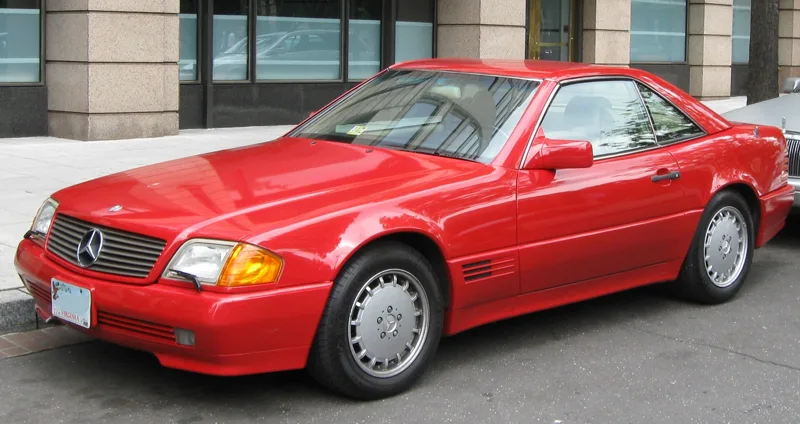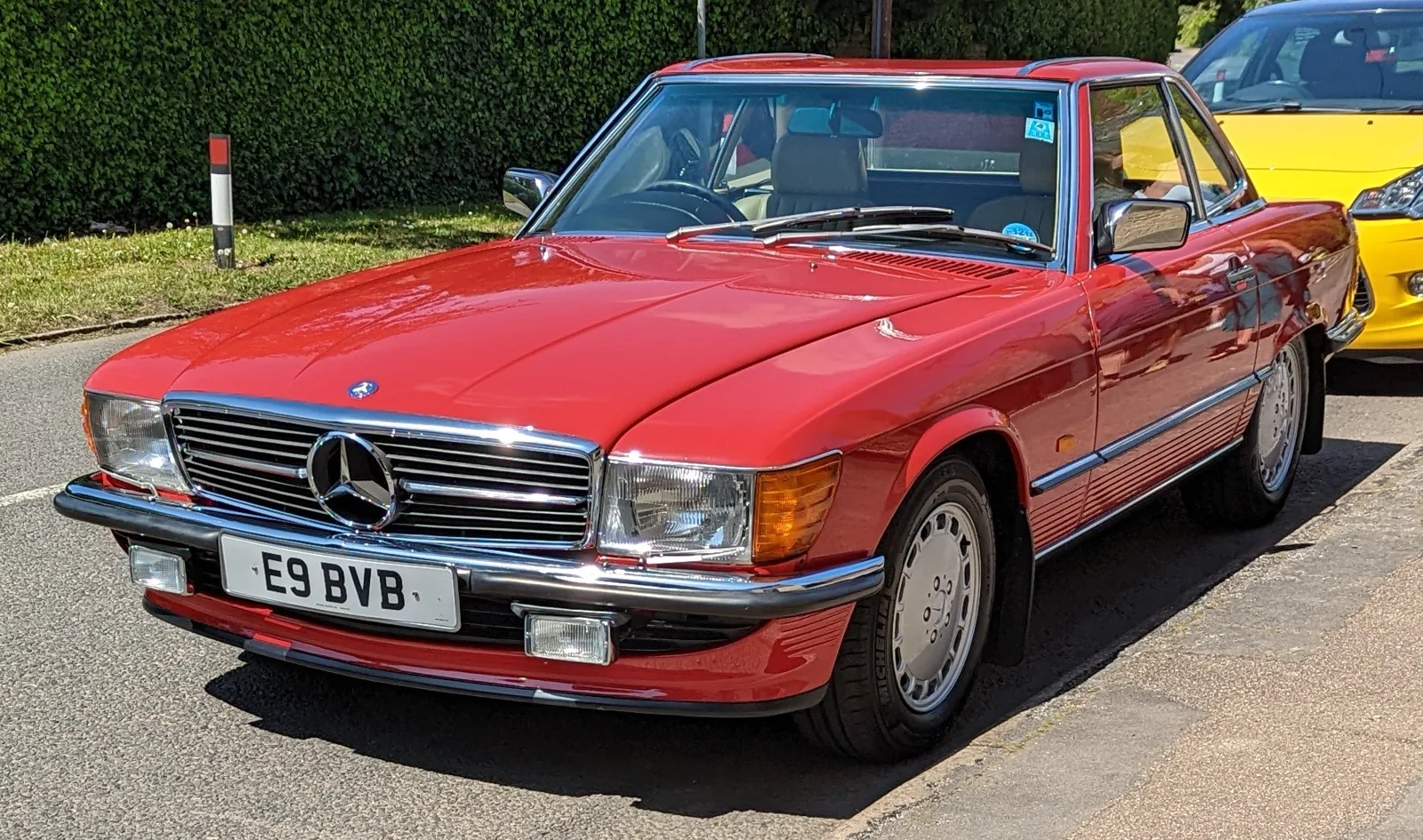
A two-seat SL roadster and a four-seat SLC coupe built on one stretched platform, with two thirds of output sold in North America.
The Mercedes-Benz R107 and C107 were the SL roadster and SLC coupe, built from 1971 to 1989. They shared a chassis and engines, and the 450SLC 5.0 and 500SL were the quickest versions. Two thirds of output went to North America.
Mercedes-Benz built the R107 and C107 from 1971 until 1989, an 18-year run that made the pair the second longest single series the company has produced after the G-Class. They shared a chassis and engines, yet they were different cars: the R107 roadster seated two under a soft top, while the C107 SLC carried four under a fixed roof. Two thirds of production went to North America, and American rules shaped their bumpers, headlights and tuning.
Where did the R107 and C107 come from?
The R107 and C107 used the chassis of the midsize 1968 W114 and paired it with the V8 engines of the W108, W109 and W111. The SL replaced the W113 roadster in 1971, and the SLC replaced the W111 coupe. Body styles barely changed before production ended.
The model names carried the engine size, so a 350SL, a 450SL and a 500SL each signalled a different V8. The SL offered a soft top as standard, with an optional winter hardtop. A small rear bench seat existed, but buyers rarely ordered it. The SLC's wheelbase was 36 cm (14.2 in) longer than the SL's, which gave the coupe normal-sized rear seats.
Built on a roadster's platform rather than a saloon's, the SLC was an unusual Mercedes-Benz coupe.
How did the SLC differ from the SL?
The SLC was a two-door hardtop; its roof did not come off, and a sliding steel sunroof was available. It was the only time Mercedes-Benz built an S-Class coupe on a stretched SL roadster platform. It took over from the saloon-based 280/300SE coupe, and Mercedes had no two-door W116 to fill that role.
The SLC kept its place in the range until November 1981, several years before production of the SL ended in 1989.
Which engines did the first cars use?
The first cars were the 350SL and 350SLC, with the 3.5-litre V8 in Europe. Volume production of the 350SL began in April 1971, with the 350SLC following in October. The rare early cars had Bosch electronic fuel injection, and some 1971 350SL cars had a four-speed fluid coupling automatic that reached 0-60 mph in 8 seconds.
The 280SL and 280SLC, with a fuel-injected 2.8-litre straight-six, arrived in July 1974. Bosch D Jetronic came first, and in December 1975 it gave way to the fully mechanical K Jetronic system. That change came with electronic breakerless ignition and hydraulic valve-lash compensation, and performance dropped slightly to meet tighter emission laws.
What made the 450SLC 5.0 special?
The 450SLC 5.0 arrived in September 1977 as a homologation car for the 1978 World Rally Championship. It used a new all-aluminium 5.0-litre V8 and an aluminium bonnet and boot lid. Those changes cut more than 100 kg, and top speed rose by about 10 km/h to around 225 km/h.
Spoilers set the 5.0 apart from the 4.5-litre car: a black rubber unit at the rear and a small lip at the front. Collectors seek out both the 5.0 and the 500SLC today.
How did the American market change the cars?
Roughly two thirds of all R107 and C107 cars went to North America, and that market drove most of the changes. American cars had four round sealed-beam headlights because of local rules. From 1974 the front and rear bumpers grew by 8 inches (203 mm) at each end to meet a 5 mph impact standard.
The predecessor W113 had already sold well in North America, with 19,440 of its 48,912 US units. The R107 and C107 pushed that further, and US emission regulations shaped their engines from the start. US cars gained lambda control from 1980, which adjusted the air-fuel mixture using an oxygen sensor.
The 350SL badge on early American cars hid a 4.5-litre V8 with a three-speed automatic, and those cars became 450SL for 1973. Emission rules pushed power down over the years, from 192 hp (143 kW) at 4750 rpm at the start to 162 hp (121 kW) at 4200 rpm later on. The protruding bumpers stayed on North American models even after the rule was reconsidered in 1981.
How quick were the later V8 roadsters?
The 380SL, the least powerful US roadster, ran 0-60 mph in 9.3 seconds and reached 205 km/h (127 mph). The 500SL, with a 5.0-litre V8 that was not sold new in America, managed 0-60 mph in 7.4 seconds and 225 km/h (140 mph), making it the fastest production R107.
American buyers who wanted the 500SL imported European cars through the grey market, where they were converted to meet federal rules. Congress closed that route in 1988. From 1986 to 1989 Mercedes-Benz sold a factory 5.6-litre 560SL in the US, Europe, Japan and Australia, but the European 500SL stayed the fastest car because it lacked emission equipment.
Which mechanical faults affected the cars?
Model years 1975 and 1976 of the 450SL suffered vapour lock and hard restarts, because the catalytic converter sat under the bonnet. From model year 1977 it moved behind the gearbox. The 380SL and SLC from 1981 to 1983 used a single-row timing chain that suffered repeated failures, and a double-row chain arrived from model years 1984 and 1985.
Late 450SL cars also had an unreliable automatic climate control, which used a servo to control coolant flow and vent vacuum. It was fitted through 1980. Earlier cars had manual climate control, while 380SL cars from 1981 received a more reliable automatic system.
What changed after the SLC ended?
After November 1981 the SL carried on as the 280SL, 380SL and 500SL. Its V8s were retuned for efficiency and lost a little power, helped by much taller axle ratios, which dropped from 3.27 to 2.47 on the 380SL and from 2.72 to 2.27 on the 500SL. In September 1985 the 280SL gave way to a 300SL and the 380SL to a 420SL.
The 1985 cars also received Bosch KE Jetronic, a more modern engine management computer that controlled idle speed, fuel rate and the air-fuel mixture. A 560SL was introduced for certain export markets, notably the US, Australia and Japan. The final car of the 18-year series was a Signal Red 500SL built on 4 August 1989, and it is now displayed at the Mercedes-Benz museum in Stuttgart.
Did the SLC compete in rallying?
The factory's 450SLC 5.0 was homologated for the 1978 World Rally Championship and went on to win the 1979 Bandama Rally in Cote d'Ivoire with Hannu Mikkola at the wheel. Mikkola also finished second at the 1979 Safari Rally, where suspension breakages cost the car a win.
In 1978 the factory prepared two cars for the Vuelta a la America del Sur, a month-long run of about 7,000 km that began and ended in Buenos Aires. Andrew Cowan and Colin Malkin took the win by 20 minutes over team-mates Sobieslaw Zasada and Andrzej Zembrzuski.
1980 went badly, and the works team was broken up when the season closed. Albert Pfuhl bought all six cars with their equipment and spares, then built cars for the 1984 Paris-Dakar Rally in a white and blue BOSS livery. They finished well down the order.
Were there South African and AMG versions?
AMG tuned the M117 in two stages, adding 19 kW (26 hp) in Tier 1 and 37 kW (46 hp) in Tier 2. Some early-1980s 500SL cars carried AMG engines of 5.2 and 5.4 litres. Separately, UCDD assembled SL and SLC cars in South Africa from early 1977.
South African assembly ran at roughly 40 units a month for the captive domestic market. Daimler-Benz took a majority stake in UCDD, the United Car and Diesel Distributors, in 1984.
AMG options also included aerodynamic and appearance parts, limited-slip differentials with 3.06, 3.27 or 3.46 final drive ratios, and rare manual gearboxes. Individual cars were built for particular clients, including a 350SLC 6.3 with an M100 engine and a 450SLC 6.9 fitted with the M100 from the W116 450SEL 6.9.
Specifications
| Specification | Detail |
|---|---|
| Production | 1971 to 1989; coupe ended 1981 |
| SL body | Two-seat convertible with detachable roof |
| SLC body | Four-seat fixed-roof coupe, 36 cm (14.2 in) longer wheelbase |
| Launch engines | 3.5-litre V8 in Europe; 4.5-litre V8 in North America |
| Straight-six | 2.8-litre, from July 1974 (280SL and 280SLC) |
| 450SLC 5.0 | All-aluminium 5.0-litre V8; homologation car from September 1977 |
| 380SL (US) | 0-60 mph in 9.3 seconds; 205 km/h (127 mph) |
| 500SL | 0-60 mph in 7.4 seconds; 225 km/h (140 mph) |
| 560SL | 5.6-litre V8, sold 1986 to 1989 |
| SLC output | 62,888 over ten years |
| US sales | 204,373 units (68%) of 300,175 total |
| Final car | Signal Red 500SL, built 4 August 1989 |