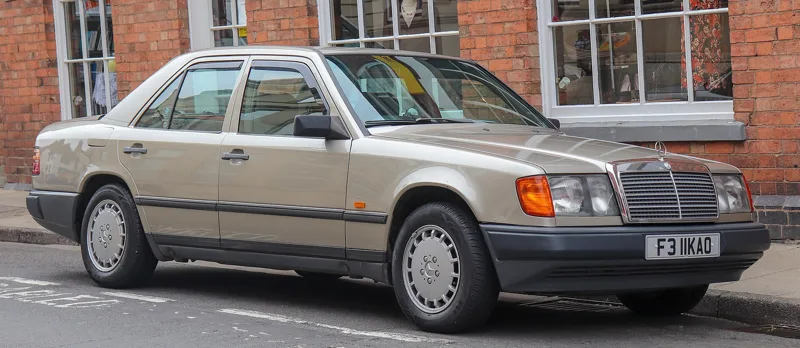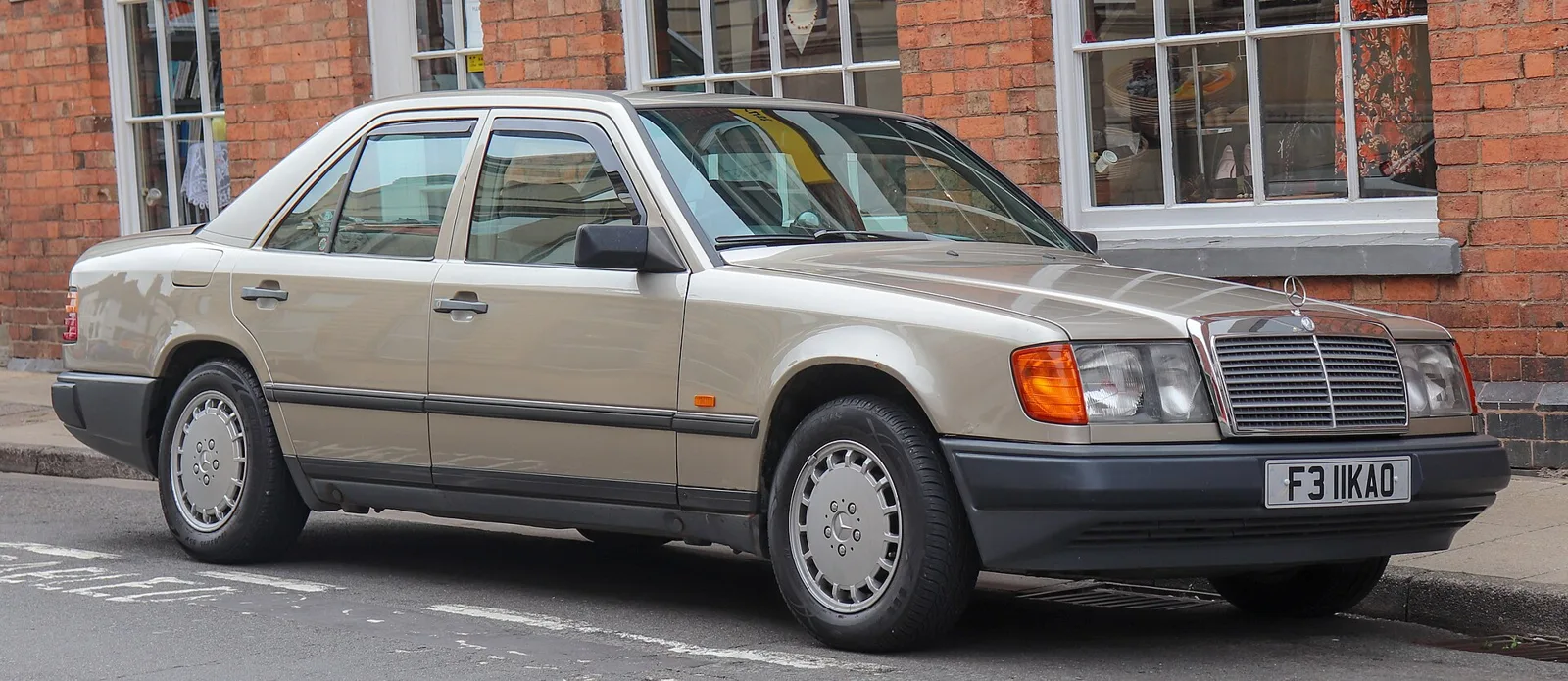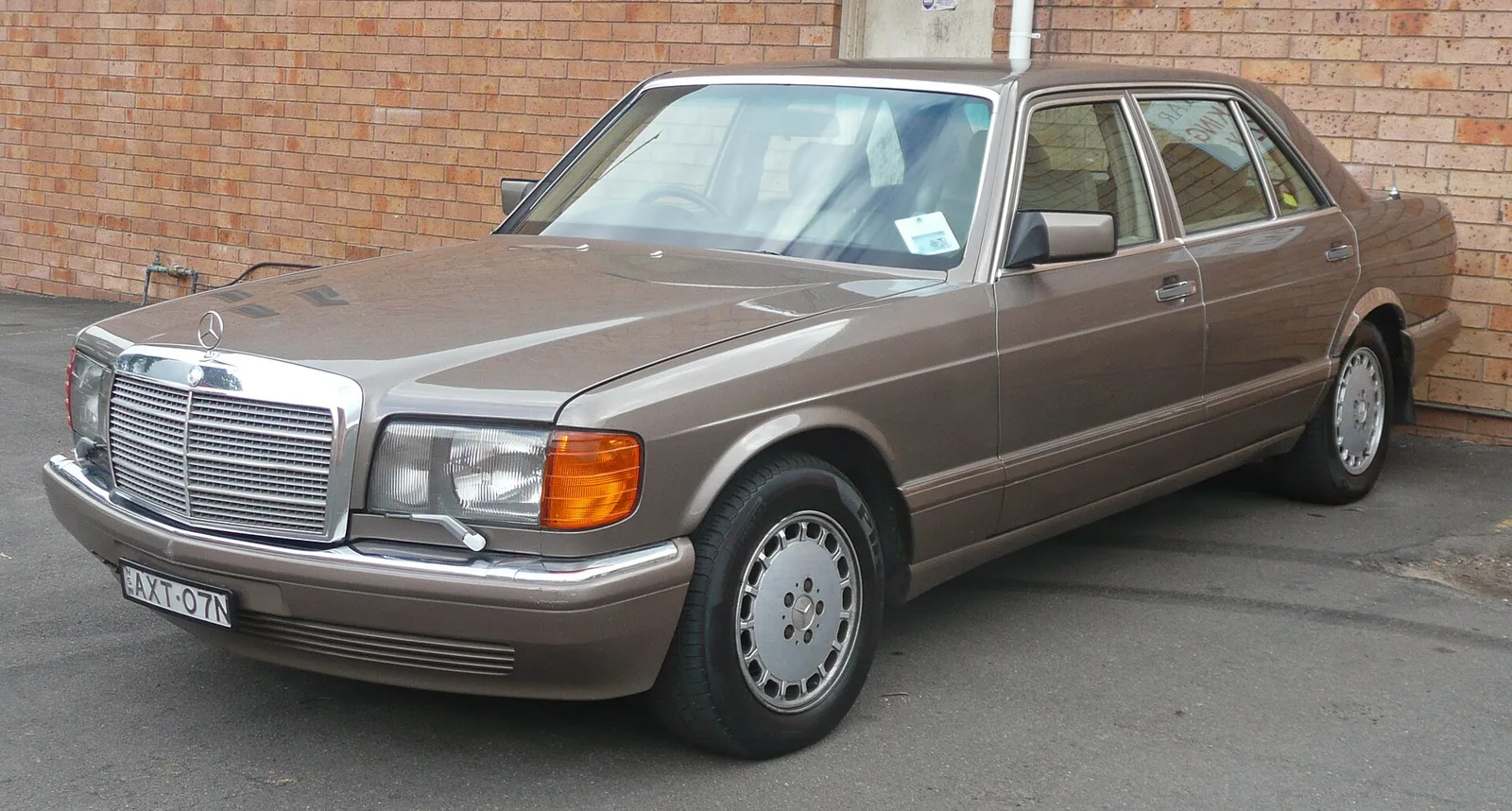
Built from 1979 to 1991, the W126 sold 892,126 cars and brought power seats, seat belt presenters and a fuel-saving redesign to the flagship range.
The W126 was the second-generation S-Class, built from 1979 to 1991 as saloons and from 1981 to 1990 as coupes. It was the highest-volume S-Class on record, with 892,126 cars built and a redesign aimed at better economy and handling.
The Mercedes-Benz W126 was the second generation of the S-Class, built by Daimler-Benz AG in saloon and coupe form. Saloons were made from 1979 to 1991 and coupes from 1981 to 1990, and the car succeeded the W116 range. Its 12-year run produced 892,126 cars, which made it the most successful S-Class generation to date.
Why was the W126 developed?
Project W126 began in October 1973, a year after the W116 S-Class debuted in 1972. The aims were a better ride, sharper handling and improved fuel efficiency. The 1973 oil crisis and tougher emissions and safety rules in the United States shaped the programme from the start.
The design team was led by Mercedes-Benz's chief designer, Bruno Sacco. Its brief was a more aerodynamic shape that still looked like an S-Class. Wind tunnel work reshaped the front end and bumper, and the wipers were hidden under the bonnet for smoother airflow.
Weight came down through high-strength low-alloy steel sheet and polyurethane deformable material for the bumpers and side claddings. The revised M116 and M117 V8s used lighter alloy, and together these changes cut fuel consumption by 10% against the predecessor.
The W126 was introduced at the IAA Frankfurt in September 1979, after six years of development. The range offered two wheelbase lengths, a six-cylinder petrol engine and two V8s, and a diesel for North America followed in September 1981.
One S-Class platform carried 892,126 cars over twelve years and became the highest-volume S-Class on record.
How did the SEC coupe come about?
The C126 coupe, sold as the SEC, arrived at the 1981 IAA Frankfurt with 380 SEC and 500 SEC versions. It was the first S-Class coupe derived from the S-Class chassis and the first with fully distinct styling. It also kept the pillarless tradition of earlier Mercedes coupes, with no B-pillar between the front and rear side windows.
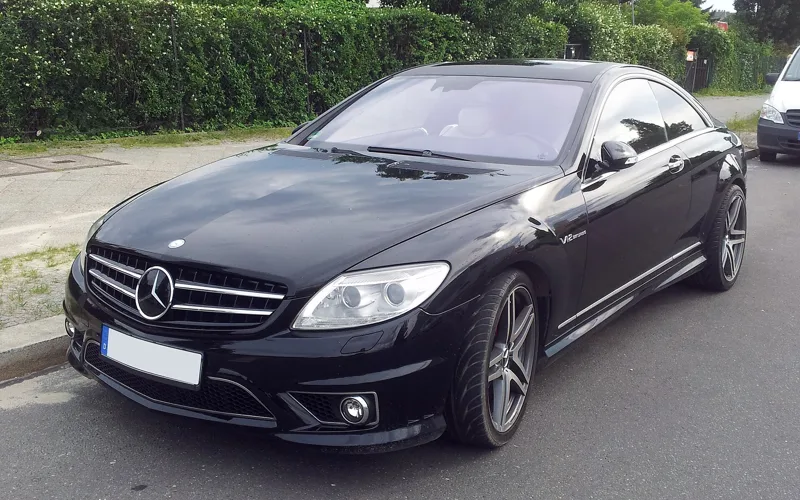
The coupe was the first S-Class to come with V8 engines only. Its styling later evolved into the CL-Class.
The same year, Mercedes-Benz launched the Energiekonzept, or Energy Concept, programme to cut fuel consumption. It revised the V8 combustion chambers and piston heads with lower compression ratios. The revision cut engine performance, and the Second Series later won back a little of it.
What changed in the 1986 Second Series?
The Second Series, shown at the 1985 IAA Frankfurt for the 1986 model year, brought new six-cylinder petrol and diesel engines and bored the M116 V8 out to 4.2 litres. Smoother bumpers, deeper front bumpers with an integrated air dam and revised Gullydeckelfelge alloy wheels marked the visual changes.
Gullydeckelfelge is the German name for the manhole-cover design, which the wheels resembled. The Second Series also put more weight on emissions and fuel use.
How did the W126 do in the United States?
When the W126 reached the United States in September 1980, only the smaller 3.8-litre V8 was offered, to avoid the gas guzzler penalty under the Corporate Average Fuel Economy rules. American buyers found the 380 SEL underpowered, with 11 seconds to 60 mph (97 km/h) and a top speed of 117 mph (188 km/h).
As fears of an oil crisis faded in 1982, American buyers wanted more power. Grey importers brought in S-Class cars with 5-litre V8s and modified them to meet US federal and EPA rules. The W126 became a major part of that parallel market, with 22,000 cars imported in a segment that reached 66,900 cars in 1985, the biggest year for grey imports.
Mercedes-Benz responded by adding the 500 SEL and 500 SEC for the 1984 model year, while the 3.8-litre V8 stayed in the 380 SE and the SL. In 1988 an intense lobbying effort by Mercedes-Benz and other foreign manufacturers led Congress to end this import option and revise the rules for registered importers.
Which engines did the first series use?
At its September 1979 launch, the W126 kept the 2.7-litre DOHC six from the W116 280 S, SE and SEL. The V8s were a revised M116 at 3.8 litres and the M117 at 5 litres, both with aluminium blocks and no iron sleeves, a change that matched the best engines of rival makers.
The M116 used a single timing chain, which often failed. In 1982 the problem was addressed by switching to the double timing chains of the M117. Mercedes-Benz also developed a silicon coating to harden the cylinder liners against wear.
The smaller V8 was at first the only one sold in the US, and the 380 SEL earned a poor reputation there for being underpowered and for its timing chain problems. The more powerful 500 SEL and 500 SEC of 1984 addressed the performance shortfall.
Diesel buyers had the 3-litre five-cylinder OM617 inline five, carried over from the W116. Diesels were not offered outside the United States and Canada, a gap Mercedes-Benz did not close until 1994, when the W140 S 350 Turbodiesel came to Europe.
What engines came with the second series?
The second series introduced the M103 six, a single overhead camshaft engine with electronic-mechanical fuel injection in 2.6 and 3-litre sizes. It ended the carburettor on the S-Class, with the 260 SE and 300 SE and SEL taking over from the carburetted 280 S.
The M116 grew to 4.2 litres for the 420 SE, SEL and SEC, and the 5-litre M117 carried over. A new 5.5-litre V8 for the 560 models came from a longer stroke on the M117 with a new crankshaft. The V8s also gained Bosch KE-Jetronic injection, which had first appeared on the W201 190E.
The most powerful engine fitted to a W126 was the 5.5-litre V8 at 221 kW (300 PS, 296 bhp), with a 10:1 compression ratio. That ECE-Variante could not be fitted with a catalyst later, and in September 1986 it gave way to the RUF-Variante, which kept the same output without the catalyst. In 1990 the 560 SEL was reduced to 200 kW (272 PS; 268 bhp).
Customers outside the US and Canada could now choose cars with or without a catalyst. Cars without one could be retrofitted later, a method called RUF, short for Rueckruestfahrzeug, meaning retrofit vehicle. These RUF models had a mechanical switch under the bonnet to choose between leaded and unleaded fuel. From 1990 all engines had catalysts and the switch was gone.
For the US and Canada a new 3-litre six-cylinder OM603 diesel replaced the five. It was Mercedes-Benz's first six-cylinder passenger diesel, and it was offered only in the long-wheelbase 300 SDL. California cars received a diesel particulate filter, a world first for a passenger car, but the early engines suffered head failures and the filter was moved further from the engine in 1988.
In 1990 the OM603 was bored out to 3.5 litres to offset stricter emissions rules, creating the 350 SD and 350 SDL. The larger pistons rocked in their bores and wore the rings, and Mercedes-Benz blamed the problem on low cetane ratings in North American fuel. Later engines had stronger connecting rods.
What transmissions did the W126 have?
The 4G-Tronic automatic had four speeds, with direct drive in fourth, for the entire run from 1979 to 1991. The 280 S, SE and SEL came with a four-speed manual as standard, with a five-speed manual and four-speed automatic as extra-cost options. No V8 was ever offered with a manual.
From 1986 the automatic gained S, for Standard, and E, for Economy, shift programmes. The 260 SE and 300 SE and SEL came with a five-speed manual as standard. For one year, from September 1986 to June 1987, the automatic option was not offered on the 260 SE and 300 SE. US models were automatic only.
How did the W126 ride and handle?
The W126 kept the self-levelling hydropneumatic suspension of the W116 450 SEL 6.9. The first version, HPF II, was fitted to the 380 SEL and 500 SEL between 1981 and 1985, and briefly to the 500 SE. The rear system was also offered as an option, as it had been on the W116 and W123.
The Second Series brought HPF III, a heavily redesigned system. It automatically lowered the chassis by 24 mm at 120 km/h and above, for better aerodynamics and high-speed stability, and it adjusted the damping from soft to hard according to speed and road. On coarse surfaces at speeds up to 80 km/h, the driver could raise the car by 35 mm.
HPF III was available from 1986 to 1990 on the 420 SEL, 500 SEL, 560 SE and 560 SEL. In the final year it was offered only on the longer-wheelbase cars. The system was complex and could fail suddenly, and owners often had it replaced with coil springs and shock absorbers from cars without the hydropneumatic system.
The automatic transmission also had a topographical sensor from the Second Series, which monitored whether the car was on the flat, climbing or descending, as well as the throttle position. This stopped the car accelerating unintentionally when coasting downhill. A hill-hold feature stopped the car rolling back when the driver moved from brake to throttle on a steep climb.
Which firsts did the W126 introduce?
The W126 premiered the power seat control, a first for Mercedes-Benz. Instead of toggles or buttons in awkward places, the switches were shaped like the seat itself, with one for the backrest and another for the cushion's forward, back, up and down movement. Two memory buttons stored the preferred positions for front occupants.
Another first was an electrically adjustable steering column, moved by a toggle under the column and stored in the driver's memory with the seat. The patent on the seat switches ran for 17 years, and other manufacturers copied the design in the late 1990s after it expired.
The most distinctive first was the seat belt presenter. Coupes had longer doors and a B-pillar set further back, so Mercedes-Benz developed a system that, when the doors were shut and the engine started, extended the shoulder anchor points forward by about 30 cm. The presenters returned to the B-pillar once the belts were fastened or after 30 seconds.
How safe was the W126?
The W126 used high-strength low-alloy sheet to save weight without losing structural strength, and it had front and rear crumple zones to absorb impact energy. Seat belt pretensioners tightened the belts in sudden braking or during a collision. The fluted taillamps, first used on the R107 and C107, stayed visible when dirt built up on their outer edges.
Anti-lock brakes first appeared on the W116 and were an option on the W126 until late 1984, when they became standard on the V8 models. From September 1986 they were standard on the 260 SE, 300 SE and 300 SEL, and on the US 300 SDL, 350 SD and 350 SDL.
The driver's airbag arrived in 1981 as an extra-cost option, and it became standard in the US for the 1985 model year. A passenger airbag was added as an option in 1988, and it became standard on V8 models in 1989 and on the whole range in 1991. Mercedes-Benz also introduced traction control, known as ASR, to stop wheelspin, and it was a company first.
What awards did the W126 win?
The 300 SD took the 1981 Motor Trend Import Car of the Year title, and the 380 SE was the Wheels Magazine Car of the Year in 1981. The Highway Loss Data Institute named the W126 its Safest Passenger Car of the Year in 1988 and 1989.
The W126 ranked third among luxury vehicles in J.D. Power's 1990 Initial Quality Survey. From 1987 to 1990 Mercedes-Benz also recorded the highest customer ratings in the J.D. Power Sales Satisfaction Index.
How did AMG and the coachbuilders change the W126?
Before its merger with Mercedes-Benz, AMG offered body kits for every W126 and a wide-body kit for the coupe, with distinctive front and rear fenders and door panels that accommodated much wider wheels and tyres. Its engine options ran to 5, 5.5 and 6 litres.
The rarest of them was the DOHC 6-litre engine, based on the original 117.968 unit. Options included a Gleason Torsen differential in various ratios, a manual gearbox that was extremely rare, and various TV and radio consoles.
Trasco Bremen offered a stretched limousine known as the 1000 SEL. Several coachbuilders produced convertibles based on the SEC coupe, and Caruna of Switzerland built a four-door convertible on the SEL with the shorter rear doors of the SE. The Dutch royal family owns one of the blue cars, which they use at their resort in Porto Ercole, Italy.
Caro International built a 560 TEL estate, and Guard versions, specially modified for dignitaries and world leaders, had a wheelbase stretch, bulletproof glass and armoured body panels.
How did the W126 perform in racing?
Two AMG-modified 500 SEC cars entered the 1989 24 Hours of Spa, and neither finished. One suffered gearbox problems, and the other had a fault in its rear axle. Both were modified 500 SEC coupes, so the race ended in two retirements.
What is the W126's legacy?
The W126 remains the highest-volume S-Class on record, and its production figures still place it above every other generation. A limited number reportedly continued to be built in South Africa until 1993, two years after the W140 arrived. Nelson Mandela received a commemorative red 1990 500 SE.
Three armoured 560 SELs ordered by Saddam Hussein reportedly had pipes that shot flames from their sides.
W126 specifications at a glance
| Specification | Detail |
|---|---|
| Production | Saloons 1979 to 1991; coupes 1981 to 1990; 892,126 built |
| Split | 818,066 saloons and 74,060 coupes |
| Launch | IAA Frankfurt, September 1979 |
| Drag coefficient | Cd 0.36 saloon, 0.34 coupe |
| Coupe | C126 SEC, with 380 SEC and 500 SEC at the 1981 IAA Frankfurt |
| Second Series | Shown September 1985 for the 1986 model year |
| Most powerful | 5.5-litre V8, 221 kW (300 PS, 296 bhp), 10:1 compression |
| 560 SEL, 1990 | 200 kW (272 PS; 268 bhp) |
| Diesel | OM603 3-litre six in the 300 SDL, later 3.5-litre in the 350 SD and 350 SDL |
| Suspension | HPF III lowers the chassis 24 mm at 120 km/h and above |
| Successor | W140 S-Class, 1991 |