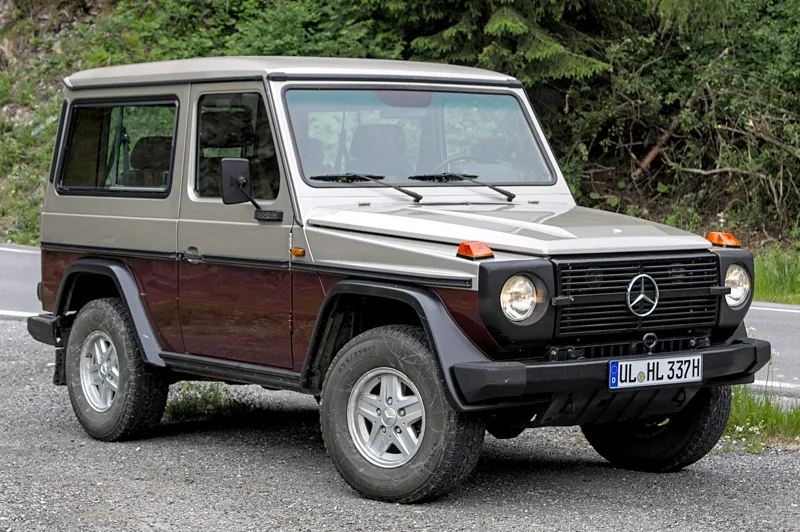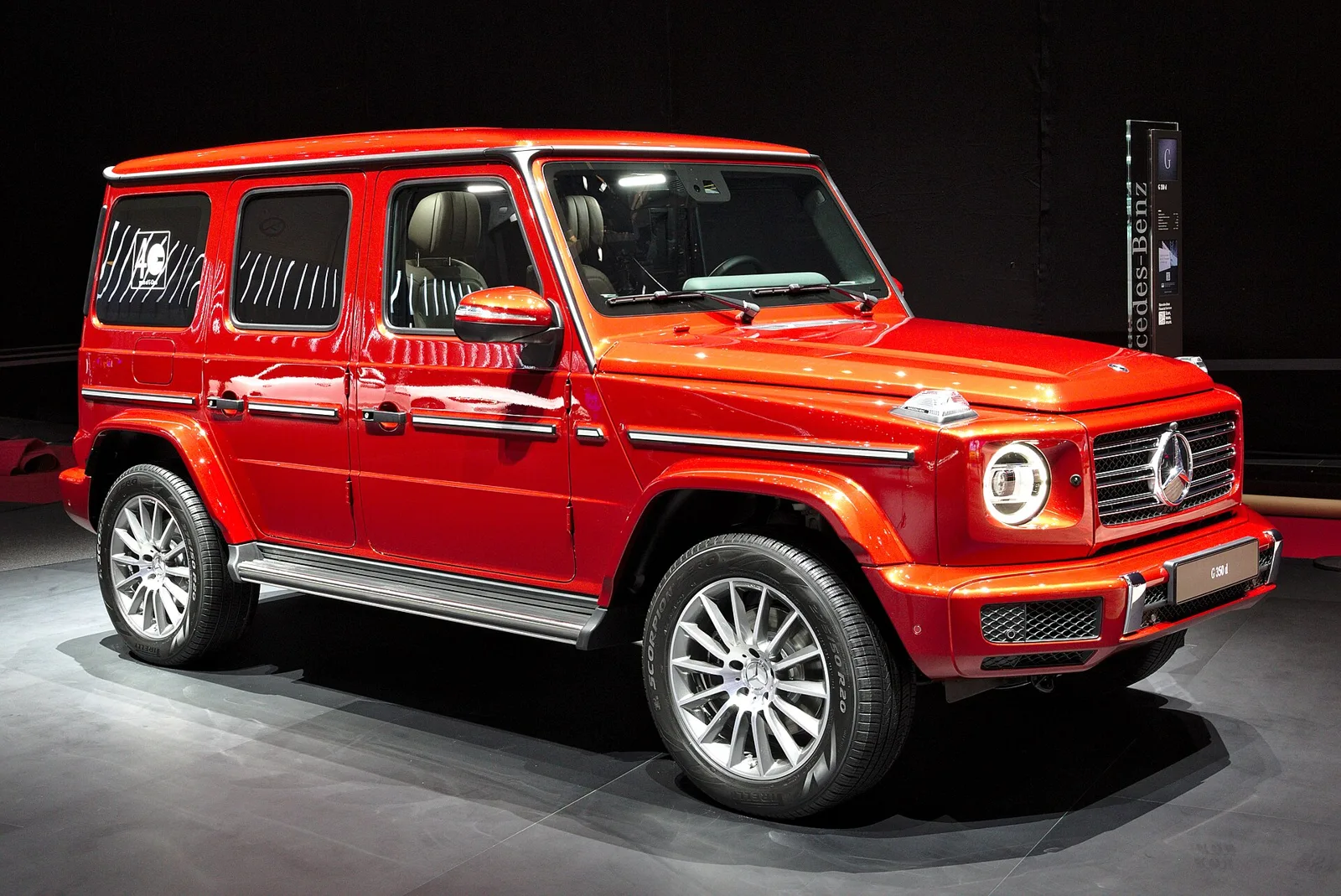
Launched at Frankfurt in 1989, the W463 added permanent four-wheel drive, V8 power, AMG versions and a six-wheel pick-up that cost almost 470,000 euros.
The Mercedes-Benz W463 was the first of two G-Class series built side by side, launched at the 1989 Frankfurt Motor Show and produced until 2017. It introduced permanent four-wheel drive and became a luxury off-roader, with V8 engines, AMG versions and the 6x6 pick-up.
Launched at Frankfurt in September 1989, the W463 brought permanent four-wheel drive to the G-Class. Over the following decades the car moved steadily from work vehicle toward luxury off-roader, and it kept the square-cut body of its predecessor.
Where did the W463 come from?
The W463 replaced the W460, and the more spartan W461 arrived two and a half years later. Daimler-Benz had found that the W460, conceived as a work or military vehicle, won over private buyers too, so the range was split in two.
The W460 enjoyed great success during the first half of the eighties, far beyond the users it was built for. Its makers discovered that private owners made up much of the demand, and at the end of its career they chose to divide the successor range into two models. Both were built on the W460's mechanical base, but each was aimed at a different buyer.
The W463 was therefore the more luxurious of the pair. Its grille was painted in body colour rather than black plastic, and chrome inserts and larger rear light units set it apart. Wheel-arch extensions, once optional, became standard across the whole range.
A work-vehicle body that turned into a luxury car, with permanent four-wheel drive from the start.
How did the W463 differ from the W461 inside?
Inside, the W463 borrowed its trim and dashboard from the W124 series, while the W460 and W461 used parts from an older Mercedes-Benz van. Leather seats and genuine burr wood set the luxury tone, and a button, not a lever, locked the differential.
The dashboard finish said more about the car's ambition than anything else. Burr wood covered the dash, and leather upholstery was available for the seats. The differential lock used a button because the lever was by then considered outdated for a luxury car.
Under the skin the body shell was almost identical to the W460, with its square shapes kept. The real technical news was the drivetrain. The W463 kept its separate steel frame, rigid axles with a Panhard rod, coil springs and mixed brakes, but this time it introduced permanent four-wheel drive.
What engines did the W463 launch with?
The W463 launched with four engines, two petrol and two diesel, and a fifth unit was reserved for Italy. The petrol range started with the 230 GE, while the 300 GE and 300 GD were the two new engines of the launch range.
- 230 GE: 2,299 cc (140.3 cu in), 126 PS (93 kW; 124 hp), carried over from the W460
- 300 GE: 2,960 cc (180.6 cu in), 170 PS (125 kW; 168 hp), one of two new engines
- 250 GD: naturally aspirated diesel of 2,497 cc (152.4 cu in), output raised from 84 to 94 PS (69 kW; 93 hp)
- 300 GD: 2,996 cc (182.8 cu in), 113 PS (83 kW; 111 hp), the second new engine
The Italian-only engine fitted under the bonnet of the 200 GE came from the W460, with 116 PS (85 kW; 114 hp). With a catalytic converter it dropped to 113 PS (83 kW; 111 hp). Every model had a 5-speed manual as standard, with a 4-speed automatic as an option, except for the 250 GD, which was available only with the manual.
Key specifications across the W463 range
| Model and year | Engine and output |
|---|---|
| 500 GE V8, 1993 | 4,973 cc (303.5 cu in), up to 241 PS (177 kW; 238 hp) |
| G 320, 1994 | 3,199 cc (195.2 cu in), 210 PS (154 kW; 207 hp) |
| G 300 TD, 1996 | Turbodiesel of 3 litres, 177 PS (130 kW; 175 hp) |
| G 500, late nineties | 4,966 cc (303.0 cu in), 296 PS (218 kW; 292 hp), top speed 195 km/h (121 mph) |
| G 55 AMG, 1999 | 5.4-litre V8, 5,439 cc (331.9 cu in), 354 PS (260 kW; 349 hp) |
| G 400 CDI, 2000 | 3,996 cc (243.9 cu in) diesel V8, 250 PS (184 kW; 247 hp) |
| G 270 CDI, early 2000s | 2,685 cc (163.8 cu in), 156 PS (115 kW; 154 hp), 400 Nm (295 lb ft) |
| G 500, 2008 | 5.5-litre V8, 388 PS (285 kW; 383 hp) |
| G 63 AMG, 2012 | Twin-turbo V8, 544 PS (400 kW; 537 hp) |
| G 65 AMG, 2012 | 6-litre V12, 612 PS (450 kW; 604 hp), self-limited to 230 km/h (143 mph) |
| G 63 AMG 6x6, 2013 | 5.875 metres (19.27 ft) long, 3,775 kg (8,322 lb), 160 km/h (99 mph) |
| G 500 4x42, 2015 | 3,021 kg (6,660 lb) unladen, 210 km/h (130 mph) |
What did the 500 GE V8 do for the W463?
The 500 GE V8 arrived in 1993 as the first G-Class with a V8 engine. It had a 4,973 cc (303.5 cu in) petrol unit producing up to 241 PS (177 kW; 238 hp), and a rich interior with burr wood and two-tone leather upholstery.
Its limited run of 500 examples, 300 of them for Germany, meant it had gone from the price list by 1994. Because it was so limited, it escaped the 1993 renaming of Mercedes-Benz models, which turned the 300 GE into the G 300 and the 230 GE into the G 230.
That renaming also marked the official birth of the G-Class name, although the term is often applied to the earlier models as well. In 1993 two high-performance versions followed, both built in small numbers and both the first G-Class vehicles to be treated by AMG.
Mid-1990s changes to the range
In 1995 the 4-speed automatic was extended to the whole range, having been standard until then only on the G 320 and on limited-run versions. In 1996 the G 350 Turbodiesel gave way to the G 300 TD, and the canvas-covered torpedo versions, also called convertibles by various sources, received an electro-hydraulic device to open and close the hood.
Also in 1996 the 4-speed automatic was replaced by a 5-speed automatic with five reduction gears, except in the G 300 Turbodiesel, which kept the older unit. In the second half of 1997 the G 320 received a V6 of the same 3.2 litres in place of the straight six, with its output rising slightly from 210 to 215 PS (158 kW; 212 hp).
The G 500 joined the price list as the new top model, bringing air conditioning, satellite navigation and one of the first parking assistance systems. Its top speed was limited to 195 km/h (121 mph), and it was the first G-Class to reach that speed. In 1999 a G 500 Classic special, built in 500 examples for the twentieth anniversary, came in a shimmering purple paint.
What were the AMG versions of the W463?
AMG of Affalterbach worked on two high-performance G-Class models in 1993, the G36 AMG and the 500 GE V8 6.0, both made in tiny numbers. The G 55 AMG, launched in 1999, was placed regularly on the price list and intended for wider production.
The G 55 AMG took a 5.4-litre V8 with 354 PS (260 kW; 349 hp). It became the G 55 AMG Kompressor in 2004 with 476 PS (350 kW; 469 hp). A revision in 2007 raised its output to 500 PS (368 kW; 493 hp), and a 2008 update added 7 PS more, for 507 PS (373 kW; 500 hp).
The G 65 AMG, launched in 2012 with a 6-litre V12 borrowed from the S-Class, was the range's top model. It developed 612 PS (450 kW; 604 hp) and had a self-limited top speed of 230 km/h (143 mph). It was distinguished by a grille with two close horizontal bars, shared with the G 63 AMG.
How did the G 63 AMG replace the G 55?
The G 63 AMG replaced the G 55 AMG in June 2012. It used an engine derived from the 388 PS V8 of the G 500, but with deep revisions to fit two turbochargers, giving 544 PS (400 kW; 537 hp). The same update brought LED daytime running lights and new mirrors.
Inside, a new dashboard was borrowed from the third-generation M-Class, launched almost a year earlier. The whole W463 range also received a new 7-speed sequential automatic gearbox, a natural evolution of the earlier unit.
What did the new millennium bring?
The new millennium opened with Magna Steyr, after the Canadian company Magna International acquired Steyr-Daimler-Puch. The G 400 CDI appeared in 2000 with a 3,996 cc (243.9 cu in) diesel V8 producing up to 250 PS (184 kW; 247 hp), and it was the first G-Class with a direct-injection common rail engine.
For a time the G 400 CDI was the most powerful diesel car engine. The update of that period improved the interior, especially in the top versions. Then the G 270 CDI took over from the G 300 Turbodiesel, and its 156 PS (115 kW; 154 hp) was less than before, but torque rose to 400 Nm (295 lb ft) from 330 Nm (243 lb ft).
The G-Class debuted in the US market in 2002, where the G 500 became the G 550. In 2003 the side indicators moved onto the mirror housings, a solution first used seven years earlier on the first-generation CLK-Class. The 25th anniversary edition of 2004 was sold as the Limited Edition in Germany and Classic 25 abroad.
What was the G 63 AMG 6x6?
The G 63 AMG 6x6 was a six-wheel pick-up shown at the 2013 Frankfurt Motor Show. It measured 5.875 metres (19.27 ft) long, weighed 3,775 kg (8,322 lb) and sold for almost 470,000 euros, built at the same Graz factory as the other W463s.
It was longer to take a second rear axle, wider with widened wings for three longer axles, and taller because of portal axles in place of the standard suspension. Its body was a pick-up with a cabin of two rows of seats. The twin-turbo 5.5-litre V8 produced 544 PS (400 kW; 537 hp) and drove all six wheels, with five lockable differentials operated from the dashboard.
Its size meant it could not be driven on an ordinary car licence, and a category C licence was needed instead. Its speed was self-limited to 160 km/h (99 mph), and it stood out as one of the most extreme versions the G-Class has produced.
How did the W463 end its run?
The convertible body was removed from the range in 2013. A Final Edition 200 was launched as a farewell, available only as the G 500 with the 5.5-litre V8, and all 200 examples had sold before the Frankfurt show closed its doors.
In 2015 the G 500 received a new engine, a 4-litre V8 with double supercharging and 422 PS (310 kW; 416 hp). The same engine went into the G 500 4x42, shown at the Geneva Motor Show that year and built from June 2015 to 2017 in small numbers. It was a sort of younger sister to the 6x6, with portal axles and 46 cm (18.1 in) of ground clearance, and its height came close to 2.25 metres (7.38 ft).
The G 500 AMG 4x42 weighed 3,021 kg (6,660 lb) unladen, and it was offered only with a long-wheelbase SW body. Its AMG versions were revised again in 2015 to 571 and 630 PS, while the G 350 BlueTEC rose to 245 PS.
In 2016 the G 350 d BlueTEC Professional arrived as the last version of the W463, a trim for professional use. It took up the role of the W461, which had been off the price list for two years, with a plainer, less rich trim. A new G-Class with entirely new technical content followed from 2018, while keeping the original body shell of almost forty years earlier.