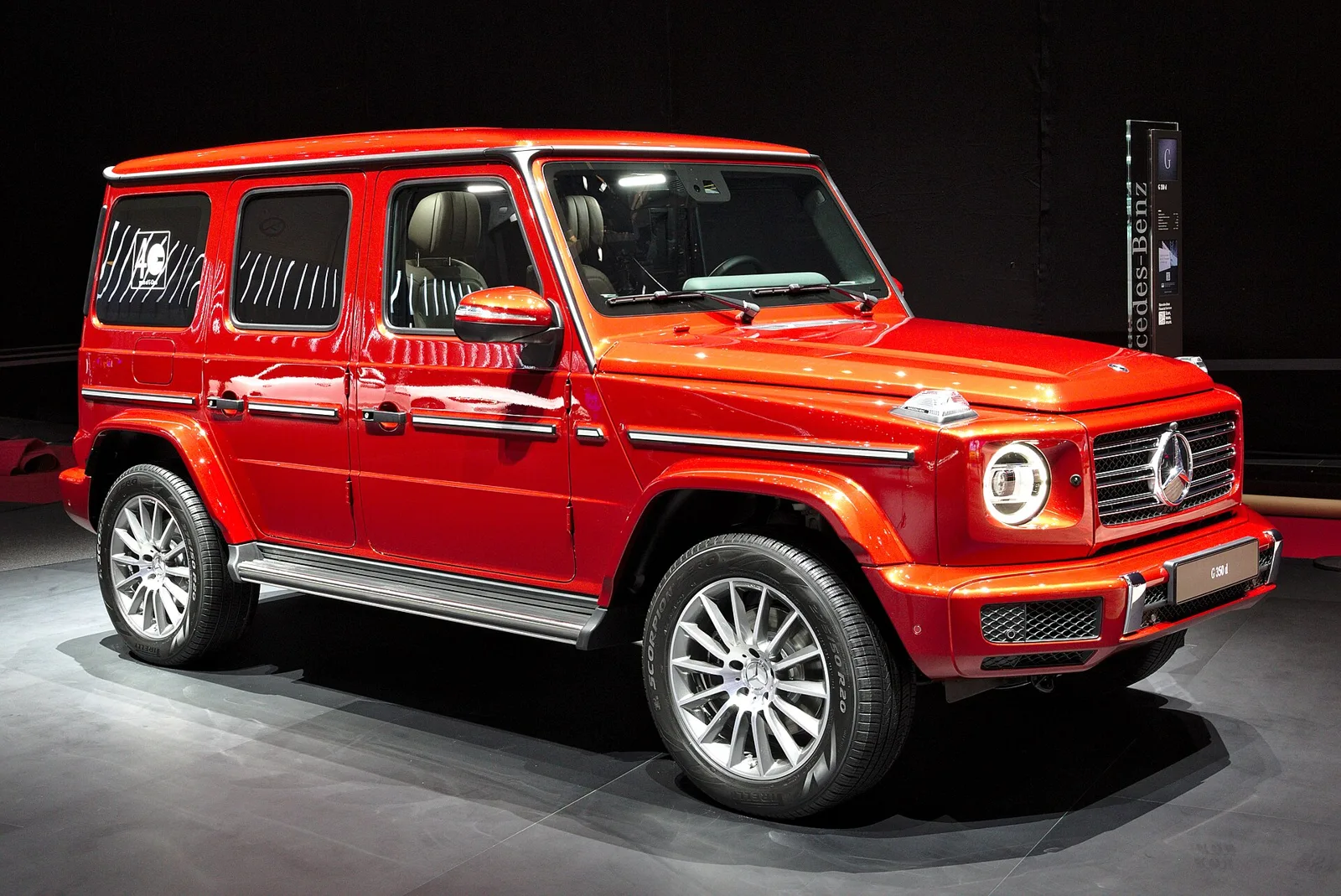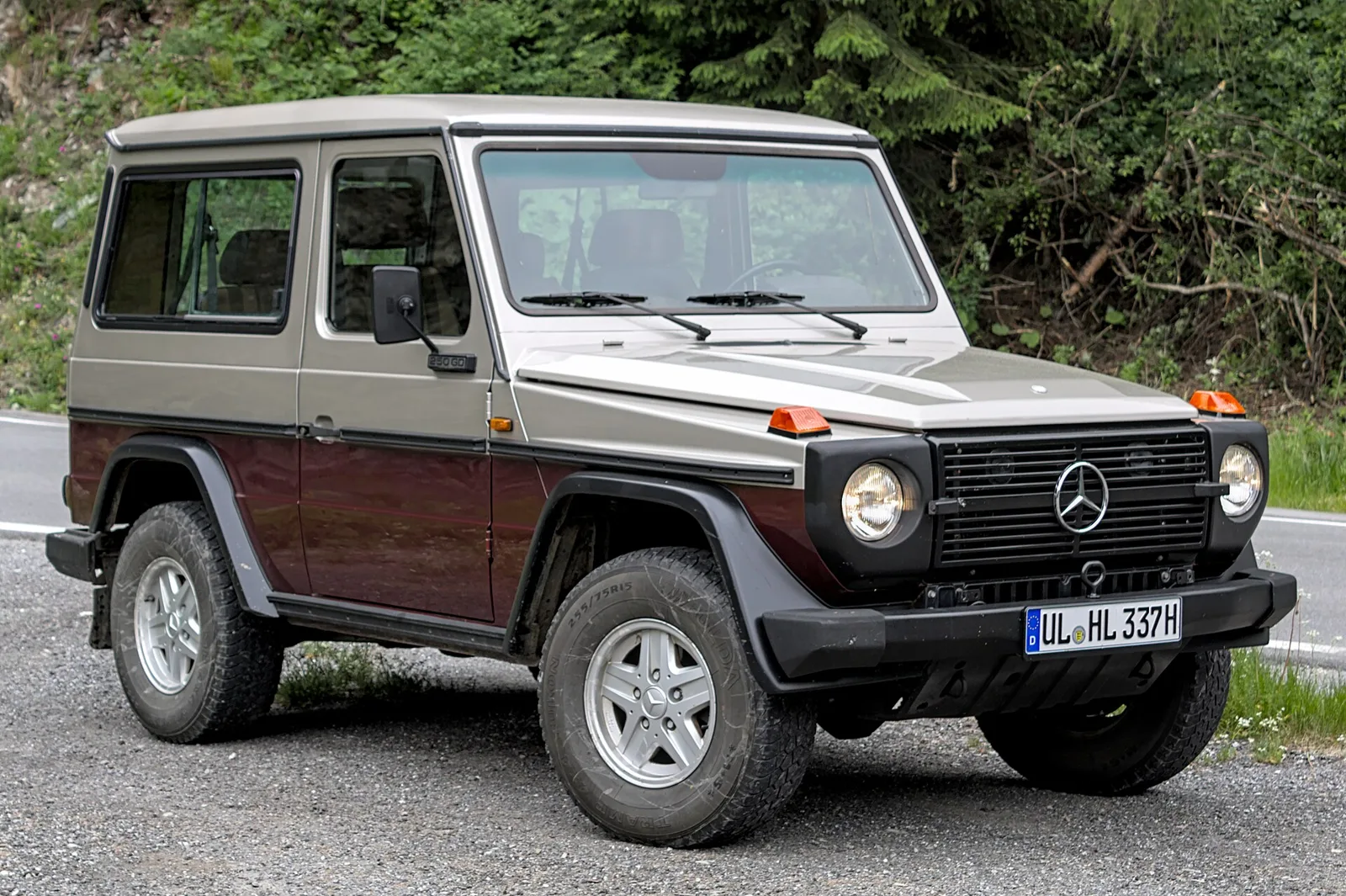
Boxy 1970s styling, a separate steel chassis, a Paris-Dakar win and a Puch G twin sold under a second badge.
Built by Mercedes-Benz and Steyr-Daimler-Puch from 1979 to 1991, the W460 was the first G-Class. Its boxy body sat on a traditional steel chassis, and its four launch engines ran from 2,307 cc to 2,998 cc. A 280 GE won the Paris-Dakar in January 1983.
The Mercedes-Benz W460 was the first generation of the G-Class, a rugged off-roader built from 1979 to 1991 by Mercedes-Benz together with the Austrian firm Steyr-Daimler-Puch. Its squared body, separate steel chassis and non-permanent four-wheel drive gave the G-Class its basic character, and later generations stayed close to its look. Four engines were offered at launch, from a carburettor petrol unit to a naturally aspirated diesel.
The W460 nearly began life around a very different buyer. Daimler-Benz had counted on an order from the Shah of Persia, Mohammad Reza Pahlavi, one of the company's largest shareholders, who had promised to take 20,000 examples. His regime fell three days before production began, and the deal collapsed.
How did production of the W460 start?
Production began on 10 February 1979, after Daimler-Benz had hoped to sell a large batch to the Shah. When his regime fell three days earlier, the company relied on minor orders from other countries and on building the vehicle as a civilian model.
Daimler-Benz, which held the Mercedes-Benz brand, and its subsidiary Steyr-Daimler-Puch could then count on little else. Selling the off-roader in civilian form spread its design and development costs, which is why the civilian model became central to the plan.
A boxy off-roader that began life as a joint venture and ended up with two badges and a Paris-Dakar win.
Who built the W460?
The W460 was built by GFG, a joint venture between Mercedes-Benz and Steyr-Daimler-Puch whose name stood for Gelaendefahrzeug Gesellschaft, or off-road vehicle company. The two partners sold the car from the start under the Mercedes-Benz name and the Puch name, and the venture was dissolved in autumn 1981.
Until that point both versions carried the GFG designation on the rear. The split was not a bitter one, and each partner went on using its own brand. Steyr-Daimler-Puch was later taken over by Magna International in 1998, and the Austrian company changed hands.
The styling was developed and refined by Bruno Sacco, who led Mercedes-Benz design for almost thirty years. His work gave the W460 a sturdy, reliable look, and that impression proved well founded in the years that followed.
How was the W460 styled?
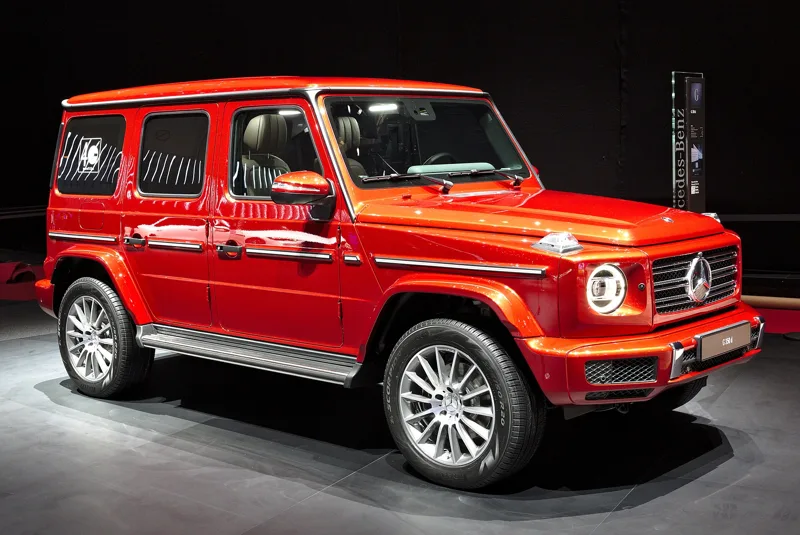
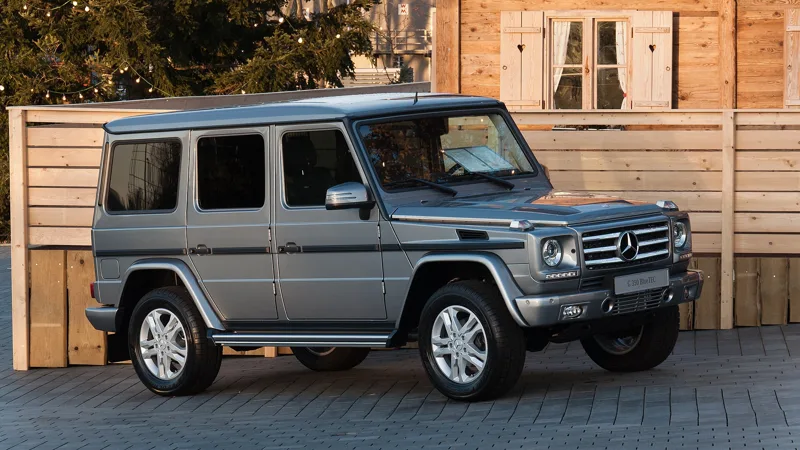
The W460 had squared lines typical of the seventies, with a black trapezoidal grille surround enclosing the radiator and round headlamps. It was offered in three body styles from the start: a two-door short-wheelbase soft-top, a two-door short-wheelbase station wagon and a four-door long-wheelbase station wagon.
In this context a station wagon meant a closed metal body rather than an open soft-top. The short-wheelbase cars measured 2.4 metres (94.5 in) between the axles, and the long-wheelbase versions added 45 cm (17.7 in) to that figure.
The cabin looked spartan. The dashboard, steering wheel and window winders came from the 207 D van. Short-wheelbase cars seated five, expandable to seven, while long-wheelbase cars seated seven, or nine when the seating was extended.
What engines did the W460 use at launch?
At launch the W460 came with four engines. The 230 G had a 2,307 cc carburettor petrol engine with 90 or 102 PS, the 280 GE had a fuel-injected 2,778 cc engine with 156 PS, and two diesels, the 240 GD and 300 GD, displaced 2,399 cc and 2,998 cc. Both diesels were naturally aspirated.
Both diesels used indirect injection with a pre-chamber. The fuel-injected 230 GE arrived in 1982 with 125 PS, and a 200 GE for Italy followed in 1986.
W460 engines and specifications
| Model | From | Engine | Displacement | Output |
|---|---|---|---|---|
| 230 G | 1979 | M115V23 carburettor petrol | 2,307 cc (140.8 cu in) | 90 or 102 PS (66 or 75 kW; 89 or 101 hp) |
| 280 GE | 1979 | M110 fuel-injected petrol | 2,778 cc (169.5 cu in) | 156 PS (115 kW; 154 hp) |
| 240 GD | 1979 | OM616 naturally aspirated diesel | 2,399 cc (146.4 cu in) | 72 PS (53 kW; 71 hp) |
| 300 GD | 1979 | OM617 naturally aspirated diesel | 2,998 cc (182.9 cu in) | 88 PS (65 kW; 87 hp) |
| 200 GE | 1986 | Fuel-injected petrol, Italy only | 1,997 cc (121.9 cu in) | 109 PS (80 kW; 107 hp) |
| 250 GD | 1987 | Diesel, replaces the 240 GD | 2.5 litres (152.6 cu in) | 84 PS (62 kW; 83 hp) |
How did the W460 handle four-wheel drive and rough ground?
The W460 combined a separate steel chassis with a longitudinal front engine and non-permanent four-wheel drive. Normally all the drive went to the rear wheels. A control brought the central differential into use, sending part of the torque forward to the front axle.
Both axles were rigid, located by Panhard rods, longitudinal trailing arms and coil springs. This layout kept the body high, with 21 cm (8.3 in) of clearance under its lowest point, enough to cross water 50 cm (19.7 in) deep.
A four-speed manual gearbox came across the range at the start, and a five-speed arrived in 1984 on every version except the 240 GD. Discs at the front and drums at the rear did the braking, and the steering used a recirculating-ball mechanism.
What changed during the W460's production run?
The W460 changed in small steps rather than big jumps. A van arrived in September 1979, an automatic option came for the 280 GE and 300 GD in 1981, and the differential lock became standard in 1985. Trim and colours were extended as the years went on.
The van version appeared seven months after the car was presented. It had two doors and an unglazed rear cargo area, and it could be built on either wheelbase.
Equipment kept growing too. Recaro seats, better air conditioning, larger tyres and alloy wheels became available, and metallic paint shades arrived in 1983. In 1985 the W460 moved out of the commercial vehicle network and into the car price list, and a long-wheelbase pick-up joined the range the same year. The interiors also became less spartan and more welcoming.
A special version for Italy used a 1,997 cc petrol engine with fuel injection, because the Italian tax regime was harsh on cars above two litres. Sold as the 200 GE from 1986, it made 109 PS (80 kW; 107 hp), and the short-wheelbase van left the price list that same year.
The 240 GD gave way to the 250 GD in 1987, a 2.5-litre diesel with output lifted from 72 PS (53 kW; 71 hp) to 84 PS (62 kW; 83 hp). In 1989 a special series of 300 cars in dark blue metallic, with chrome side inserts, arrived in the 230 GE line.
The end came in stages. The 280 GE left the price list in 1990, and in August 1991 the 230 GE and 250 GD were removed as well. The W460 was then replaced by two models derived from it.
Which body styles came besides the main three?
Beyond the three main bodies, the W460 was sold as a pick-up and as a bare chassis for customers who wanted their own bodywork. The pick-up arrived in 1985 with a long wheelbase, and the bare chassis used a wheelbase increased to 3.12 metres as its starting point.
The van had been sold since 1979 with either wheelbase, and its short-wheelbase version disappeared from the price list in 1986.
What was the Puch G?
The Puch G was the Austrian version of the W460, sold beside the Mercedes-Benz model in a more luxurious specification. It was offered in Austria, Switzerland, Liechtenstein, Great Britain, Yugoslavia and other Eastern European countries, and it carried the Puch name in those markets.
Standard equipment on the Puch included a rear differential lock, which the first Mercedes-Benz-badged cars did not have. It also came with halogen headlamps, front headrests, air conditioning, a fuel filler with a lock and a stone guard grille, all of which were absent or extra-cost on the German car.
Its tyres had a wider tread, 215 mm (8.5 in) against 205 mm (8.1 in) on the Mercedes-Benz version. Puch G sales continued into the following generation's career until 2000, when every market was switched to the Mercedes-Benz badge alone.
The Puch also crossed the Atlantic. Arnold Schwarzenegger, the bodybuilder and actor, was the first person to drive one in the United States, and he had been born in Graz too.
How did the W460 perform in motorsport?
The W460 became well known in motorsport in January 1983, when a 280 GE driven by Jacky Ickx, with Claude Brasseur as co-driver, won the Paris-Dakar. The rally car had its engine raised from 156 PS to 220 PS (162 kW; 217 hp) for the punishing African event.
The car had been extensively reworked for the desert race. Some panels that would normally be made of sheet steel were produced in aluminium specifically to reduce the car's mass.
What came after the W460?
The W460 was replaced by two derived models after August 1991. The W461 was more spartan and aimed at professional use, while the W463 was richer, better equipped and in some cases very luxurious.
The W461 kept the working focus of the first car, while the W463 pushed the range into luxury and, in some versions, into extreme specifications. Later generations of the G-Class stayed close to the W460's look for decades.