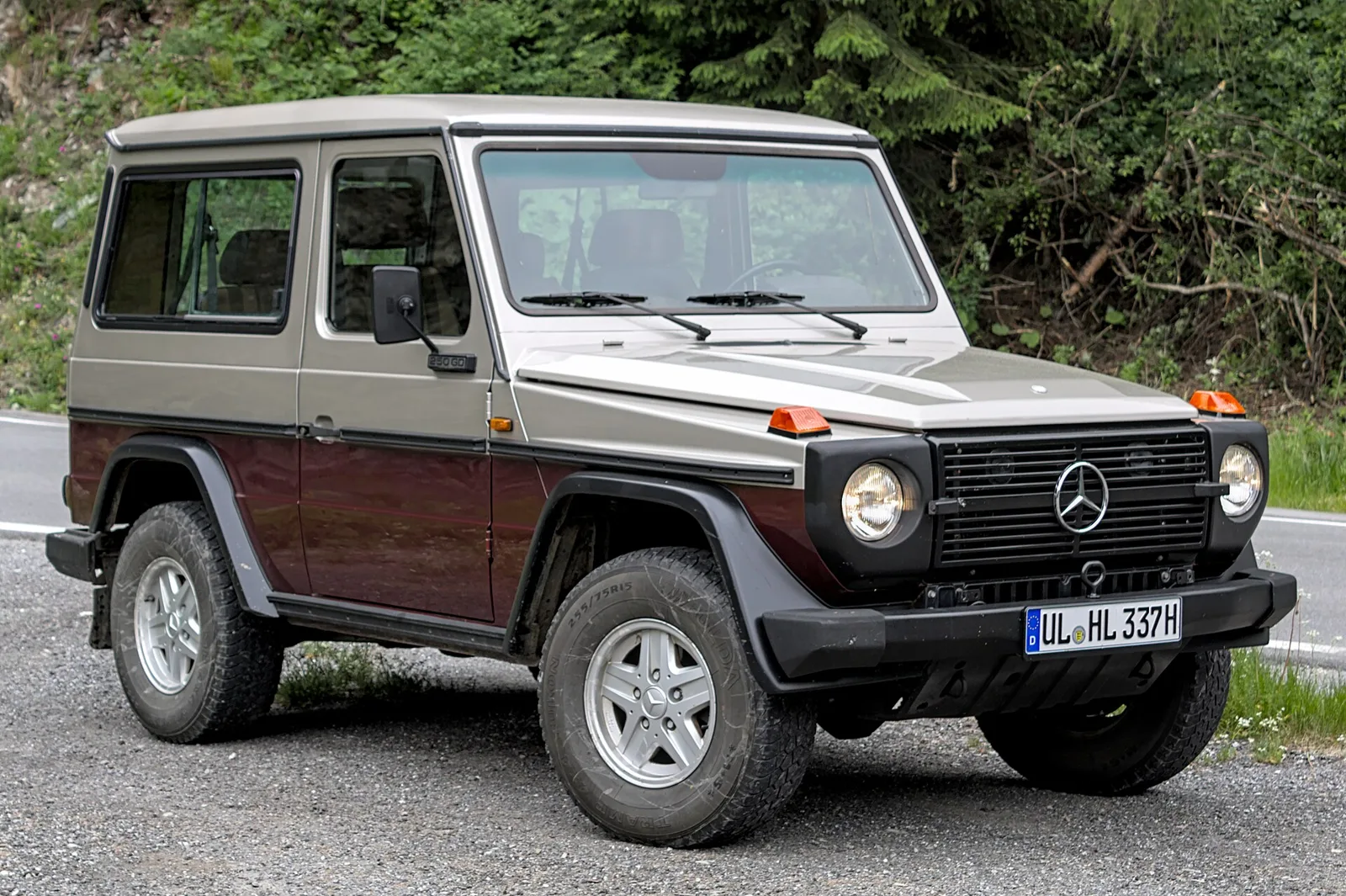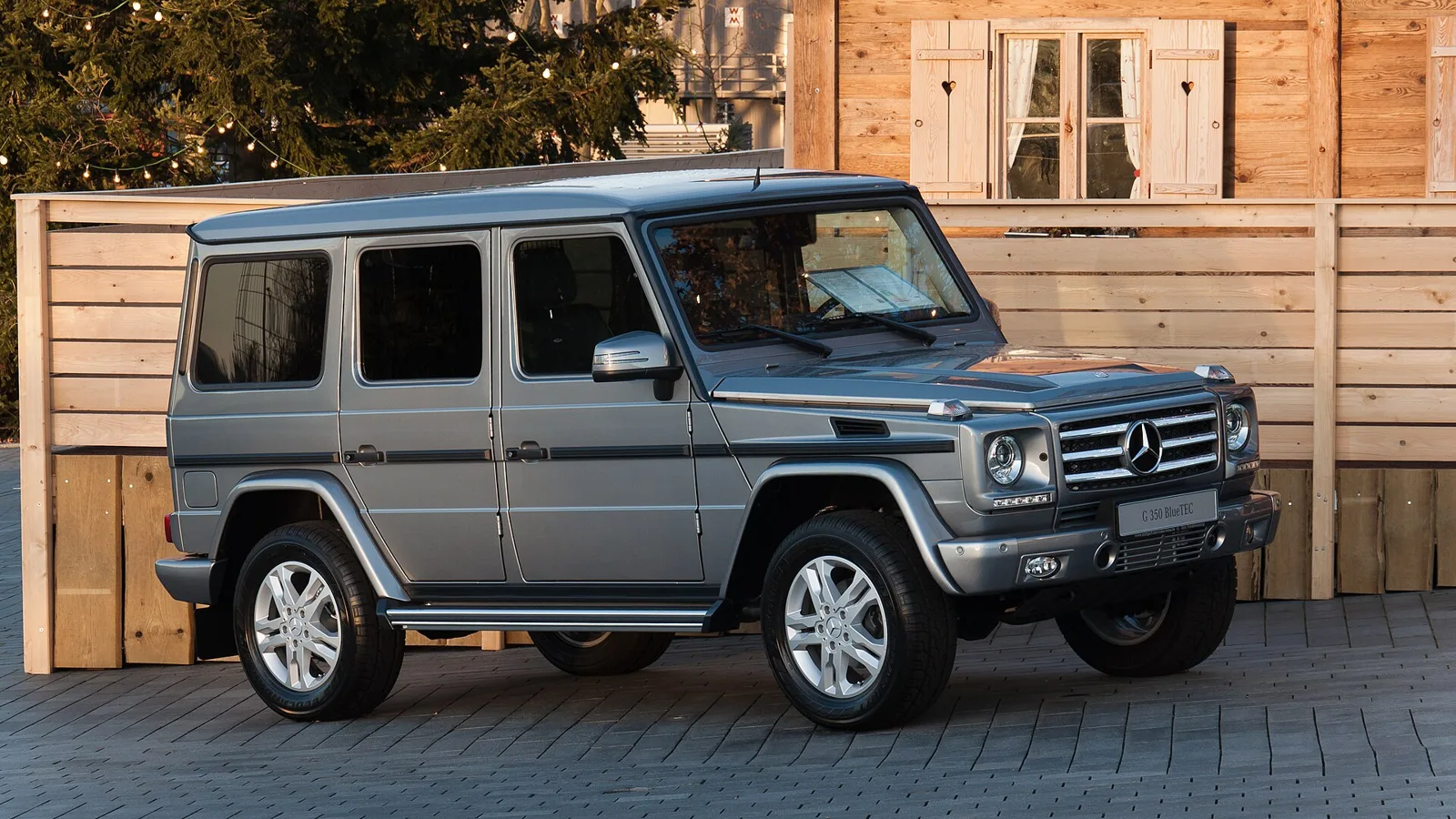
A military off-roader with three locking differentials that refused to be replaced and became a luxury SUV.
The Mercedes-Benz G-Class is a boxy four-wheel-drive SUV developed with Steyr-Daimler-Puch in Graz, Austria, from a military brief. Civilian sales began in 1979. It has three locking differentials, outlived its intended 2006 replacement and reached its 500,000th unit in April 2023.
The Mercedes-Benz G-Class has outlasted the SUV meant to replace it. Mercedes launched the unibody GL-Class in 2006 as its successor, yet the boxy original is still being built, one of the longest-produced vehicles in Daimler's history. Only the Unimog has run longer.
How did the G-Class start as a military truck?
The G-Class began as a military vehicle, after Mohammad Reza Pahlavi, the Shah of Iran, put the idea to Mercedes. Civilian customers could buy one from 1979. In its military role it was sometimes known as the "Wolf".
Development started in 1972, when Daimler-Benz signed a cooperation deal with Steyr-Daimler-Puch of Graz, Austria. The work was split: Mercedes-Benz engineers in Stuttgart handled design and testing, while the team in Graz drew up the production plans. A wooden model went before Daimler-Benz management in 1973, and in 1974 the first drivable prototype began a testing programme that took it through German coalfields, the Sahara Desert and the Arctic Circle.
Graz then built a new production facility in 1975, where the cross-country vehicle was assembled nearly entirely by hand. Production of the "G Model" began there in 1979. The first generation, coded W460, was shown to the press at an off-road proving ground in Toulon, France. Sales opened in September 1979, with three engines and five body styles to choose from.
The G-Class is still in production despite a 2006 successor intended to replace it.
Who builds the G-Class, and what is a G Wagen Steyr?
The G Wagen Steyr connection is the Austrian one. Steyr-Daimler-Puch was the company that partnered with Daimler-Benz on the project, and it built the vehicle in Graz. Its history reaches back to 1864, when Josef und Franz Werndl and Company began as a rifle maker. Bicycles followed in 1894, and a 1934 merger with Austro-Daimler-Puch created Steyr-Daimler-Puch.
The firm's all-terrain pedigree already included the two-cylinder Haflinger, built from 1959 to 1974, and the Pinzgauer, built from 1971 to 2000. The Puch G, also known as the Mercedes G-Class, joined them in 1979. Steyr-Daimler-Puch both designed and first manufactured these utility vehicles.
The company broke up in stages between 1987 and 2001. Automobile production stayed with a division called Steyr-Daimler-Puch Fahrzeugtechnik until Magna International acquired a majority holding in 1998, and in 2001 to 2002 that division was absorbed fully into Magna, becoming Magna Steyr.
Why is it called the Puch G in some countries?
An agreement between Daimler-Benz and Steyr-Daimler-Puch decided the badge by market. Vehicles sold in Austria, Switzerland, Yugoslavia and its successor states, Mongolia and the Eastern European COMECON countries were called Puch G. Everywhere else they were called Mercedes-Benz G-Wagen or G-Class.
The reason was Puch's reputation for all-terrain vehicles, thanks to the Haflinger and Pinzgauer. When the agreement expired in 2000, buyers could order a retrofit kit from the Puch Competence Centre at Magna to swap the Mercedes-Benz badges for Puch emblems. During Pope John Paul II's visit to Austria in 1983, the Popemobile wore Puch emblems instead.
How did the G Wagen go from army truck to luxury SUV?
In small steps, then a big one. The first refinements arrived in 1981: an automatic gearbox, air conditioning, a spare fuel tank, headlamp guards and a cable winch. The 230 GE, introduced in Turin in 1982, brought fuel injection, plus better front seats, extra heating, wider tyres and fender flares. Differential locks, central locking and a rev counter became standard for 1985, and by 1986 over 50,000 G Models had been produced.
Fame arrived in 1980 when Mercedes-Benz built a Popemobile on the 230 G cabriolet for the first visit of Pope John Paul II to Germany. The Vatican received a specially built G-Wagen topped with a clear thermoplastic dome. The "Papa G" now lives in the Mercedes-Benz Museum in Stuttgart.
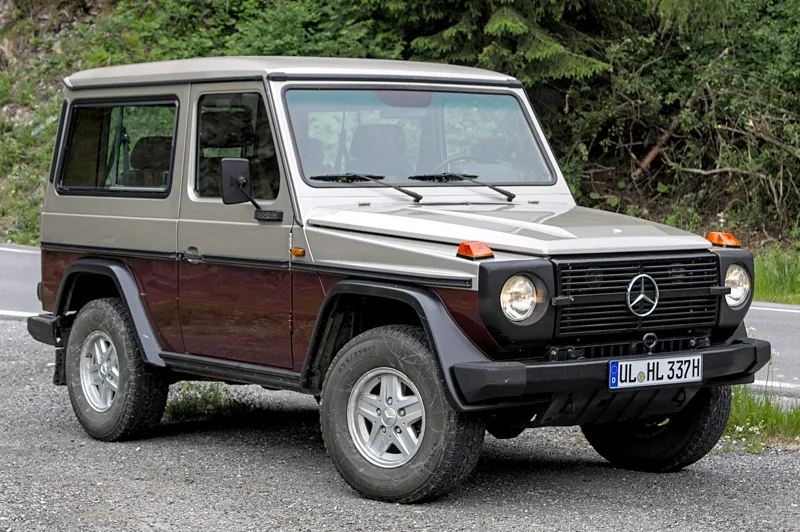
The biggest step came in 1989, when the 10th anniversary model appeared at the Frankfurt International Motor Show with permanent four-wheel drive, wooden interior trim and optional ABS. Production began the following April, and the car was facelifted in 1990. That year the W460 was extensively revised and received a new chassis number, W463, shifting the G-Class away from its spartan, workmanlike roots into luxury territory alongside the S-Class and the plush Range Rover.
The changes were visible. The front end was smoothed out, with the fender flares, cooling grille and headlamp bezels painted in body colour, and side running boards became standard. Inside, wood trim and leather upholstery appeared for the first time. In 1992 the civilian cars gained cruise control, a stainless-steel spare-tyre cover and Burl Walnut trim, and in 1994 the range took the official name G-Class, with ventilated front disc brakes and a driver's air bag as standard. The 100,000th G Model was built in Graz in 1992.
What makes the G-Class special off road?
Its mechanical layout is old-fashioned in the right ways. The G-Class is characterised by boxy styling and body-on-frame construction, in which the body is a separate unit bolted to a ladder-type chassis. It uses three fully locking differentials, which makes it one of the few passenger vehicles with that feature. Locking a differential forces the wheels on an axle to turn together, so a wheel with no grip cannot spin away all the power.
In 2006 a documentary filmmaker drove a standard G 500 to Siberia in winter, the first foreigner to get there in a passenger vehicle. The trip covered nearly 19,000 km with no breakdown, in cold down to -53 degrees C (-63 degrees F).
How powerful did the G-Class become?
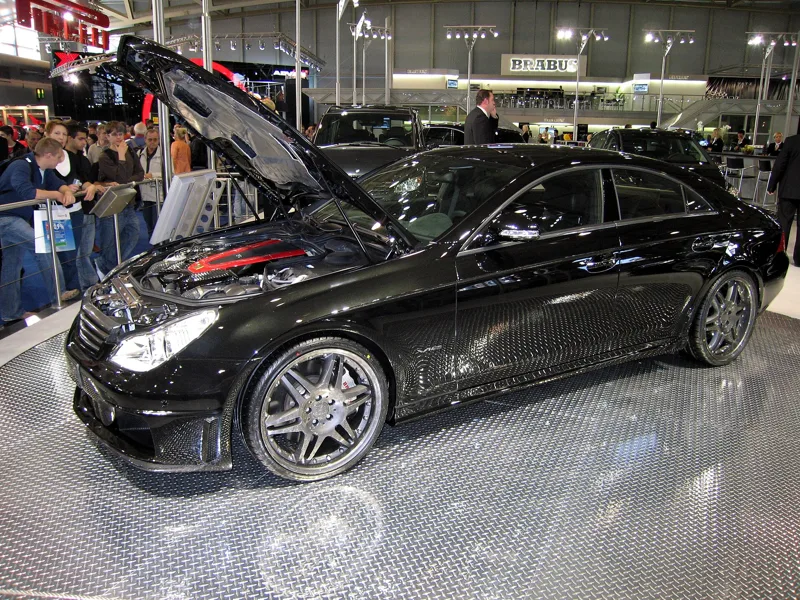
Early W460s were modest. The 230 GE, 280 GE and 300 GD were described as severely underpowered, and although turbocharged diesels existed in other Mercedes-Benz vehicles, none was ever fitted to the W460. Tuners stepped in. Brabus enlarged the 2.3-litre four-cylinder to 2.6 litres for 114 kW (155 PS), while AMG reworked the 2.8-litre six for 134 kW (182 PS).
| Model | Engine | Output |
|---|---|---|
| 230 GE 2.6 Brabus (from 1989) | 2.6-litre four | 114 kW (155 PS) |
| 280 GE AMG | 2.8-litre six | 134 kW (182 PS) |
| G 500 (1998) | V8 | 300 PS (221 kW; 296 hp) |
| G 55 AMG (1999) | V8 | 354 hp |
| G 55 AMG (2004) | Supercharged V8 | 480 PS (353 kW; 473 hp) |
The V8 changed the picture. The range-topping G 500 entered series production in 1998 with 300 PS, and in 1999 a limited run of V8 "G 500 Classic" special editions marked the 20th anniversary. Later that year the G 55 AMG debuted as the strongest G-Class yet, and in 2004 it was upgraded with a supercharged V8. Alongside came safety and driving aids: in 2001, the year of the US market launch, the G-Class gained the Electronic Stability Program, Brake Assist and the four-wheel Electronic Traction System, and also new alloy wheels, a chrome grille, body-colour bumpers and a more luxurious cabin.
One experiment stayed rare. Just two 560 GE cars were built in 1993, a feasibility study that led to a limited series of the W463 500 GE in 1993 and 1994, and then to the G 500 from 1998.
Why did Mercedes never sell the original G-Wagen in America?
Mercedes-Benz never sent the G-Wagen to the United States officially. It saw the car as a utility vehicle that did not match the American idea of a Mercedes-Benz. During the 1980s, grey import specialists brought the W460 in and modified it to meet US regulations. In 1988 the Motor Vehicle Safety Compliance Act tightened the rules, making it harder and more expensive for registered importers to federalise the car, so only a very small number were converted. The engines also counted against it: the underpowered 230 GE, 280 GE and 300 GD may not have appealed to buyers there.
The official US market launch of the G-Class did not happen until 2001.
What are the W460, W461 and W463?
They are three chassis codes, and they explain a lot. The W460 is the original, which ran from 1979 to 1991. The W463 is the luxury version that appeared with the 1990 update. The W461, which took over from the W460, is a deliberately simple vehicle: it has essentially the W460 chassis and body, with the W463 powertrain, and it is built specifically for military users, public authorities and non-governmental organisations. Its electrical system is 24-volt.
The W463 and W461 diverge in useful details. The three-door panel vans in short and long wheelbases, and the rear barn doors, are exclusive to the W461. The W461 was offered in the 1990s with a 2.3-litre four-cylinder petrol engine and a 2.9-litre five-cylinder diesel from 1992 to 2001, then from 2001 to 2014 with a 2.7-litre five-cylinder turbodiesel and later a 3.0-litre V6 turbodiesel. These were sold as the G 270 CDI Worker and G 280 CDI Worker.
Military copies
The G-Wagen served in uniform around the world. The Argentine Army was the first military anywhere to use it, from 1981, with the military model 461, and at least one was captured in the Falklands and later served with the Royal Air Force. Peugeot built the P4 under licence in France for the French Army from 1981 to 1988, with a Peugeot engine and transmission, its own seats and wiring, and rectangular headlamps. Because Peugeot used its own axles, the front differential lock was left out. ELBO assembled kits in Thessaloniki, Greece, for the Greek Army, as the 240 GD with a 2.3-litre petrol four and the 290 GDT with a later 2.9-litre diesel five, and Mercedes-Benz did the same at its Aksaray plant in Turkey.
Stripped-back civilians
Mercedes-Benz also built limited civilian editions of the W461 for people who wanted a stripped-down vehicle. In 2009, to mark 30 years of the G-Class, it launched the G 280 CDI EDITION.30 PUR, a five-door long-wheelbase station wagon with four seats in hard-wearing fabric or vinyl, rubber floor coverings and a wood floor in the load area. The success of the PUR led to the G 280 CDI Professional later in 2009 and the G 300 CDI Professional in 2010, which came in five body variants, including a panel van and a two-door cabriolet. The civilian version continued through 2019, while the military version carried on until 2022, when the new W464 replaced it.
Where this goes next
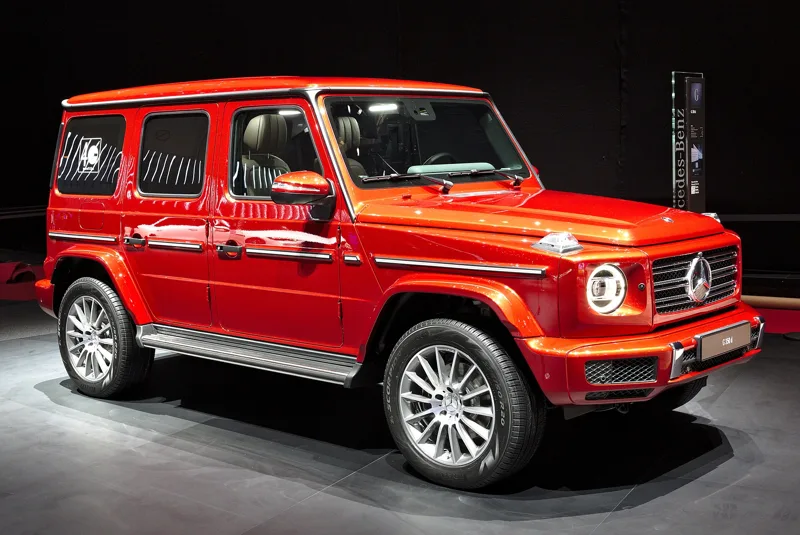
In 2018 Mercedes-Benz introduced the second-generation W463 with a heavily revised chassis, powertrain, body and interior. The 400,000th G-Class was built on 4 December 2020, and the 500,000th followed in April 2023, three years later. That car was a one-off in agave green with a black nose and amber indicators, a tribute to the 1979 press photo of a W460 240 GD caught mid-jump.
Mercedes-Benz announced a new variation of the W461 called the W464 on 1 October 2021. In 2023 it announced plans for a smaller version of the G-Class, nicknamed "little G", though it gave no launch date.