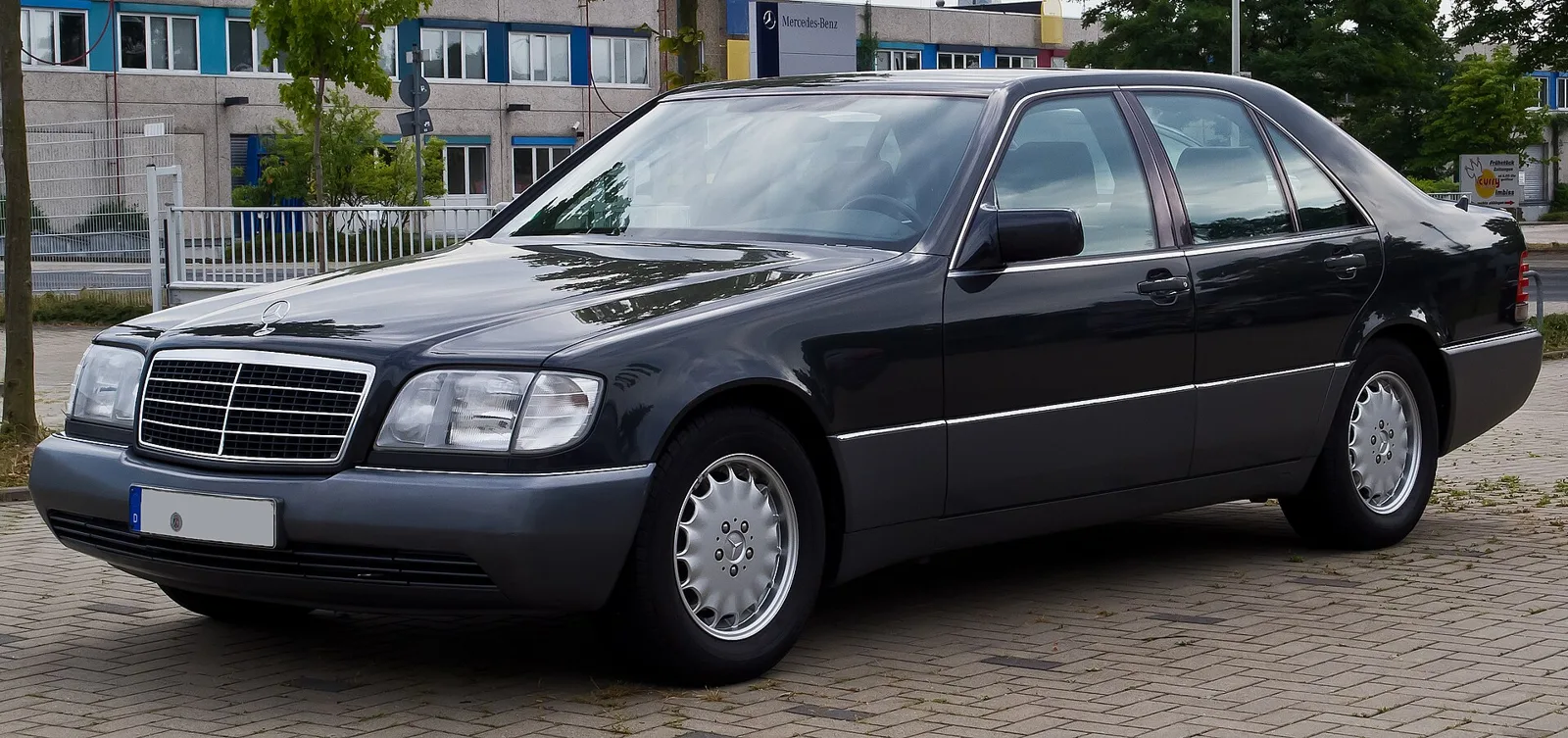
The 1991 to 1998 flagship with a new V12, a V16 that never reached production and a price rise that slowed sales during a recession.
Built between 1991 and 1998, the W140 sat at the top of the S-Class line in saloon and coupe bodies with two wheelbase lengths. A delay forced by BMW's V12 pushed its launch back eighteen months, and its prices and sales suffered during the early 1990s recession.
The Mercedes-Benz W140 was the flagship S-Class of 1991 to 1998, sold as a saloon and a coupe in two wheelbase lengths. Its launch was pushed back by BMW's new V12, and the car that finally arrived carried a V12 of its own, one of the largest engines in the range. Sales were slow during the recession, and the reasons say a good deal about the company in the early 1990s.
Why was the W140 delayed?
The official introduction had originally been set for September 1989. BMW's 7-Series, introduced in 1986 with the first post-war German passenger V12, forced Mercedes-Benz to put the W140 back by eighteen months to 1991. The delay gave the company time to develop its own V12 and to rearrange the engine bay around it, along with upgrading the brakes.
Development had begun in 1981. Several design proposals were studied from 1982 until 1986, when a definitive design by Olivier Boulay was chosen on 9 December 1986. Engineering prototypes were tested from early 1987, and the final exterior was locked in September 1987.
Patent filings followed on 23 February 1988 in West Germany and 23 August 1988 in the United States. Bruno Sacco, who led the design, named Jaguar's XJ40 and BMW's E32 7-Series as major influences on the shape.
The final development prototypes were completed in June 1990, and pilot production ran from June 1990 to January 1991. The overruns and the delay cost Wolfgang Peter, the chief engineer, his job.
A delayed flagship, a V12 built to answer BMW and a V16 that never left the prototype stage.
How did the W140 price compare with its rivals?
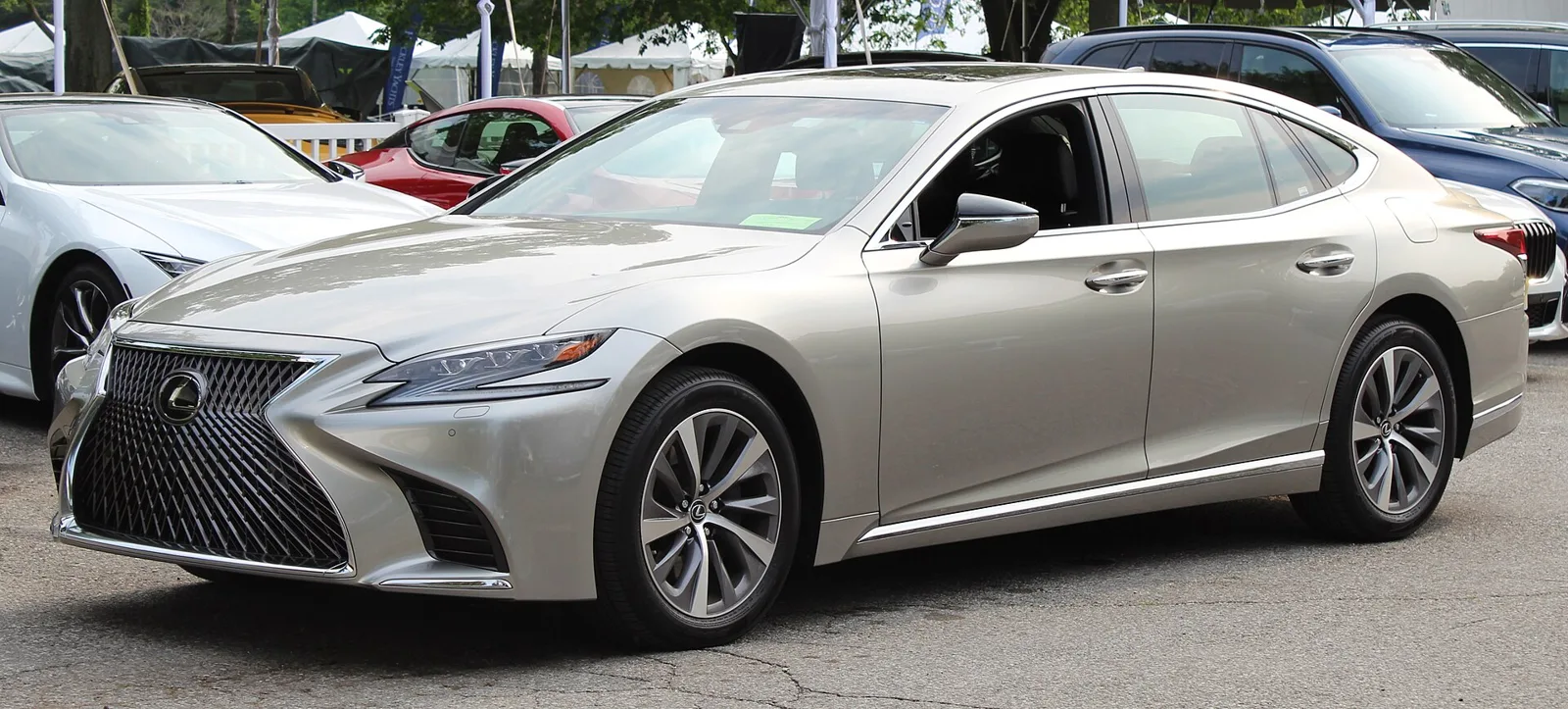
The W140 cost considerably more than the W126 it replaced, by as much as 25 per cent. It went on sale in the recession of 1990 to 1994, when buyers were already tightening their budgets. A six-cylinder 300SE listed at $71,500 in 1992, while the Lexus LS400 started at $44,300 and the Infiniti Q45 at $43,600.
Japanese luxury cars had arrived before the W140, and many prospective buyers switched to them. The Acura Legend started at $28,800. The Japanese cars also promised lower maintenance costs, and the LS400 was considered an ownership experience just as good as the European cars, if not better.
Mercedes-Benz moved away from what it called engineer's design during the 1990s and towards market-driven design. Many enthusiasts argue that the W140 was the last true S-Class, because its successor, the W220, drew criticism for inferior engineering and, in early cars, poor reliability.
What was the V16 project?
Mercedes-Benz developed two very large engines in answer to a rumoured BMW V16: a stillborn V16 based on a stretched V12, and an 8.0-litre W18 meant for a hypothetical 800 SEL or S 800. Only the V12 reached production, and the rest of the programme stayed on paper or in prototypes.
BMW was reportedly testing a V16 in a 7-Series mule called Goldfisch V16. The W18 never got beyond the blueprint stage, but the company built a small fleet of 85 W140 prototypes with V16 engines.
The V16 was quietly cancelled in the early 1990s. Concern about climate protection, and a fear of sending the wrong message to the public, weighed against it.
What engines did the W140 use?
The W140 introduced a new generation of DOHC inline-six and V8 petrol engines with four valves per cylinder and variable valve timing, plus Mercedes-Benz's first passenger V12, introduced in 1991 in response to BMW's 750i. Only the 3.5-litre inline-six diesel carried over from the W126.
The M 120 V12 was offered in 6.0 litres for the whole run. It produced 290 to 300 kW (394 to 408 PS; 389 to 402 hp) with 569 to 580 N m (420 to 428 lb ft) of torque. The 300 kW version was sold in Europe from 1991 to 1992 and in the United States for 1992 only, and in 1993 it was detuned slightly to 290 kW (394 PS; 389 bhp) for emissions control.
An AMG-prepared M 120 rated at 327 kW (445 PS; 439 hp) with 623 N m (460 lb ft) was available only on S-Class and CL-Class coupes, not on the saloons.
The 4.2-litre M 119 E 42 and 5.0-litre M 119 E 50 V8s stayed unchanged for the whole run, though they were detuned in 1993 for emissions. In 1994 AMG developed a 6.0-litre M 119 E 60 rated at 279 kW (379 PS; 374 bhp), with torque of 580 N m (428 lb ft), built in very limited numbers for Japan. The S 500 AMG 6.0 and CL 500 AMG 6.0 were built to order from 1994 to 1999.
The M 104 petrol six arrived in 1992 in two sizes. The 2.8-litre M 104.94x powered the 300 SE 2.8 for a single year before the S 280 took over from 1994 to 1998, and the 3.2-litre M 104.99x went into the 300 SE and 300 SEL before the S 320 from 1994 to 1998.
Diesel buyers had the 3.5-litre OM 603.97x inline six, offered as the 300 SD TURBODIESEL from 1991 to 1993 and the S 350 TURBODIESEL from 1994 to 1996. In 1996 it gave way to the 24-valve OM 606.961 ERE, which was loosely derived from the M 104 petrol engine. The S 300 TURBODIESEL produced 130 kW (177 PS; 174 hp) and 330 N m (243 lb ft), with fuel delivered indirectly into a precombustion chamber.
What transmissions were offered?
At launch the choice was a five-speed manual and a four-speed 4G-Tronic automatic. The W140 was the last S-Class offered with a manual, while the diesels never had one. In 1994 a five-speed version of the 4G-Tronic arrived for the petrol sixes, with an electronically controlled fifth gear bolted onto the transmission housing.
In September 1996 the 5G-Tronic arrived, with the overdrive built into the main housing and full electronic control. It was the sole automatic offered from 1996 to 1998, and it had a higher torque rating than the 4G-Tronic.
4MATIC all-wheel drive, introduced on the W124, was never fitted to the W140. The W220 that followed became the first S-Class with 4MATIC as an extra-cost option.
What chassis technology did the W140 have?
The W140 had a new double-wishbone front axle and an independent multi-link rear. Its first-generation hydropneumatic Adaptive Damping System, a Skyhook-type design, arrived in 1991 and was standard on V12 models and optional on V8s. The system adjusted shock damping to keep the car stable at speed, in aggressive driving, or if the driver lost control.
Self-levelling suspension was integrated with ADS in 1996. The car also introduced a CAN bus network with five nodes.
How safe was the W140?
The V8 and V12 models sent more braking power to the rear wheels, which improved stopping. Brake Assist System BAS followed in 1996 and boosted braking to its maximum in an emergency manoeuvre. Electronic Stability Program appeared in 1995 on the S 600 Coupe, and Mercedes-Benz later licensed the system to other makers.
Mercedes-Benz developed ESP to use on-board computers to improve handling in difficult conditions. Xenon low-beam headlights arrived in 1995, followed by automatic rain-sensing wipers in 1996.
Side airbags and seat occupancy sensors were introduced in 1996 for the 1997 model year. The car also drew headlines for grim reasons: in 1997 an S 280 was involved in the crash in a Paris tunnel that killed Diana, Princess of Wales. Eduard Shevardnadze, President of Georgia, survived an RPG strike while travelling in one.
How did the W140 update in 1994 and 1995?
Mercedes showed the revised W140 at the 1994 Geneva Auto Salon, and it reached showrooms in April 1994. In 1995 the two-tone exterior became monotone, the rear indicator lenses turned clear and xenon low beams were added. The changes reached Europe as 1996.5 models in June 1996 and arrived in the United States as 1997 models.
In June 1993 the range had been renamed. Every model became an S-Class regardless of wheelbase, body or fuel type, starting with the 1994 model year, and the diesels carried a TURBODIESEL label on the boot lid. In 1996 the coupe was spun off as the CL-Class.
How did the W140 body range work?
The W140 kept the three body types of the W126: a four-door saloon in two wheelbase lengths and a two-door coupe. A Pullman version with a 4140 mm wheelbase arrived in 1995 as the S 500 Pullman and S 600 Pullman, and an armour package was available on the S 600 Pullman.
Eighteen S 73 T estate cars with AMG-prepared V12 engines were ordered by the Sultan of Brunei, and ten were delivered. Each had either a coupe or saloon front end, the rear of an S210 estate and S-Class saloon taillights. A one-off long-wheelbase S 500 landaulet was built as a Popemobile for Pope John Paul II in 1997.
What comfort features did the W140 offer?
The W140 introduced double-paned soundproof glass to the S-Class, and it offered 12-way heated front seats with three memory settings, dual-zone climate control and four-zone control on long-wheelbase cars. Its climate system could run for 20 minutes after the engine was switched off.
Parameter steering made low-speed manoeuvres easier by reducing the effort needed in speed-sensitive situations such as parking. The guide rods that extended from the boot lid in reverse were replaced by the sonar-based Parktronic system in 1995.
The exterior mirrors could be folded electrically and were heated, and the V12 offered four-place rear seating with a burlwood console in place of the centre seat, creating a 2+2 layout. Orthopedic seats with inflatable air cushions were an expensive factory option.
In 1995 the S 600 Coupe became the first Mercedes with GPS navigation, called the Auto Pilot System. It used CD-ROM maps and a full colour display in the centre dashboard. Linguatronic voice control and Parktronic arrived in 1996, and the TELEAID emergency and tracking system followed in the US in 1997.
What was the W140's production run?
The W140 was built for eight years, from 1991 to 1998, and production reached 432,732 cars. Of these, 406,710 were saloons and 26,022 were coupes. The car was replaced in 1998 by the W220 saloon and the C215 CL-Class coupe.
Was the W140 the first Mercedes with ECE headlamps in the US?
The W140 was the first Mercedes-Benz model sold in the United States with ECE headlamps, after US rules were revised to allow them. The rules were also extended to cover the H4 (HB2) and H1 bulbs, and ECE stands for the Economic Commission for Europe.
W140 specifications at a glance
| Specification | Detail |
|---|---|
| Production | 1991 to 1998; 432,732 built |
| Launch | Geneva International Motor Show, March 1991; sales from April 1991 |
| Body styles | Saloon (W140 standard, V140 long wheelbase), coupe (C140) |
| V12 | M 120 6.0-litre, 290 to 300 kW (394 to 408 PS; 389 to 402 hp) |
| V8 | M 119 4.2-litre (E 42) and 5.0-litre (E 50) |
| AMG 6.0 | M 119 E 60, 279 kW (379 PS; 374 bhp), 580 N m (428 lb ft) |
| AMG V12 (coupes) | 327 kW (445 PS; 439 hp), 623 N m (460 lb ft) |
| Diesel | S 300 TURBODIESEL, 130 kW (177 PS; 174 hp), 330 N m (243 lb ft) |
| Transmission | Five-speed manual and 4G-Tronic at launch; 5G-Tronic from 1996 |
| Price against W126 | Up to 25 per cent higher |
| Successors | W220 saloon and C215 CL-Class coupe, 1998 |