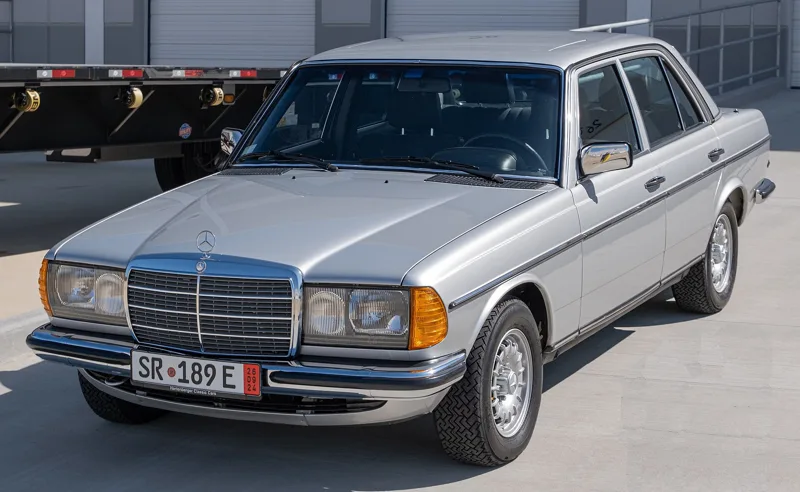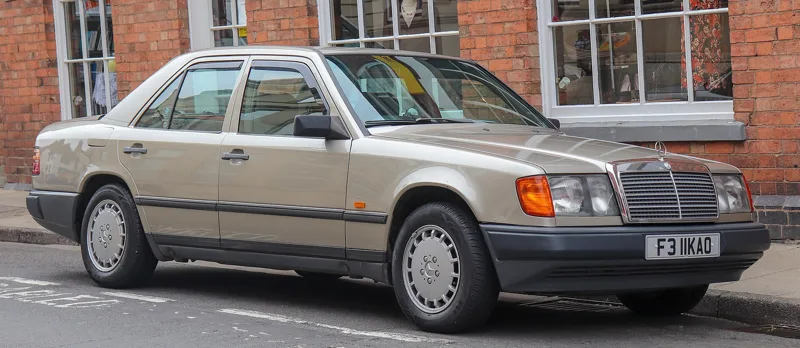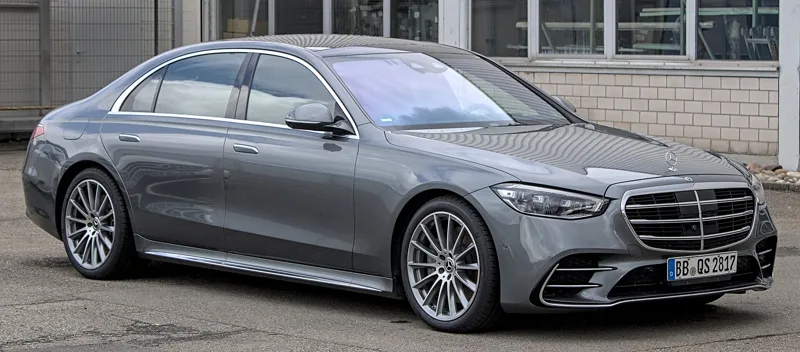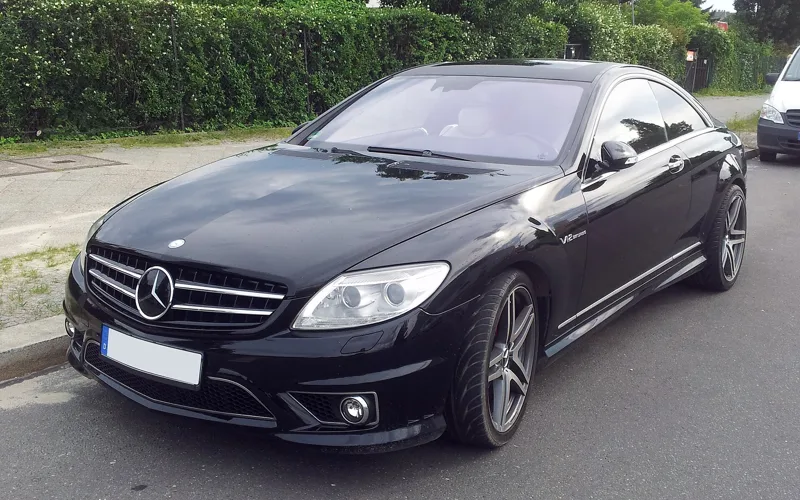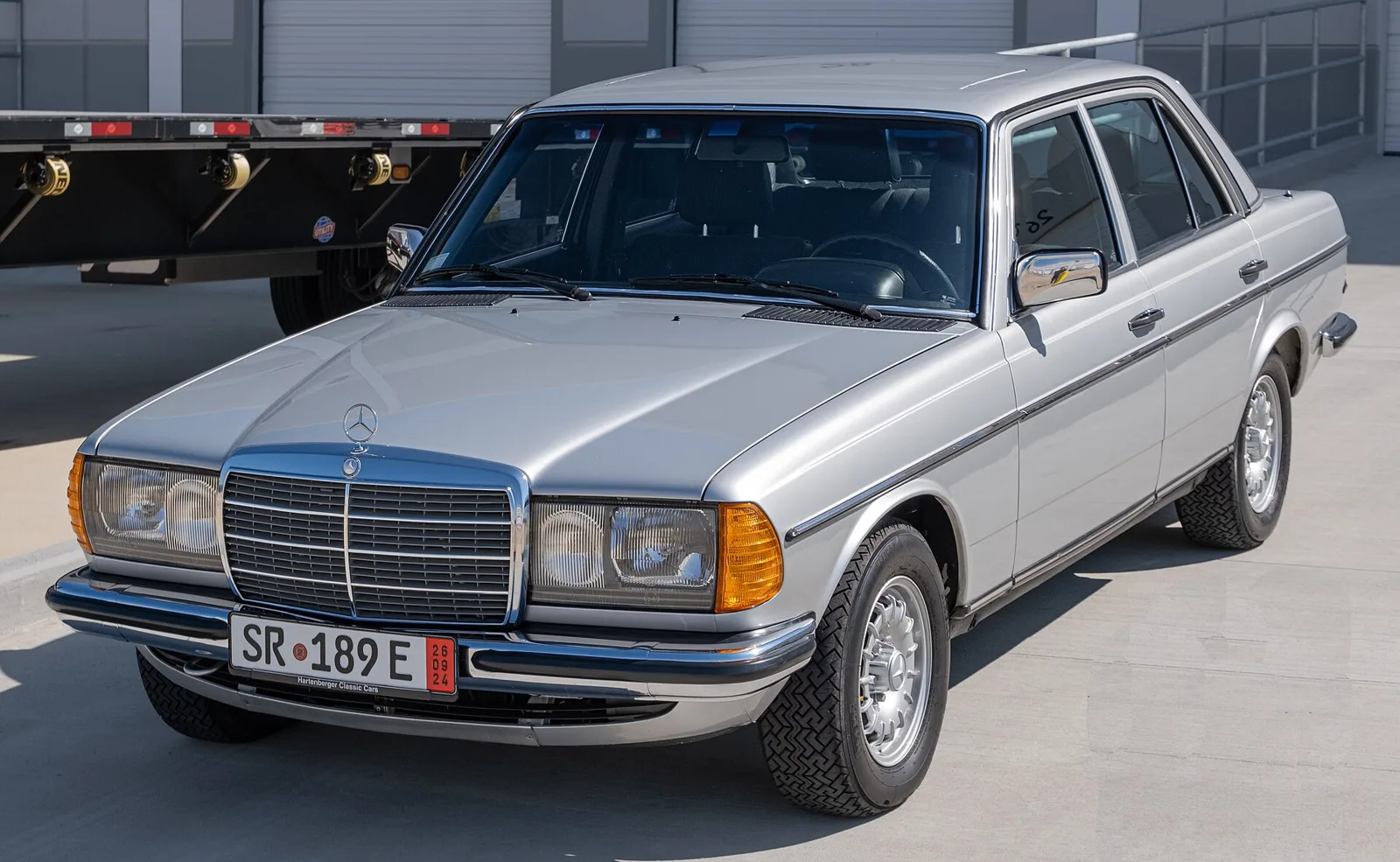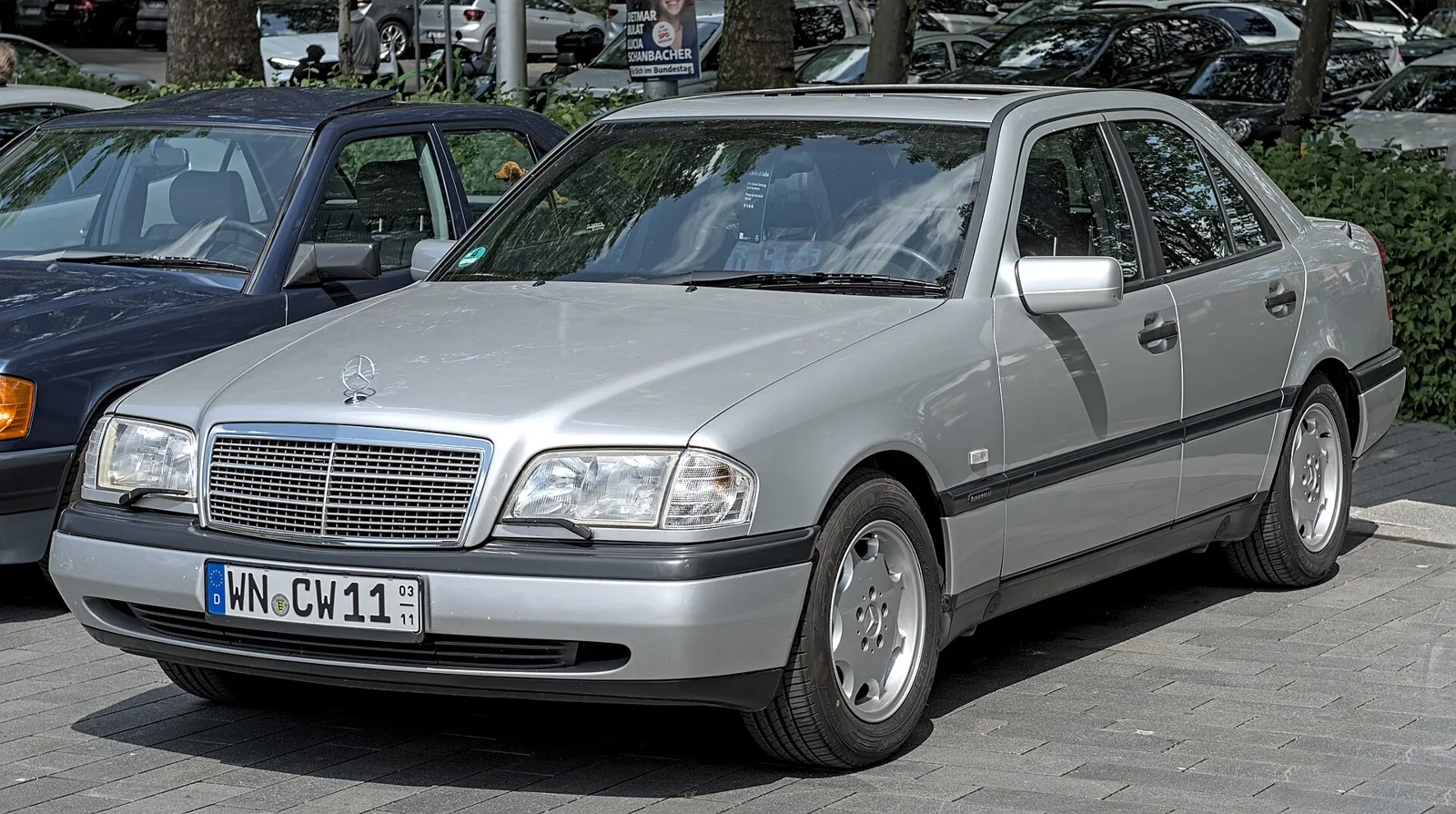
Four generations of the compact Mercedes saloon, from the 190 replacement through the AMG V8 years to aluminium construction, a cabriolet and a plug-in hybrid.
The Mercedes C-Class began as the W202 in 1993, replacing the 190 series. The W203 followed in 2000, the W204 in 2007 and the W205 in 2014, each adding body styles, engines and AMG versions, until the W206 became the fifth generation.
In the summer of 2003, development of the W204 C-Class leaned on a 2.1 terabyte digital replica of the car that was run over a virtual 15 million miles, an industry first that allowed crash testing before any physical prototype existed. That detail shows how far the model travelled between the W202 of 1993 and the W205 that finished in 2021.
Four generations turned a compact entry-level saloon into a family of estates, coupes, a cabriolet and a plug-in hybrid. Along the way the AMG versions stopped being tuned saloons and became cars engineered as performance models, and each generation answered a specific rival or a specific rule.
How did the Mercedes W202 C-Class start the story?
The W202 was the first C-Class, replacing the 190 series in June 1993 and built between 1992 and 2001. It was Mercedes' entry-level model until the A-Class arrived in 1997, and production reached 1,847,382 over model years 1994 to 2000.
Work on the replacement began in October 1986, with design under Bruno Sacco starting in 1987. By December 1988 the first full-scale models had been cut to two directions. Olivier Boulay's proposal won in 1989, the shape was frozen in January 1990 and it was patented on 19 December 1990. North America received the car in November 1993.
Four generations took the C-Class from entry-level saloon to a range with a cabriolet, a plug-in hybrid and an AMG V8.
What engines powered the W202 C-Class?
The W202 launched with multi-valve M111 petrol fours in the C 180, C 200 and C 220, plus a straight-six in the C 280 rated at 193 PS. Diesels used the 190's OM601 or a five-cylinder OM605, and a supercharged C 230 Kompressor matched the C 280's output.
The fours began at 1.8 litres and 122 PS in the C 180 and reached 150 PS in the 2.2-litre C 220, the only four-cylinder the United States received. Diesel buyers had the 2.0-litre OM601, and many of those cars went to work as taxis because they used little fuel and kept running.
The surprise was the C 230 Kompressor. Its Roots-type supercharger lifted the four-cylinder to 193 PS at 5300 rpm, the first time Mercedes had used supercharging in 50 years. Because of tax law, Italy and Portugal got a supercharged 2.0-litre C 200 Kompressor with a similar output instead.
The 1997 refresh reshaped the engine room. The diesels switched to the OM611, a common rail unit developed with Bosch, and the new C 220 CDI made 30 PS more than the diesel it replaced. The inline sixes gave way to the M112 V6 family, with three valves per cylinder and twin spark plugs. The C 230 became the V6 C 240, and the C 280 kept its displacement and gained 4 PS.
How did W202 gearboxes and safety equipment develop?
German buyers got a five-speed manual as standard with a four-speed automatic as an option, while American buyers received the automatic as standard. A five-speed automatic replaced the old four-speed in 1996, and ESP became standard across the range in 1999, a first for a compact saloon.
At launch the safety list held a driver airbag, ABS and side-impact protection built into the body, with a front passenger airbag standard from 1995. The 1997 facelift added front side airbags and Brake Assist as standard, plus ASR on almost every model, and the two basic models caught up in 1998. The same facelift brought darker tail lamps, new wheels, reshaped bumpers and Kompressor badges on supercharged cars.
Which W202 models took on the BMW M3?
The C 36 AMG of 1993 was the first genuine performance C-Class, built to counter the six-cylinder BMW M3. Its 3.6-litre engine made 280 PS (206 kW; 276 hp) at 5750 rpm and 385 Nm at 4000 rpm. Only 5200 were produced.
AMG had by then become a Daimler-Benz subsidiary, and the C 36 was essentially a ready-to-sell C 280 taken apart and tuned at the AMG factory. The suspension dropped 25 mm. The car covered 0-60 mph in 5.8 seconds, with a limiter at 250 km/h (155 mph), though an unrestricted car was recorded at 272 km/h (169 mph).
The C 43 AMG followed in late 1997 and changed the job description. A 4.3-litre V8, the M113 first seen in the W210 E 430, delivered about 306 PS and 410 Nm, and the saloon reached 100 km/h in 5.7 seconds. It was the first C-Class with a Mercedes V8 and the first AMG assembled entirely at a Mercedes factory. Roughly 4,200 were built before spring 2000, around 20 percent of them estates, and only 25 of the 2000 model year reached the United States.
What made the Mercedes W203 C-Class different from the W202?
The W203 was the second generation, sold from 1999 to 2010 under DaimlerChrysler. It added a hatchback SportCoupe and an estate to the saloon, brought common rail diesels and a standard six-speed manual to most of the range, and went on sale in September 2000 after a presentation on 21 March 2000.
Design work began in mid-1994 and the board approved the final shape in December 1995. Most engines came over from the W202, though the C 320 was new, with 160 kW (218 PS). The SportCoupe, internally CL203, was shown in October 2000, and the estate, S203, arrived in 2001. From the 2003 model year a family of supercharged 1.8-litre M271 fours spread across the range, including a natural gas version, and the C 240 and C 320 could be had with 4MATIC four-wheel drive.
By 20 September 2006 more than two million W203s had been sold: 1.4 million saloons, 330,000 estates and 283,000 SportCoupes. Over 30 percent went to Germany and over 20 percent to the United States. The last saloon left Sindelfingen on 14 December 2006.
What changed in the 2004 W203 facelift?
The refresh arrived in early 2004, with a new interior of four chrome gauges around a multifunction display, a fully integrated iPod kit, optional Bluetooth and fresh bumpers and grilles outside. The bigger story sat under the bonnet.
New M272 petrol and OM642 diesel V6 engines followed, and the C230, C280 and C350 replaced the C240 and C320 with 150 kW (204 PS), 170 kW (231 PS) and 200 kW (272 PS). That was up to 24 percent more than the sixes they replaced, with better economy and lower CO2. The V6 cars received the seven-speed 7G-Tronic automatic, and the 320 CDI gained a new 3.0-litre V6 diesel.
Which AMG models did the W203 offer?
The W203 had three AMG models, and they did not behave alike. The C 32 AMG used a supercharged V6, the C 30 CDI AMG a five-cylinder diesel that remains the only diesel AMG ever sold, and the C 55 AMG a naturally aspirated 5.4-litre V8 that earned a reputation for reliability.
The C 32 AMG ran from 2001 to 2003 and was designed to match the displacement of the BMW E46 M3. Its 3.2-litre V6 carried an IHI twin-screw supercharger and produced 260 kW (354 PS) and 450 Nm, with a 5.2 second sprint to 100 km/h. AMG built 6,695 saloons and 1,556 estates. The C 30 CDI AMG of 2002 to 2004 used a 3.0-litre diesel with 170 kW (231 PS) and 540 Nm, missed its sales targets and was retired in 2004.
The C 55 AMG of 2005 and 2006 used a V8 from the M113 family with 270 kW (367 PS) and 510 Nm, cutting the 0-100 km/h time to 4.7 seconds. It borrowed its longer nose from the CLK 55 AMG and was the first AMG C-Class with quad exhausts. A Nurburgring Nordschleife lap of 8:22 compared with 8:37 for the C 32. Where the C 32 before it and the C 63 after it were plagued by engine problems, the C 55 has been praised for staying healthy.
What were the SportCoupe and the CLC?
The SportCoupe, code-named Peanut, was a three-door hatchback on the W203 platform, sold in Europe from October 2000. It was seven inches (178 mm) shorter than the saloon on the same wheelbase and wore a star grille. From October 2000 until 2007, 230,000 were built in Bremen and Brazil.
In North America the C 230 and C 320 versions were the cheapest Mercedes on sale, which led some commentators to say an inexpensive Mercedes undermined the badge. Mercedes, though, reported that 40 percent of SportCoupe buyers came back for a more expensive model. In 2008 the coupe became the separate CLC-Class, built at Juiz de Fora in Brazil with a front and tail inspired by the W204. Daimler then ended the line.
How did the W204 C-Class improve on the W203?
The W204 was the third generation, sold as a saloon from 2007 to 2014, an estate from 2008 to 2014 and a coupe from 2011 to 2015. Production passed 2.4 million, making it the brand's best seller at the time.
DaimlerChrysler introduced it on 18 January 2007 at the Geneva show. Buyers chose between Classic, Elegance and Avantgarde trims, called SE and Sport in the United Kingdom. Avantgarde added a sport grille with three wide bars and an optional AMG body kit, and most advertising featured that look. An agility control package adjusted damper settings to road conditions and driving style, and the 4MATIC cars used permanent all-wheel drive with a 45:55 torque split.
From spring 2008 the BlueEFFICIENCY cars chased economy with a drag coefficient of 0.25, a suspension lowered by 15 mm, a grille shutter and low rolling resistance Michelin tyres. The C 350 switched in 2011 to a new 3.5-litre M276 V6, lifting output from 215 kW (292 PS) to 225 kW (306 PS). A limited C 250 CDI BlueEFFICIENCY Prime Edition was capped at 5,000 units.
What was the C 63 AMG of the W204 generation?
The C 63 AMG was the first AMG C-Class to be more than a bolt-on package. Its 6.2-litre V8 sat behind a front suspension shared with the CLK 63 AMG Black Series, and its steering was the sharpest in the Mercedes range at the time.
Earlier AMG versions had been criticised by Car and Driver for relentless understeer and heavy steering. Car and Driver measured 3.9 seconds to 60 mph and a quarter mile in 12.3 seconds at 116 mph in its December 2007 test. The P31 Development Package of 2010 raised output from 457 PS (336 kW; 451 hp) to 487 PS (358 kW; 480 hp) and the top speed to 280 km/h (174 mph), using forged pistons from the M159 engine of the SLS AMG.
W204 versus W205, where did the biggest gaps open up?
The W205 arrived in 2014 as the first car on the Modular Rear Architecture, an aluminium-heavy structure that cut weight by 100 kg (220 lb). It was also about 94 mm longer and 43 mm wider than the W204, and its AMG C 63 swapped the old 6.2-litre V8 for a 4.0-litre twin-turbo that Mercedes says used 32 percent less fuel.
The car was presented on 16 December 2013, and production began on 4 February 2014 at Bremen. European sales started in March 2014, North America followed in September 2014 and South Africa in March 2015. By then the CLA of April 2013 had taken over as Mercedes' entry-level saloon. The first engines were a 2.0-litre turbo four with 241 hp (180 kW) and a 3.0-litre bi-turbo V6 with 329 hp (245 kW), on a four-link front and five-link rear suspension.
Which bodies and hybrids did the W205 add?
The W205 range grew to saloon, estate (S205), coupe (C205), cabriolet (A205) and long-wheelbase saloon (V205). The C 350e plug-in hybrid arrived in January 2015, and the first C-Class cabriolet followed at Geneva in 2016.
The C 350e paired a four-cylinder petrol engine with a 60 kW electric motor for a combined 205 kW (275 hp). A 6.2 kWh lithium-ion battery gave an electric range of 31 km (19 mi), and on the NEDC cycle it returned 2.1 L/100 km with CO2 emissions of 48 g/km. A diesel plug-in C 350 followed in 2018.
The coupe, first shown in Frankfurt in 2015, offered Collision Prevention Assist able to brake autonomously at speeds up to 124 mph (200 km/h). The cabriolet was the only compact cabriolet Mercedes had offered since 1955, and its fabric roof opened or closed in 20 seconds at speeds up to 50 km/h (31 mph).
How fast were the W205 AMG models?
The W205 produced three AMG tiers. The C 450 AMG 4MATIC of 2015 to 2017 became the AMG C 43 in 2017, while the C 63 and C 63 S used the 4.0-litre twin-turbo V8 shared with the AMG GT, making 469 hp (350 kW) and 503 hp (375 kW) respectively.
The C 450 had a twin-turbo 3.0-litre V6 with 362 hp (270 kW) and reached 100 km/h in 4.9 seconds. The C 63 was quoted at 4.1 seconds with a 250 km/h limiter, and the S at 3.9 seconds, with its limiter raised to 290 km/h (180 mph) on special request from AMG. The optional AMG Performance Exhaust let drivers open and close exhaust flaps, but noise and emissions rules muted it from 2019. The estate was Formula One's official Medical Car from 2015 to 2021.
What did the 2018 facelift add to the W205?
The 2018 refresh made LED headlights standard, added a 12.3-inch display and Apple CarPlay, and introduced Active Lane Assist, Active Emergency Stop Assist and Active Steering Assist. The diesels were a 148 hp C 200 d, a 192 hp C 220 d and a 241 hp C 300 d.
The C 200 with EQ Boost badging delivered a nominal 181 hp, with an extra 13 hp on kickdown as the alternator acted as a motor, while the C 300 made 255 hp without electric help. The AMG C 43 gained larger turbos and 385 hp, up 23 hp.
How do the four C-Class generations compare?
| Generation | Years | Body styles | Top AMG | Headline change |
|---|---|---|---|---|
| W202 | 1992 to 2001 | Saloon, estate | C 43 AMG, 4.3-litre V8 | Replaced the 190 series; ESP standard across the range in 1999 |
| W203 | 1999 to 2010 | Saloon, estate, SportCoupe | C 55 AMG, 5.4-litre V8 | Common rail diesels and a six-speed manual; CLC spin-off |
| W204 | 2007 to 2015 | Saloon, estate, coupe | C 63 AMG, 6.2-litre V8 | Digital prototype testing; BlueEFFICIENCY models |
| W205 | 2014 to 2021 | Saloon, estate, coupe, cabriolet, long-wheelbase saloon | C 63 S, 4.0-litre twin-turbo V8 | Aluminium MRA platform; C 350e plug-in hybrid |
Where this goes next
The W205 was superseded by the W206, which makes the C-Class a model now in its fifth generation. The AMG GT 4-Door Coupe took over the Formula One Medical Car role that the C 63 estate held from 2015 to 2021.