How compressed-air bellows replaced steel springs in buses, luxury cars and off-road vehicles, and why they still fail the way they do.
Air suspension uses a compressor to inflate rubber air springs in place of steel coils, letting height and ride be adjusted. It was patented in 1901, reached cars in the 1950s and became electronically controlled in systems such as Land Rover's ECAS.
Air suspension replaces steel springs with air-filled bellows that a compressor inflates, so a vehicle's height and ride can be adjusted. The idea dates back to patents filed in 1901, and it has since moved from buses and trucks into luxury cars and electronically controlled systems.
What is air suspension and how does it work?
Air suspension uses an electric or engine-driven compressor to pump air into a flexible bellows, usually made from textile-reinforced rubber. The air inflates the bellows and raises the chassis from the axle. Unlike hydropneumatic designs, which use pressurized liquid, it relies only on air, and the correct term for the unit is air spring.
The main purpose is a smooth, constant ride quality, although some designs are also used for sports suspension. Modern electronic systems in cars and light trucks almost always include self-levelling along with raising and lowering functions. The older names air bags and air bellows still appear, although they often describe just the rubber element and its end plates.
An air spring trades a steel coil for a rubber bellows and a compressor, a trade that has shaped the car for more than a century.
Where is air suspension used today?
Heavy vehicles such as buses and trucks have long used air springs in place of steel springs, and so have some passenger cars. Semi trailers and passenger trains also rely on the technology. A long list of car makers has used it, including Audi, BMW, Cadillac, Mercedes-Benz, Porsche, Tesla and Volvo.
Most air suspension designs are height adjustable, which makes it easier to get into the vehicle, clear bumps or cross rough terrain. Lower ground clearance also changes aerodynamics, so automakers use active suspension to improve efficiency or handling. Tesla's Active Air Suspension on the Model S and Model X lowers the car for aerodynamics and increased range.
Some manufacturers have linked the suspension to sport modes. Jaguar and Porsche changed spring rate and damping settings in those modes, and the Lincoln Mark VIII tied its suspension settings to the memory seat so the car adjusted to each driver.
When was air suspension first developed?
Air suspension dates back to 1901. British engineer Archibald Sharp patented a seal for pneumatic or hydraulic apparatus, then applied for a patent on using it for air suspension on bicycles. An American, William W. Humphreys, patented a pneumatic spring for vehicles later that month.
Sharp's seal was the foundation for further developments. Air Springs Ltd began producing the A.S.L. motorcycle in 1909, with pneumatic suspension at front and rear. Its forks replaced the normal spring with a telescopic air unit that could be pressurized to suit the rider, and production stopped in 1914.
From 1920 the Frenchman George Messier supplied aftermarket pneumatic suspension. His 1922-1930 Messier automobiles used air to hold the car aloft on four gas bubbles, which made them an early example of the idea on four-wheeled cars.
During World War II the United States developed air suspension for heavy aircraft, because compact construction saved weight. Air systems also gave self-levelling in heavy trucks and aircraft, so the axle height no longer depended on vehicle load. In 1946 William Bushnell Stout built a non-production prototype, the Stout Scarab, which included four-wheel independent air suspension among its many innovations.
How did cars adopt air suspension after the war?
In 1950 the Air Lift Company patented a rubber air spring that fitted inside a factory coil spring. General Motors then made air suspension standard on the 1957 Cadillac Eldorado Brougham, and Buick and American Motors followed with optional systems that were cheaper or more practical.
The Air Lift spring expanded into the spaces inside the coil spring, which stopped it from fully compressing and kept the vehicle from sagging. Springs of this kind were commonly used on NASCAR race cars for many years.
The Eldorado Brougham used an Air Dome assembly at each wheel, with sensors that compensated for uneven road surfaces and held the car's height automatically. The system ran for 1958 and 1959, and it was offered as an extra-cost option on other Cadillacs.
Buick's 1958 Air-Poised Suspension used four cylinders of air in place of conventional coil springs. A Bootstrap control on the dashboard raised the car 5.5 inches (139.7 millimetres) for steep ramps, rutted country roads, tyre changes or cleaning whitewall tyres. For 1959 Buick offered Air Ride on all models, with soft-rate steel coil springs at the front and air springs at the rear.
Rambler Ambassadors and American Motors Cross Country wagons offered the Air-Coil Ride system in 1958 and 1959. It used an engine-driven compressor, a reservoir, air bags inside the coil springs and a ride-height control. At $99 the option was not popular, and American Motors dropped it for 1960.
Which European makers pioneered the technology?
In Europe, the Frenchman Paul Mages developed a functioning air-oil hydropneumatic suspension in 1954, and Citroen used it on the Traction Avant 15 Hydraulique and then the DS. In 1960 the Borgward P 100 became the first German car with self-levelling air suspension, and Rolls-Royce later fitted self-levelling to its 1965 Silver Shadow.
The hydropneumatic design brought together the strengths of earlier air concepts, but it used hydraulic fluid rather than air under pressure. Citroen replaced the steel springs on the rear axle of its top model in 1954, and in 1955 the DS had four-wheel hydropneumatic suspension.
The DS combined a very soft, comfortable ride with controlled movements for sharp handling, together with self-levelling. In 1956 EMD's experimental Aerotrain also used air suspension, showing that the principle could work on a train as well.
Rolls-Royce built its Silver Shadow self-levelling system under licence from Citroen, which shows how the European designs spread beyond their country of origin.
What did Mercedes-Benz add to air suspension?
In 1962 the Mercedes-Benz W112 featured air suspension on the 300SE, using a Bosch main valve with two axle valves at the front and one at the rear. An engine-driven single-cylinder compressor filled a reservoir that kept the ride height constant. By 1964 the Mercedes-Benz 600 used larger air springs, and its compressed air system also powered the brake servo.
Each wheel axle controlled a cone-shaped air spring, which kept the car level under changing loads. The 600 kept this compressed air system until 1984, even though it was expensive, complex and problematic.
In 1975 the Mercedes-Benz 450SEL 6.9 used hydropneumatic suspension once the patents on the technology had expired. That design replaced the older compressed air arrangement. American-built production cars went without air suspension from 1960 to 1983.
In 1984 Ford introduced a new air suspension design on the Lincoln Continental Mark VII. In 1986 Nissan also modified MacPherson struts with air bags, fitted to the Cedric and Gloria.
What is ECAS and how does it work?
Electronically Controlled Air Suspension, or ECAS, is a variable-height system developed in the early 1990s by Dunlop Systems and Components of Coventry, UK. It first appeared on the 1993 model year Land Rover Range Rover, and it gives five heights chosen from speed and undercarriage sensors.
The five heights run from lowest to highest: Loading, Highway, Standard, Off-Road and Off-Road Extended. Loading and Off-Road are available only at speeds below about 35 mph (56 km/h). Highway is set automatically once the vehicle has moved above about 50 mph (80 km/h) for over 30 seconds.
A manual ride height switch lets the driver override the automatic choice. Because air pressure sets the height, ECAS can raise the body for off-road clearance and lower it for faster road driving. A mechanical spring cannot do this, since its deflection is proportional to load.
The developers also designed LoadSafe, a related system that measures load and changes in load on light commercial vehicles fitted with air springs. Dunlop later made the electronic control unit small enough to fit under the vehicle floor, with smaller and lighter control valves.
What parts make up an air suspension system?
A typical ECAS-style system has an air spring at each wheel, a compressor, an optional storage tank, a valve block, an electronic control unit, air pipes, a drier and height sensors. Every part has to work with the others, because a fault in one can leave the vehicle stranded at the bump-stops.
- A vulcanised rubber air spring at each wheel.
- An air compressor, usually in the boot or under the bonnet.
- An optional storage tank that holds air at about 1000 kPa for rapid kneel.
- A valve block that routes air through solenoids, valves and many o-rings.
- An ECAS computer that talks to the car's main computer, the BeCM, and decides where air goes.
- Air pipes of 6 mm, which carry air from the tank to the springs through the valve block.
- An air drier canister containing desiccant to remove moisture.
- Height sensors, ideally on all four corners of the vehicle.
What is multi-chamber air suspension?
Multi-chamber air suspension controls spring characteristics step by step rather than all at once. The Genesis G90 uses three chambers, with three giving a smooth ride and one providing a more dynamic driving feel. Its basic minimum ground height is divided into four stages.
A solenoid valve between each chamber and a separate electronic control unit manages the process. Four stages are available, namely high, normal, low and ultra-low, chosen according to driving mode, speed and environment. The driver is told about the garage control on the infotainment screen.
The same system also covers speed bump control, hump control, slope control and high-speed driving control. Those functions are activated under the air suspension control, so the car adapts to the road as well as the mode.
What are the advantages and drawbacks of air suspension?
Air suspension gives a smooth, constant ride and lets the height change with the road, the load and the driving mode. Its weaknesses are mostly about upkeep, because leaks, moisture and cheap parts can make the system unreliable. The balance depends on how the system is built, maintained and used.
Advantages:
- A smooth, constant ride quality, with height that does not depend on load.
- Adjustable height for entry, obstacles and rough terrain.
- Lower height for aerodynamics and better efficiency.
- Air helper springs that can be deflated to keep the factory ride when not towing.
Drawbacks:
- Leaks and moisture cause failures, particularly in compressors and dryers.
- A failed air spring can immobilise a vehicle, since it may rub the ground or sit too high to move.
- Cheap, low quality components tend to be very unreliable.
- Air lines can wear through where they rub against sharp chassis edges.
Why do air suspension systems fail?
Most failures trace back to moisture, leaks or wear. Air bags fail from wet rust, age or debris punctures. Compressors burn out while trying to hold pressure in a leaking system, and a saturated dryer lets moisture build up and damage the springs.
| Part | Common cause | Typical result |
|---|---|---|
| Air bag or strut | Wet rust, age, moisture or road debris | Failure can immobilise the vehicle |
| Air line | Rubbing on a sharp edge or moving component | A hole forms in the nylon brake line |
| Fittings | Cheap components or poor installation | Very unreliable connections |
| Compressor | Leaking springs or moisture in the electronics | Burns out maintaining pressure |
| Dryer | Desiccant that has become saturated | Moisture builds up and damages springs |
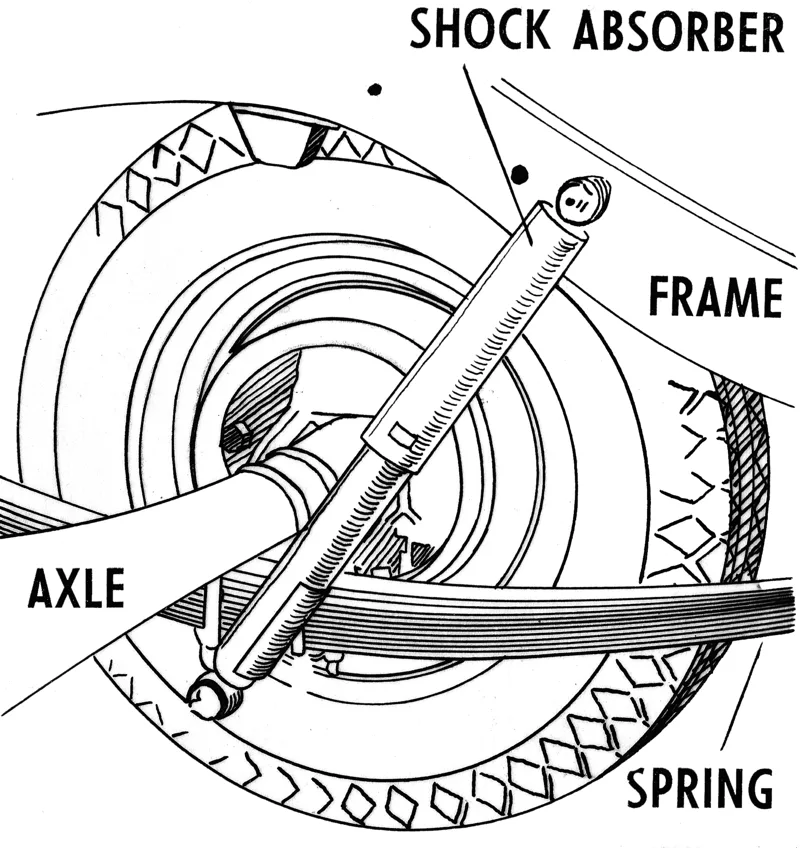
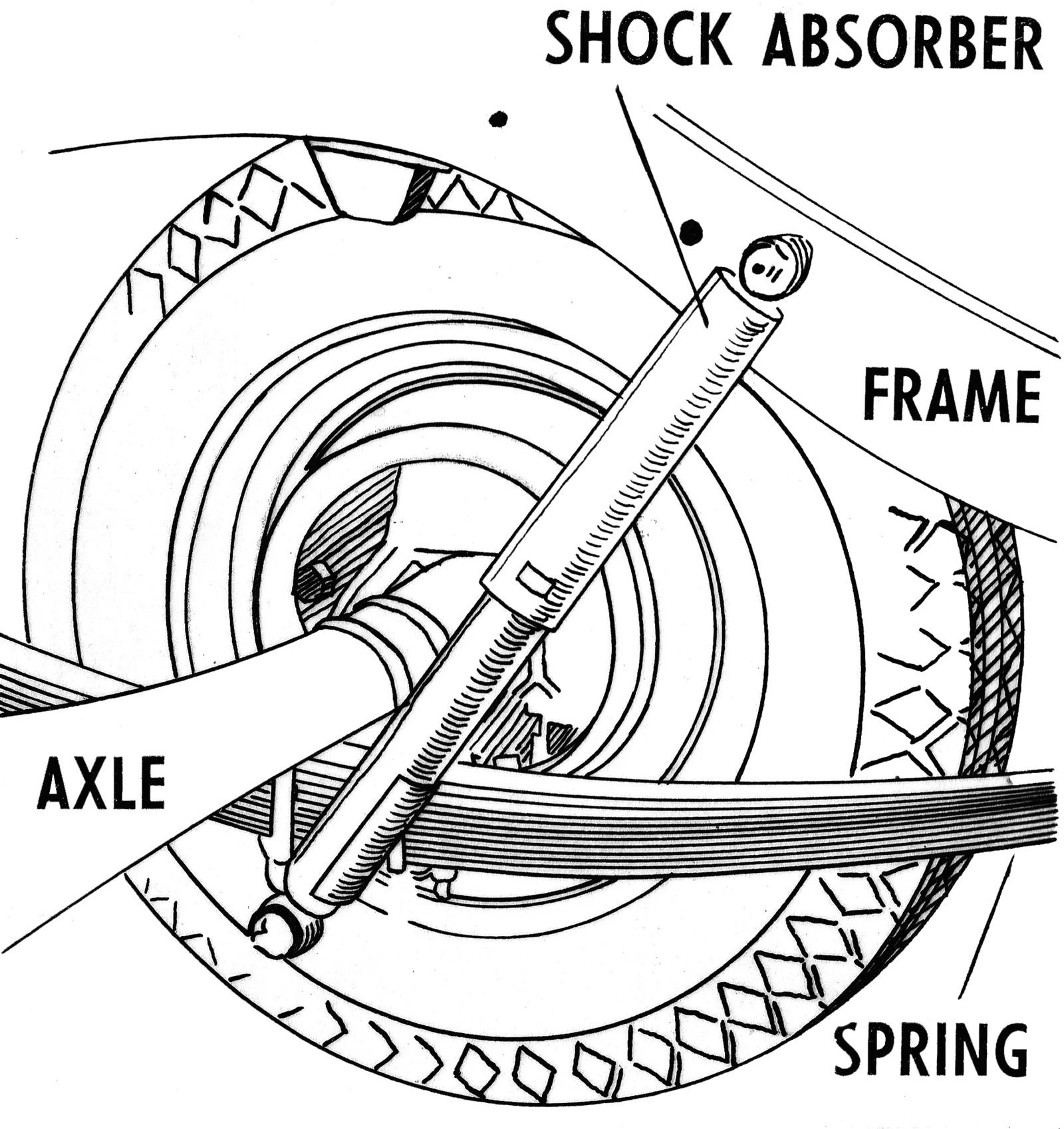
Rubber can dry out, and over-extension can tear the flexible layers of an air spring that is not constrained by a shock absorber. Most modern automotive systems have overcome many of these problems.
Air line failure is usually a hole formed where the DOT-approved nylon air brake line rubs a sharp chassis edge or a moving suspension component. It can take some time to appear after installation. Road debris is unlikely to cause it in normal use, although harsh off-road conditions can.
Compressor failure is primarily due to leaks. Low specification compressors with insufficient duty cycle are often bought for their low cost. Leaks from main seal wear caused by excessive duty cycle also bring compressor failure forward.
ECAS has its own safeguard. Its computer can detect a fault and switch the system into Hard Fault Mode, which lowers the vehicle onto its bump-stops. The vehicle remains usable with much reduced performance until the fault is repaired.
How is air suspension used in custom cars and for towing?
Custom builders use air springs to make vehicles sit very low and then rise high enough to clear obstacles on paved surfaces. Owners also fit air helper springs to boost load capacity for towing or hauling. The helper springs can be deflated when they are not needed, which keeps the factory ride.
Most custom systems use small electric or engine-driven compressors that fill an on-board receiver tank. The tank must be sized for the task using a formula based on compressor output, atmospheric pressure and the compressed pressure. Radical setups sometimes use high-pressure industrial gas bottles, such as the tanks used for welding gases.
Pneumatic solenoid valves control the airflow, and a momentary switch lets the owner make adjustments. Installation means removing the metal coil or leaf spring and fitting an air bag in its place. Owners sometimes cut away parts of the frame and add a C-notch to keep the structure sound.
Why do buses and coaches use air springs?
Buses and coaches use air springs because the suspension can adjust to different vehicle weights by changing bag pressure, which keeps the vehicle at a set height. Coaches also have a ferry lift that raises the body and increases its breakover angle. The kneel-down facility lowers the step height for passengers.
The ferry lift helps coaches load onto ferries with steep ramps, where the risk of grounding out is high. It also suits rough ground and steep crests. Kneel Down is more common on public transport buses, and it supports the built-in wheelchair ramps.
Commercial vehicles have used air suspension extensively since 1980.