A full-size ultra-luxury limousine with a 6.3-litre V8, a hydraulic comfort system and a clientele of heads of state, royalty and film stars.
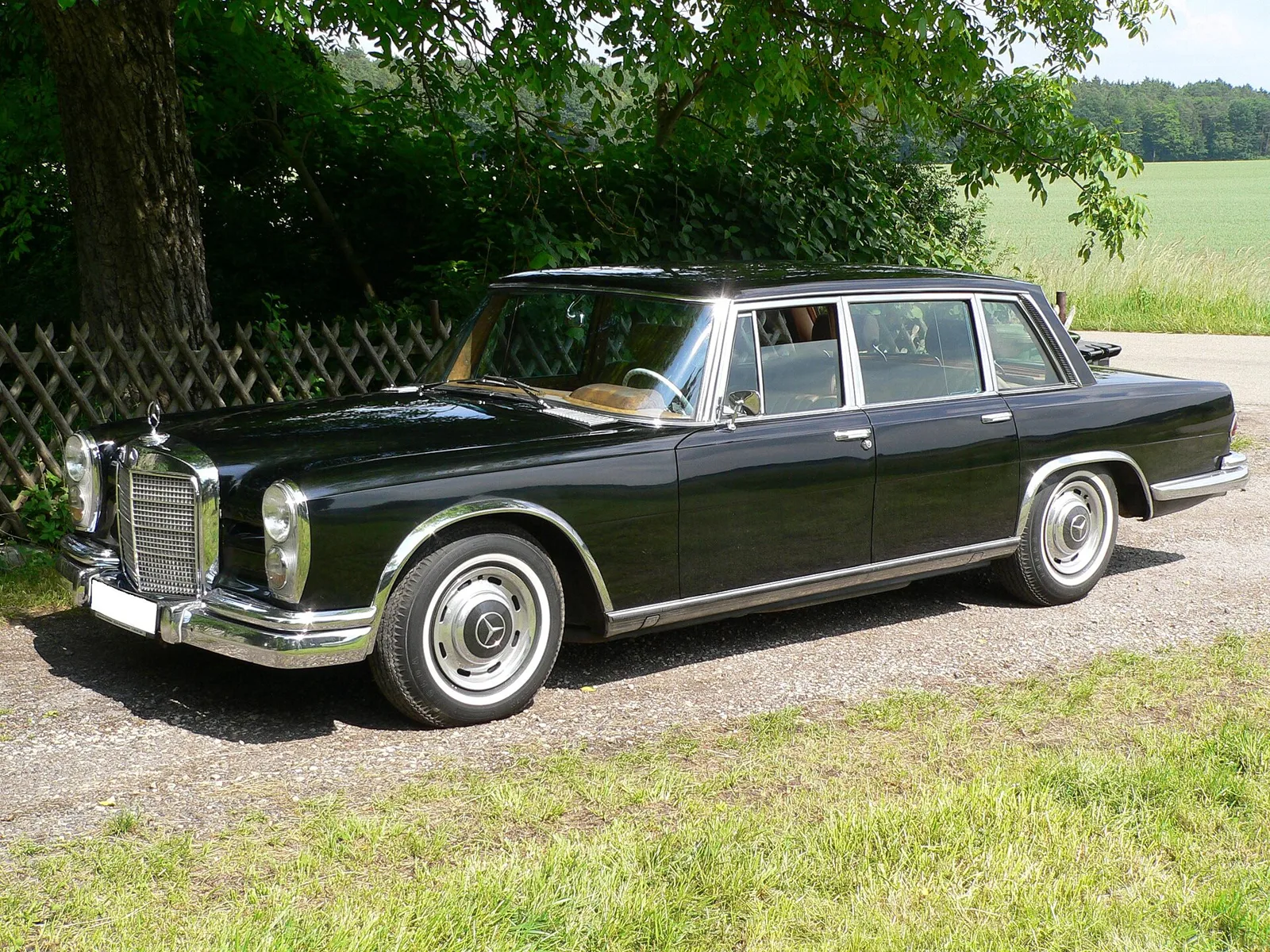
The Mercedes-Benz 600 (W100) was a full-size ultra-luxury limousine that Daimler-Benz built from 1963 to 1981. It used a 6.3 L V8 and a hydraulic comfort system, and 2,677 were produced across saloon, Pullman and landaulet bodies.
Daimler-Benz's 600 sat at the very top of its range from 1963 until 1981. Known as the Grosser Mercedes, it was priced well above the 300-series and launched at a price that no other car could match. Its hydraulic systems and long-wheelbase limousines made it a favourite of heads of state and the very wealthy.
Where did the Mercedes-Benz 600 come from?
The 600 was a single-generation limousine made by Daimler-Benz between 1963 and 1981. It replaced the W189 300d, the last version of the company's flagship 300-series, which had been built between the early 1950s and early 1960s. Its nickname, Grosser Mercedes, recalled the 1930s Mercedes 770.
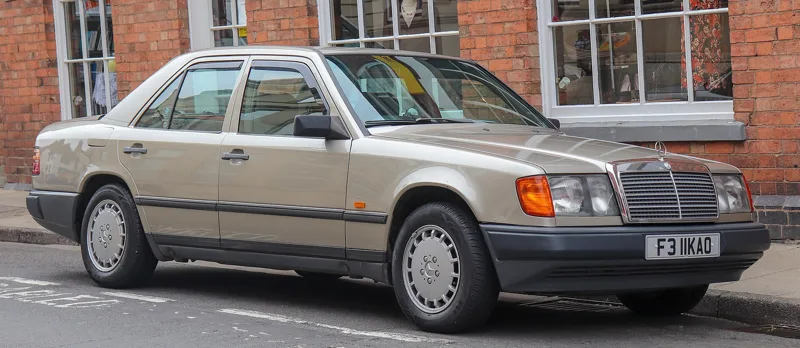
The elder W186 model was nicknamed the Adenauer, after Konrad Adenauer, who served as the first Chancellor of West Germany and used several of these cars during his time in office. That lineage gave the 600 a political heritage before it had even been launched.
Many historians and enthusiasts regard the 600 as the greatest luxury automobile ever produced. That view rests on its engineering, its finish and the scale of its amenities, which set it apart from the rest of the market.
The most expensive car in the world at its 1963 launch, built with a hydraulic system that opened its windows and seats at a touch.
What was the 600's place in the market?
At its launch in 1963 the 600 carried the highest price tag of any car on sale. It sat well above the 300-series in price, equipment and status, which made it the brand's clear statement of luxury.
Its rivals were British and American. The 600 competed with the Rolls-Royce and Bentley marques, along with the Cadillac and the top model lines from Lincoln.
The price gap was matched by the size of the car. It was a full-size limousine, designed to be driven or chauffeured with a degree of comfort that no mass-produced saloon could offer.
Why is the 600 so expensive to keep?
The 600 remains costly to own and maintain. Its complexity, along with the high cost of parts and specialist labour, makes running one a serious commitment, even though the car is decades old.
Values reflect that expense. Good-condition examples and historically important models can fetch up to $3.5 million, a figure that reflects both their rarity and their prestige.
Owners were also helped by the optional hydraulic repair kit, which came with special tools for minor failures. The kit reflected how closely the car's systems depended on regular, careful attention.
Was the 600 owner-driven or chauffeured?
The short-wheelbase models were designed for owner-drivers. The long-wheelbase and limousine models were intended for chauffeurs, and they often included a central divider with a power window.
That split shaped how the car was specified and sold. Buyers who wanted to drive themselves chose the shorter car, while those who employed a driver took the longer models with the divider for privacy in the rear.
How many Mercedes-Benz 600s were built?
Series production started in August 1963 for the 1964 model year and carried on until 1981. In that time 2,677 units were built, made up of 2,190 saloons, 304 Pullmans, 124 six-door Pullmans and 59 landaulets.
The Pullman figure of 304 refers to the long-wheelbase four-door limousine, the most common of the stretched versions. Each body style served a different buyer, from the owner-driver to the state chauffeur.
What body styles did the 600 come in?
The 600 came in two wheelbase lengths, producing three main variants. The short-wheelbase four-door saloon could be fitted with a power divider window between the front and rear seats, although most were built without one.
The long-wheelbase four-door Pullman had two extra rear-facing seats behind a power divider. The six-door Pullman added two forward-facing jump seats at the middle doors, alongside a rear bench.
Several limousines were turned into landaulets, which had a retractable top covering some or all of the rear cabin. The short roof folds down like a cabriolet over the last row, while the long roof folds back from the cabin divider, a layout known as the Presidential roof.
What were the landaulets used for?
Landaulets were used by state figures and by the German government, notably during the 1965 state visit of Queen Elizabeth II. The Vatican also commissioned a specially designed 600 four-door landaulet for the Pope, which now resides at the Mercedes-Benz Museum in Stuttgart.
The total of 59 included four-door models of unknown breakdown, along with six-door short roofs and six-door long roofs. Production of the landaulet versions ended in 1980.
A six-door long-roof landaulet once used by the former Yugoslavian president Josip Broz Tito sold in England in 2017 for GBP 2.5 million, which underlines how much these cars have come to be valued.
What special 600s were built?
In 1965 Mercedes built a single special short-wheelbase two-door coupe. The standard wheelbase was cut by 22 cm (8.6 inches) between the axles, to 298 cm (117.3 in).
In 1967 Mercedes also built a short-wheelbase four-door landaulet for the former racing driver Philipp Constantin von Berckheim. It combined the handling of the shorter wheelbase with the qualities of a landaulet, and it remains one of the rarest 600 variants.
What engine powered the 600?
The 600's size, weight and hydraulic amenities needed more power than Mercedes' largest engine at the time, the 3-litre six-cylinder M189, could provide. Mercedes developed an eight-cylinder with well over double the capacity, the 6.3 L (384.4 cu in) M100.
Each bank of the M100 carried one overhead camshaft, and mechanical injection by Bosch, working intermittently at eight points, fed the fuel. It produced 250 PS (184 kW; 247 hp), enough to move the heavy car with ease.
Why was the V12 never built?
Chief engineer Fritz Nallinger originally envisioned two models. The base model was to be called 500, for the planned 5-litre V8, and the top model 750 was to feature a 7.5-litre V12. Adolf Wente was assigned the design of the V12.
The V12, codenamed M101, was to share the 90-degree bank angle with the V8, but it would have used dual chain-driven overhead camshafts and a Bosch fuel injection pump in the central vee. It was intended to deliver around 380-400 bhp.
The V8 was eventually enlarged to 6.3 litres instead, and the V12 never entered production. The eight-cylinder engine became the one that the car was built around.
How did the comfort hydraulic system work?
The 600 used what Mercedes called the comfort hydraulic system, made for the car in conjunction with Bosch. It used pressurised hydraulic fluid to control the windows, seats, optional sunroof, boot lid, ventilator flap and air conditioning.
The closed-loop system was powered by an engine-driven pump that raised the pressure to around 150 bar (2,176 psi). A switch opened a control valve, which sent fluid to the pistons that moved each amenity. A nitrogen-filled accumulator held some pressure when the car was switched off.
The result was unusually quick and quiet operation compared with the vacuum and electrical systems of other luxury cars. Early models even pulled the doors closed if they were not fully latched, an early form of self-closing door.
The hydraulics needed attentive maintenance, because a leak in any line could stop an amenity from working and eventually fail the whole system. Mercedes offered the optional hydraulic repair kit so owners could deal with minor failures themselves.
How did the air suspension work?
The 600's suspension was not fully hydraulic, because Citroen held a patent on hydropneumatic suspension at the time. Instead the car used a load-levelling air suspension similar to the one on the Mercedes-Benz W112, pressurised by an engine-driven pump.
The driver could choose from three settings on a switch on the steering column. N-mode was for normal driving, H-mode raised the ride height by 50 mm (2.0 in), and S-mode disabled the air suspension for servicing.
Unlike other Mercedes models with this system, the 600 also used the air pump to control brake boosting. If the air system failed, the brakes took priority, and they could even draw on the suspension's air supply at low pressure. The suspension delivered excellent ride quality, and it beat the lap times of the Mercedes-Benz 230SL.
What came after the 600?
The 600 had succeeded the 1961 W112 in using a pneumatic self-levelling suspension. That system was an enhancement of the dashboard-activated torsion bar setup of the 300d Adenauer, and a version of it survives in Mercedes' current Active Body Control.
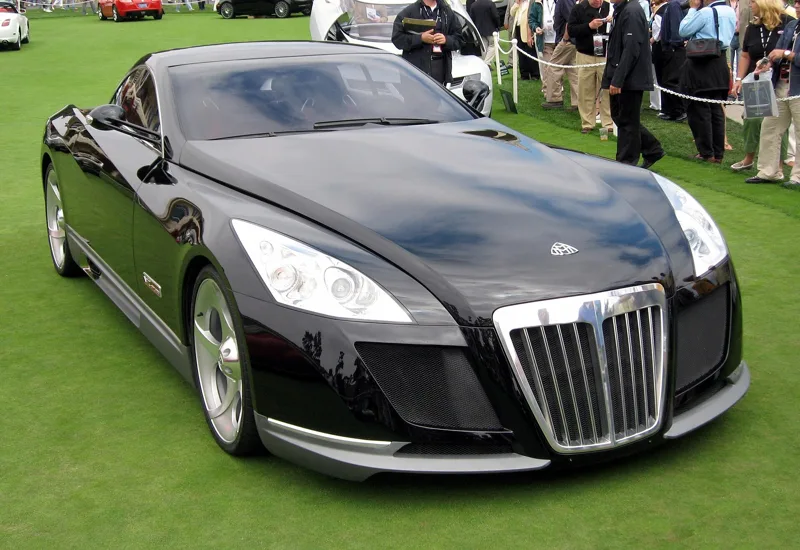
With the car's demise in 1981, the 600 closed a long run of ultra-luxury models that began with the 60 hp Simplex of 1903, although the line was never continuous. The company returned to the segment some 20 years later with the Maybach 57 and 62, but those cars did not sell in the numbers needed, and the Maybach brand was dropped by Mercedes-Benz in 2012.
The top of the range in 2026 is the Mercedes-Maybach S-Class. It does not use its own platform, which marks a more cost-effective approach to the segment. It is seen as a spiritual successor to the Maybach, and it is the first luxury model since the 600 to offer bespoke design touches.
Who owned the Mercedes-Benz 600?
The 600 is well known for its ownership among celebrities, political leaders and royalty through the late 20th century. Those owners helped turn it into the emblem of prestige that it still is today.
Ownership remained expensive, and that exclusivity was part of the car's appeal. The mix of hydraulic sophistication, a chauffeur-driven body and a price well above the rest of the range made it a choice for the very top of the market.
Where did the 600 appear in popular culture?
Several James Bond films used the car. It appeared in On Her Majesty's Secret Service and Diamonds Are Forever, where it carried the villain Blofeld, and in Octopussy a villain is seen leaving London's Sotheby's in a 600 Pullman.
In the 1978 film Who Is Killing the Great Chefs of Europe?, Jacqueline Bisset's character is seized at Heathrow and driven off in a 600 Pullman. The car also turned up in the first episode of Twin Peaks.
On Top Gear, Jeremy Clarkson compared his 1973 short-wheelbase 600 with James May's 1972 Rolls-Royce Corniche. The car also featured in the 1994 song United by Prince Ital Joe and Marky Mark, which showed it being driven in the music video.
What are the Mercedes-Benz 600 specifications?
| Specification | Detail |
|---|---|
| Type | Full-size ultra-luxury limousine, rear-wheel drive |
| Years | 1963 to 1981 |
| Engine | 6.3 L (384.4 cu in) M100 V8 |
| Output | 250 PS (184 kW; 247 hp) |
| Injection | Bosch-made intermittent 8-point mechanical |
| Hydraulic pressure | around 150 bar (2,176 psi) |
| 1965 coupe wheelbase | 298 cm (117.3 in) |
| Total production | 2,677 units |
| Landaulets | 59 built, 1980 production end |
| Predecessor | Mercedes-Benz W189 300d |
| Successor line | Mercedes-Maybach S-Class |