Twin-cam engines, Group 2 homologation and a 1960s racing and rally record that carried the Cortina name across Europe and beyond.
The Lotus Cortina was a UK-built high-performance saloon from 1963 to 1970, produced by Ford with Lotus Cars. The Mark 2 followed in 1967, and the cars went on to win races and rallies across Europe, Britain and the United States.
The Lotus Cortina is a high-performance saloon that Ford and Lotus Cars built in the United Kingdom from 1963 to 1970. Ford supplied the bodyshell and sold the cars, while Lotus fitted a twin-cam engine and reworked the chassis. Two generations were built, with 3,306 Mark 1 cars and 4,093 Mark 2 cars produced.
Each generation started out as an ordinary Ford Cortina. Ford promoted the Mark 1 as the Consul Cortina developed by Lotus, and the Mark 2 was marketed as the Cortina Lotus, a name that stayed with it even after its badges changed.
Where did the Lotus Cortina come from?
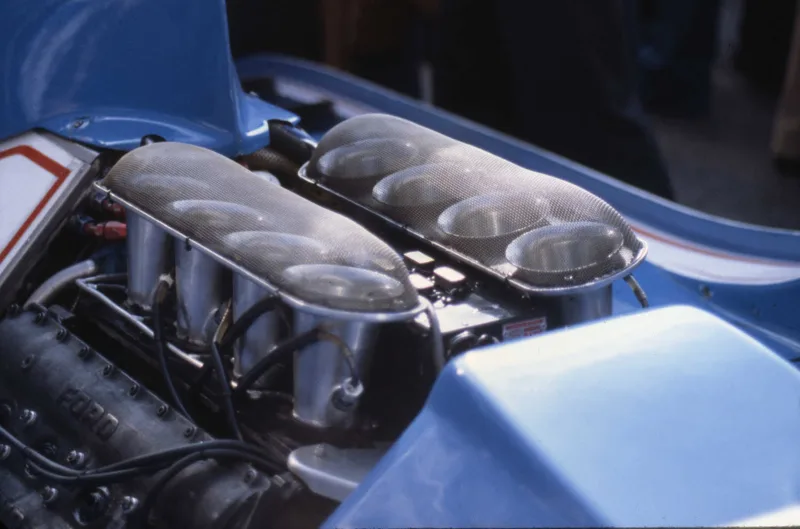
The Lotus Cortina began with Colin Chapman's wish to build his own engines, because the Coventry Climax unit was expensive. Harry Mundy designed a twin-cam version of the Ford Kent engine, and Ford then asked Chapman to fit it to 1,000 saloons so the car could be homologated for Group 2 racing.
Ford supplied the two-door bodyshells and handled all the marketing and selling. Lotus carried out the mechanical and cosmetic changes at its Cheshunt works.
The 1,000-car figure mattered because Group 2 homologation required that many cars to be built before the model could race in that class. The car was homologated in September 1963, and it made its debut in the same month.
The Mark 2 was built differently. Ford had grown concerned about the unreliability of Lotus-built cars, and Lotus was moving to Hethel in Norwich in 1966, so Ford decided to build the Mark 2 itself at Dagenham alongside the other Cortina models.
A Ford saloon that Lotus turned into a touring car winner and a rally contender from one 1963 design.
What engine did the Lotus Cortina use?
The Mark 1 used a 1,557 cc twin-cam engine producing 105 bhp (78 kW; 106 PS). It began life as a 1,498 cc Ford 116E unit, and its bore was enlarged to bring the car nearer the 1.6 litre class in motorsport.
Keith Duckworth of Cosworth helped tune the engine. The unit first appeared in 1962 at the Nurburgring in a Lotus 23 driven by Jim Clark, and it soon reached production Lotus Elans before the Cortina took it on.
Harry Mundy's twin-cam design was built around the Ford 116E, a five-bearing unit. The bore was then enlarged, so the production engine gave the car more capacity than the original Ford unit had offered.
The car used the Elan's close-ratio gearbox and an 8.0 in (200 mm) diaphragm-spring clutch. Those ultra-close ratios suited a race track but made the clutch hard work in traffic, so the ratios were later revised.
How did the Mark 1 differ from a standard Cortina?
The Mark 1 had shorter front struts, forged track control arms and a rear end that swapped leaf springs for coil spring dampers located by an A-bracket. The car also had 9.5 in (240 mm) front discs, built by brake specialist Girling.
Stiffening braces ran behind the rear seat and from the rear wheelarch down to the chassis in the boot. Those braces meant the spare wheel had to move, so it was bolted to the left side of the boot floor, while the battery went behind the right wheelarch to help weight distribution.
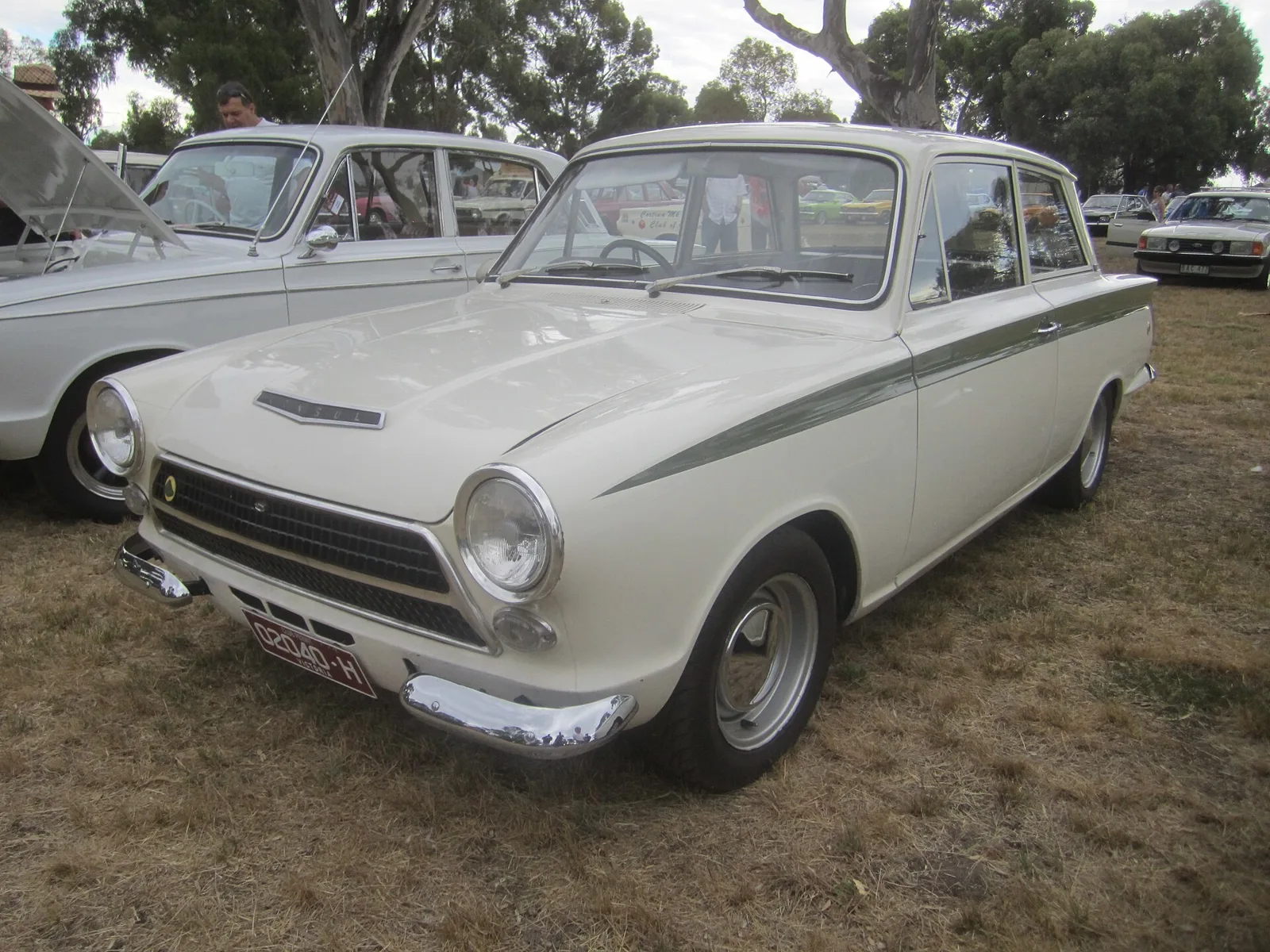
Alloy panels covered the doors, bonnet and boot. Factory cars were painted white with a green stripe, and round Lotus badges marked the rear wings and the radiator grille.
Inside, a new centre console housed the relocated gear lever, and the car had a wood-rimmed steering wheel. The dashboard carried a tachometer and speedometer, along with gauges for oil pressure, water temperature and fuel level.
How did the Mark 1 change during production?
Four main updates tackled early faults, including differential housings that could come away from the casing. The first fixes brought a two-piece prop shaft, Ford's standard transmission casing and Cortina GT gear ratios, and later changes added Cortina GT rear suspension and 2000E gearbox ratios.
A late 1964 facelift brought a full-width grille and Aeroflow ventilation outlets on the rear C-pillar. The Cortina range as a whole was refreshed at the same time, which affected the Lotus as well.
In mid-1965 the rear suspension changed to the leaf springs and radius arms of the Cortina GT, which removed the stiffening tubing. The rear drums were also swapped for self-adjusting items that year. Left-hand drive cars were built late in Mark 1 production, which ended around late 1966.
The changes made the cars less specialised but far more reliable, and every special part stayed available for competition as well as to members of the public.
How did the Mark 2 differ from the Mark 1?
The Mark 2 was built at Dagenham with a 109 bhp (81 kW; 111 PS) engine, a 3.77:1 final drive and the remote-control gearchange from the Mark 2 GT. It was wider than the Mark 1, so its steel wheels had a different offset, and it came with radial tyres.
Under the bonnet the Mark 2 used an improved engine, the same unit that had been offered as a special equipment option on the Lotus Elan. Its final drive was 3.77:1 rather than the 3.9:1 of the Mark 1, which changed how the car pulled through its gears.
The Mark 2 lost the Lotus stripe and gained a black front grille. The Lotus rear badge was replaced within months by a TWIN CAM badge under the Cortina script, and production ran until 1970. In Europe the car was marketed as the Cortina Twin Cam in 1969 and 1970.
How did the Lotus Cortina perform on the track?
The Cortina Lotus made an immediate impression. At its debut at Oulton Park in September 1963 it finished 3rd and 4th behind two Ford Galaxies, yet it beat the 3.8-litre Jaguars that had dominated saloon racing for years. Team Lotus ran the cars in Britain and Alan Mann Racing ran them in Europe, both for Ford.
Jim Clark won the 1964 British Saloon Car Championship with ease. In the United States, Jackie Stewart and Mike Beckwith won the Marlboro 12-hour, and Alan Mann Racing took a 1-2 at the Six Hour race at Brands Hatch.
The car also won national titles in Austria, South Africa and Sweden, which showed how widely it was campaigned.
1965 was a stronger year, helped by the new leaf spring rear end. Sir John Whitmore won the European Touring Car Championship for Alan Mann Racing in KPU-392C, Jack Sears won his class in the British championship, and Jackie Ickx took the Belgian Saloon Car Championship.
In 1966 Team Lotus entered new cars for the British Saloon Car Championship under Group 5 rules, which allowed fuel injection. BRM tuned the engines, which produced 180 bhp (130 kW; 180 PS) at 7750 rpm, and the cars took 8 class wins, many of them driven by Jim Clark.
Whitmore added four more wins in the European Touring Car Challenge but finished behind the Alfa Romeo Giulia GTA in the standings. In the Trans Am Series the Cortina competed in the under 2000 cc class, and Allan Moffat won Round 3 of the inaugural series in 1966 at Bryar Motorsports Park.
The fastest official speed recorded at Mount Panorama, Bathurst is 147 mph (237 km/h), set by Marc Ducquet in a car owned by Bob Pearson. The car was heavily modified, so that speed reflects a prepared car rather than the factory specification.
How well did the Lotus Cortina rally?
The Cortina Lotus was overshadowed by the Escort in rallying, but it still performed well in the mid-1960s. Henry Taylor took a Cortina GT with a Lotus engine to 4th at the 1963 Spa-Sofia-Liege, and a Cortina Lotus finished 6th on the 1963 RAC Rally.
The 1964 Tour de France Automobile was a 10-day, 4,000-mile (6,400 km) run on sealed roads, mixing sprints, hillclimbs and mountain rallying. Vic Elford and David Seigle-Morris finished 4th outright in the Touring Car category and won the handicap section.
Ford moved to the GT rear suspension in June 1965. The first works victory came in December that year, when Roger Clark and Graham Robson won the Welsh International.
In 1966 Ford homologated the car for Group 1, which required 5000 cars to be built. Bengt Soderstrom won the Acropolis Rally after the leading Mini Cooper S was disqualified, and then took the 1966 RAC Rally outright by 13 minutes with Gunnar Palm. Jim Clark crashed twice in the same event.
Soderstrom's final win before the Mark 2 arrived came in the snowy Swedish Rally of 1967. In Australia, Harry Firth won the first Australian Rally Championship in 1968 with a Lotus Cortina.
What were the Lotus Cortina specifications?
The Mark 1 offered 105 bhp (78 kW; 106 PS) from 1,557 cc, while the Mark 2 raised output to 109 bhp (81 kW; 111 PS). The table keeps the two generations apart and adds the racing engine figures from the Group 5 period.
| Specification | Detail |
|---|---|
| Body | Two-door saloon based on the Ford Cortina |
| Built | 1963 to 1970 in the UK, Ford with Lotus Cars |
| Mark 1 engine | 1,557 cc twin-cam, 105 bhp (78 kW; 106 PS) |
| Mark 2 engine | 109 bhp (81 kW; 111 PS) |
| Mark 1 final drive | 3.9:1 |
| Mark 2 final drive | 3.77:1 |
| Clutch | 8.0 in (200 mm) diaphragm spring |
| Front brakes | 9.5 in (240 mm) discs by Girling |
| Wheels | 5.5J by 13 steel |
| Group 5 racing engine | 180 bhp (130 kW; 180 PS) at 7750 rpm |
| Production | 3,306 Mark 1; 4,093 Mark 2 |
How did critics and owners react?
Early reviews were enthusiastic. One magazine described the car as a tin-top version of a Lotus 7, and it gave enthusiasts who might otherwise have bought a Cortina GT or a Mini-Cooper a serious alternative. It also surprised buyers used to overweight sports cars such as the Austin-Healey 3000.
The launch was not without problems. Some Ford dealerships did not understand the car, and early owners reported low power and differential housings that came away from the casing. Several of these faults were tackled by the four main Mark 1 updates.
Not every early owner was satisfied, and the differential problem recurred often enough to shape the whole Mark 1 programme. The staged changes are the reason the later cars are remembered as the more dependable of the two generations.
The Mark 2 met Ford's aims. It was far more reliable than the Mark 1 yet still quick enough for competition, until the Escort Twin Cam replaced it.
Why do Lotus Cortinas still race today?
Historic Touring Car events around the world still feature Mark 1 Lotus Cortinas, and the cars continue to take class wins against newer machinery. The Bathurst speed shows what a prepared example can still achieve on a demanding Australian circuit.
The alloy panels and the twin-cam engine are the features that set the Lotus version apart from the Cortina GT it was built from. Those same features explain why the cars still stand out in historic events.