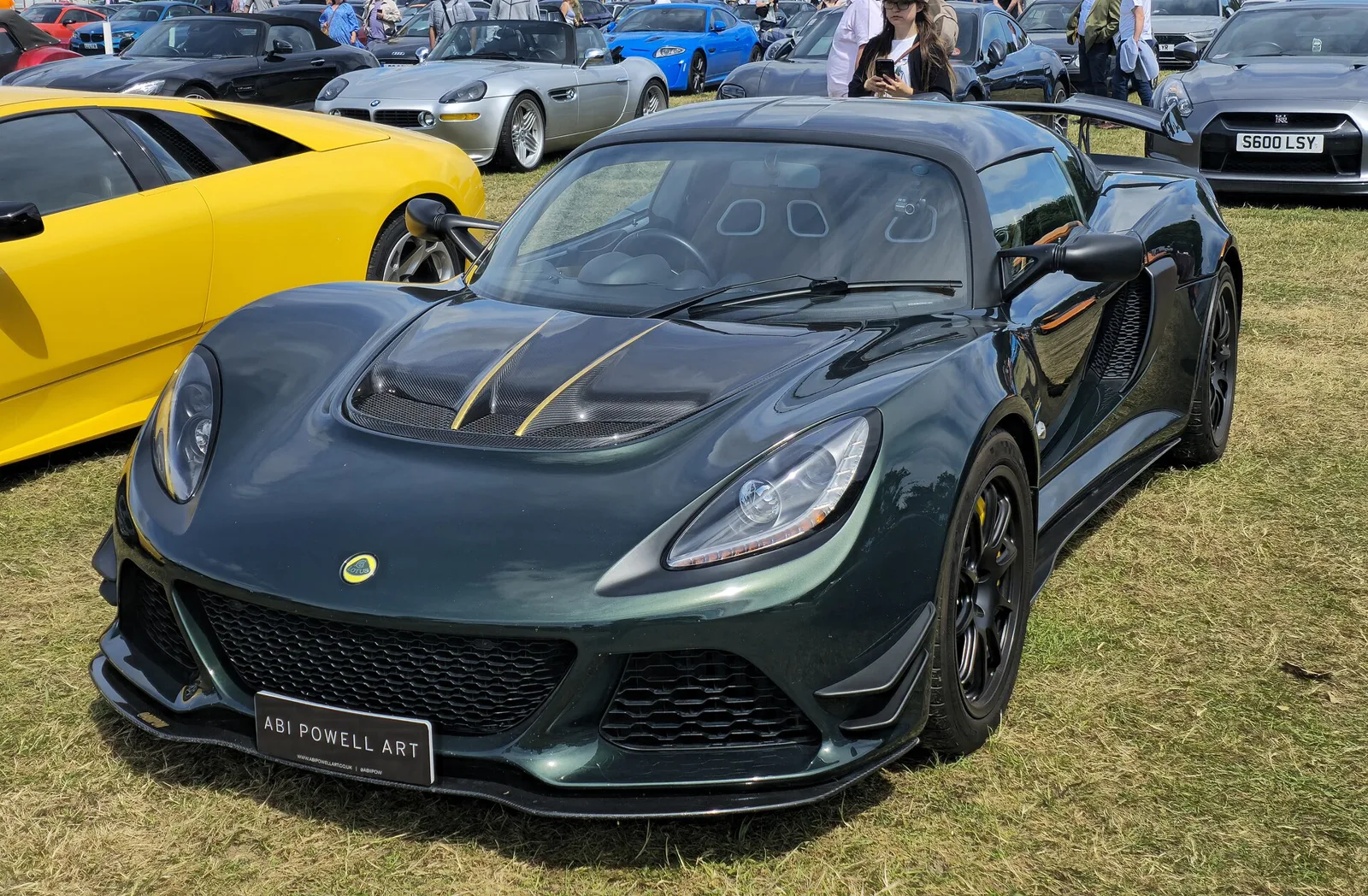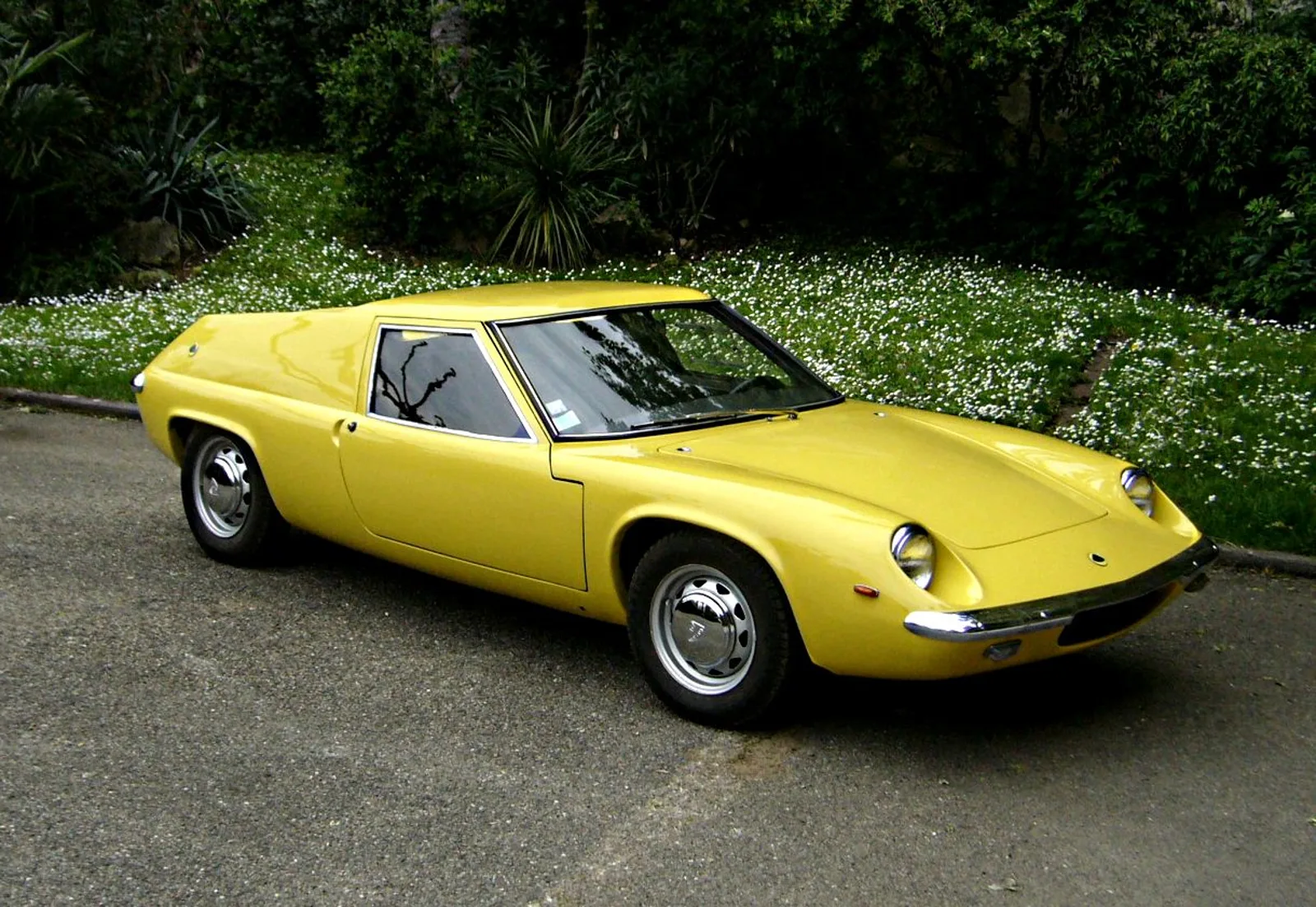
Colin Chapman's affordable two-seater, built on Renault parts from 1966, later given a Twin Cam engine and revived as the Elise-based Europa S.
The Lotus Europa was a mid-engined two-seater coupe built by Lotus Cars from 1966 to 1975, with 9,230 cars of all models produced. It used a Renault 16 engine and transaxle at first, later adopted the Lotus-Ford Twin Cam, and was revived in 2006 as the Elise-based Europa S.
Lotus Europa is the name of two mid-engined grand touring cars from the British maker Lotus Cars. The original Europa, built in several types from 1966 to 1975, gave Lotus a cheap, lightweight two-seater with its engine behind the driver. The Elise-based Europa S of 2006 to 2010 revived the name on a newer platform.
Where did the Lotus Europa come from?
The Europa was Lotus's attempt to build an affordable mid-engined two-seater for the road. The Series 1 was announced for European sale on 20 December 1966. Output across all models reached 9,230 cars before the line closed in 1975.
Rear mid-engined layouts had already proven themselves on the track. Ferrari's 250 P beat its front-engined 250 GTO siblings at the 1963 Le Mans race, and Grand Prix cars had used the layout since the late 1950s. Road cars were slower to follow. Matra's Djet arrived in 1962 and the V8-powered ATS 2500 GT in 1963, so Lotus was a late entrant that still aimed for a reasonable price.
Colin Chapman's design philosophy, 'simplify, then add lightness', shaped the car. Lotus solved the packaging problems of the mid-engined arrangement with a series of inventive, economical choices rather than expensive new components.
A mid-engined two-seater built on Renault parts, shaped by Chapman's drive to keep weight down.
Why did Lotus choose a Renault engine?
Lotus needed a low-cost engine and gearbox that would suit a mid-mounted car, and it picked the 1,470 cc Renault unit and transaxle from the Renault 16. Chapman wanted to move away from the Ford parts used in earlier Lotus cars. Rotating the transaxle 180 degrees gave Lotus a usable mid-engined package.
The engine itself suited the job. Its aluminium block carried cast-iron cylinder liners, which kept the unit light for its size. Lotus made several changes for its use, and the compression ratio rose from 8.6 to 10.25. The result was a 23% gain, taking output from 63 hp (47 kW) at 5,000 rpm to 82 hp (61 kW) at 6,000 rpm. US cars received a de-tuned 1,565 cc unit with 80 hp (60 kW) at 6,000 rpm.
Later Europas adopted the Lotus-Ford Twin Cam, a twin-overhead-cam, 8-valve engine already used in the Elan from 1962. It was rated at 105 hp (78 kW) in European form and 126 hp (94 kW) in big-valve guise. The twin-cam reached European cars in mid-1971 and North American ones in early 1972, where the federal version produced 113 hp (84 kW).
In 1973 Renault introduced its 16 TX with a five-speed gearbox, and Lotus soon offered that unit as a Europa option.
How did the Europa's chassis and suspension work?
The Europa used a boxed-steel backbone with a fibreglass body, the same combination Chapman had used on the Elan in 1962. Four-wheel independent suspension, a steering rack from the Triumph Herald and a modified Chapman strut at the rear gave it sharp handling, which road testers likened to a Formula car.
The frame was light by design, with the main member running forward to a cross-beam at the front. Early bodies were fully bonded to the chassis for stiffness, but Lotus moved to bolted-on bodywork so that normal repairs could be carried out. The chassis split into a U shape behind the cabin to hold the engine, transmission and final drive, and to carry the rear suspension.
The rear suspension was a heavily modified Chapman strut. Its lower end pivoted on the hub and no longer controlled camber. Instead, a driveshaft top link, a tubular lower link and a large radius arm running diagonally forward located each wheel. The radius arms used a sandwich bush, flexible in shear but stiff in compression and tension, to balance isolation against handling.
What changed between the Series 1 and Series 2 cars?
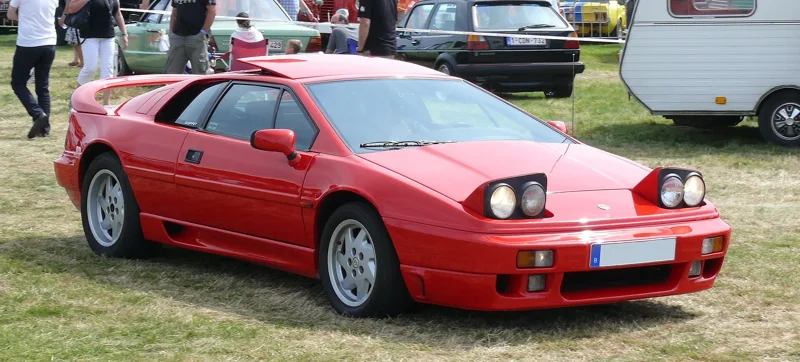
The Series 1, also called Type 46, was the first production Europa and was built as 296 cars plus around 350 S1A and S1B examples. The Series 2, or Type 54, arrived in April 1968 with opening electric windows, adjustable seats and bolt-on bodywork. Series 2 production totalled 3,615.
The first Series 1 cars had fixed side windows, no door handles and an aluminium dashboard. Their chassis numbers ran from 460001 to 460296, and they weighed 610 kg (1,345 lb). Later S1A and S1B cars gained removable side windows and a wooden dashboard, and the S1B also received a redesigned rear panel.
Road testers measured 121 mph (195 km/h) and 0-60 mph in 9.3 seconds on the first cars, and lateral acceleration above 0.9 g on road tyres of the period.
The Series 2 kept the 1,470 cc Renault engine but changed how the body was fixed. Bolts replaced full bonding, which trimmed rigidity but made repairs cheaper, a change insurers welcomed. Some 1968 cars wore black-badge emblems, said to honour Jim Clark after his death earlier that year, although some sources dispute that link.
Contemporary tests put the Series 2 near 120 mph (195 km/h), with 0-60 mph in 9.3 seconds, a quarter mile of about 16.7 seconds and economy around 30 mpg (9.4 L/100 km).
A small number of Series 2 cars were federalised for the United States. The 1969-70 Type 65, known as the S2 Federal, used a larger 1,565 cc engine rated at 80 hp to meet US standards. A contemporary test of the Federal car returned 116 mph (187 km/h), with 0-60 mph taking 9.6 seconds.
Which Twin Cam and Special models followed?
The Type 74 Europa Twin Cam arrived in 1971 with a 1,558 cc Lotus-Ford engine and a reshaped body for better rearward visibility. Lotus built 4,710 Type 74 cars, and 3,130 of them carried Special badging. The first 100 JPS Specials marked Team Lotus's 1972 Formula One title.
Lotus shipped 1,580 cars as Twin Cams before switching to the big-valve engine, rated at 126 hp (94 kW). The Europa Special used that engine in Europe with Dell'Orto carburettors, and it could be ordered with a five-speed Renault gearbox.
A tested Special weighed 740 kg (1,631 lb) and reached 123 mph (198 km/h). It covered 0-60 mph in 6.6 seconds and the quarter mile in 14.9 seconds, figures that were a clear step up from the earliest cars.
The JPS cars were black with gold pin stripes, echoing the colours of the Team Lotus Grand Prix cars. A numbered dashboard plaque set the first 100 apart from other black Specials.
Did the Europa go racing?
The production Europa was not competitive with the Renault engines of its day, so Lotus turned to racing variants. The Type 47 race car, bodied by Lotus Components and sold to private entrants, used Formula Junior parts, while the Type 62 test bed won its class at the 1969 BOAC 500.
The Type 47 used a 1,594 cc Cosworth Mk.XIII dry sump engine producing 165 hp (123 kW), with a Hewland FT 200 five-speed gearbox, both drawn from Lotus 23 and 22 Formula Junior cars. Its body was thinner than the Europa's, and side vents into the engine bay were added after temperature problems. Estimates put total production between 55 and 68 cars, built in 1966-70.
The Type 62 was a different proposition. Only two were made, as mobile test beds for the 2-litre Lotus 907 engine, which produced 240 hp. They ran F1 suspension and shared only a few Europa body panels. It took its class at its debut event, the 1969 BOAC 500 at Brands Hatch, where John Miles and Brian Muir drove it.
Zakspeed took a different route in 1979, building a Group 5 Europa Turbo for the DRM series. The car combined a ToJ sportscar chassis, a four-cylinder Ford-based turbo engine and parts from a Europa. Replica 47 and 62 cars are built by Banks Europa Engineering in several variations.
Which custom and special versions were built?
Several tuners and customisers offered special Europas over the years. The Swiss Lotus importer built two special versions, the Hemi 807 and the fuel-injected Black Shadow 807. In 1972 GS Cars of Bristol produced a limited variant of which 17 units were built, and only five are known to survive.
The Hemi 807 produced 105 PS (77 kW) SAE and could reach 200 km/h (124 mph). The Black Shadow was rated at 137 PS (101 kW), gained a five-speed gearbox and used Kugelfischer injection. Two Lotus Hemi cars entered Group 4 GTS competition in 1971.
Chip Foose restored and modified a Europa for season 11, episode 6 of Overhaulin'. He fitted a 1.8 litre Elise four-cylinder engine and a Porsche Boxster transmission to the car.
The GS Lotus Europa was based on the Twin Cam, and its bodywork resembled that of the Maserati Merak.
What is the Europa S?
The Europa S is a different car from the 1966 original, built on the Lotus Elise. Shown at the 2006 Geneva Motor Show, it was produced from July 2006 to 2010 with a turbocharged 2.0 litre four-cylinder engine producing 200 PS (147 kW; 197 hp).
The Europa SE followed at Geneva on 5 March 2008, raising output to 225 PS (165 kW; 222 hp) and torque to 300 N m (221 lb ft).
The Europa S reached 0-60 mph in 5.6 seconds and 0-100 km/h in 5.8 seconds. Its 272 N m (201 lb ft) of torque arrived at 5,400 rpm, and its top speed was 143 mph (230 km/h).
Lotus did not export the Europa S to the United States. Dodge had its own plan, an electric vehicle based on the Europa called the Dodge Circuit, which was planned for the US market by 2010. The project was cancelled in May 2009.
Lotus Europa specifications
| Specification | Detail |
|---|---|
| Original Europa types | Types 46, 47, 54, 65 and 74, built 1966 to 1975 |
| Total production | 9,230 cars of all models |
| Series 1 engine | 1,470 cc Renault, 82 hp (61 kW) |
| Series 1 weight | 610 kg (1,345 lb) |
| Series 1 performance | 121 mph (195 km/h); 0-60 mph in 9.3 seconds |
| Series 2 (Type 54) | Introduced April 1968; 3,615 built |
| Twin Cam engine | 1,558 cc Lotus-Ford; 105 hp (78 kW) European, 126 hp (94 kW) big valve |
| Europa Special | 740 kg (1,631 lb); 0-60 mph in 6.6 seconds; quarter mile in 14.9 seconds |
| Europa S | Built 2006 to 2010; 2.0 litre turbo, 200 PS (147 kW; 197 hp) |
| Europa SE | 225 PS (165 kW; 222 hp) from 2008 |
| Type 47 race engine | 1,594 cc Cosworth Mk.XIII, 165 hp (123 kW) |