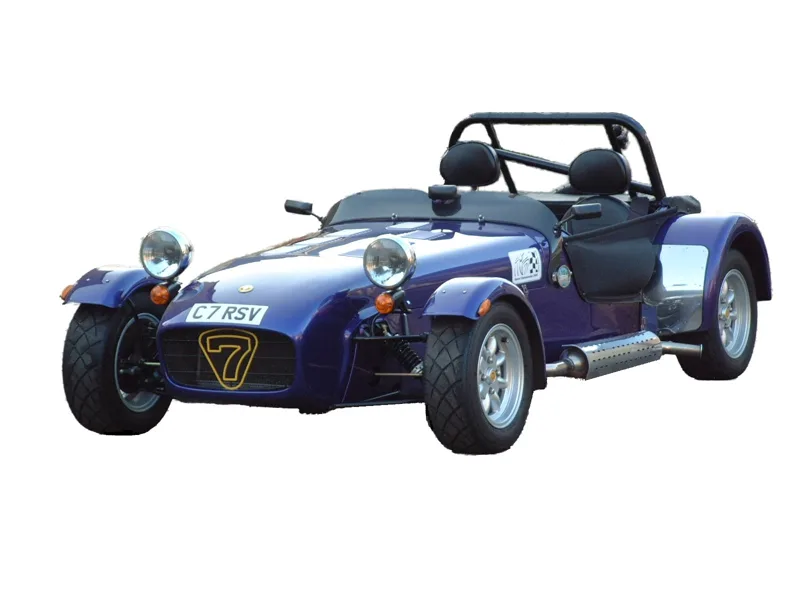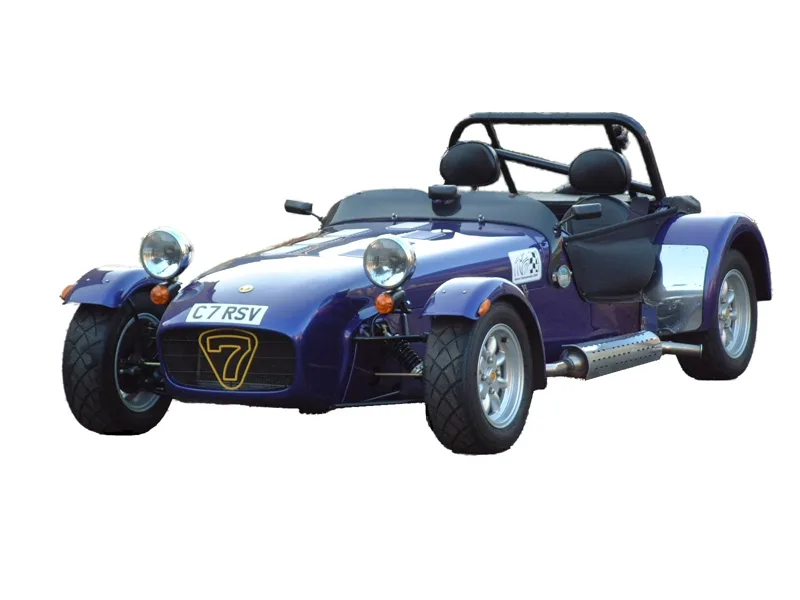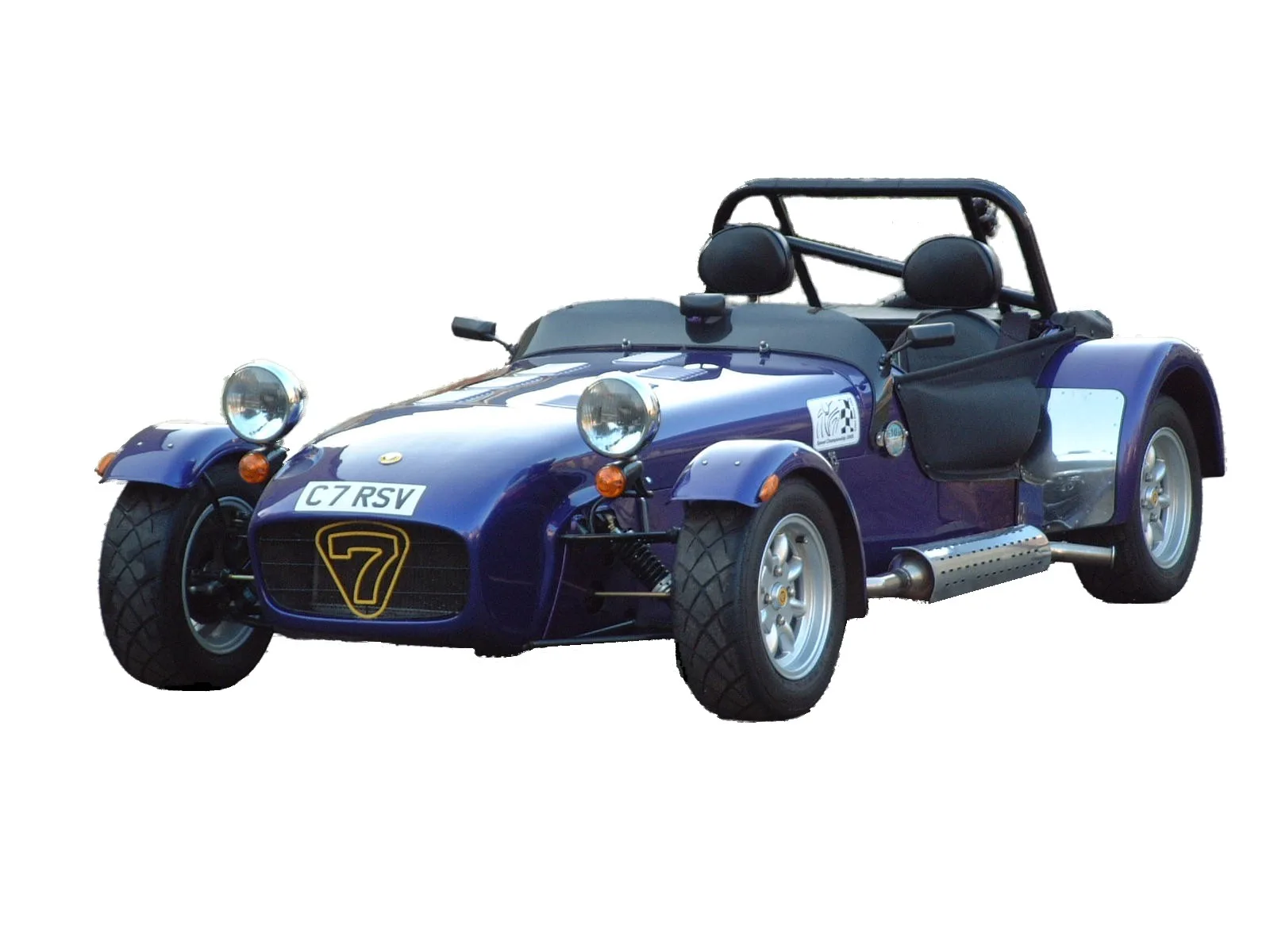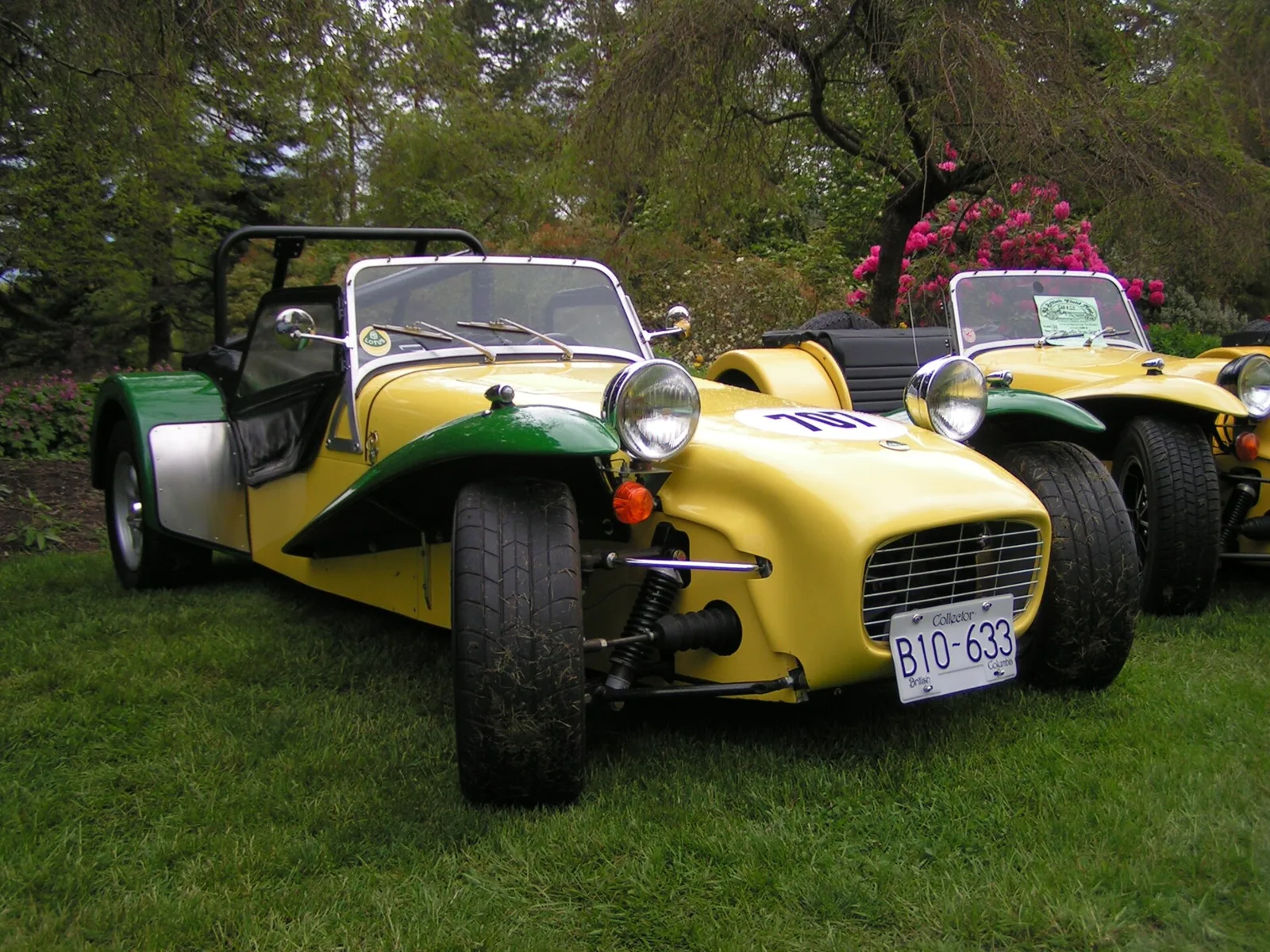
A two-seat, open-top car built on low weight and simplicity, sold largely as kits in Britain and reborn as the Caterham 7.
Designed by Colin Chapman, the Lotus Seven was a light two-seat roadster built by Lotus from 1957 to 1973. More than 2,500 were sold in the original run, and Caterham later took over the design.
The Lotus Seven was a two-seat, open-top sports car with open wheels, produced by Lotus Cars from 1957 to 1973. Colin Chapman, the company's founder, designed it to show what performance could come from low weight and simplicity. Caterham later took over the design and still builds its own version as the Caterham 7.
Where did the Lotus Seven come from?
The Seven was launched in 1957 to replace the Mark VI as Lotus's entry-level model. Its name was carried over from an abandoned plan for a Riley-engined single-seater, which Lotus had intended to enter into Formula Two in 1952 or 1953. The Seven's frame and body were a fresh design rather than a development of that project.
The car was intended to be road legal and usable for clubman racing. That combination proved its appeal, and more than 2,500 examples sold in the original production run.
Colin Chapman's two-seat open-top car, built on low weight and simplicity, and still reborn today as the Caterham 7.
How did the Series 1 Seven differ from later cars?
The Series 1 looked similar to the earlier Mark VI but had a different tubular frame, close in layout to the Lotus Eleven. Its engine was a 36 bhp (27 kW; 36 PS) Ford Sidevalve 1,172 cc straight-four, and BMC Series A and Coventry Climax FWA engines were also offered. The Series 1 was used both on the road and for club racing with the 750 Motor Club in the UK.
The Series 1 aluminium nosecone was later replaced by fibreglass on the Series 2. Cycle fenders were standard at first, while clamshell wings were standard on the 1500, the Super Seven and the America, or optional on other cars.
What changed in the Series 2 and Series 3?
The Lotus Seven S2 arrived in June 1960, and the Lotus Super Seven S2 followed in 1961. Both were slightly more road-oriented than the Series 1, and they had a somewhat simpler chassis. Most Series 2 cars ran Ford Kent units of 1,340 or 1,499 cc, taken from the Consul Classic, while the 1172 cc Sidevalve remained available until 1962.
Series 2 production ended in August 1968, after 1,310 examples had been built. Its rear axle and differential, borrowed from the Standard Companion estate, could not cope with the car's power and cornering forces. The Series 3 solved this by fitting a Ford Cortina rear end.
The Seven S3 was released in 1968 and typically received the 1,599 cc crossflow Kent engine. The Super Seven Twin Cam SS, first shown at Earl's Court in 1969, used the Lotus Twin Cam engine, but only 13 examples were built. The Series 3 design was later revived by Caterham and is still produced in modified form.
What engines did the Lotus Seven use?
The Series 2 used Ford Kent units, and the Cosworth-modified Super Seven 1,340 cc delivered 85 bhp (63 kW; 86 PS). The later Super Seven 1500 produced 105 bhp (78 kW; 106 PS). Some Series 2 cars built in 1968 carried the 1,599 cc crossflow Kent, a version often called the Series 2+1/2.
The Series 4 could be supplied with 1298 or 1599 cc Kent engines or the twin cam, while the crossflow unit became the most common engine in the Series 3 and Series 4. A small number of earlier cars received Coventry Climax FWA engines, and the later cars could be fitted with the Lotus-Ford Twin Cam.
How fast was the Lotus Seven?
The Motor tested a car with a tuned Ford 1172 cc engine and a close-ratio gearbox in 1958. It recorded a top speed of 80.4 mph (129.4 km/h), a 0-60 mph (97 km/h) time of 6.2 seconds, and 31.0 mpg-imp (9.1 L/100 km; 25.8 mpg-US). The test car cost GBP 1,157, of which GBP 386 was tax.
Top speed depended heavily on body, power and gearing. Early cars with modest engines struggled past 90 mph (140 km/h), but a race-prepared Seven was clocked at 127 mph (204 km/h) by Brausch Niemann at the 1962 Natal Grand Prix. Cycle wings and low aeroscreens helped, while clamshell wings added drag.
Light weight gave the Seven strong acceleration. Early examples weighed about 1,100 lb (500 kg), and by the early 1960s, with improved Ford-Cosworth engines, the car could reach 0-60 mph in the low seven seconds.
Why were so many Sevens sold as kits?
Buying a kit avoided the surcharge that purchase tax added to assembled cars. Tax rules barred the inclusion of assembly instructions, and the arrangement lasted until 1973, so a large share of UK Sevens went out as kits.
When the UK joined the EEC on 1 January 1973, VAT replaced purchase tax and the kit-car advantage ended. Lotus decided to shed its kit car image that year and sold the rights to the Seven to its remaining agents, Caterham Cars in England and Steel Brothers Limited in New Zealand.
What happened to the Seven after 1973?
Caterham ran out of Series 4 kits in the early 1970s. Under its agreement with Lotus it then introduced its own version of the Series 3, and it has built the car ever since as the Caterham Seven. Caterham now makes both kits and fully assembled cars.
In New Zealand, Steel Brothers Limited assembled Lotus Seven Series 4 cars until March 1979, when the last of 95 kits supplied by Lotus was used up. The New Zealand cars offered far more factory options than the UK models, including carpet, a centre console, a radio, a hardtop, close-ratio gears and adjustable suspension. Many went to competition buyers, and they were successful in local racing.
Steel Brothers also tried to build a wider, modernised version of the Series 4, the Lotus Super 907, with the twin cam Lotus 907 engine. It was announced in spring 1978 for sale in the United States, but the US importer lacked funds and the plan collapsed. The single finished car went to the United States in 2010 for a full restoration.
What did the Seven look like under the skin?
The Seven was designed with racing in mind, and lightness was Chapman's main concern. The Series 1 used a race-oriented multi-tube space frame with high sides for stiffness, while the Series 2 and later road versions had simpler frames. Its body used a stressed-skin construction, in which flat aluminium panels, especially the floor, stiffened a largely rectangular steel tubular frame. The panels were flat to avoid the expense of curved bodywork, and the simple cloth-lined plastic doors were hinged from the windscreen.
At the front, the double wishbone suspension used a traditional lower arm, while the upper arm integrated an anti-roll bar. This worked well with early cross-ply tyres but was less adjustable with later radials. The rear used a live axle, which was cheap and drew on parts from Ford, Standard Motor Company and Austin. The rack and pinion steering gave minimal play.
Aerodynamics were less refined. The drag coefficient ranged from 0.65 to 0.75 depending on the bodywork, and the nose gained more lift than downforce above about 70 mph (110 km/h). The highest point of the car stood about 900 mm (three feet) from the road, and the lowest chassis tubes sat about 127 mm (five inches) up.
Which Lotus Seven has a place in popular culture?
An S2 Lotus Seven, registered KAR 120C and driven by creator and actor Patrick McGoohan, appeared in the opening titles of the 1967-1968 television series The Prisoner. The car in the final episode was a different one, driven by Caterham Cars managing director Graham Nearn.
Marvel Comics' Wolverine drove a Lotus Seven, and a version appears as a stealable car in Grand Theft Auto: London 1969. In the Sonic the Hedgehog games the Seven is said to be the favourite car of Tails, and his vehicles in the Sonic Drift series are based on it. Chris Rea's 1991 album Auberge also carried a Lotus Seven on its cover.
What are the Lotus Seven specifications?
| Specification | Detail |
|---|---|
| Built | 1957 to 1973 by Lotus Cars |
| Layout | Two-seat, open-top, open-wheel sports car |
| Series 1 engine | 36 bhp (27 kW; 36 PS) Ford Sidevalve 1,172 cc straight-four |
| Cosworth Super Seven 1,340 cc | 85 bhp (63 kW; 86 PS) |
| Super Seven 1500 | 105 bhp (78 kW; 106 PS) |
| Early weight | About 500 kg (10cwt), around 1,100 lb |
| 1958 road test | 80.4 mph (129.4 km/h) top speed; 0-60 mph in 6.2 seconds |
| 1958 fuel use | 31.0 mpg-imp (9.1 L/100 km; 25.8 mpg-US) |
| Race-prepared top speed | 127 mph (204 km/h), 1962 Natal Grand Prix |
| Series 2 production | Ended August 1968 after 1,310 built |
| Series 3 Twin Cam SS | Lotus Twin Cam engine; 13 built |
| Series 4 engines | 1298 or 1599 cc Kent, or twin cam |
Which companies built Seven replicas?
Because the Seven's relatively simple design was easy to copy, more than 160 companies have offered replicas or Seven-type cars over the years. Caterham, the UK rights holder, has challenged many of them. Such cars are often called sevenesque, clubmans or locosts, and the list below covers some of the better-known names.
- Donkervoort, a Dutch manufacturer that began with Super Seven kits and now builds its D8 with Audi powertrains.
- Elfin Sports Cars, an Australian maker of the Elfin Type 3 Clubman and Elfin T5 Clubman.
- Westfield Sportscars, which produces several models.
- Rotus, built in Hagerstown, Maryland from the early 1980s to the mid-1990s, first with Japanese-spec Toyota twin-cam engines.
- Cobra Cars, which builds the Garbi in Spain with a 180 hp Yamaha R-1 engine.
- Lynx, made in New Zealand from 1985 to 1988, and Wilco, made there from 1992 to 1996.
Which books cover the Lotus Seven?
The Seven has inspired many books, test reports and articles, and several remain in print. Collections of road tests from magazines around the world, a Haynes guide and Peter Egan's columns are the main places to start for owners and enthusiasts.
- Lotus Seven 1957-1980, edited by R.M. Clarke (Brooklands Books, 1980), which collects magazine test reports and articles.
- The Magnificent 7 by Chris Rees (Haynes, second edition 2007), a guide to all models of Lotus and Caterham Seven.
- Lotus and Caterham Seven: Racers for the Road by John Tipler (Crowood Press, 2005).
- Side Glances by Peter Egan, collections of his Road & Track column, many of which feature Sevens.