From a 1978 kit car importer to the 591 hp P24 RS, the Dutch builder has stayed small and deliberately uncompromising.
Donkervoort Automobielen is a privately held Dutch maker of hand-built, ultra light sports cars, founded in 1978 by Joop Donkervoort and based in Lelystad. Its current model is the P24 RS, introduced in 2026 with a 591 hp Ford V6, following a run of D8 cars that used Ford and later Audi engines.
Donkervoort is a small Dutch sports car maker based in Lelystad, and it has built light, driver-focused cars since 1978. Joop Donkervoort started out as a kit car importer, then began building his own cars when the imported kits proved too far from road-legal. The current flagship, the P24 RS, pairs a 591 hp Ford V6 with rear-wheel drive and a production cap of 150 units.
When did Donkervoort start building cars?
Donkervoort began in 1978 as a kit car importer. Joop Donkervoort soon found that the imported kits needed major changes before they could be used legally on public roads. He began building the first S7 in a shed at Tienhoven, using a design derived from the Lotus Seven, and the company grew from that single workshop.
The business outgrew its first home in steps. A move to a larger facility at Loosdrecht came in 1983, and in 2000 the company settled into its present headquarters and factory at Lelystad. Chassis production had been contracted to an outside supplier, but it was brought in-house to Lelystad in 2003, which gave the firm direct control over the structure at the heart of each car.
That steady relocation tells the story of a company trying to balance growth against its roots. Each step kept production close to the people building the cars, and the Netherlands remained the home of every model. The brand still builds its cars in the country where it began.
A small Dutch maker that still treats the absence of electronic aids as the point of the car.
What does No Compromise mean for a Donkervoort?
No Compromise is the brand motto, and it describes driving without electronic aids such as ABS or ESP. The standard car has no power steering either, so the driver feels the road through the wheel and the car responds without filters. The P24 RS can be ordered with power steering and ABS as options.
The motto is more than marketing in the company's telling. It explains the emphasis on low weight, the steel tube chassis and the heavy use of carbon fibre in the bodywork. Those priorities run from the early S7 through to the latest P24 RS, even though the engines have changed many times over the decades.
Options on the current car show how the philosophy has been adapted rather than abandoned. Buyers can choose carbon ceramic brake calipers, which save 2.1 kg (5 lb) per corner, and a removable aero kit that adds 90 kg (198 lb) of downforce. Those choices let an owner move the car toward a track focus without changing its basic character.
Who runs Donkervoort today?
Denis Donkervoort is Managing Director, having taken over in 2021 from his father Joop, who retired in 2019. The business remains privately held. Joop's wife Marianne and their daughter Amber have also played key roles in developing the company's branding and marketing across its range.
The family's presence shows in the car names as well. The F22 carries the first name of Denis's daughter, and its story is told further down this page. Since the handover the company has kept building small, numbered runs, including the limited F22 and the current P24 RS.
Which early models came before the D8?
The S7 was the first Donkervoort, built from 1978 to 1982 with a 1.6-litre Ford Crossflow engine producing 90 PS (66 kW). The S8 followed in late 1983 with a 2.0-litre Ford of Europe inline-four, and the S8A arrived in 1985. The turbocharged S8AT came in 1986 and was discontinued in 1994.
The S7 was an ultra light weight sports car with a top speed of 170 km/h (106 mph), and it was built in Tienhoven before the company moved on to larger premises. The move to Loosdrecht came in the same year the S8 arrived, so the early years combined a new model with a new home.
How did the D8 range develop?
The D8 arrived in 1993 and its first versions used 1.8 and 2.0-litre Ford Zetec engines. The D8 Zetec ran until 1998, and a Cosworth-engined version was offered from 1995 until the same year. Those cars were the last Donkervoorts to use Ford power until the P24 RS appeared.
From 1999 the D8 switched to Audi power. The 1.8-litre R4 engine produced between 150 and 245 PS (110 to 180 kW), and the line ran until 2008. From 2003 the E-gas Wide Track version offered outputs of 150, 180, 210 and 270 bhp, and its total weight of 630 kg (1,389 lb) kept the acceleration figures sharp.
The D8 270 was available from the summer of 2008 and accelerates from 0 to 100 km/h in 3.6 seconds. It followed the limited D8 270 RS, which was introduced in 2005 in 25 numbered units.
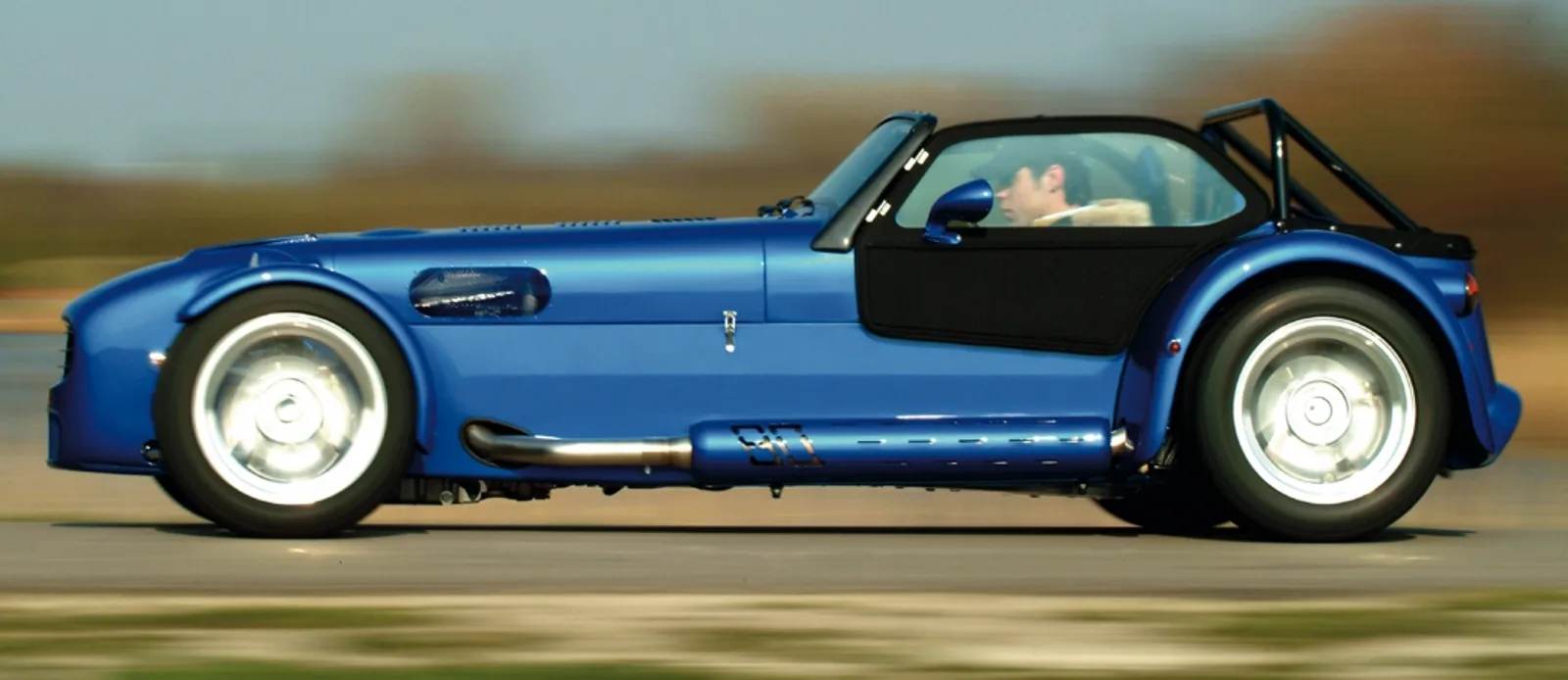
The D8 GT arrived in 2007 as the first closed Donkervoort. It added 17-inch aluminium wheels and a track 8 centimetres wider than the open car. Its carbon fibre roof, rear, doors and fenders keep the total weight to 650 kg (1,433 lb), and Donkervoort says it is the lightest GT in the world.
What made the D8 GTO so quick?
The D8 GTO was an entirely new design built around a turbocharged TFSI five-cylinder Audi engine. It produced 250-280 kW (340-380 PS) and 450 Nm of torque, and the car weighed less than 700 kg. A power-to-weight ratio of 1.8 kg/PS helped it reach 100 km/h in 2.8 seconds and 200 km/h in 8.6 seconds.
The GTO was built in several forms. Limited Premium cars were made in 25 units in 2013, and they offered more than 380 bhp. Regular production began in 2014 with Touring and Performance versions, and the Performance car produced the 380 hp output that later set the Bilster Berg record.
The sharper GTO RS arrived in October 2016 as the successor to the D8 270 RS. It offered an optional dual-clutch automatic transmission, and it is not street legal, so it belongs on a track rather than a public road.
The GTO Individual series was launched on 9 September 2021 and leaned into personalised specification, in keeping with the brand's emphasis on individual cars.
How fast was the Bilster Berg record?
In September 2014 a D8 GTO set a lap of 1 minute 46.12 seconds at the Bilster Berg Drive Resort in Germany. It was a record for street-legal production cars, and the car used for it was the 380 hp Performance version. The lap gave the brand a benchmark for road-legal cars at that circuit.
Donkervoort marked the achievement with the Bilster Berg Edition, a limited run of 14 cars. The edition sat alongside the regular GTO range and carried the lap's association with the brand. It remains one of the clearest examples of what a light, lightly equipped car can achieve on a demanding circuit.
Which anniversary editions did Donkervoort build?
Donkervoort marked several milestones with special cars. The D10 of 1988 celebrated the company's tenth anniversary and was built in a series of ten. The D8 270 RS of 2005 was limited to 25 numbered cars, while the GTO-40 marked the 40th anniversary with 40 examples.
The JD-70 was built to mark the 70th birthday of founder Joop Donkervoort, and 70 cars were produced in total. A track-tuned JD70 R was offered as well, and it came with driver coaching included in the purchase.
Not every special car reached production. The D20 was a prototype with a V6 engine tuned to 280 hp (210 kW), but emissions rules blocked it from production. The J25 prototype made 270 hp (200 kW) and never entered production either.
What was the F22?
The F22 was a limited-production Donkervoort with 75 examples, of which 50 had already sold when the model was announced. It weighed 750 kg (1,653 lb) and used a five-cylinder Audi engine producing 492 hp (367 kW) and 640 Nm (472 lb ft) of torque.
Early reports said the F22 would weigh less than 1,000 kg (2,200 lb), which led to speculation that it would be heavier than expected. Donkervoort later clarified that its target was considerably less than 800 kg (1,800 lb). The episode showed how closely buyers track every kilogram in a car of this kind.
The F22 measured 4,039 mm (159.0 in) in length and offered 298 L (10.5 ft3) of luggage space. It was named after Filippa, the daughter of Denis Donkervoort, who was born in 2022. A 2024 Art Edition was built for the car's owner, Cees Lubbers.
What is the P24 RS?
The P24 RS was teased on 14 March 2025 and introduced on 24 January 2026. It uses a 3.5-litre twin-turbocharged Ford EcoBoost V6 from the Ford GT, producing 441 kW (591 hp) and 800 Nm (590 lb ft). Production is limited to 150 units.
The car weighs 780 kg (1,720 lb) and puts its power through the rear wheels using a 5-speed manual with a Torsen limited-slip differential. It reaches 200 km/h (124 mph) in 7.4 seconds and has a top speed of more than 300 km/h (186 mph). Lateral acceleration is rated at 2.3 G.
The P24 RS was the first Ford-engined Donkervoort since 1998, a clear break from the Audi power of the preceding decades. Buyers can also specify power steering, ABS, carbon ceramic brakes and a detachable aero package that generates 90 kg (198 lb) of downforce.
Output of 591 hp places the P24 RS well above the 492 hp (367 kW) of the F22, which itself sat far above the early cars. That gap captures how far the range has moved since the S7 of 1978, while the 150-unit cap keeps the newest car rare.
Donkervoort specifications at a glance
The table gathers headline figures for the current P24 RS, the D8 GTO and the F22 in one place. Earlier models used different engines, so each number applies only to the car named in its row.
| Specification | Detail |
|---|---|
| Founded | 1978, by Joop Donkervoort |
| Headquarters | Lelystad, Netherlands |
| P24 RS engine | 3.5-litre twin-turbocharged Ford EcoBoost V6 |
| P24 RS output | 441 kW (591 hp) and 800 Nm (590 lb ft) |
| P24 RS weight | 780 kg (1,720 lb) |
| P24 RS 0-200 km/h | 7.4 seconds |
| P24 RS production | 150 units |
| D8 GTO 0-100 km/h | 2.8 seconds |
| D8 GTO 0-200 km/h | 8.6 seconds |
| F22 engine | Five-cylinder Audi, 492 hp (367 kW) and 640 Nm (472 lb ft) |
| F22 weight | 750 kg (1,653 lb) |
| F22 production | 75 examples |
Frequently asked questions
How much does the P24 RS weigh?
The P24 RS weighs 780 kg (1,720 lb). It pairs that weight with a 441 kW (591 hp) twin-turbocharged V6 taken from the Ford GT.
Can the P24 RS be ordered with ABS and power steering?
Yes. Power steering and ABS are both offered as options, and the optional carbon ceramic brakes save 2.1 kg (5 lb) per corner.
How many F22 cars were made?
The F22 run was limited to 75 examples. Donkervoort said 50 of them had already sold when the car was announced.
Is the D8 GTO RS allowed on public roads?
No. The D8 GTO RS is not street legal, although it offers an optional dual-clutch automatic transmission.
Where is Donkervoort headquartered?
The company is headquartered in Lelystad, Netherlands. It moved to its present factory there in 2000, after building cars at Loosdrecht from 1983.