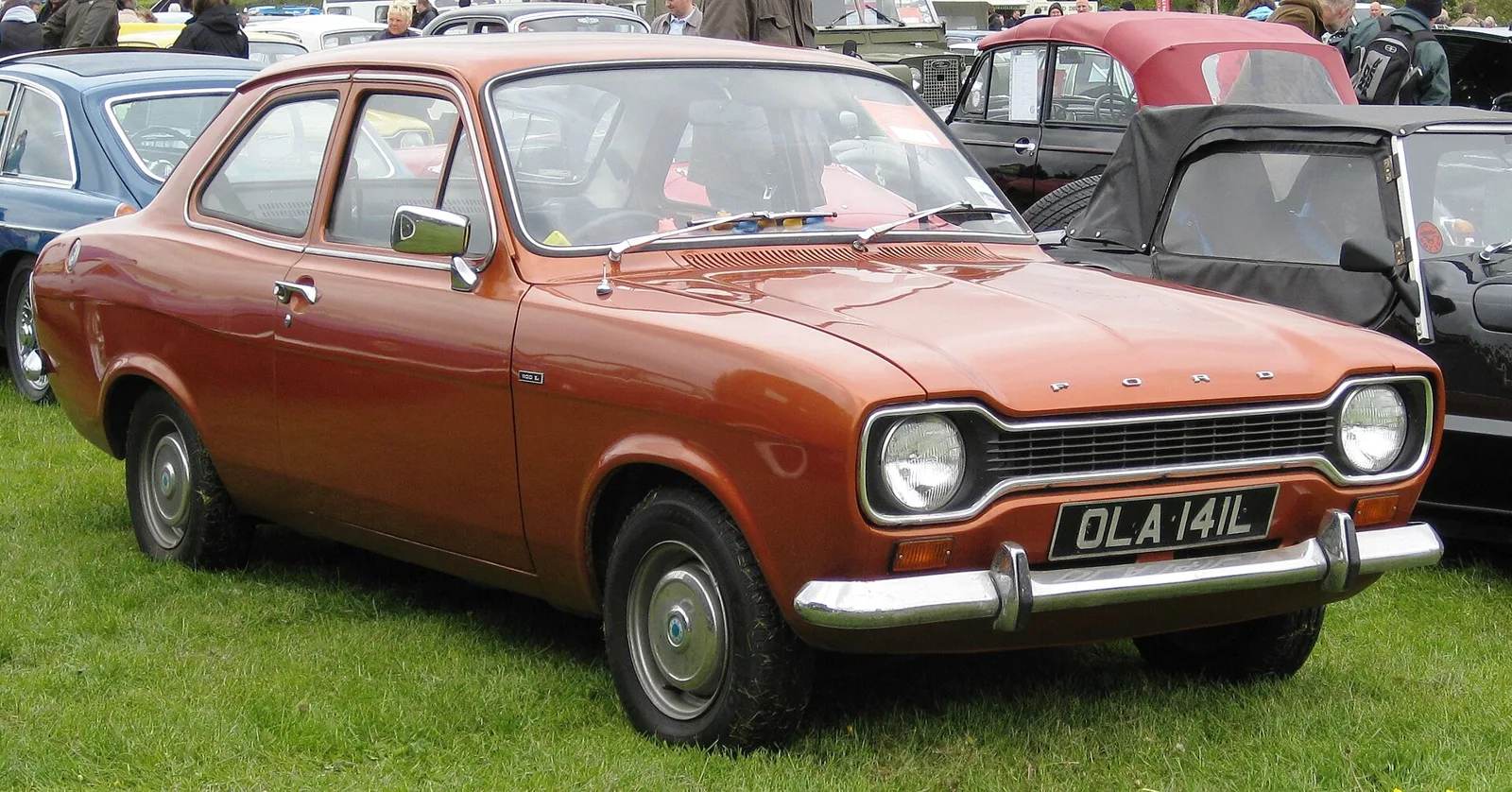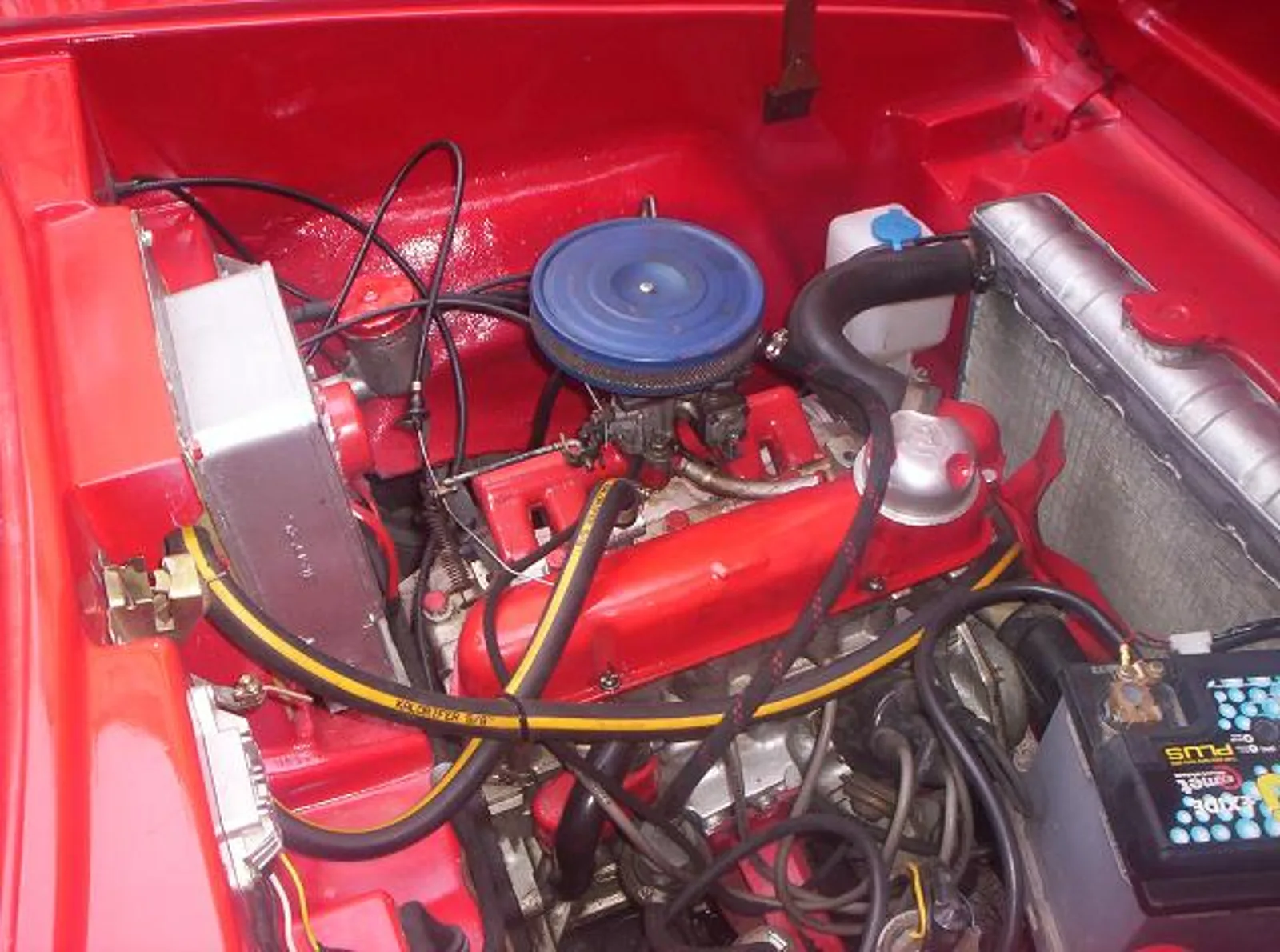
A 1959 Anglia engine that became the Crossflow, the Valencia and the Endura-E, and the reason so many racing engines and drivers began on Kent blocks.
The Ford Kent is a cast-iron, overhead valve, pushrod four developed in 1959 for the Ford Anglia. It went through the Crossflow, Valencia, HCS and Endura-E generations, and it became the basis of a large share of European and American racing engines.
The Ford Kent is a pushrod overhead valve engine from Ford of Europe, first developed in 1959 for the Ford Anglia. Its in-line four-cylinder design, with a cast-iron block and head, went through three main families and spent 44 years in production cars. It is also the engine that much of British and European motorsport was built on.
What is the Ford Kent engine?
Ford's Kent is an internal combustion engine developed in 1959 and used across a long run of models. The unit is a four-cylinder with overhead valves operated by pushrods, and both its head and block are cast iron. The Kent family divides into three basic sub-families: the original pre-Crossflow engine, the Crossflow, and the transversely mounted Valencia.
The name itself is a little loose. It stuck to the engine even after the Crossflow and Valencia changed its shape, which is why enthusiasts still use it as a catch-all term. Inside Ford, the name originally referred to the A711 and A711M blocks, which had square main bearing caps. Outside the company, the name was used more widely, and it came to describe the earlier engines as well.
A pushrod four from 1959 became the foundation for a generation of racing engines, and its blocks still turn up on track today.
Where did the Kent engine begin?
Its pre-Crossflow applications stretched from the Ford Corsair and the 107E Prefect to the Lotus Seven S2, the Marcos 1500 GT and the Autocars Sussita.
The original overhead valve, three-main-bearing Kent first appeared in the 1959 Anglia, where it displaced 997 cc (1.0 L). It produced 39 bhp (29 kW) at 5,000 rpm, which was unusually high for the time. The Anglia was the only car to carry the 1-litre Kent.
Its bore and stroke of 80.96 mm x 48.41 mm were an unusual choice for an English engine of the period, which was usually undersquare. The short stroke kept piston speeds low, and independent ports for four intake and four exhaust valves were a departure from traditional practice. The oil filter and pump were mounted externally, which made production cheaper and servicing easier.
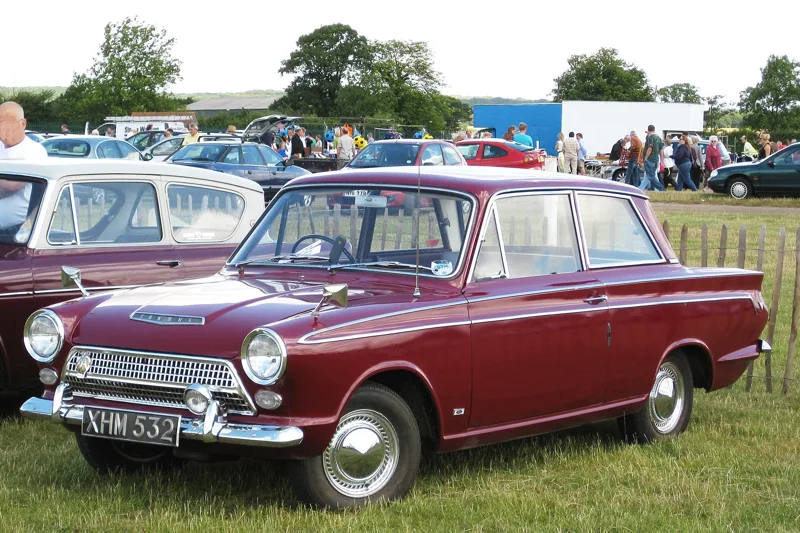
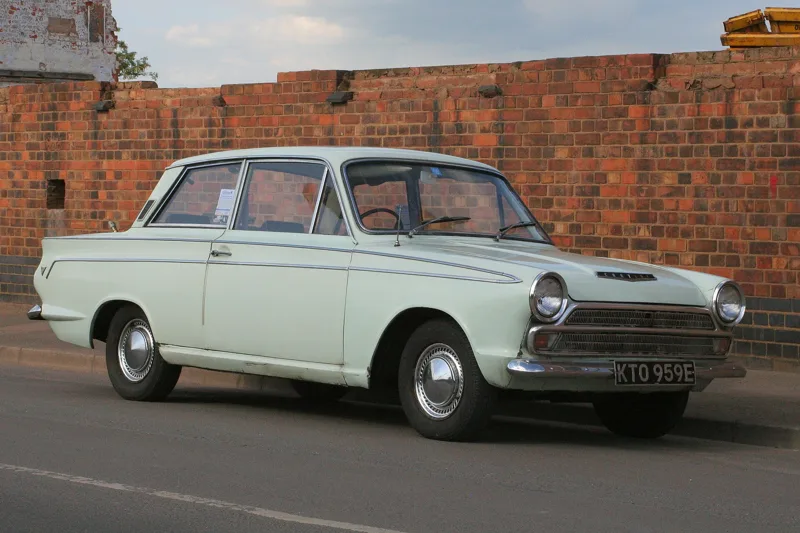
The same bore was used with longer strokes to build larger capacities. The Consul Classic ran a 1.3 L (1,339 cc) version and the Consul Capri used 1.3 and 1.5 L engines (1,339 and 1,498 cc). The Mk1 and early Mk2 Cortinas used 1.2 L (1,198 cc) and 1.3 and 1.5 L five-bearing versions.
What made the Crossflow different?
A 1967 redesign fitted the engine with a cross-flow head, which gives the Crossflow its name. Its combustion chamber took a Heron form, sitting within the piston crown instead of the cylinder head. The head itself was flat, and each capacity used different pistons in its 681F and 711M blocks.
The larger 1.6 L engine at 1,599 cc used the 691M block, whose heavier square bearing caps later carried over to the 711M. In 1970 the new A711 block for the 1.3 L and the A711M for the 1.6 L arrived with thicker walls, square main caps, large diameter cam followers and wider cam lobes. The 711M blocks are commonly regarded as the reliable heart of the Crossflow story.
The Valencia plant began building a 1.6L, 63 bhp (47 kW), five-main-bearing version for the American market in 1977. It had a low-emission bowl-in-piston chamber based on the Crossflow head and a Dura-Spark electronic ignition, and it went into the short-lived Mk1 Fiesta sold in the United States.
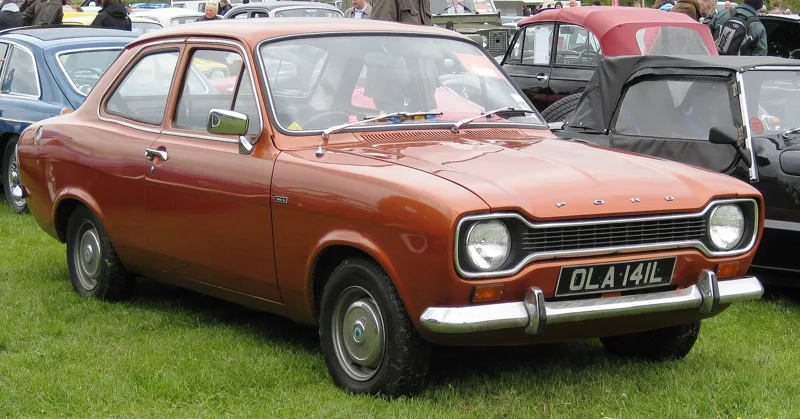
The Crossflow powered the smaller Cortinas and Capris, the first and second European Escort, and the North American Ford Pinto in 1971, 1972 and 1973. Reliant used a 1.3 and 1.6 Crossflow in its Anadol from 1968 to 1984, and kit-car builders adopted the engine widely.
How did the Valencia adapt the Kent for front-wheel drive?
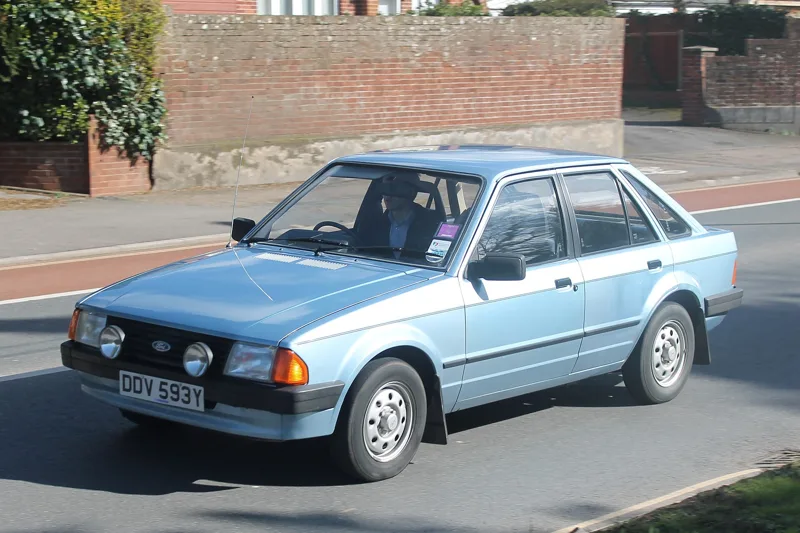
A redesigned version of the Kent was conceived in 1976 to suit transverse installation, primarily for the Mk1 Fiesta. Entry-level versions of the Escort Mk3 also used it, and the engine was a mainstay of Ford's entry-level range for nearly 25 years. Its two major revisions came in 1988 and 1995.
Fitting the Crossflow into the Mk1 Fiesta had been a challenge, since the car had been designed around the shorter Valencia. Engineers had to mount the engine lower in the chassis and use shorter driveshafts so the transaxle could still be removed for clutch work.
To make it fit, the ancillaries were moved and the block was shortened by 30 mm (1.2 in). The original Valencia was offered in 957 cc and 1,117 cc versions, with the bore reduced to 74mm and the extra capacity found by varying the stroke. Ford regarded it as a new engine and called it the L-Series at first, although it became known as the Valencia.
Few parts were shared with the Crossflow. The block lacked the mounting spigots cast into the Crossflow faces, so the Valencia relied on the transaxle mountings for lateral location. In 1986 a five-bearing 1.3 L (1,297 cc) version joined the Escort and Orion, replacing a similarly sized CVH unit.
What did the HCS and Endura-E change?
The second-generation Valencia, launched in 1988, was built to meet tighter European emissions rules. The cylinder head was new, with reshaped chambers and inlet ports suited to lean running, along with hardened valves and seats for unleaded fuel. Ford's EDIS fully electronic ignition replaced the older points system.
Weber carburettors were specified in place of the unreliable Ford Variable Venturi unit, and single-point fuel injection was offered for cars that carried a catalytic converter.
The HCS used a lean fuel-to-air ratio of 1:19. Ford claimed that fuel economy rose by 11 to 18 percent, while power rose by between 5 and 8 percent, according to the model. It first appeared in the Escort and Orion for 1989, and in the Fiesta Mark III the same year, which also received a 999 cc version.
Ford kept revising the design through its life, and the later changes were aimed at noise and servicing as much as performance.
The final redesign came in 1995 with the fourth-generation Fiesta. The Endura-E added a thickened cylinder block and a cast aluminium sump to reduce noise and harshness, and multi-point fuel injection became standard. It was used in the Ka until 2002, when the Duratec took over.
| Generation | Years | Typical capacity | Notable feature |
|---|---|---|---|
| Pre-Crossflow | 1959 onward | 997 cc to 1,498 cc | Over-square bore and external oil filter |
| Crossflow | 1967 onward | 1,298 cc and 1,599 cc | Cross-flow head with Heron chambers |
| Valencia | 1976 onward | 957 cc and 1,117 cc | Transverse mounting for the Fiesta |
| HCS | 1988 onward | 1,118 cc and 1,297 cc | Lean-burn head and EDIS ignition |
| Endura-E | 1995 to 2002 | Multi-point injection | Thickened block and cast aluminium sump |
How did the Kent shape motorsport?
Few engines have had a greater effect on motorsport than the Kent. Lotus used Kent engines on its Mk.VII, which helped establish the company, and it later relied on Cosworth racing engines for much of its success. Lotus also built its TwinCam engine on the Kent block, crankshaft and connecting rods.
Cosworth's first products were all Kent based. Its later SCA, FVA and BD designs, all built on Kent blocks, won numerous FIA classes, including the Formula 2 and Formula 3 categories. Builders such as Holbay, Vegantune, Novamotor, Brian Hart, Richardson and Wilcox also owe their foundations to Kent-based engines.
Cosworth's SCA was designed using the reverse-flow cylinder head layout of the FWE, which Harry Mundy co-designed. The same Mundy connection explains why the Lotus TwinCam shared its valve clearance shims with Coventry Climax engines in production.
The Crossflow was the regulation engine in Formula Ford for many years. In Europe the series later moved to the Zetec, but American Formula Ford stayed Kent-powered until 2010. The 1300 cc unit was the engine of choice for BriSCA Formula 2 stock cars until a carburettor rule change moved teams to the 2000 cc Pinto.
Morgan used the Crossflow in its 4/4, Caterham in the Seven, and TVR in its Grantura, Vixen and 1600M, which kept the engine alive in small-volume sports cars. Kit-car builders remained loyal to it for the same reasons, and many still are.
Why did Ford bring back the Kent block?
On 16 October 2009 Ford announced it would put the Kent block back into production to supply the historic racing community and active Formula Ford series with spares. Engineering work began at Ford Racing's Performance Parts division in the United States, and sales were scheduled to start in 2010.
The historic racing community had long relied on the engine, so the announcement was a practical response to the need for spares rather than a new engine programme. Spares were the main need, because many owners of historic cars depended on them for repairs.
The timing coincided with a Sports Car Club of America rule change that allowed the Honda engine in Formula Ford events, which kept the Kent in the American series. Ford's decision recognised that historic racing still depended heavily on Kent-based engines.
Which drivers started on Kent engines?
Because it was nearly impossible to succeed in motorsport without some activity in Formula 2, Formula 3 or Formula Ford, most well-known racing drivers of the 1960s, 1970s and 1980s owe their careers to Kent engines to some extent. The Kent's role was less about any single star and more about the ladder it provided.
Formula Ford itself was a proving ground, and its Kent-powered cars gave many young drivers their first taste of single-seater racing.
Kent-based engines are still central to historic motor racing today. The Valencia remained in production in Brazil as an industrial engine, where it is known as the VSG-411 and VSG-413, which shows how far the design travelled from its British origins.
How did the Endura-E affect owners day to day?
Owners of Endura-E engines have long reported tappet noise, which is often linked to valve setup or to the wrong oil grade. The recommended oil is a 5W-30 semi-synthetic, and a large exhaust tappet clearance can be a contributing factor.
The oil filter is another sore point. It sits at the back of the engine facing from left to right, which makes it hard to reach from below without a ramp, and the can-type filter sits close to the starter motor.