A clean-sheet, front-wheel-drive Escort that became Britain's best-selling car in 1982, then spread to Brazil and South Africa.
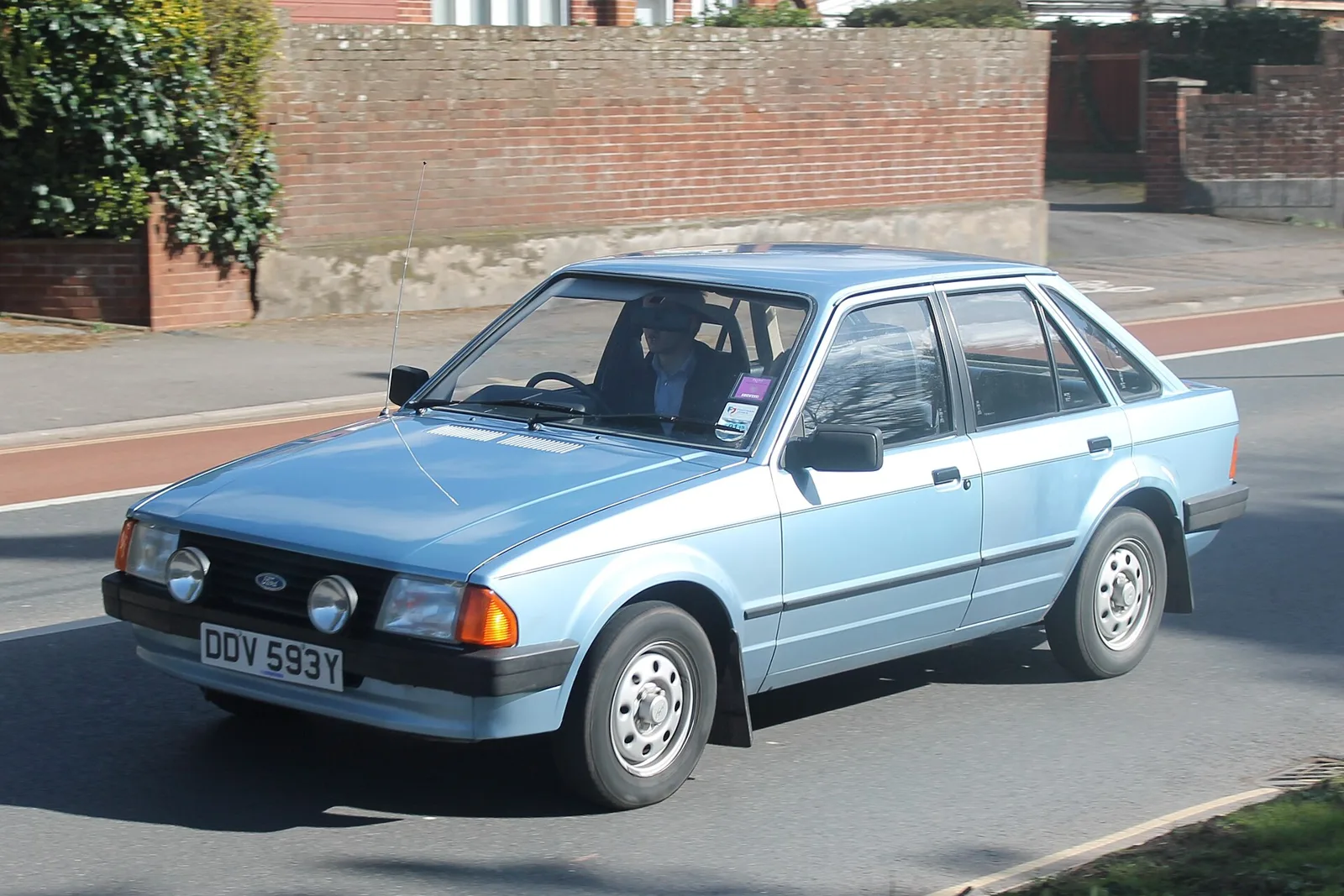
The Ford Escort Mk3 was the third generation of Ford's compact C-segment car, presented in 1980. It introduced a transverse engine and front-wheel drive, became Britain's best-selling car in 1982, and was built in Europe, Brazil and South Africa.
The third-generation Ford Escort was a clean-sheet car rather than a reworked second generation. Ford gave it a transverse engine and front-wheel drive, and by 1982 it had overtaken the Ford Cortina as Britain's best-selling car.
Its life ran from Halewood in England to Sao Bernardo do Campo in Brazil. Along the way it spawned ordinary liftbacks and hot versions such as the XR3, RS1600i and RS Turbo, and it was built in Europe, Brazil and South Africa.
Where did the Escort Mk3 come from?
Ford presented the third-generation Escort in September 1980, after development at its Halewood offices in England. Its new chassis was a clean break from earlier Escorts. The team worked under the code name Erika, but the Escort name was kept for production.
Customers in Britain were reluctant to give up the Escort name, because the second generation had been a total success there and had been the country's best-selling model in 1976. German buyers rejected Erika, which recalled a well-known military march from the Second World War. The North American Escort, launched at about the same time, was only distantly related to the European car.
Front-wheel drive, a 0.37 drag coefficient and a spell as Britain's best-selling car in 1982.
What made the Escort different from its predecessors?
The car broke with its predecessors by moving to a new chassis, a transverse engine and front-wheel drive. It was the second Ford model in Europe to use front-wheel drive, after the Fiesta, presented in 1976. The first version was a liftback with either 3 or 5 doors.
Styling followed the Ford design language of the period, with a radiator grille of horizontal black strips and front lamps tilted slightly back. A small aerodynamic tail stub, which Ford registered as the Aeroback, was later carried over to the liftbacks of the Sierra and Scorpio. With it, the drag coefficient fell to Cx=0.37, the best in the class.
Ford designed the car to compete with the Volkswagen Golf and the Honda Civic, the benchmarks of the C segment, and launched it under the slogan Simple is Efficient. It was conceived as a high-technology, efficient machine, and was a clean break from the second generation. That car had been a bodywork reworking of the 1968 Mark I platform.
What engines did the Escort Mk3 use?
The Escort used new CVH engines with overhead camshafts, in 1.1, 1.3 and 1.6-litre sizes. The 1.1 CVH was cancelled in 1982 because of its high production costs, and older Valencia engines took over that slot. Suspension was fully independent, a sharp change from the leaf springs of earlier cars.
The Valencia name came from the Spanish town of Almusafes, where the engines were built. They were derived from the 1.1-litre Kent unit fitted to the Ford Fiesta. A five-speed manual became standard across the 1.6-litre range from 1982 and was optional on the 1.3.
A three-speed Ford ATX automatic arrived for 1983. It had been developed mainly for the American Escort, and it was offered as an option on the 1.6 some years after launch. Equipment included a tilting, sliding sunroof, central locking and electric windows.
Most models apart from the Base and L had warning lights for low fuel, oil, coolant, washer fluid and worn brake pads. Power steering was missing from the European car but fitted to the North American version.
Sales in Britain and Europe
Sales jumped after the launch. In 1982 the Escort overtook the former Ford Cortina to become the country's best-selling car, and this began a reign that extended over eight years in Britain. It was voted European Car of the Year for 1981, ahead of the Italian Fiat Panda and the MG Metro, which represented British Leyland.
Production was mainly in the United Kingdom, Germany and Spain. A South American line, opened in 1983, added a different market.
Commercial vehicles and the Bantam
The two-door van reached the market in February 1981, slightly delayed by large remaining stocks of the Escort Mk II van. It had symmetrical rear doors and small, unusual windows behind the rear doors, which gave the driver better rear visibility over the shoulder.
Visibility was mainly hampered by the fact that the van was built with the front doors of the 5-door version. A derivative of the van was a pickup developed and produced in South Africa, known as the Ford Bantam.
Why did the Brazilian Escort matter?
The Brazilian Escort opened the South American market to the model. Production began in July 1983 at the plant Ford had bought from the defunct Willys Overland do Brasil, using the locally developed CHT engine. Brazilian cars were liftbacks only at first, with 3 or 5 doors, and the 3-door version had rear windows that could be opened because of the heat.
The CHT engine was developed by Ford's Brazilian subsidiary from Renault's Cleon-Fonte engine, which had powered the Ford Corcel. That car came about through agreements between Ford, Willys and Renault as part of the purchase of the Sao Bernardo plant. Alcohol-fuelled versions produced marginally more power.
Brazilian trim levels began as Base, LX and GLX, with 4 or 5-speed manuals, and the luxury Ghia arrived in October 1983. Exports went to Sweden, Denmark, Norway and Finland between 1983 and 1986, where the car replaced the low-cost German-built Escort. It earned a poor reputation there because of serious body rust and problems with the wet cylinder liners of the CHT engine.
The CHT engines could also run on petrol or on a mix of petrol and 15 to 20% ethanol, but the blend caused problems on ordinary petrol. The Escort LX sold in Switzerland used larger engines.
The XR3, XR3i and RS models
The XR3 arrived in 1981 to rival the Volkswagen Golf GTI. Its tuned CVH 1.6 used a twin-barrel Weber carburettor, and it had an uprated suspension and cosmetic changes. Despite the sporting billing, it kept a four-speed manual, which held it back until October 1982, when fuel injection turned it into the XR3i.
The RS1600i followed in May 1983, a limited run of 8,659 cars developed at Ford's plant in Cologne. Its 115 PS (85 kW; 113 hp) came from computerised ignition, a modified rocker cover and fuel injection. Brazil also built an XR3 late in 1983, with a prepared 1.6 engine that ran only on alcohol, a rear spoiler and 14-inch alloy wheels.
What were the RS Turbo's figures?
The RS Turbo arrived in October 1984 with a turbocharged engine producing 132 PS (97 kW; 130 hp). Its development was postponed several times, the definitive launch came in 1985, and its chassis drew heavy criticism. It was the final high-performance update of the Escort.
Only 5,000 examples were produced, all in white, and the first series was sold exclusively in some European nations. Extras included alloy wheels like the RS1600i's, Recaro seats and a limited-slip differential. The only black RS Turbo was built for Princess Diana, and production carried on alongside the fourth-generation Escort, presented in 1986.
Where was the Escort Mk3 built?
Factories were at Halewood in Merseyside, Almusafes in Valencia, Saarlouis in Germany, Sao Bernardo do Campo near Sao Paulo, and Silverton near Pretoria in South Africa. South African cars were prefabricated in Europe and assembled locally, with some components made in the country to meet local production rules.
The South African Escort was sold only as a liftback from March 1981, fitted with Valencia engines of 1.3 and 1.6 litres. The XR3 sold widely there, first with a conventional carburettor and later with fuel injection as the XR3i.
What are the Escort Mk3 specifications?
The third-generation Escort had a drag coefficient of Cx=0.37, Valencia and CVH engines in Europe, and CHT engines in Brazil. Quoted outputs include 82.9 PS (61 kW; 81.8 hp) in the Brazilian XR3 and 132 PS (97 kW; 130 hp) in the RS Turbo.
| Specification | Detail |
|---|---|
| Presented | September 1980 |
| Body styles | Liftback (3 or 5 doors), estate, 2-door van, 2-door cabriolet (Brazil, 1985) |
| Drag coefficient | Cx=0.37 |
| European engines | CVH 1.1, 1.3 and 1.6 litre; Valencia units |
| Brazilian engines | CHT 1.3 L (1,341 cc; 81.8 cu in) and 1.6 L (1,555 cc; 94.9 cu in) |
| XR3 (Brazil) | 82.9 PS (61 kW; 81.8 hp) |
| RS1600i | 115 PS (85 kW; 113 hp); 8,659 built |
| RS Turbo | 132 PS (97 kW; 130 hp); 5,000 built |
| Gearboxes | 4 or 5-speed manual; Ford ATX three-speed automatic from 1983 |
| Wheels | 14-inch alloys on the Brazilian XR3 |