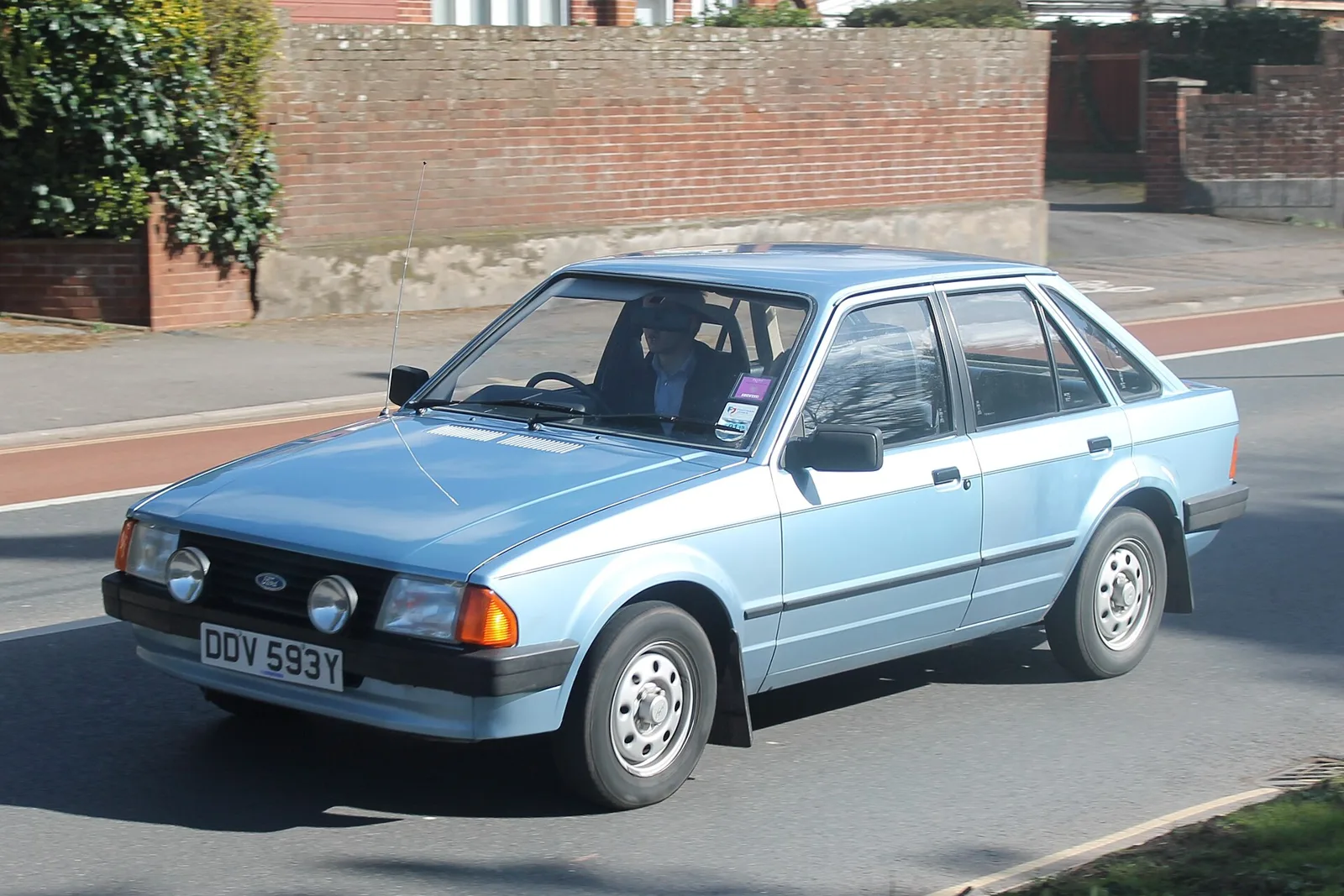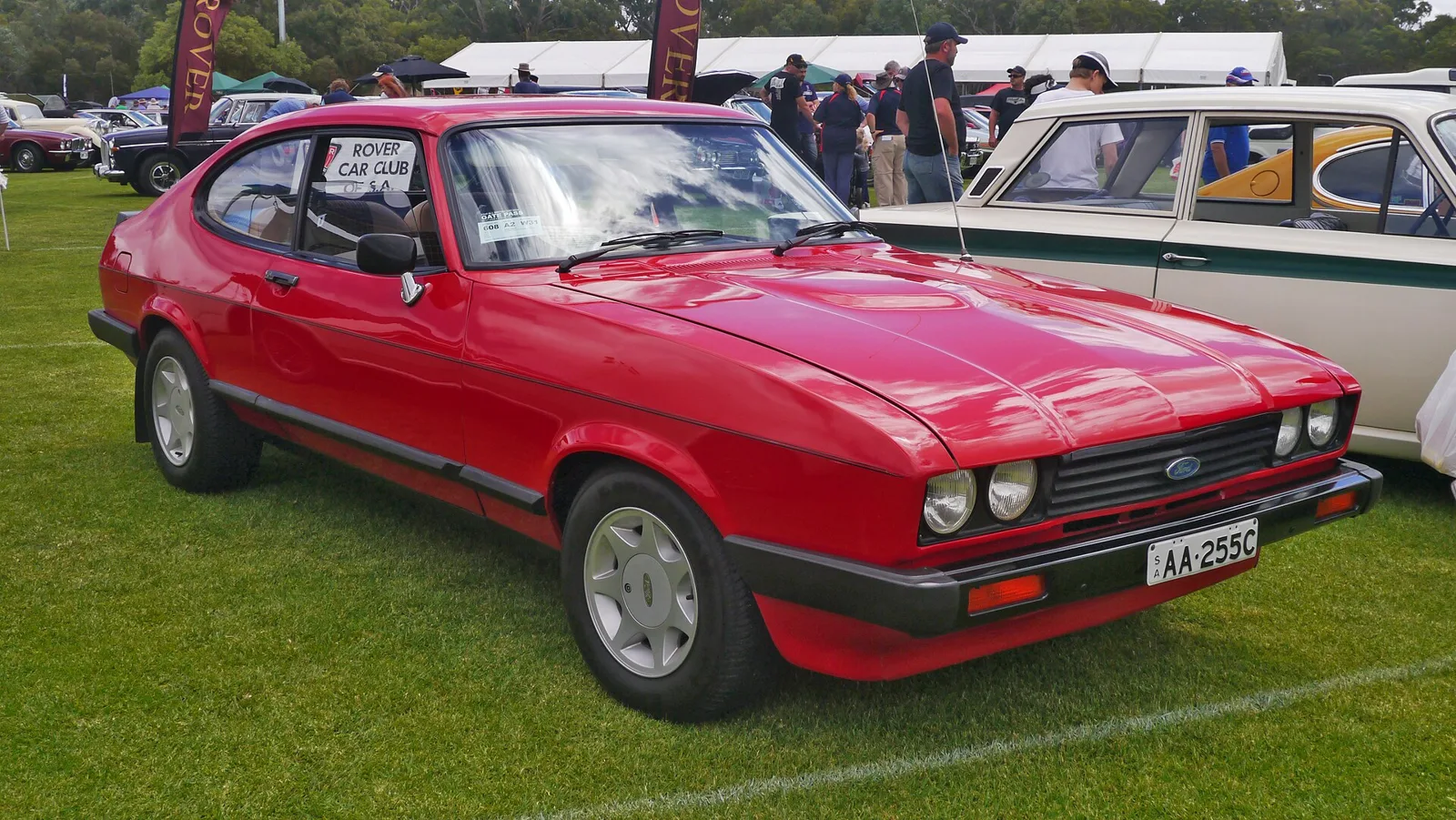
From a car almost called the Colt to RS racers, a hatchback Mk II and the hot hatches that closed the Capri's market.
Ford of Europe's Capri ran from 1968 to 1986 as a fastback built to bring the Mustang idea to Europe. It sold nearly 1.9 million cars across three generations, then ended in December 1986, with no official successor, as hot hatchbacks took over its market.
Ford wanted to call its European pony car the Colt, and it used that name throughout development before finding that Mitsubishi had trademarked it and been using it on its own Colt since 1962. The name Capri was the substitute, and the car that carried it sold nearly 1.9 million units in 18 years.
What was the Ford Capri?
Between 1968 and 1986 Ford of Europe made the Capri, a fastback coupe. Philip T. Clark designed it, a man who had worked on the Ford Mustang, and it used mechanical parts from the Mk2 Cortina. Ford intended it as the European equivalent of the Mustang. The top of the range used V6 engines named Essex and Cologne, while the straight-four Kent and the V4 Taunus powered the lower models.
Ford of Europe itself was new. It was formed in 1967 by merging Ford of Britain, Ford Germany and the Irish Henry Ford and Son Ltd, with headquarters in Cologne. Before that the British and German arms had kept out of each other's home markets and competed elsewhere in western Europe with separate product lines, despite sharing an American parent. The Transit van of 1965 was their first formal joint project. Tariffs between Britain and the European Economic Community had justified the separation, and once the United Kingdom entered the bloc in 1973, aligning the ranges made sense.
Ford meant the Capri to do for Europe what the Mustang had done in North America, and sold nearly 1.9 million of them.
Ford Capri history: the European pony car
The Escort arrived first, assembled in England from October 1967 and reaching showrooms at the beginning of 1968. The Capri was Ford Europe's second new car. Loosely based on the Mk II Cortina platform, it came with engines ranging from 1300 cc up to 3000 cc, and was made in both Britain and Germany, where it used a different range of V4 and V6 engines. It was an instant success and often appeared among Britain's ten best-selling cars.
Production started in November 1968 and the car made its debut at the Brussels Motor Show in January 1969, and customers could buy one from the following month. The aim was to repeat the Mustang's North American success by building a pony car for Europe. Ford wanted the flashy fastback to be affordable to a broad spectrum of buyers, and offering many engines helped. The name came from the Italian island and had been used before on the Ford Consul Capri, which people usually shortened to Capri in the same way they dropped Consul from Cortina.
Ford Capri Mk I, 1969 to 1974
The Mk I was built at Halewood in Britain and at Genk in Belgium, Saarlouis and Cologne in Germany. The two countries ran different line-ups. Continental cars used the Taunus V4 in 1.3, 1.5 and 1.7 litre sizes, while British ones had the Kent four in 1.3 and 1.6 litres. The 2.0-litre Essex V4, built in Britain, and the German-built 2.0-litre Cologne V6 were the first range-toppers. New sports versions followed in 1969: the 2300 GT in Germany with 92 kW (125 PS), and in September the British 3000 GT with the Essex V6 and 103 kW (138 hp). The 3000E followed in March 1970 with a more luxurious interior.
Underneath the new body sat running gear much like the 1966 Cortina: a live rear axle on leaf springs with short radius rods, and MacPherson struts at the front with rack and pinion steering taken from the Escort and a column that collapsed in a crash. Reception was broadly favourable.
Ford sold the Capri in Australia from May 1969 and in North America and South Africa from April 1970. North American cars wore a power-dome bonnet and four round headlights, carried no Ford badge and were sold through Lincoln-Mercury dealers as the sexy European. In South Africa Basil Green Motors near Johannesburg built the Perana, first with a 3.0-litre Essex engine and then a 302ci Windsor V8. Japan received 1.6 and 2.0-litre GT versions through Kintetsu Motors, and the larger engine attracted a higher annual road tax.
Ford Capri RS: from RS 2600 to RS 3100
The RS2600 appeared in September 1971 with a 2,637 cc Cologne V6 assembled by Weslake with special alloy heads and Kugelfischer fuel injection, giving 110 kW (150 PS). It was the base for the Group 2 car that raced in the European Touring Car Championship. The road car also had altered suspension, a close-ratio gearbox, lightened body panels, ventilated disc brakes and aluminium wheels, and reached 100 km/h in 7.7 seconds. Dieter Glemser of Germany took the 1971 drivers' title in a Ford Koln RS2600, and his compatriot Jochen Mass repeated it in 1972.
On 25 September 1973 Ford approved a right-hand-drive RS Capri, the RS 3100, which replaced the Cologne-based RS 2600 with the Essex V6 bored out to 3,098 cc. It matched the earlier car with 110 kW (150 PS) at 5000 rpm and 254 Nm (187 lb ft) at 3000 rpm. Its ride height was lower by an inch, and it had a ducktail spoiler, gold pinstriping, wider front wings to cover negative camber, Bilstein gas dampers, a small front air dam and 9.75 inch ventilated front discs. Reviews found it very stable at speed but complained of a rough ride. Only 250 RS3100s were built in November and December 1973 for homologation, to qualify the racing version for the 1974 Group 2 class above three litres. Ford Motorsport also made a 100-car limited edition, and Cosworth tuned the racing engine into the 3,412 cc GAA, a four-valve DOHC unit with fuel injection and 324 kW (435 hp). The same engine also raced in Formula 5000.
The facelifted Mk I and its sales peak
Within two years 400,000 Capris had been sold. A revision followed in late 1971 with more comfortable suspension, bigger taillights, new seats and larger headlamps with separate indicators, and the 3000GXL got quad headlamps. The Kent engines made way for the Pinto, and the 3000 GT, once UK-only, joined the German range. North American cars gained larger rubber-covered bumpers in 1973 to meet US rules.
That year the Capri reached its highest sales total ever, 233,000, and on 29 August Ford finished the millionth Capri, an RS 2600.
Special editions of the Mk I
Ford's first Special, the Capri Vista Orange Special, went on sale in November 1971 on top of the 1600 GT and 2000 GT. It came only in vista orange, with a dealer-fitted boot spoiler and rear window slats as an option, a direct link to the Mustang. Standard extras included a push-button radio, fabric seats, inertia reel belts, a heated rear screen and a black vinyl roof. Just 1200 were built. Another limited edition, the GTXLR Special, came in metallic green or black with red interior, opening rear windows and, for the first time on models under 3.0 litres, a bonnet bulge. It was offered only with the 1.6 or 2.0-litre engines.
Capri Mk I, II and III at a glance
| Generation | Years | Defining change |
|---|---|---|
| Mk I | 1969 to 1974 | Fastback coupe on Cortina parts; V4, V6 and four-cylinder engines |
| Mk II (Capri II) | 1974 to 1978 | Hatchback with a 630-litre boot; larger cabin, shorter bonnet |
| Mk III | 1978 to 1986 | Quad headlamps, black Aeroflow grille, better aerodynamics |
The Capri II and its hatchback
Ford introduced the Capri II on 25 February 1974. After 1.2 million cars and with the 1973 oil crisis behind it, Ford made the Capri easier to live with: a shorter bonnet, a larger cabin and a hatchback rear door over a 630-litre boot. It was the first Ford with a hatchback, a layout that Renault had patented in the mid-1960s. By mid-1970s standards the Capri II was well developed and had few reliability issues.
German buyers could choose straight-fours of 1.3 litres (40 kW), 1.6 litres (53 kW), a 1.6 GT (65 kW) or 2.0 litres (73 kW), along with a 2.3-litre V6 (79 kW), plus a 3.0-litre V6 from Britain with 103 kW. Gearboxes were the four-speed Type 5 manual or Ford's new C3 three-speed automatic, which was offered on everything but the 1.3. The automatic proved so popular with Ghia buyers that it became standard on Ghias after 1976. Large rectangular headlights remained the easiest way to separate a Mk II from a Mk III, and larger front discs, an alternator and a front air dam on S models completed the changes.
In March 1975 Ford launched the John Player Special limited edition, in black or white with gold pinstriping to echo the Formula 1 livery, gold wheels and a beige cloth interior. Sales were falling by May 1976, and the intermediate 3.0 GT gave way to the 3.0 S and Ghia. In October 1976 the Halewood plant, the only British factory making Capris, stopped, and all production moved to Cologne. The last year Capris were built for the US market was 1977.
Capri Mk III, Project Carla
Inside Ford the Mk III was Project Carla, a heavily revised Capri II. The first cars reached customers in March 1978 and sold very well at first. A Capri II with an Escort RS2000 style front, four headlamps and a rear spoiler had previewed it at the 1976 Geneva show. The black Aeroflow grille, first seen on the Mk I Fiesta, and sawtooth rear lamps matched the design language introduced across the range by Uwe Bahnsen, chief stylist at Ford of Europe. The same elements reached the 1979 Cortina 80, the Escort Mk III of 1980 and the Granada Mk IIb of 1981. Better aerodynamics improved performance and economy, and the bonnet's leading edge pulled down over the quad headlamps for a more aggressive look.
Existing engines and gearboxes were carried over. The 3.0 S was regarded as the most desirable model, though in Britain the softer Ghia with an automatic gearbox was the better seller of the two V6 cars. In Germany S models made up 63 percent of Capri sales.
Why did the Ford Capri end?
As sales fell elsewhere, Ford turned its attention to Britain, where the Capri had something of a cult following. Unlike the four-door Cortina, British Capri sales went mostly to private buyers, who demanded fewer discounts than fleet buyers, so margins on the coupe were higher. In 1977 Ford offered X Pack options from the Rallye Sport range to hold interest. They were expensive and slow selling, but they showed that magazines were keen to write about hotter Capris.
The bigger problem came from the early 1980s, when hot hatchbacks and sports saloons took over. Demand for affordable sports cars fell throughout Europe. Production of the Capri ended in December 1986 after 18 years with no replacement, though stocks sold into 1987. Sporting coupes lost favour as fast hatchbacks such as Ford's own Escort XR3i, Vauxhall's Astra GTE, Peugeot's 309 GTI and Volkswagen's Golf GTI took off, and Ford itself did well with faster Fiestas, Escorts and Sierras.
What to know if you are looking at a Ford Capri
Capris vary more than they first appear. The headlamps separate generations: large rectangular lamps on a Mk II, quad lamps on a Mk III. North American cars have a power-dome bonnet and no Ford badge, and the rare RS models were built for competition: 250 RS3100s for homologation and 1200 Vista Orange Specials. Capri II reliability was good for its era. British Ford and German Ford also used different engines, so a car's origin matters, as the Essex V6 is British and the Cologne V6 German.
Where this goes next
Ford never named a direct successor to the Capri. The second-generation Probe is described as its effective replacement after reaching the European market in 1994. The Capri itself remained the coupe that set out to bring the Mustang idea to Europe.