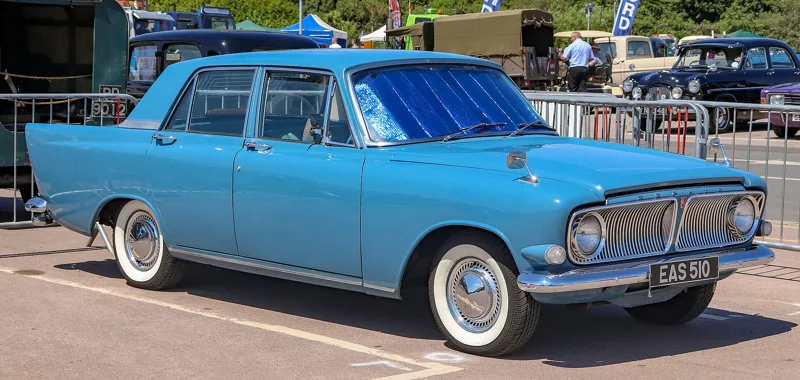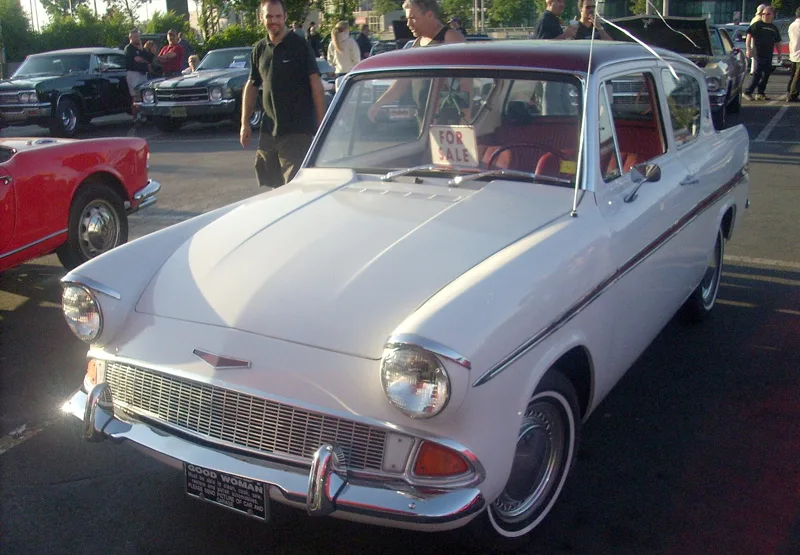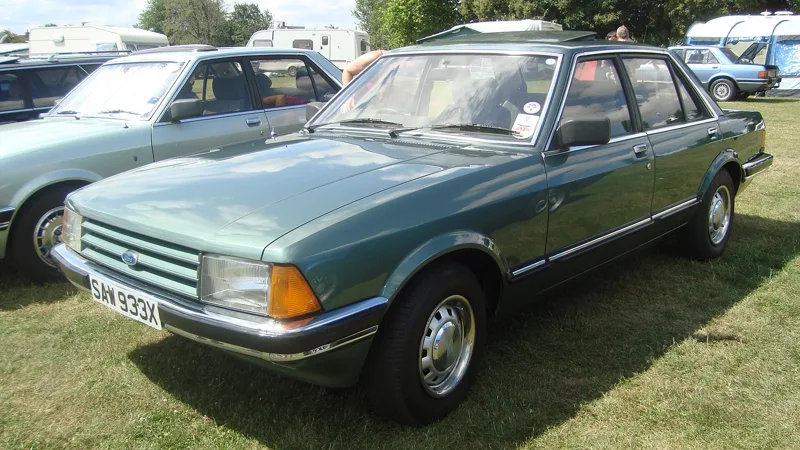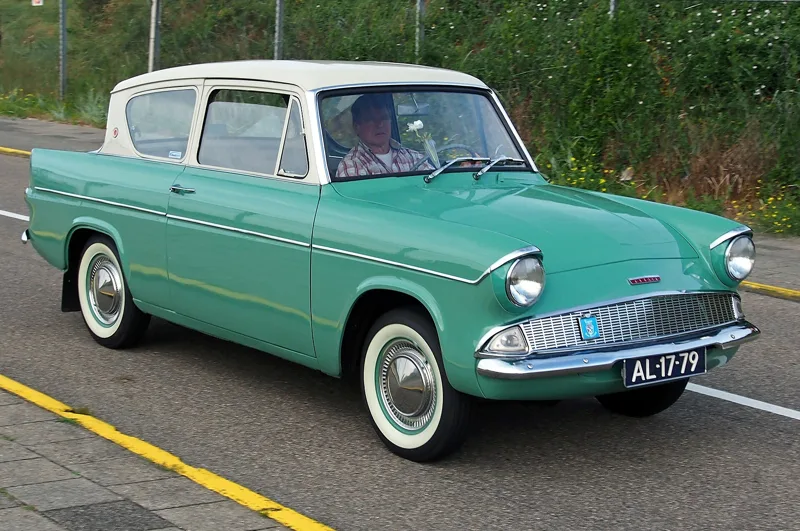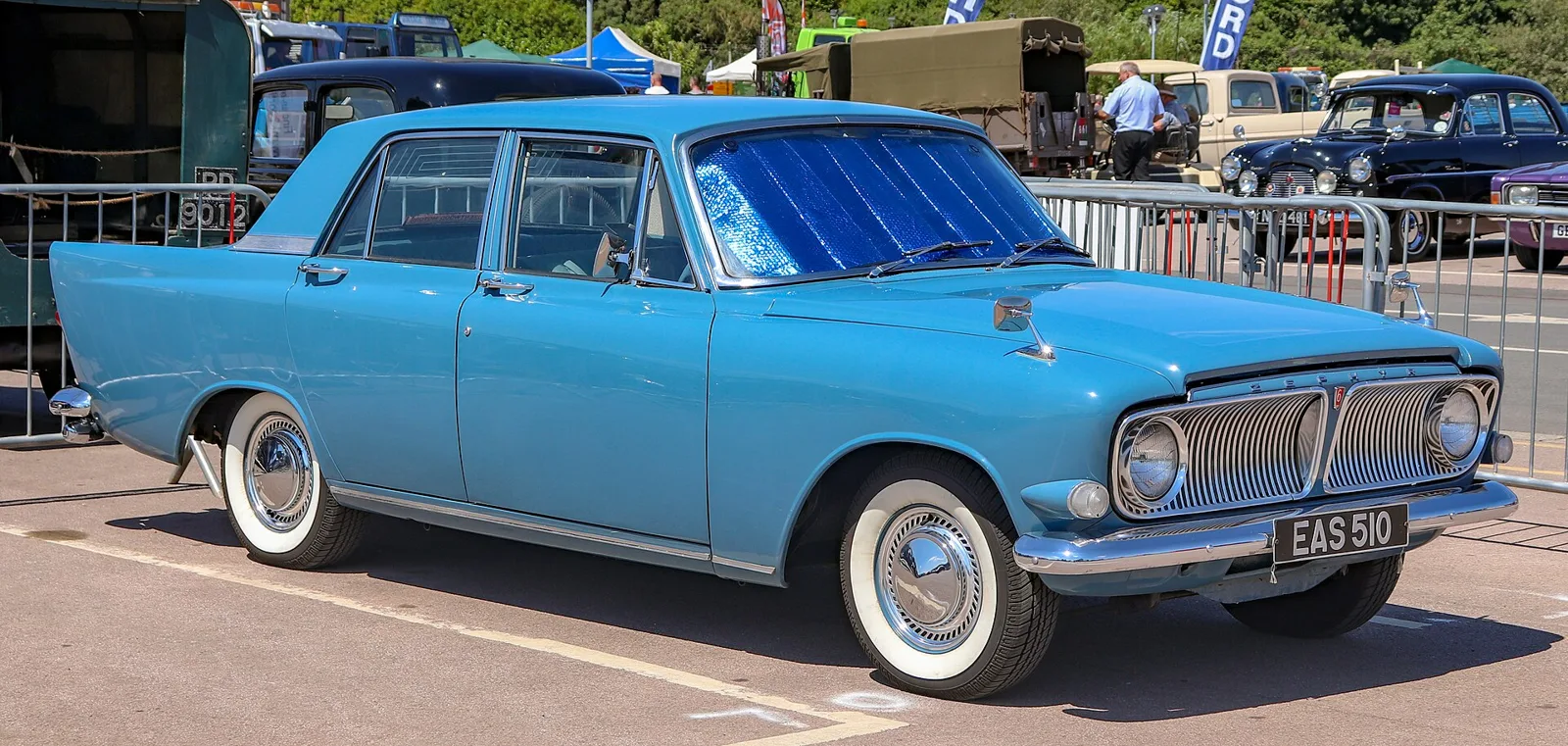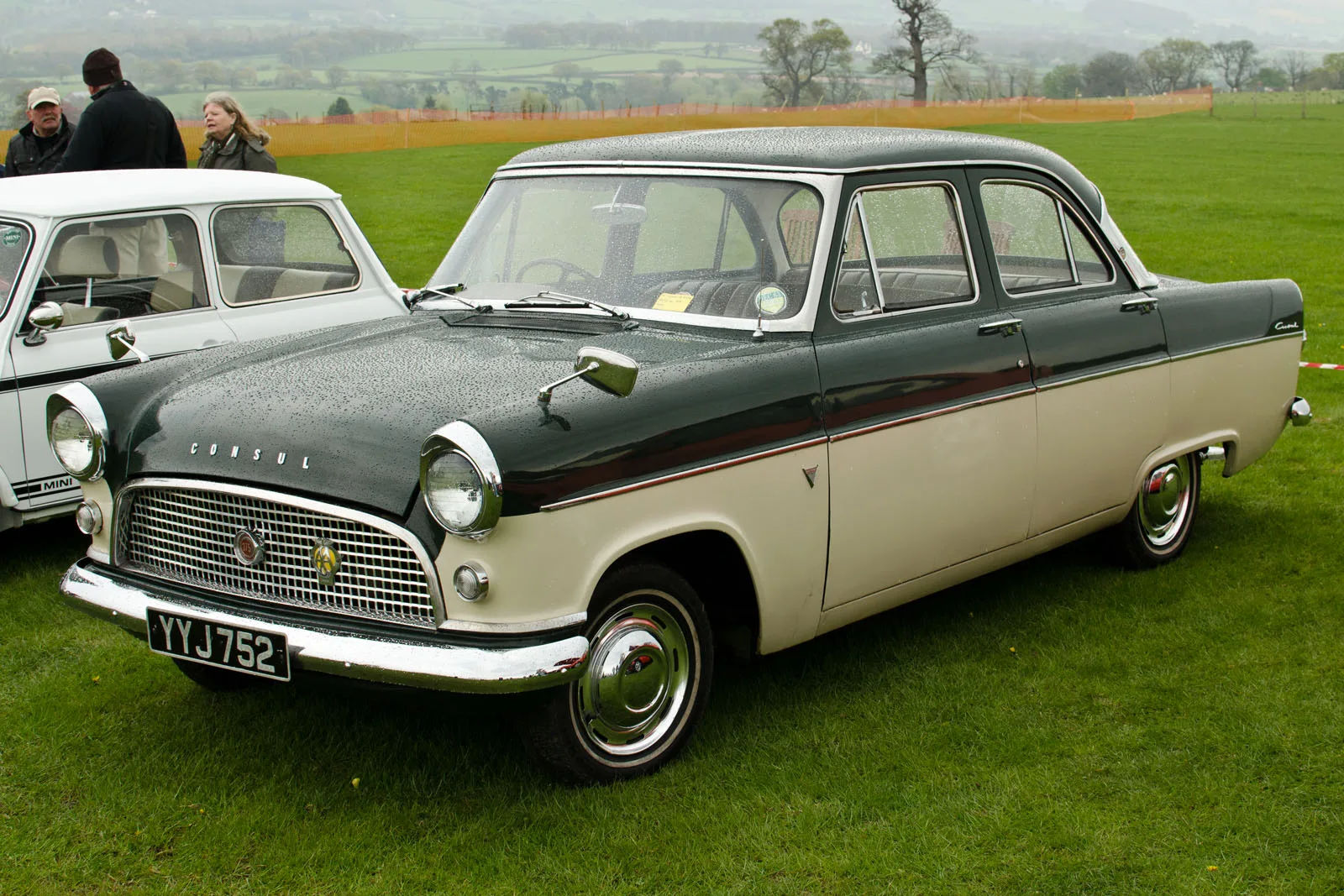
From a small upmarket Prefect of 1938 to the Consul that brought unibody construction and MacPherson struts, and the Corsair that shared a Cortina's bones.
The Ford Prefect was an upmarket small family car built from 1938 to 1961. The Consul was the four-cylinder base model of the Zephyr range from 1951 to 1962, and the Corsair was a mid-size car, built from 1963 to 1970, that was essentially a longer, re-skinned Cortina.
An alien in The Hitchhiker's Guide to the Galaxy took the name Ford Prefect because he thought a small British family car would be nicely inconspicuous. The Prefect was one of three Ford of Britain names, with the Consul and the Corsair, that carried the company from the sit-up-and-beg shapes of the 1930s to the jet-age lines of the 1960s and beyond.
What was the Ford Prefect?
Ford UK made the Prefect from 1938 to 1961, pitching it above the Popular and the Anglia as the more refined small family car. It was introduced in October 1938, built until 1941, and returned in 1945. In 1953 it moved from its original upright style to a modern three-box shape.
Ford Australia built and sold some versions too, and in Britain the light body and four-cylinder engines made the Prefect a favourite starting point for hot rods. The first model, the E93A, was made at Dagenham in Essex as a slight rework of the 7W of the year before, which was the first Ford designed outside Detroit. It was aimed squarely at British buyers.
A Ford Prefect lent its name to an alien who thought it would be nicely inconspicuous.
What was the original Prefect like to live with?
The E93A used a 1,172 cc (71.5 cu in) side-valve engine cooled by thermosiphon, with no water pump. A crank handle could start it if the battery was too weak for the 6-volt starter, as on many cars of the time. The windscreen wipers ran off manifold vacuum, so they slowed to a halt as the car laboured uphill and resumed when the engine eased at the top. The windscreen hinged outwards at the top edge, and two flaps beside the scuttle let in air.
Most were two- or four-door saloons, with a few tourers and drophead coupes before the war. After the war the home market had four-door saloons only, while two-door cars were made for export. Ford built 41,486 up to 1941 and a further 158,007 between 1945 and 1948. In Australia the car was recoded E03A in late 1939 and gained an all-steel roof, and the A53A of 1946 added a longer boot.
The E493A of 1949 to 1953 moved the headlamps into the wings and added trafficators, small illuminated semaphore arms that sprang out of the door pillars. The brakes were still rod-operated, made by Girling, on 10 in (250 mm) drums, and transverse leaf springs sat at both ends. In 1948 The Motor clocked one at 61 mph (98 km/h), took 22.8 seconds to reach 50 mph (80 km/h) and logged 33.2 mpg imperial (8.5 L/100 km; 27.6 mpg-US). The magazine noted that in standard form it was the cheapest four-door car on the British market. Ford made 192,229.
How did the 100E and 107E change the Prefect?
The 100E arrived in 1953 beside the similar Anglia and stayed in production until 1959. The Prefect had vertical bars in its grille and four doors. The separate chassis was gone, replaced by integral construction, and coil springs with independent front suspension replaced the transverse leaf. Brakes became hydraulic, still from Girling, on 7 in (180 mm) drums that soon grew to 8 in (200 mm).
The 1172 cc side-valve engine was new but kept the old bore, stroke and layout, and was otherwise redesigned, with adjustable tappets, larger inlet valves and a compression ratio raised from 6.3:1 to 7:1. Power rose by 20 percent to 36 bhp. Inside were separate PVC front seats, a floor gear change and a heater that cost extra. The wipers still depended on manifold vacuum and faded when the engine worked hard. In 1955 an estate arrived as the Ford Squire, with timber trim strips and better fittings.
A de luxe 100E tested by The Motor in 1957 managed 71 mph (114 km/h), needed 32.2 seconds to reach 60 mph (97 km/h) and gave 33.1 mpg imperial on a touring run. It cost 658 pounds including 220 pounds of taxes, and 100,554 were made. The 107E of 1959 to 1961 used a reworked 100E body with the new 997 cc overhead-valve engine, four-speed gearbox and banjo-type rear axle from the Anglia 105E. It existed to supply a four-door model until the Consul Classic replaced it, and 38,154 were made, most of the British ones in two-tone paint with deluxe trim. MacPherson struts held up the front, and the test car reached 73 mph (117 km/h).
Where did the Prefect sell outside Britain?
Besides the United Kingdom and Australia, Prefects were sold in the United States, New Zealand, where they were assembled locally, Argentina and Canada, where the model was left-hand drive. In Latvia, Ford-Vairogs built it under licence as the Junior. Ireland assembled it at Cork until 1962, South Africa at the Struandale plant in Port Elizabeth, and Ford of Malaya in Singapore built the 100E from kits.
It also turned up in fiction. The hero of V. S. Naipaul's A House for Mister Biswas buys an early 1950s Prefect as one of his few prized possessions, a target for ridicule from relatives and a symbol of how little he had risen in the world.
What was the original Ford Consul?
Ford of Britain built the Consul from 1951 until 1962 as the entry-level four-cylinder car in a Zephyr trio that rose through the Zephyr to the Zephyr Zodiac. Ford first showed the 1500 cc Consul in London in 1950, the opening move in its push into the family saloon market.
With the Zephyr, it was the first British Ford of modern unibody construction. Most were four-door saloons with bodywork by George Walker of the American parent company, but Abbott built a few estates and from 1953 Carbodies offered a convertible. Cutting the roof off weakened the shell, so a large X-frame was welded into the floor pan. Unlike the pricier Zephyr, the convertible's hood had to be raised and lowered by hand.
It was also the first Ford built with current engineering. Its new 1508 cc engine, rated at 47 bhp (35 kW), used overhead valves, and the clutch was hydraulic, unusual in 1950, though the three-speed gearbox kept synchromesh only on second and top. The Consul was the first British production car to use MacPherson strut independent front suspension, which is now standard practice. The bench seat was in PVC, the handbrake was an umbrella-style pull under the dash, and the wipers used a vacuum pump driven off the fuel pump rather than the inlet manifold.
From September 1952 a redesigned asymmetrical dashboard put the instruments above the steering column. The Motor's 1953 figures were 72 mph (116 km/h), 28 seconds to 60 mph (97 km/h) and 26 mpg imperial (11 L/100 km; 22 mpg-US). The test car cost 732 pounds including taxes.
How did the Consul Mark II differ?
The 1956 Consul Mark II, code 204E, was still the four-cylinder member of the Zephyr family and shared its body shell. It had a longer wheelbase, a 1703 cc engine of 59 bhp (44 kW) and a full restyle that borrowed cues from the 1956 Thunderbird and Fairlane. The wipers were still vacuum-operated.
In 1959 a lowline version appeared with a lower roof, new rear lights and stainless steel brightwork. Front disc brakes with a vacuum servo were optional in 1960 and standard in 1961, except in Australia, which kept four drums. In mid-1961 it became the Consul 375, aimed at three rivals, the Morris Oxford Series III, the Austin A55 Cambridge and the Vauxhall Victor F. The Carbodies convertible continued, a De Luxe with a contrasting roof joined in 1957, and Australia built its own coupe utility, estate and saloon. Ford of Canada imported them as a companion to the Falcon.
The Motor's 1956 test car reached 79.3 mph (127.6 km/h), covered 0-60 mph in 23.2 seconds and returned 22.1 mpg imperial (12.8 L/100 km; 18.4 mpg-US), for 781 pounds. A 1960 Consul Mark II was also the taxi in which Eddie Cochran died, not a London hackney cab as many have said.
The family was reshuffled in 1962. The Consul gave way to the Zephyr 4, the Zephyr became the Zephyr 6 and the Zodiac lost its Zephyr prefix. The Consul name moved to smaller cars, first the Consul Classic, built between August 1961 and March 1963, and the Consul Capri, built from October 1961 to August 1964, and soon the smaller Consul Cortina. In 1964 the Cortina and the Corsair dropped the Consul tag, and the Cortina became a best-seller.
What was the Ford Consul Corsair?
The Ford Consul Corsair, later the Ford Corsair, was a mid-size car unveiled at London's motor show in October 1963 and sold as a saloon or estate from 1964 to 1970. Crayford Engineering built a convertible, now rare and sought after. The whole production run was a Mark 1, with changes confined to the interior, engine and mechanical parts.
The Corsair came from the Mark 1 Cortina team: Roy Brown Jr. oversaw the styling by Charles Thompson, and Fred Hart led the engineering. It took over from the Consul Classic and amounted to a Cortina on a longer wheelbase with new bodywork, added sound deadening and roomier, softer seats for fast long-distance driving. It shared its windscreen and side windows with the Cortina and its mechanical parts with the Cortina GT.
The styling was bold for its day, with a sharp V-shaped crease across the nose into which round headlights were set. That gave the Corsair a slippery shape, and the Corsair 1500 was quicker than the equivalent Cortina 1500 despite being slightly larger and heavier. Sharply pointed vertical rear lights hinted at fins, recalling the Consul Mark 2. The theme was shared with the early 1960s Thunderbird, and both drew on Uwe Bahnsen's 1960 Ford Taunus P3 design. In 1964 Tony Brookes, with his twin brother among the drivers, took 15 International class G world endurance records at Monza in a Corsair 1500 GT.
Why did the Corsair V4 struggle?
The early cars used the 1.5-litre Kent engine: the Deluxe had 60 bhp (45 kW) with a single carburettor and the GT had 78 bhp (58 kW), as in the Cortina. Journalists were positive, with reservations about the dash layout and how close the steering wheel sat to the driver. The 1963 to 1965 cars outsold the Classic, but they were not a best-seller like the Cortina. Given low development costs, Ford was presumed to have profited.
The September 1965 revision brought a better dashboard and improved ventilation, but it also brought the new Essex V4 engines, which idled roughly and sounded coarse on the road. A 1.7-litre (1,663 cc) V4 powered the Deluxe and a 2.0-litre version, thirsty and disappointing, went into the V4 GT. Advertising promised a car that was seen but not heard, which was a stretch given the engine. The public thought poorly of the V4 cars and sales tapered off.
Ford fixed the problem in two steps. A much improved 2.0-litre engine arrived in January 1967, and in April 1967 the V4 GT gave way to the 2000E. This was Ford's Executive treatment, which brought a vinyl roof, reversing lights, special wheel trims, flush door handles, dechromed flanks and a polished wood dashboard. At 1,008 pounds it undercut the 1,357 pound Rover 2000 and the 1,047 pound Humber Sceptre. Crayford also offered a 3.0-litre Essex V6 conversion.
Later 2.0-litre cars reached 110 mph (180 km/h) on the speedometer, helped by a 28/36mm twin-choke Weber carburettor. An Abbott estate joined the range in March 1966, just before the Geneva Motor Show. Crayford made two open versions, a five-seater convertible and a cabriolet seating four. Just 18 cabriolets were built, using technology from Karl Deutsch in Germany, and four of them are known to remain.
The Mark 3 Cortina replaced the Corsair in 1970, by which time the Escort filled the size below and the new Capri carried Ford's sporting aspirations. Over six years Ford built 310,000 Corsairs, and as of 2019 roughly 600 are believed to remain in Britain. Of 200 convertibles built, about 75 remain. Ford also built the car in Ireland and South Africa and exported a few to Australia and New Zealand.
Did Ford bring back the Consul and Corsair names?
Ford revived the Consul name in April 1972 for the cheaper, simpler versions of the new Granada, which Ford Britain and Ford of Germany developed together and built at Cologne and Dagenham. A two-panel cross-mesh grille set Consuls apart from Granadas. Consul, Consul L and Consul GT versions came as two-door and four-door saloons, a two-door coupe and a five-door estate, and Ford built the estate itself instead of using an outside contractor.
UK engines were a 1663 cc Essex V4 of 77 hp, a 1996 cc V4 of 92 hp and a 2495 cc Essex V6 of 118 hp (88 kW), with a 2994 cc V6 of 138 hp (103 kW) in the GT. Because it was less well equipped than a similar Granada, the GT weighed about 1 long cwt (110 lb; 51 kg) less and was quicker. The Pinto 2.0-litre replaced the V4 in late 1974. German buyers had Taunus V4, straight-four and Cologne V6 engines. The Consul name ended in late 1975, when the Court of Appeal in the UK decided that Granada Group had no power to stop Ford trademarking Granada; the Granada badge then went on every model.
The Corsair name had two further lives. Ford Australia sold a badge-engineered Nissan Pintara as the Corsair from 1989 to 1992, developed as Project Matilda under the Button Plan, in sedan and five-door liftback forms with 2.0-litre and 2.4-litre engines. It was meant to replace the Mazda 626-based Telstar but sold worse, and it ended with Nissan's closure of its Australian plant in 1992. The unrelated Edsel Corsair was sold in the United States in 1958 and 1959.
Three names compared
| Name | Years | Role | Numbers |
|---|---|---|---|
| Prefect | 1938 to 1941, 1945 to 1961 | Upmarket version of the Popular and Anglia | 192,229 E493A; 100,554 100E; 38,154 107E |
| Consul | 1951 to 1962 | Four-cylinder base model of the Zephyr range | 1508 cc, then 1703 cc engine |
| Corsair | 1963 to 1970 | Mid-size car from the Cortina team | 310,000 built |