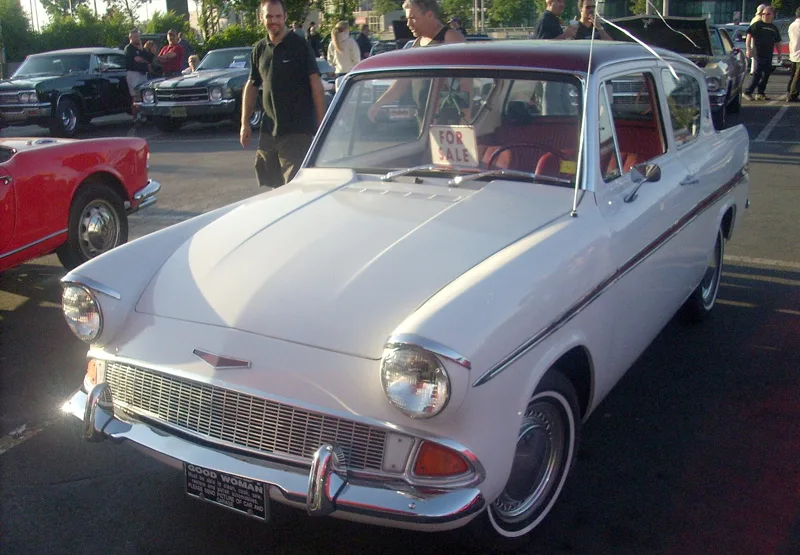
A two-door New Anglia with an overhanging rear roof and a 997 cc Kent engine, which spawned estates, vans, a stronger Super and an Italian-built saloon.
Ford of Britain built the Anglia 105E, sold as the New Anglia, as a two-door compact from 1959 to 1967. Its 997 cc overhead-valve four-cylinder sat under a roof that overhangs the rear, and more than 200,000 were sold in Britain in 1960.
The Ford Anglia 105E, sold as the New Anglia, was a compact two-door saloon that Ford of Britain built from 1959 to 1967. It came with a 997 cc overhead-valve four-cylinder engine and a rear roof that overhangs the boot, and in its first full year it was Britain's top seller.
Where did the New Anglia come from?
The New Anglia was the successor to the 100E-series Anglia, and Ford decided early on to offer the successor only as a two-door from 1959. Series production began in June 1959, ahead of an October launch that let dealers sell the cars they already had.
Planning started in 1956 in Ford's newly formed planning department in Dagenham. Overall responsibility for development lay with the engineer Frederick Leslie Fred Hart (1914-2008). The 100E series had been the first Ford British model with a unitary body.
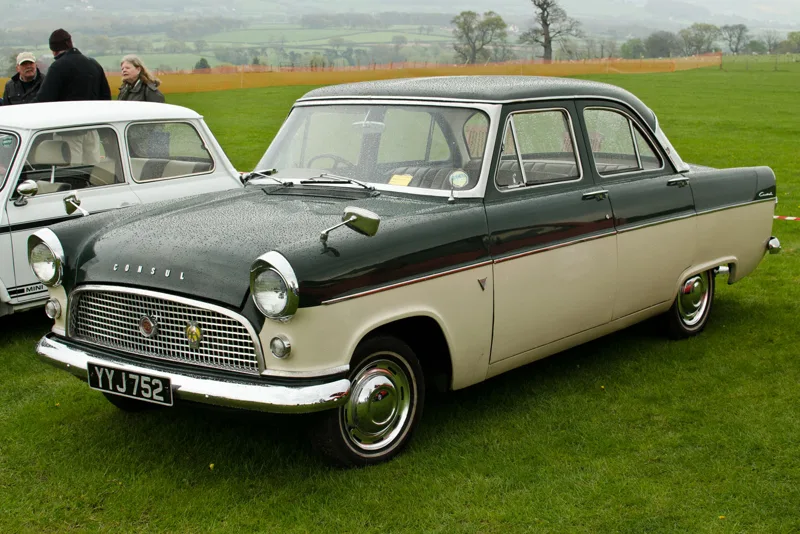
The Popular, a version of the older 100E Anglia with slightly modified technology and an unchanged body, was built until 1962. The four-door Consul Classic of 1961 took over from the Prefect and the Consul Mark II, and it was positioned above the Anglia.
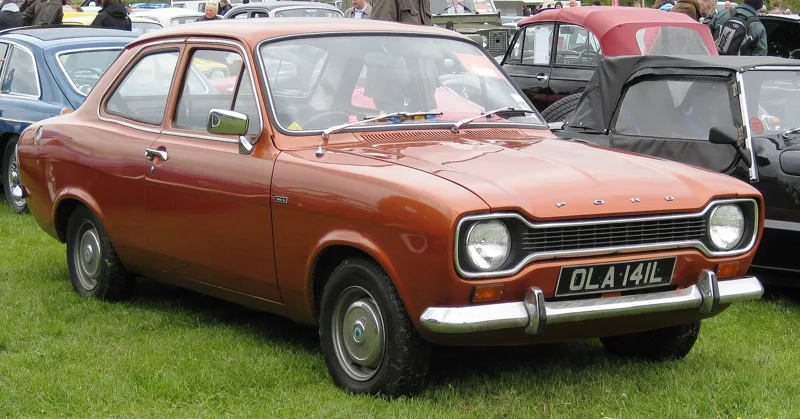
With the Popular gone in 1962 the Anglia became Ford's entry-level model. Production of the New Anglia ended in 1967, and the Ford Escort took its place.
The Anglia 105E was Britain's top seller in its first full calendar year.
What did the Anglia's engine produce?
The 105E used a 997 cc overhead-valve four-cylinder engine that produced 39 bhp (29 kW; 39 PS) at 5,000 rpm. Its maximum torque of 53 lb-ft (72 Nm) arrived at 2,700 rpm, and the engine's stroke ratio was 0.6:1.
The engine was the first variant of the Kent series, which the Ford engineer Alan Worters had developed and which was introduced in 1959. With a bore of 80.96 mm and a stroke of 48.41 mm it was extremely short-stroke, and its compression ratio was 8.9:1.
Power went through a manual gearbox with a centre change. It was the first four-speed gearbox at Ford of Britain, and every gear except first was synchronised.
How was the Anglia's chassis built?
The front wheels used MacPherson struts with wishbones and an anti-roll bar, while the rear had a rigid axle on longitudinal asymmetric leaf springs with lever-arm dampers. The body was a unitary shell of pressed steel sheet, with cross-shaped reinforcements in the floor.
Ford fitted longer leaf springs than its predecessor for a more comfortable ride. The saloon's rear springs had four leaves and the estate's had seven. Steering came from Burman and Sons, and the brakes from Girling, which matched those of the old car.
What made the design unusual?
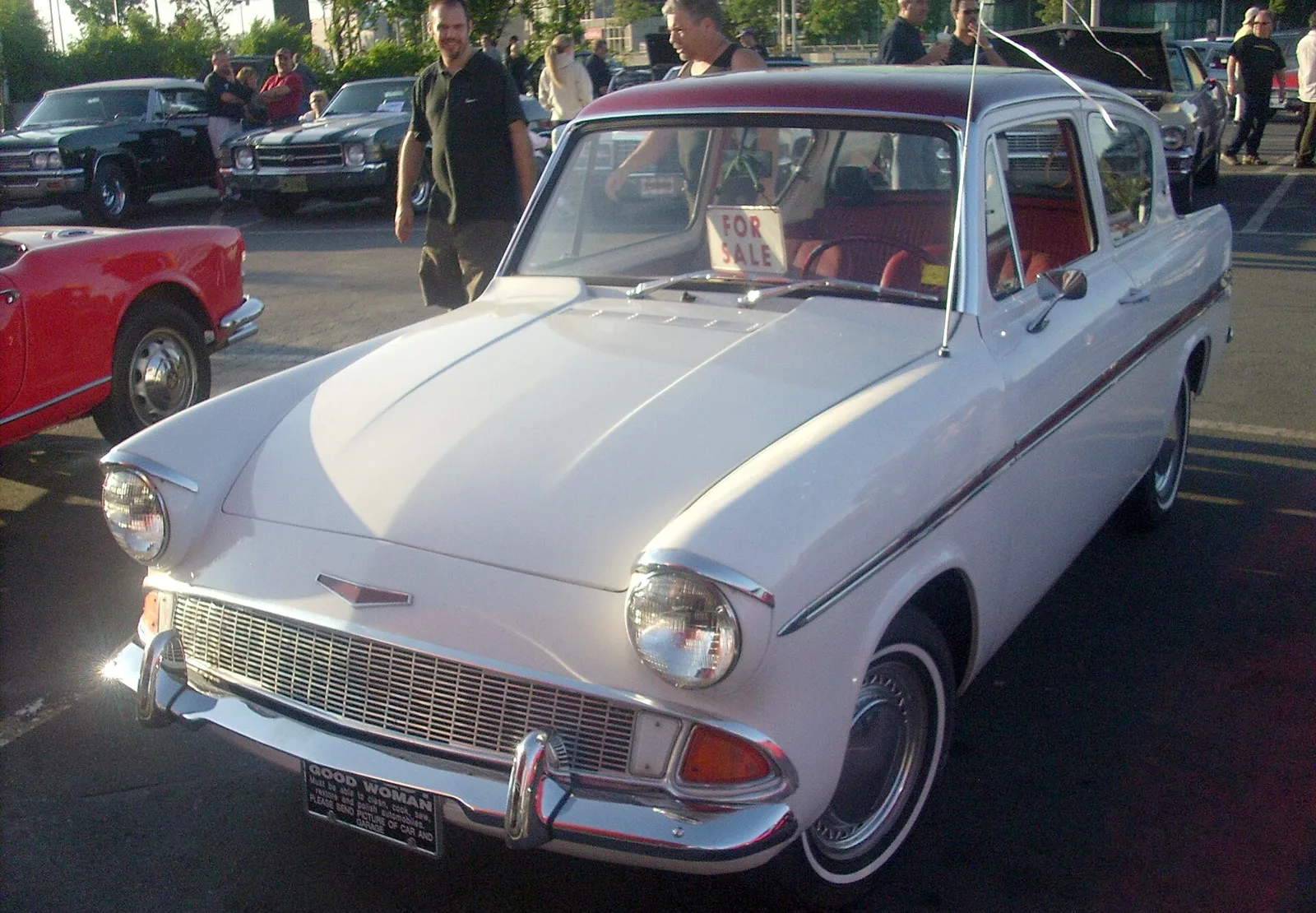
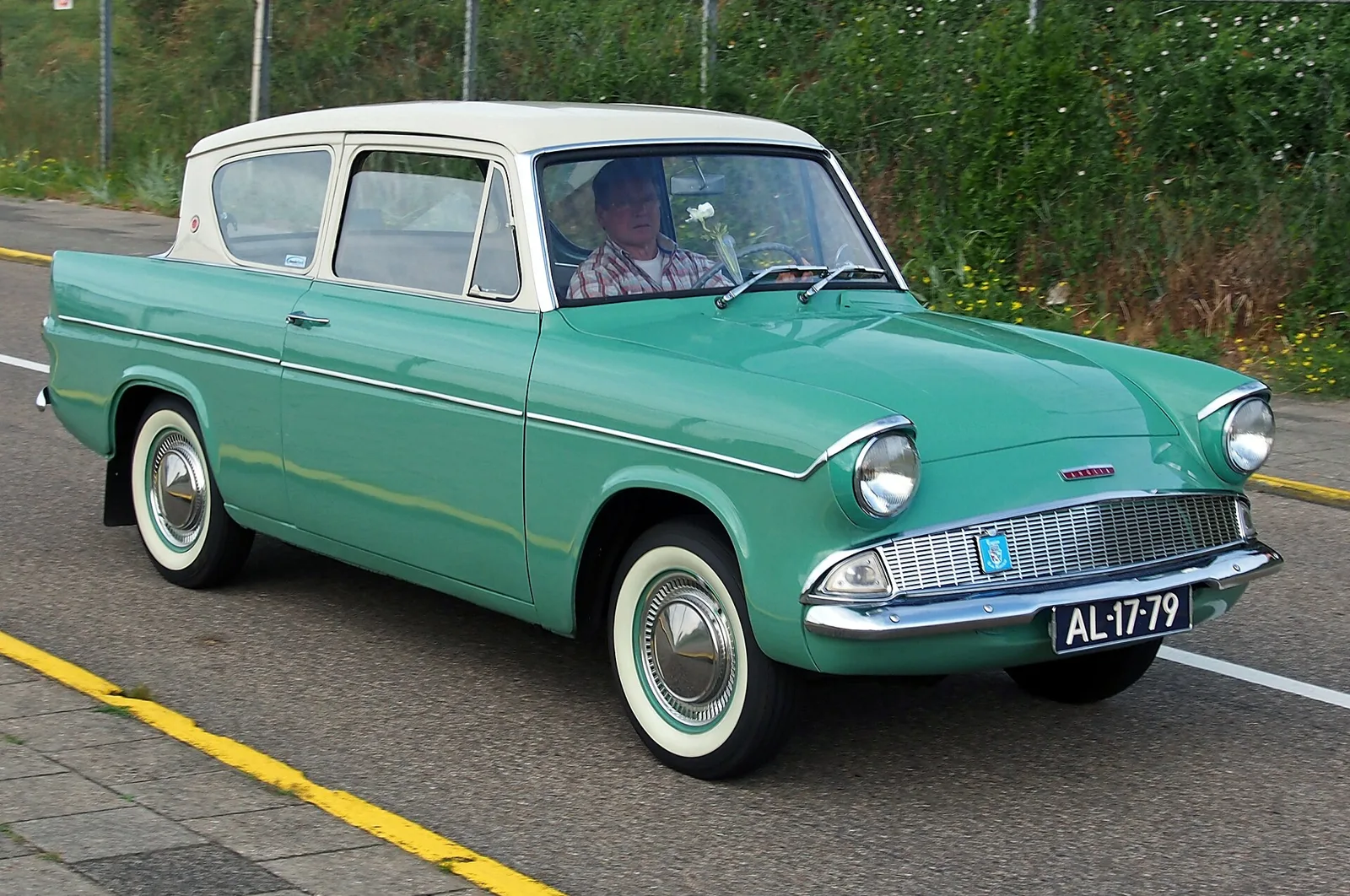
The saloon's roof overhangs at the rear, and its C-pillar leans forward in its lower area, at an angle that roughly matches the A-pillar. Ford's designers wanted as much rear headroom as possible, and the inward-leaning rear glass kept the view clear in rain.
The shape had a precedent across the Atlantic. Ford's American subsidiary Lincoln had used a similar treatment on the Continental Mark III in 1958, although the Anglia's rear window stayed fixed rather than lowering. One source says the American Ford designer Elwood Engel was closely involved in the body shape.
Other designers borrowed the shape. Ford of Britain adopted it for the Consul Classic in 1961, and Citroen for the Ami 6 and Reliant for the Regal 3/30 took it up too. Ford said it had run wind tunnel tests on the body, and the bonnet between the headlights was shaped to slope down to reduce air resistance.
What set the basic and Deluxe versions apart?
The basic and Deluxe versions shared the same technology and differed mainly at the front. The basic car had a narrow radiator opening framed by painted sheet metal, while the Deluxe had a grille spanning the full width of the car.
The Deluxe also had more chrome decoration, an engine temperature gauge, rear side windows that could be opened, better seat covers and optional leather upholstery.
How big was the New Anglia and how fast was it?
The basic New Anglia measured 3,912 mm (154.0 in) and weighed 737 kg (1,625 lb). Its top speed was 79 mph (127 km/h), and 0 to 60 mph (96 km/h) took 26 to 29 seconds, depending on the rear axle ratio.
It was about 6 cm longer than the car it replaced, but 25 kg (55 lb) lighter.
What was the Anglia Super 123E?
The Anglia Super 123E was the stronger, better equipped top model that Ford introduced in October 1962. It used a 1,198 cc (73 cu in) version of the Kent engine, which made 48.5 bhp (36 kW; 49 PS) and gave a top speed of 84 mph (135 km/h).
The engine was a 1.2 litre version of the Kent four that had been designed for the Cortina, a medium-class saloon introduced in 1962. The bore stayed the same and the stroke grew to 58.17 mm to increase the displacement.
The Super had a fully synchronised four-speed gearbox, carpets, a heater, electric windscreen wipers and a cigarette lighter as standard. A two-tone paint scheme, with the roof and flank beading in a contrasting shade, marked it out from the Deluxe.
It launched at 598 GBP, which was 60 GBP more than the 105E Deluxe and 84 GBP more than the basic 105E.
Which equipment packages were offered?
The 1200 Package, offered from late 1962 to October 1964 for 24 GBP, gave the 105E and the Deluxe the Super's 1.2 litre engine and fully synchronised gearbox. It did not include the Super's higher-quality interior or its two-tone paint.
In autumn 1964 the 1200 Package was replaced by the Super Package, which cost an extra 25 GBP on the Deluxe. It brought the Super's high-quality equipment, but not its more powerful engine.
What set the Anglia Estate apart from the saloon?
The Anglia Estate was introduced at the British Motor Show in October 1961, and it shared almost all of its chassis with the saloon. Its rear leaf springs had seven leaves, and the roofline ended in a narrow C-pillar rather than the saloon's drawn-in roof.
The rear seat folded down to make a flat load floor up to the front seats, and the one-piece tailgate was hinged at the top. The estate had no tail fins. It was first offered with the 1.0 litre engine, and from 1962 the 1.2 litre could be ordered.
Stylistically the estate matched the saloon as far as the side doors. The design was the work of the Canadian Roy Brown Jr., who had designed the Edsel models for Ford some years earlier.
A special Estate Combi was built only for export. It had metal panels in place of the rear side windows, so that the load area could not be seen from outside.
Why did the Thames van matter?
The Thames was a purely commercial version of the New Anglia, introduced in 1961 alongside the estate. It was sold as the Thames until February 1965, and from March 1965 it was renamed the Anglia Van. Payloads of 250 kg (5 cwt) or 350 kg (7 cwt) were possible.
Its front end matched the Anglia estate, but its roof was higher and its rear body was box-shaped. The doors were newly designed, with a lower edge that rose towards the rear so that they could open against a high kerb.
The van was very simply equipped. Only a driver's seat came as standard, and a passenger seat cost extra. Its load volume was 2.1 cubic metres.
Who else converted the Anglia?
Friary Motors and Abbott of Farnham built three-door conversions of the New Anglia, and Kenex Coachwork developed a pick-up. The Friary Touring Saloon cost 89 GBP to convert, while Abbott's Sports Saloon came in at 75 GBP.
Friary Motors of Basingstoke, Hampshire, presented its own estate version half a year before Ford's launch. The Touring Saloon was in fact a design of Abbott of Farnham, which had made estate conversions of Ford saloons since 1955. Friary was an Abbott subsidiary.
Friary kept the upper roof section of the New Anglia but redesigned the C-pillar, so that the roof formed a trapezoid. Abbott later dropped Friary's rear side windows, which according to one source had sealing problems, and fitted the regular saloon windows.
Kenex Coachwork of Dover developed a two-seat pick-up on the Thames in 1961, with conversion costs of 45 GBP. Before it could go into series production, Kenex was taken over by the Folkestone car dealer Martin Walter, who began series production in 1964, almost three years late.
Did Italy build its own Anglia?
Italian Ford sold the imported Anglia 105E with some success in the early 1960s, but sales fell as its roof came to look dated. Ford Italia saw the need for a restyle in 1963, but Ford of Britain was unwilling to carry one out, so it commissioned a new body from the Turin designer Giovanni Michelotti.
Michelotti designed a straight-lined notchback with a trapezoid roof, thin pillars and a high boot. From April 1965 the Anglia Torino was offered in Italy alongside the British cars, built in series by Officine Stampaggi Industriali (OSI) in Turin.
The Torino came with either the 1.0 litre engine or the 1.2 litre four, and the 1.2 was delivered as an S version with a Weber twin carburettor. By 1967 Ford had sold only 10,007 Torinos in Italy. Some sources blame the poor build quality of the OSI body for damaging the car's reputation.
The car eventually reached only the Benelux countries, where cars were assembled by Ford's Belgian subsidiary.
How many Anglias were sold?
The Anglia 105E sold more than 200,000 units in Britain in 1960, which made it Britain's top seller in its first full calendar year. By November 1967 Ford had built 954,426 saloons of the 105E and 123E series, plus 129,529 works estates.
Ford offered the car across almost all Western European markets, though not in West Germany. It also sold well in other markets around the world.
How did the Anglia launch go?
The New Anglia debuted at the Earls Court Motor Show in October 1959, where Ford advertised it as the world's most exciting light car. By the end of the ten-day show Ford had received 101,000 orders, two thirds of them from its North American subsidiaries.
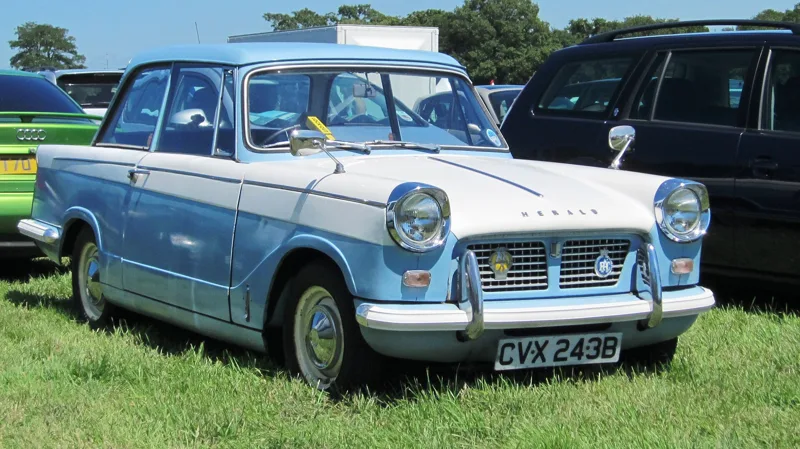
The same show saw the introduction of the Mini and the Triumph Herald, with the Mini coming from Ford's rival BMC. The New Anglia was one of the outstanding exhibits of the show.
The car was later built in Belgium, Portugal, Australia, South Africa and Rhodesia as well as in Britain. From March 1963 British production moved from Dagenham to the new, far more automated Ford plant at Halewood near Liverpool.
How did the New Anglia's price compare?
The New Anglia was at times among the cheapest cars made in Britain, with only the Mini priced a few pounds lower. Some figures put Ford's profit at about 45 GBP per car, while the British Motor Corporation lost 5 GBP on every Mini, although some sources doubt the Ford figure.
Prices moved up and down over the years. Ford managed several price cuts, although tax reductions played a part in some of them.
Why was the Anglia important to Ford?
For Ford of England, a manufacturer that had been markedly conservative and often favoured simple solutions, the New Anglia was a commercially important car. It was the first car from the company designed to contemporary criteria.
Its success proved to Ford that up-to-date styling ideas could sell, and the New Anglia counted as a car of considerable significance for company policy.
Where does the Anglia appear in fiction?
A light blue Anglia 105E with a white-painted roof appears in Harry Potter and the Chamber of Secrets. It is the flying car that Fred, George and Ron Weasley use to fetch Harry from the house of his relatives, and it later rescues Harry and Ron from the Forbidden Forest.
The 2002 film of the same name also contains flying Anglia scenes. The producers used an authentic Anglia Deluxe built in 1962 or 1966, which was mounted on a rotating crane for the special effects.
The film car, which was not roadworthy, was stolen in 2005 from the premises of South West Film Studios in St Agnes, Cornwall, a company that was insolvent at the time. The theft caused strong media interest in Britain, and the car was later found again. It is assumed the thieves could not sell it because of the extensive coverage.