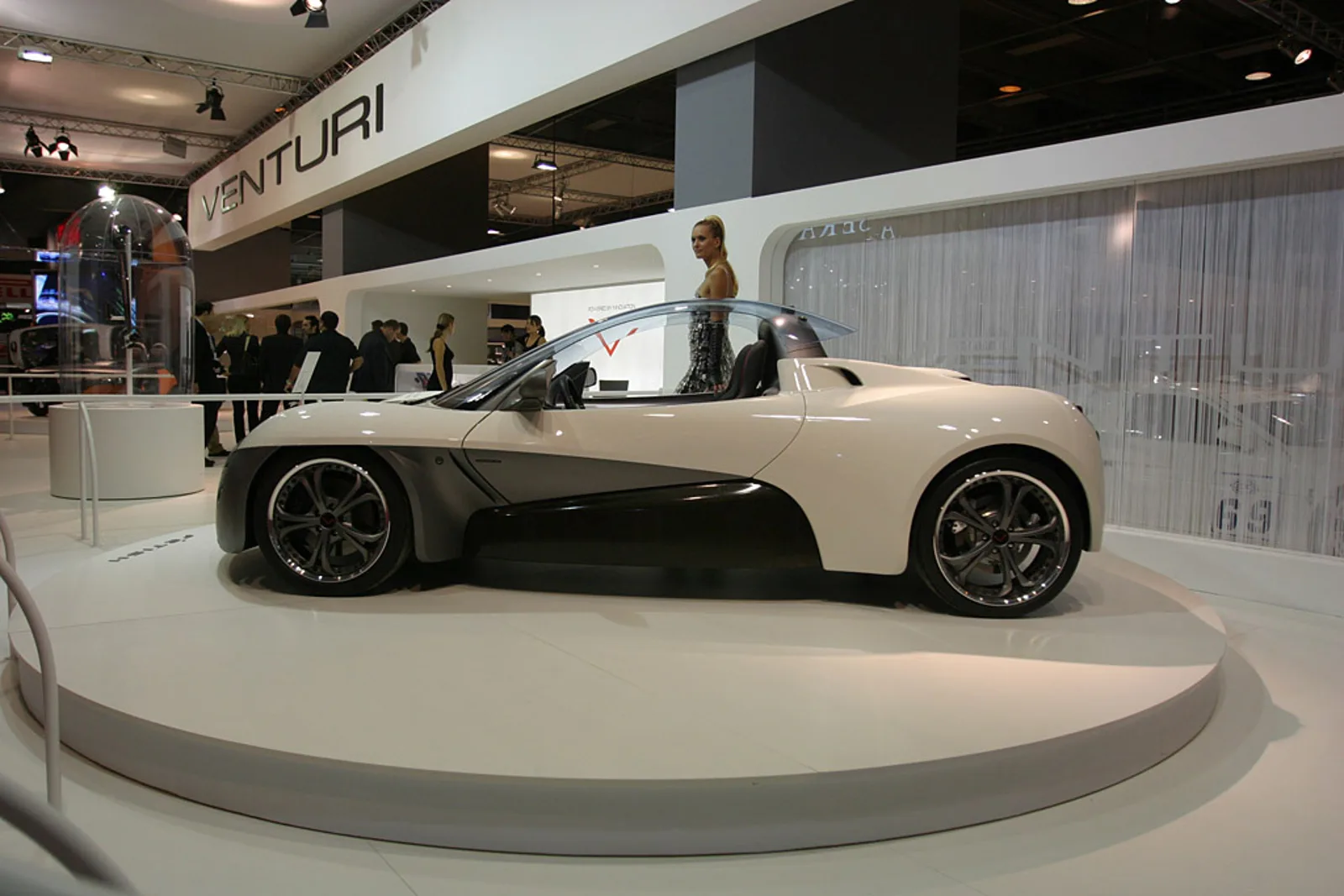
Founded by two former Heuliez engineers, the Venturi sports car business was rescued by Gildo Pastor in 2000 and turned towards electric speed records, expeditions and Formula E.
Venturi is a Monaco-based maker founded in 1984 as MVS by two French engineers. Bought by Gildo Pallanca Pastor after its 2000 bankruptcy, it now focuses on electric vehicles, speed records, polar and lunar projects and Formula E.
Venturi is a Monaco-based automotive manufacturer that began in 1984 as the French sports car maker MVS. It built mid-engined coupes and roadsters in France before going bankrupt in 2000, when Gildo Pallanca Pastor bought it and turned the company towards electric power. Its later work covers electric speed records, polar and lunar vehicles and the Formula E championship.
How did Venturi begin in 1984?
Venturi was founded in 1984 by the French engineers Claude Poiraud and Gerard Godfroy, who had both worked at Heuliez. They first called the company MVS, short for Manufacture de Voitures de Sport, and the brand traded under that name for its early years.
The first car they showed, in 1984, was a grand tourer intended to match Aston Martin, Ferrari and Porsche. It used a Volkswagen Golf GTi engine, and the name was spelled Ventury, with a y, at the start.
A French sports coupe maker that became an electric speed-record and lunar business under Monegasque ownership.
What was the first production Venturi?
A 1985 showing paired the car with a 200 PS (147 kW) Peugeot 505 Turbo. At the 1986 Paris show it took its final shape, powered by the PRV V6. Production started in 1987, with five cars built in that first year.
Output rose in the following years, and the headquarters at Coueron in the Pays de la Loire produced almost 750 cars over the next twenty years. The company operated for nearly sixteen years before going bankrupt in 2000.
Which engines powered the early Venturis?
From 1987 to the mid-1990s the company built mid-engined coupes and roadsters with turbocharged PRV engines and Renault gearboxes. Power ran from 200 to 260 PS (147 to 191 kW) across the Coupe and Transcup series.
A naturally aspirated Venturi 160 used a catalysed 2849 cc version of the PRV V6, and it was offered with an automatic gearbox because it was aimed at Japan. The Venturi 180, rated 185 PS (136 kW), was developed mainly for Italy and used a turbocharged 1995 cc inline-four from the Renault 21 Turbo.
Was Venturi involved in Formula One?
Venturi was briefly linked to the Larrousse Formula One team. Its 1992 car, which carried the Venturi name, came from a British firm, Venturi Larousse UK, once called Fomet 1. Fomet 1 had earlier designed the 1991 Fondmetal Formula One cars.
What made the Venturi 400 GT special?
The Venturi 400 GT is often counted among the highest-performing French cars ever built, and it was the first production car to have carbon brakes as standard. Its Atlantique 400 GT had a 2,975 cc twin-turbo V6 with four valves per cylinder, rated at 300 kW (408 PS; 402 hp) at 6000 rpm.
The 400 GT could reach 100 km/h in 4.7 seconds and a top speed of 291 km/h (181 mph). The cheaper Atlantique 300 Biturbo, with 310 PS, also reached 100 km/h in 4.7 seconds, and its top speed was 275 km/h (171 mph).
How did Venturi compete at Le Mans?
A limited 400 GTR was built to meet the homologation rules for the 24 Hours of Le Mans. Venturi also gained a name through its Le Mans results. In 1993 Christophe Dechavanne and Jacques Laffite raced for the Venturi Jacadi team, and in 1995 Paul Belmondo drove the 600 SLM.
The Gentlemen Drivers Trophy was started on the advice of Stephane Ratel, who later founded the FIA GT Championship. A total of 72 cars were made for it, and customers could convert them to road specification at the end of the season. The cars were driven by 75 different drivers.
How strong was Venturi in the BPR series?
The BPR Global GT Series was where Venturi built its reputation, with wins over Porsche and Ferrari on several occasions. In 1994 the 600 LM Jacadi was driven by Ferte and Neugarten at Dijon-Prenois, and Henri Pescarolo and Jean-Claude Basso took a 600 LM to victory at the 1000 km of Paris.
The same pair of Michel Ferte and Michel Neugarten also won at the 4 Hours of Spa.
What happened to Venturi after 2000?
In 2000 Gildo Pallanca Pastor bought the company and decided to concentrate on electric vehicles. The Fetish model followed, along with a series of technology demonstration missions. In December 2009 Venturi bought the French motorcycle maker Voxan, which gave it a route into motorcycles.
What was Mission 01 and the Jamais Contente project?
Mission 01 was launched in 2009 with the Ohio State University's Center for Automotive Research. It aimed to set electric vehicle speed records at the Bonneville Salt Flats in Utah. The project is named after the Jamais Contente, the car that first broke the symbolic 100 km/h barrier in 1899 under Camille Jenatzy, reaching 105 km/h.
The hydrogen fuel-cell VBB-2 broke 487 km/h (303 mph) in 2009. The VBB-2.5, with an electric battery pack, averaged 495 km/h (308 mph) the following year. In 2016 the VBB-3, the most advanced electric version with 2,200 kW (3,000 HP), set a FIA-certified record of 549 km/h (341 mph) that still stands.
How did the Shanghai to Paris journey work?
Mission 02 was an electric expedition that recalled Citroen's Croisiere Jaune, one of the first long rally raids of the 20th century. It left Shanghai on 3 May 2010, covered 14,900 km through China, Kazakhstan, Russia, Ukraine, Poland, the Czech Republic and Germany, and reached Paris on 13 July.
Xavier Chevrin and Geraldine Gabin drove an electric Citroen Berlingo, which was labelled Powered by Venturi. Two extra battery packs raised its range to 500 km. The company says it remains the longest distance covered by an unassisted electric vehicle.
What did the Antarctica vehicle do?
Mission 03 was a zero-emissions take on the Croisiere Blanche, a 20th-century raid across Canada's North-West that ended in failure because of the terrain and the weather. On 6 March 2019 the Venturi Antarctica travelled 42 km in British Columbia, in temperatures as low as -30 C, to test it in conditions similar to the South Pole.
The next generation was unveiled in June 2021 for the Princess Elisabeth Antarctic research station. It is 3.4 metres long, 2.18 metres high and weighs 2.5 tons. Its 52.6 kWh battery gives 50 km of range, two axial flow motors each produce 60 kW, and it can carry up to six people. Recharging takes between 2 and 18 hours.
Who asked Venturi for a polar vehicle?
After a trip to the Antarctic in 2009, Prince Albert II of Monaco noted that the research stations had no clean vehicles. The Prince Albert II Foundation asked Venturi for a zero-emission vehicle to carry people and equipment to scientific sites. The third Antarctica was finished on 10 December 2021 and delivered to the International Polar Foundation.
What were Missions 04 and 05?
Mission 04 was a modern version of the Croisiere Noire, a 1924 expedition that crossed Africa from north to south. Xavier Chevrin drove alone from Nairobi on 11 May 2012 and covered 5,800 km unassisted, reaching Johannesburg a month later. It was described as the first crossing of Africa by an electric vehicle without assistance.
In December 2021 Max Biaggi rode the Voxan Wattman to 21 new electric motorcycle world speed records.
What was Mission 07 on Spitsbergen?
Mission 07 marked the centenary of Prince Albert I, the great-great-grandfather of Prince Albert II. Chairman Gildo Pastor sent the eco-explorer Xavier Chevrin to Spitsbergen in Svalbard. In June 2022 the adventurer covered 234 km on cross-country skis over 21 days, in temperatures down to -15 C.
Did Venturi enter Formula E?
Yes. Venturi was the first manufacturer to sign up for Formula E, and it has raced since the first race in 2014. In 2015 it became an FIA-approved manufacturer and supplied powertrains to Dragon Racing and to the Mercedes-backed HWA Racelab.
In 2018 the team signed the former Formula One winner Felipe Massa and rehired Edoardo Mortara, and Susie Wolff became team principal. At the 2019 Hong Kong ePrix, Mortara scored Venturi's first win. The team finished eighth in the 2018-19 championship with 88 points.
For the 2019-20 season Venturi took a title partnership with ROKiT and a powertrain partnership with Mercedes-Benz. It finished 10th in the teams' standings with 44 points, and Massa retired from Formula E at the end of the season.
In December 2020 American investors, headed by Scott Swid and Jose M Aznar Botella, acquired the team, and Wolff remained. The team was renamed MSG Racing for 2023 after eight seasons, and Maserati took on a title and powertrain partnership in April 2022.
What are the Venturi electric cars?
The electric range has included the Fetish, marketed as the first electric sports car in the world, and the Eclectic, promoted as the first autonomous urban vehicle. The Astrolab was billed as the first electric-solar hybrid vehicle, and the Volage was an electric concept roadster with eight in-wheel motors from Michelin.
The America electric crossover was announced at the 2010 Paris Motor Show, and the Fetish II followed as the next generation of the original model.
How is Venturi connected to space?
In April 2022 Venturi said it would apply its knowledge to space, forming strategic partnerships with Venturi Lab in Switzerland and Venturi Astrolab in the United States. The aim was to become a candidate for developing mobility technology for the Moon.
On 31 March 2023 Venturi Astrolab agreed with SpaceX to send its FLEX rover to the Moon in 2026. In June 2023 the lunar wheel designed by Venturi Lab, built from 192 cables, was shown at the Paris air and space show. On 3 April 2024 Astrolab received a NASA contract to support the Artemis lunar terrain vehicle.
Key dates in the Venturi story
| Year | Event |
|---|---|
| 1984 | MVS founded by Poiraud and Godfroy; first car shown |
| 1987 | Production begins with five cars |
| 1992 | Venturi-badged Larrousse Formula One car |
| 1993 | Venturi Jacadi team at Le Mans |
| 2000 | Bankruptcy, then purchase by Gildo Pallanca Pastor |
| 2009 | Voxan motorcycles acquired; Mission 01 starts |
| 2010 | Mission 02 leaves Shanghai on 3 May |
| 2016 | VBB-3 sets 549 km/h electric record |
| 2019 | Mortara wins the Hong Kong ePrix |
| 2021 | Third Antarctica delivered to the International Polar Foundation |
| 2023 | Venturi Racing renamed MSG Racing |
| 2024 | NASA contract for the lunar terrain vehicle |