How a manual gearbox with a computer-controlled clutch and shifter grew from early Hudson and Citroen designs into Ferrari, BMW and heavy truck systems.
An automated manual transmission is a manual gearbox whose clutch and or gear shifts are operated automatically by actuators and a computer. Early versions, such as Hudson's 1942 Drive-Master, automated only parts of the process. Modern systems appear in performance cars and heavy trucks, though dual-clutch units have largely replaced them in cars.
An automated manual transmission, or AMT, is a gearbox for motor vehicles built on a manual layout. It is a conventional manual gearbox fitted with automatic actuation to operate the clutch, the gear shifts or both. The driver may still choose the gears, or the system may choose them, depending on the design.
How does an automated manual transmission work?
The design keeps the internal parts of a manual gearbox, but replaces the foot clutch and the gear lever with actuators controlled by a transmission computer. Gear shifting, clutch actuation, shift timing and rev matching are all under automated control, using electronic sensors, a computer and actuators. The driver selects the wanted gear, and the system does the rest.
Many systems use hydraulic or electro-hydraulic actuation, though others use electro-mechanical, pneumatic, electromagnetic or purely electric motors. Torque and power transfer to the drive wheels are also controlled electronically. The clutch re-engages within milliseconds, while the throttle is adjusted to match the revs of the new gear.
Most modern systems shift sequentially, so the driver moves up or down one gear at a time. Some go further. BMW's SMG and Ferrari's F1 gearboxes can skip gears in both directions when the driver uses steering wheel paddles.
The gearbox keeps its gears and loses the pedal, and that one change reshaped how a manual transmission drives.
What is the difference between semi-automatic and fully automatic AMTs?
Early semi-automatic systems, such as the Autostick, automated only the clutch. The driver still had to initiate every gear change, which is why these are sometimes called clutchless manual systems. Modern fully automatic systems, such as Selespeed and Easytronic, control both the clutch and the shifts, so no driver input is needed for gear changes.
Depending on the design, some AMTs shift by themselves at the right points, like a conventional automatic. Semi-automatic and clutchless manuals need the driver to select each gear, even when the engine is at its redline, because they automate only the clutch.
An AMT is not the same as a manumatic. A manumatic is an automatic with a torque converter in place of a clutch, and it can be overridden to shift manually. An AMT has a clutch, and its feel is closer to a manual gearbox than to an automatic.
How are AMT gearboxes built?
Add-on AMTs can still work as a normal manual gearbox with a manual shift lever. Integrated AMTs do not need a normal shift pattern, so they can be designed with an optimised layout, which may be unusual for a driver to shift by hand.
Integrated designs use either gear selector drums or single actuators. Drums allow only serial shifting with no skipped gears, but the system is fairly inexpensive because it needs only one actuator. Single-actuator systems need one actuator for each shifting sleeve, which costs more but shifts faster.
Actuators can be electro-hydraulic or electro-mechanical. Electro-hydraulic actuators cost more, but they are faster, suit single-actuator systems well and allow higher torque. Electro-mechanical actuators are cheaper but are usually limited to 250 N m (184.5 lb-ft) of input torque, because the clutch force grows with torque and the shifts must be quick.
| Design choice | Option | Trade-off |
|---|---|---|
| Shift control | Gear-selector drum | Serial shifting only, but needs one actuator and is inexpensive |
| Shift control | Single actuator per sleeve | Costs more, but shifts faster |
| Actuator type | Electro-hydraulic | More expensive, faster, handles higher torque |
| Actuator type | Electro-mechanical | Cheaper, usually limited to 250 N m of input torque |
Electro-mechanical actuators are essentially electric motors, and larger motors carry more mass, which slows the shifts. Bigger motors also stress a car's 12-volt electrical system. The result is a choice between slow shifting with a very large battery, which is unsuitable for cars, and fast shifting with a smaller battery that works up to 250 N m of torque.
Some modern AMTs, including the Suzuki Auto Gear Shift and the Dacia and Renault Easy-R, work with electronic throttle control to initiate gear changes at set engine speeds or throttle positions.
When did automated gearboxes first appear?
The AMT has its origins in early clutchless manual transmissions on mass-production cars in the 1940s and 1950s. The Hudson Commodore of 1942 introduced the Drive-Master, which used a servo-controlled vacuum clutch and offered three modes: fully manual, semi-automatic with an automated clutch, and fully automatic.
The 1955 Citroen DS used a four-speed BVH transmission with an automated clutch operated by hydraulics, but the driver still selected each gear. The 1956 Renault Dauphine could be ordered with a Ferlec clutch worked by an electromagnet.
Two 1967 cars relied on vacuum clutches and hydraulic torque converters: the NSU Ro 80, with its Fichtel and Sachs three-speed, and the Porsche 911 with its four-speed Sportomatic. The 1968 Volkswagen Beetle and Karmann Ghia offered a three-speed Autostick, which used an electric switch on the shifter to operate the clutch servo.
In 1963, Renault moved from an automated clutch to a fully automatic three-speed Jager transmission. An electro-mechanical control unit operated both the clutch and the shifts, which made it one of the earliest true AMTs. It was controlled from electronic push buttons on the dashboard.
Which passenger cars brought AMTs to performance buyers?
The Isuzu NAVi5 five-speed transmission arrived in the 1984 Isuzu Aska, sold only in Japan. Based on a manual gearbox with hydraulic actuators for the shifter and clutch, it had been designed for trucks. Early versions only let the driver lock out higher gears, and later versions added a manual mode.
Ferrari's involvement began with a seven-speed paddle shift transmission in the 1989 Ferrari 640 Formula One car. The 1992 Ferrari Mondial T offered a Valeo five-speed semi-automatic, and the 1997 F355 introduced an F1 six-speed gearbox with paddles behind the steering wheel. Ferrari moved to a dual-clutch transmission for the 458 in 2009.
Alfa Romeo's related Selespeed five-speed debuted on the 156 in 1999 and was also used in the Fiat Punto and Stilo. Maserati followed in 2001 with its Cambiocorsa six-speed in the Maserati Coupe.
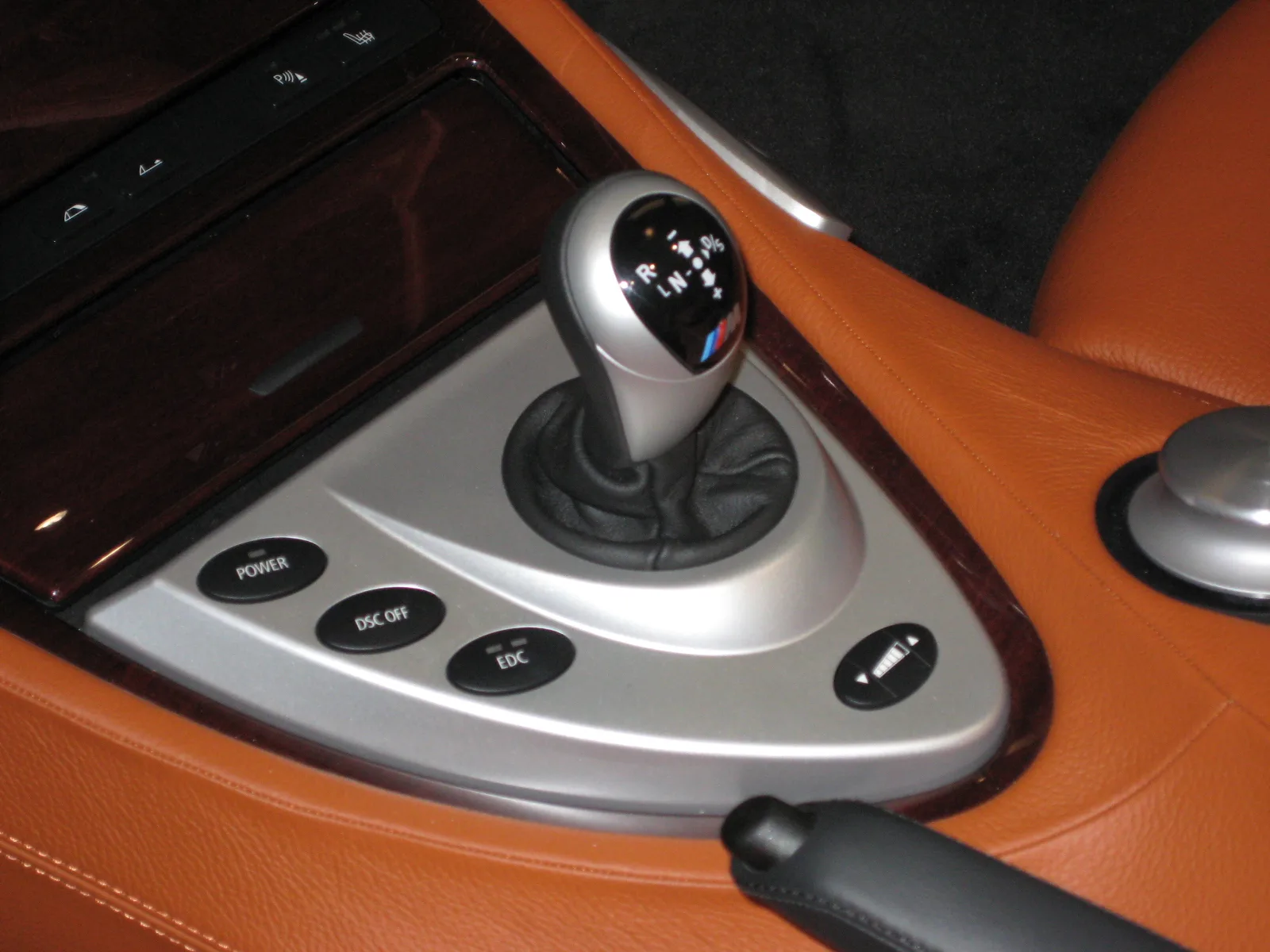
BMW's first AMT was the six-speed Shift-tronic, offered on the Alpina B12 coupe in 1993. Built with an automated clutch from LuK and a standard H-pattern shifter, it was fitted to fewer than 40 cars. Mass production began in 1997 with the SMG six-speed in the E36 M3. The SMG was replaced by the SMG-II in the E46 M3 in 2000, and BMW's last AMT, the seven-speed SMG-III, appeared in the 2004 to 2010 E60 M5 and the E63 M6. In its most aggressive mode, the SMG-III completed a gear change in 65 milliseconds.
From 2002 to 2007, the third-generation Toyota MR2 was offered with an SMT six-speed automated manual transmission. It used electro-hydraulic activation for the clutch and shifting, with a shift lever pushed or pulled instead of an H-pattern, and steering wheel buttons were added. Lamborghini's six-speed E-gear arrived in the 2004 Murcielago and Gallardo, and it was also offered on the 2007 to 2012 Audi R8 as R-tronic.
How did AMTs spread to trucks?
Heavy vehicles adopted AMTs widely. Volvo's I-Shift arrived in 2001 as an add-on to a conventional unsynchronised manual gearbox, and ZF's AS Tronic followed in 2003 for trucks, buses and coaches. Renault's Optidriver arrived in 2004, and Eaton's AutoShift was an add-on for heavy trucks with non-synchromesh gearboxes in the early 2000s.
Later systems include Mack's mDRIVE, introduced in 2010 with synchronisers, Daimler's DT12, introduced in 2012 for the Freightliner Cascadia, and Mercedes-Benz PowerShift, a non-synchronous unit for heavy-duty trucks. UD Trucks' ESCOT, introduced in 1995, is an add-on for manual gearboxes that has been produced in six versions.
Why did AMTs fall out of favour in cars?
AMTs became a more sporting alternative to the traditional hydraulic automatic in passenger cars in the mid-1990s. During the 2010s, however, they were largely replaced by the increasingly widespread dual-clutch transmission. Brands within the Volkswagen Group mostly used dual-clutch units rather than AMTs, although they did offer the E-gear and R-tronic systems for a time.
AMTs remained popular for smaller cars in Europe and in some developing markets, particularly India. There they are favoured over conventional automatics and CVTs because they cost less to build.