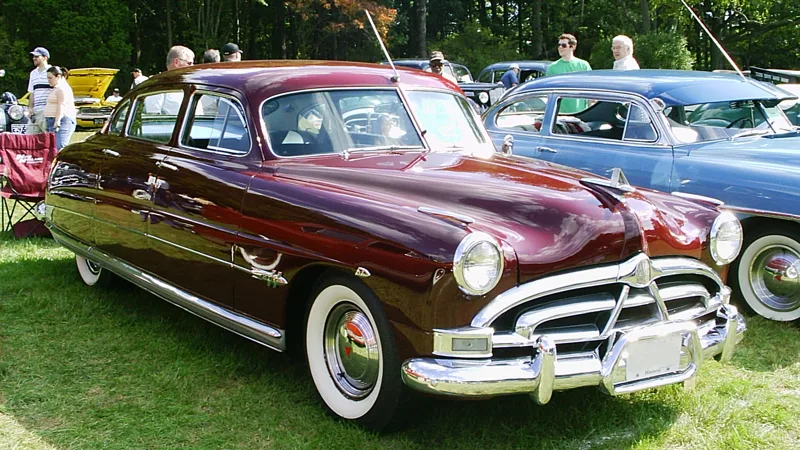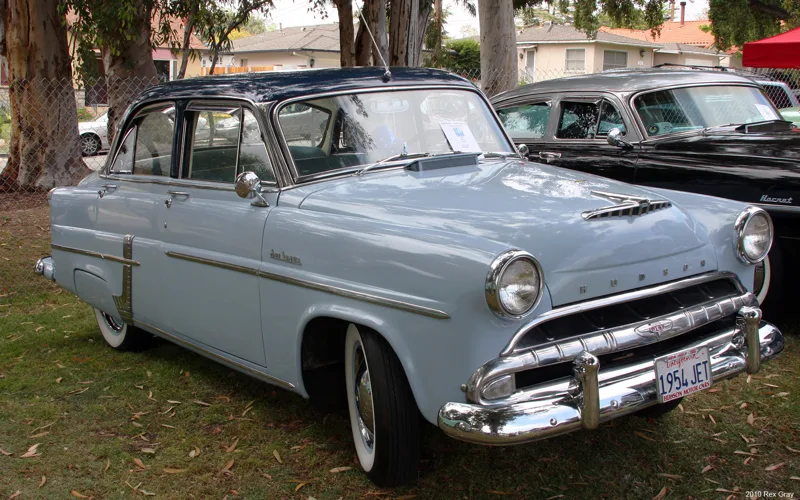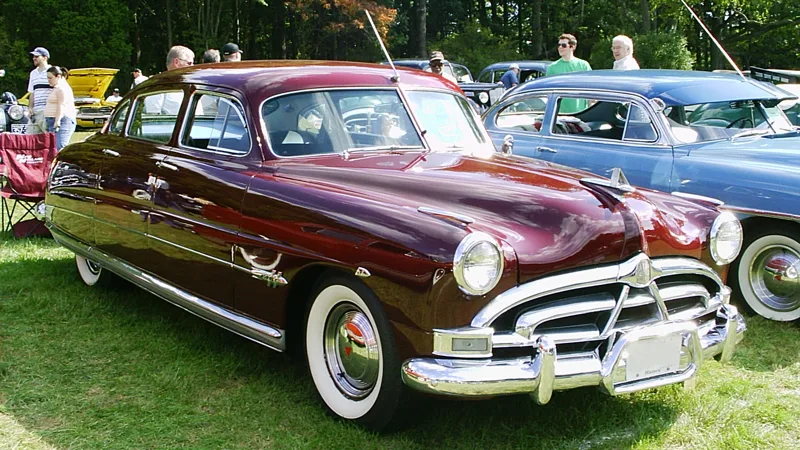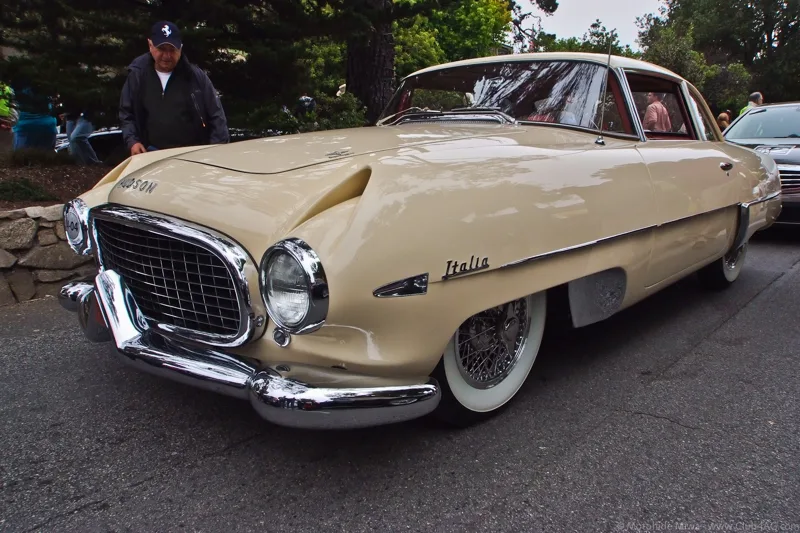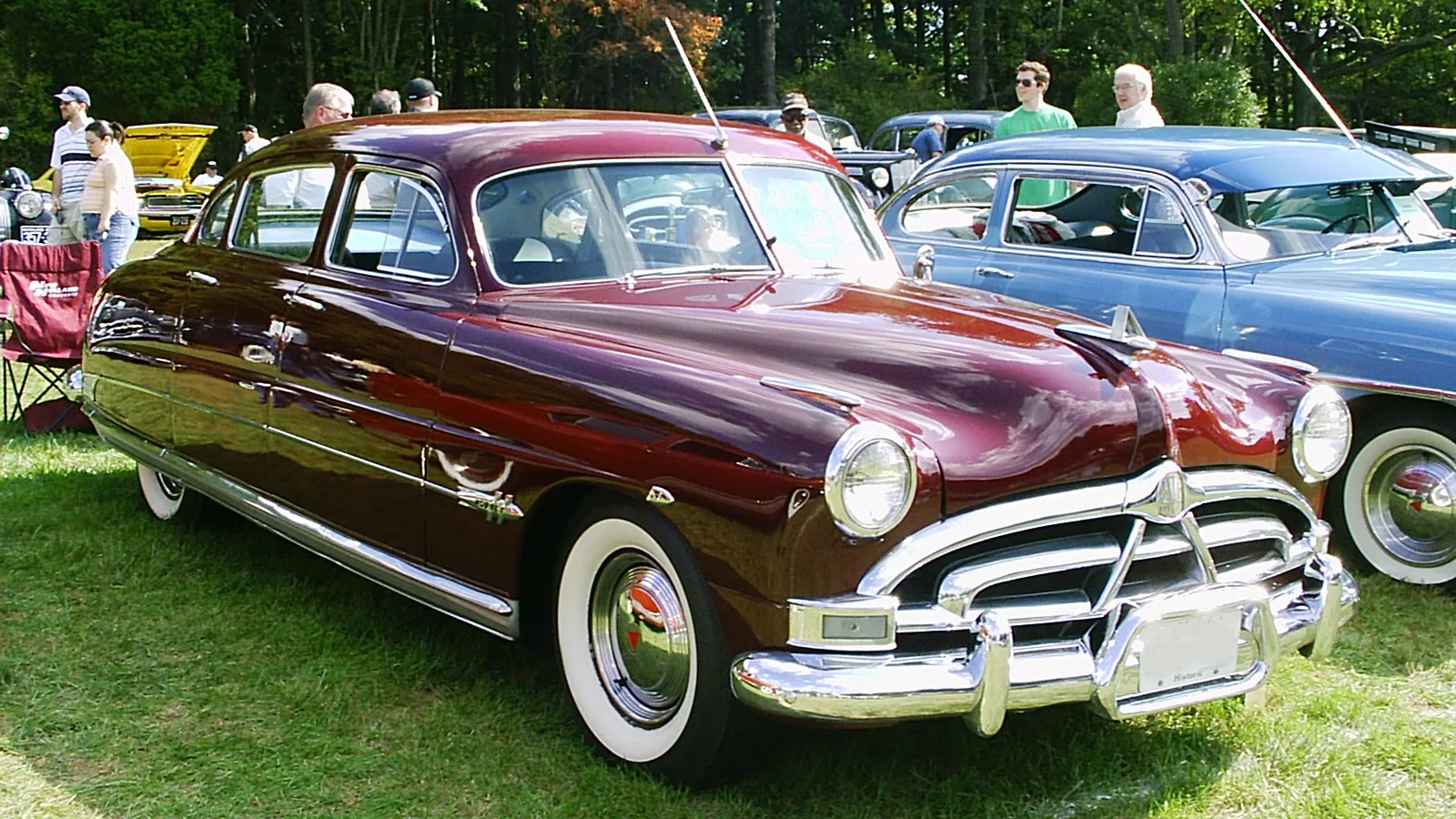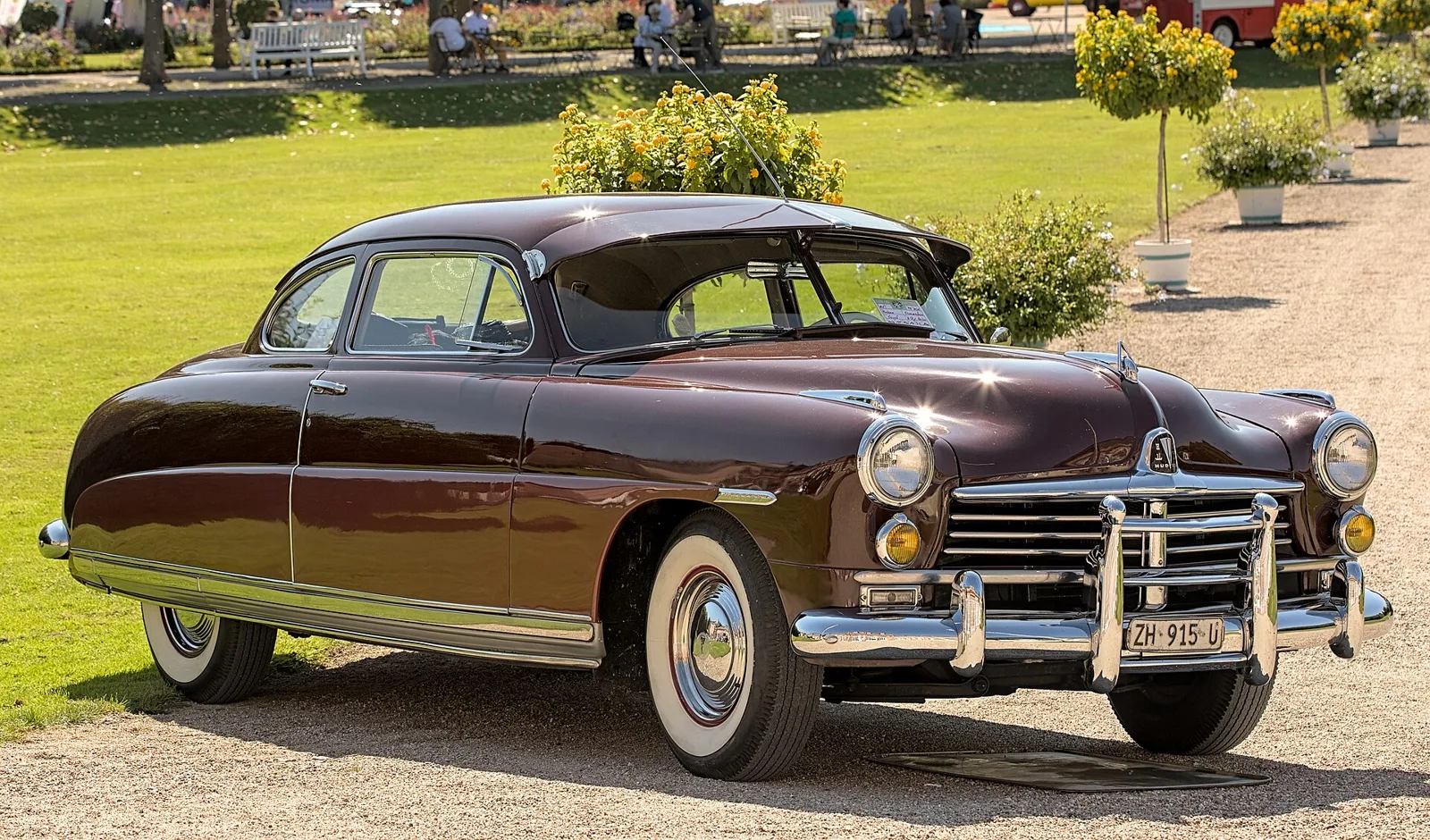
Hudson step-down styling, a Drive-Master semi-automatic gearbox and the 1949 sedan that starred in Driving Miss Daisy.
The Hudson Commodore was a full-size luxury car built by Hudson in Detroit from 1941 to 1952. Its third generation, launched for 1948, introduced the step-down body that Hudson promoted as a safety and handling advantage. The Commodore used straight-six and straight-eight engines and offered the Drive-Master semi-automatic gearbox.
The Hudson Commodore was a luxury car built in Detroit by the Hudson Motor Car Company, in three generations between 1941 and 1952. Every generation used a straight-six or straight-eight engine and a sealed clutch system, and the 1948 cars introduced a low step-down body that set them apart from rivals. This guide follows the model from its launch to its end, covering transmissions, engines, styling, specifications and the cars that made it famous.
Where did the Commodore come from?
The Commodore arrived in 1941 as the successor to the Hudson Greater 8 and became the largest and most luxurious model in the Hudson line. Production stopped in 1942, when wartime needs took priority, and civilian assembly restarted in 1946. The third generation, introduced for the 1948 model year, is the design most often praised today.
Hudson restarted production on 30 August 1945, but the first postwar cars were based on the 1942 designs and differed mainly in small cosmetic touches. Most of the change was in the grille, which gained a prominent concave centre. Enthusiasts count these cars as a second generation, even though the body looked much like the pre-war model.
Hudson's step-down body and sealed clutch made the Commodore one of the most distinctive luxury cars of the postwar years.
What did the 1941 Commodore offer buyers?
The 1941 range was Hudson's largest, with sedans, coupes and convertibles. Buyers could pick a 102 bhp straight-six or a 128 bhp straight-eight, and prices ran from US$1,028 for a Series 12 coupe to US$1,537 for the top Custom sedan. Interior colours and fabrics were matched to the body paint without any added cost.
The junior models, the Series 12 and Series 14, rode on a 121 in (3,073 mm) wheelbase, as did the Series 15 Custom coupes. The Series 17 Custom sedans stretched to 128 in (3,251 mm). A station wagon also joined the range as the Commodore Eight wagon, Hudson's first car with that body type, although only about 100 were made.
Hudson also marketed safety heavily. Its advertising called the car America's safest, and standard equipment included Double-Safe Hydraulics, a separate mechanical system that backed up the hydraulic brakes through the same pedal. A handbrake on the dashboard gave a third way to stop the car, and the independent front suspension used coil springs that were usually found on far costlier cars.
Options were practical rather than flashy. A Sleeper Kit from Hudson dealers turned the sedan rear seat into a double bed through the trunk, leaving the front seats in place. Three radios were offered, from a basic 5-tube Junior set to an 8-tube Custom with push-button station selection.
How did the Drive-Master transmission work?
Drive-Master was a semi-automatic transmission introduced for the 1942 model year as Hudson's answer to General Motors' Hydra-Matic. A knob on the dashboard selected manual, Vacumotive Drive or full Drive-Master operation, with vacuum cylinders, solenoids and switches working the clutch and gear changes.
In manual mode the system was switched off, so the driver worked the clutch pedal and gear lever as normal. Vacumotive Drive kept manual gear changes but let vacuum power operate the clutch whenever the accelerator was pressed or released, so there was no need to use the clutch pedal to pull away or stop.
In full Drive-Master mode the driver selected high and pressed the accelerator, and the car set off in second gear, a stage Hudson called Pick-Up gear. Lifting off moved the car into high, and braking to a stop returned it to Pick-Up, so the system handled every shift without a clutch pedal.
Pricing made the options worth comparing. In 1946 Vacumotive Drive cost $40 and the Drive-Master with Vacumotive cost $98, while overdrive fitted to the three-speed manual added $88. Drive-Master later formed the basis for Super-Matic Drive in 1950, which added overdrive to the system.
Why was the 1948 step-down design important?
The 1948 Commodore used Hudson's step-down, or monobuilt, construction, so passengers stepped down into a body that sat lower than rival cars. Wrapping occupants in the chassis gave a low centre of gravity, saved weight and needed less steel to build. Frank Spring led the design, and the result is still regarded as one of the great postwar shapes.
The semi-unit body rode on a perimeter frame that encircled the passengers, which is why buyers stepped down into the cabin. The cars had slab-sided bodies with fully integrated fenders, and a character line ran front to back, making them look lower still. Betty Thatcher also contributed to the design, and she is described as the first woman designer hired by a carmaker.
Body styles followed the roofline. The Brougham and sedans were fastbacks, while the convertibles and coupes were notchbacks. The 1948 range came in one series, with a six or an eight, and sedan interiors used broadcloth while convertibles were trimmed in leather.
Which engines powered the Commodore?
The first generation used two engines: a 202 cu in (3.3 L) straight-six rated at 102 bhp (76 kW) and a 254.4 cu in (4.2 L) straight-eight rated at 128 bhp (95 kW). The eight was the premium choice for the top of the range, and it stayed available through 1952.
For 1948 the new six grew to 262 cu in (4.3 L) and produced 121 hp (123 PS; 90 kW), just 7 hp (7 PS; 5 kW) down on the eight. The eight was smoother to drive, and the six reached 0-40 mph in 12 seconds with Drive-Master, although stick-shift cars were quicker.
Total Commodore output for 1948 reached 62,474 cars, of which 35,315 were eights. In 1951 Hudson introduced a new straight-six and offered the General Motors Hydra-Matic automatic transmission as an option.
How did the Commodore change in the 1950s?
The early 1950s brought gradual change rather than new designs. The 1950 model received a restyled grille with the Hudson triangle set across four horizontal bars, a split-back window and redesigned interiors, while 1951 brought an oval grille and a pillarless Hollywood hardtop.
The grille change became known as the Hudson look, and the oval shape carried through to 1953. The two-door Hollywood hardtop, in production from January 1951, was Hudson's first pillarless body style, and the Custom Commodore convertible debuted in mid-April 1950.
The 1952 model year was the last. The Commodore was split into a Six Series and an Eight Series, and both were offered as a Club Coupe with two doors, a Sedan with four, a Convertible Brougham or a Hollywood hardtop. Buyers could choose seven solid colours, four special colours and 15 two-tone combinations, although convertibles were limited to solid paint.
What happened to Hudson after the Commodore?
The Commodore ended after 1952 because Hudson could not keep up with rivals' annual restyles. The company chose to develop its Jet compact instead of redesigning the ageing set-down models. In 1954 Hudson merged with Nash to form American Motors Corporation, which later moved Hudson production to Kenosha, Wisconsin.
From 1953 Hudson sold only the Hornet and Wasp, alongside the new Jet compact. After the merger, AMC gave Hudson styling to Richard Arbib following slow sales in the 1955 model year. His V-Line look did not draw buyers back, and output fell further.
In the brand's final year the range was pared back to the Hornet. AMC also produced a single 1957 show car that bore the Commodore name, identical in shape to the production Hornet but finished with gold exterior trim and unique upholstery.
What are the Hudson Commodore specifications?
| Specification | Detail |
|---|---|
| Maker | Hudson Motor Car Company, Detroit, Michigan |
| Generations | Three, from 1941 to 1952 |
| Engines, 1941 | 202 cu in (3.3 L) I6 at 102 bhp (76 kW); 254.4 cu in (4.2 L) I8 at 128 bhp (95 kW) |
| Engines, 1948 | 262 cu in (4.3 L) I6 at 121 hp (123 PS; 90 kW); 254 cu in (4.2 L) I8 |
| Wheelbase | 121 in (3,073 mm) for Series 12, 14 and 15 coupes; 128 in (3,251 mm) for Series 17 sedans |
| Clutch | Fluid-Cushioned Clutch in a sealed, oil-filled bell housing |
| Transmission options | Manual, overdrive, Vacumotive Drive and Drive-Master |
| Prices, 1941 | US$1,028 Series 12 coupe to US$1,537 Series 17 sedan |
| Production, 1942 model year | 5,396 cars before civilian output ended |
| Production, 1948 | 62,474 in total, of which 35,315 were I8 models |
| Final model year | 1952 |
Who owned a famous Hudson Commodore?
Actor Steve McQueen owned four Hudsons, which he drove around Los Angeles. One was a 1950 Commodore Six Brougham, the only convertible among them, and he fitted its standard six with the Twin-H engine from a Hudson Hornet, which displaced 308 cu in (5.0 L).
That car was offered for sale in 2019, and its papers include a registration record showing McQueen as the owner in 1979. Its history with a well-known owner is a large part of why collectors pay attention to the model today.
Where did the Commodore appear on screen?
Morgan Freeman played the driver of a 1949 Commodore sedan in Driving Miss Daisy, the 1989 Oscar-winning film, and the car gained worldwide fame. The movie is often read as a story about freedom and driving, and the car is central to that theme.
Writers have described the film as de-stressing, especially in its driving scenes in the Commodore, which is shown as a beautiful car and a fabulous ride. The film's success kept the Hudson name in front of audiences decades after the company had stopped building it.
What was the Sir Vival?
The Sir Vival was a safety concept car built by Walter Jerome from two 1948 Hudsons. It used a hinged two-section body and a raised, turret-shaped driver compartment for panoramic visibility. Only the prototype was completed, and it was sold to the Lane Motor Museum in 2022, which plans to restore it.
Jerome bought the donor cars from Bellingham Motors, a Massachusetts dealer that sold Hudsons, and planned to build up to a dozen a year. Features that later reached production cars, such as rubber bumpers, seat belts and marker lamps, were part of the concept. When Bellingham Motors closed, the prototype went back to the dealership for storage in the early 1970s.
Was a Commodore station wagon ever built?
Yes, in two forms. Hudson offered a Commodore Eight station wagon in 1941, but only about 100 were made. In 2007 a re-creation was built from a 1948 Commodore Eight four-door sedan, with a roof taken from another car added to its rear, and it used hand-made ash framing with mahogany veneer panels.
The woodie drew on sketches by Don Butler, an Army illustrator hired by Hudson in 1946, who had sketched unofficial ideas for a wagon, a pickup truck and a town car. The car is a modern realisation of a design that was never built during the company's lifetime.