A two-door aluminium coupe built in Italy on Hudson Jet running gear, launched in January 1954 and sold through American Motors in its first two model years.
The Hudson Italia was a limited-production coupe from Hudson and the Italian studio Carrozzeria Touring. Introduced in January 1954, it was sold through American Motors in its first two model years, and only about 25 production cars were built.
The Hudson Italia was a two-door coupe with an aluminium body, styled and built in Milan by Carrozzeria Touring on Hudson Jet running gear. It was introduced on 14 January 1954, and only about 25 production cars were made before American Motors ended the programme.
The Italia was based on the Hudson Jet platform and running gear, which gave the coupe a familiar mechanical base beneath its new body. It began as a styling study and was produced in a small run. It sold through American Motors in the 1954 and 1955 model years, and its story is one of an ambitious idea arriving at a company that was already merging with another.
Why did Hudson commission the Italia?
Hudson's management wanted the kind of publicity that Chrysler won with its Ghia show cars. Chief designer Frank Spring was unhappy with changes to the Jet, so Hudson gave him permission to build an experimental sports car on Jet mechanicals. In the early 1950s Hudson had several product projects under way, among them the Hornet, a new six-cylinder engine, the Jet and the car that became the Italia.
The original idea was a fast, sporty car based on the Hudson Hornet, with competition in the Carrera Panamericana in mind. It was meant to rival the Corvette, the Nash-Healey, the Kaiser Darrin and the Ford Thunderbird.
Hudson lacked the capital to develop a new model, so it agreed for a prototype to be built in Milan. A complete Hudson Jet was shipped to Italy, and Spring's sketches were formed into a body over a steel tubular frame.
A coupe built in Milan on American running gear, arriving just as its maker was swallowed by a merger.
How was the Italia built?
The body was a superleggera construction, with aluminium panels over a tubular steel frame. Spring and Hudson vice-president Stuart Baits supervised the work, and the Italia was the only project Carrozzeria Touring undertook for a US automaker.
The prototype cost Hudson a reported $28,000 and was completed in September 1953. Spring and his wife then drove it around Italy before it crossed the Atlantic. It was shown at Hudson dealerships by late 1953.
The Touring method saved less weight than its builders might have hoped. Jet unit construction required the production floorpan and cowl, which effectively negated the weight savings of the thin-wall tubing and hand-formed panels.
What did the Italia look like?
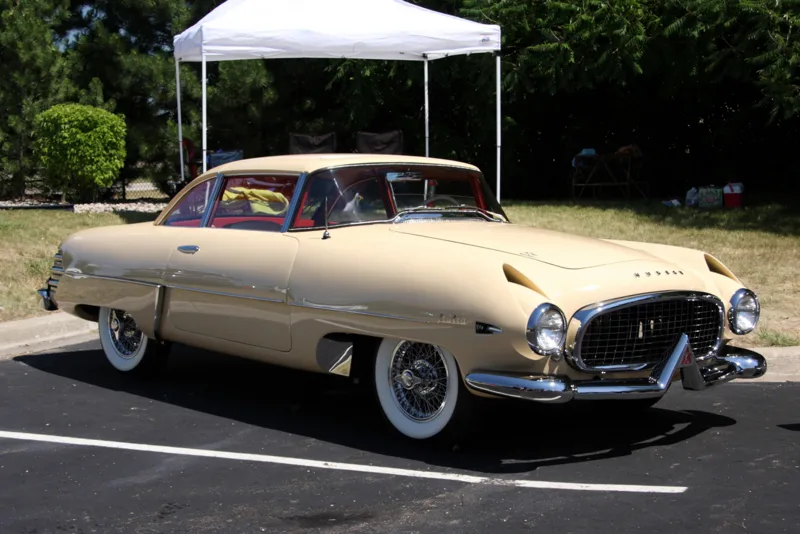
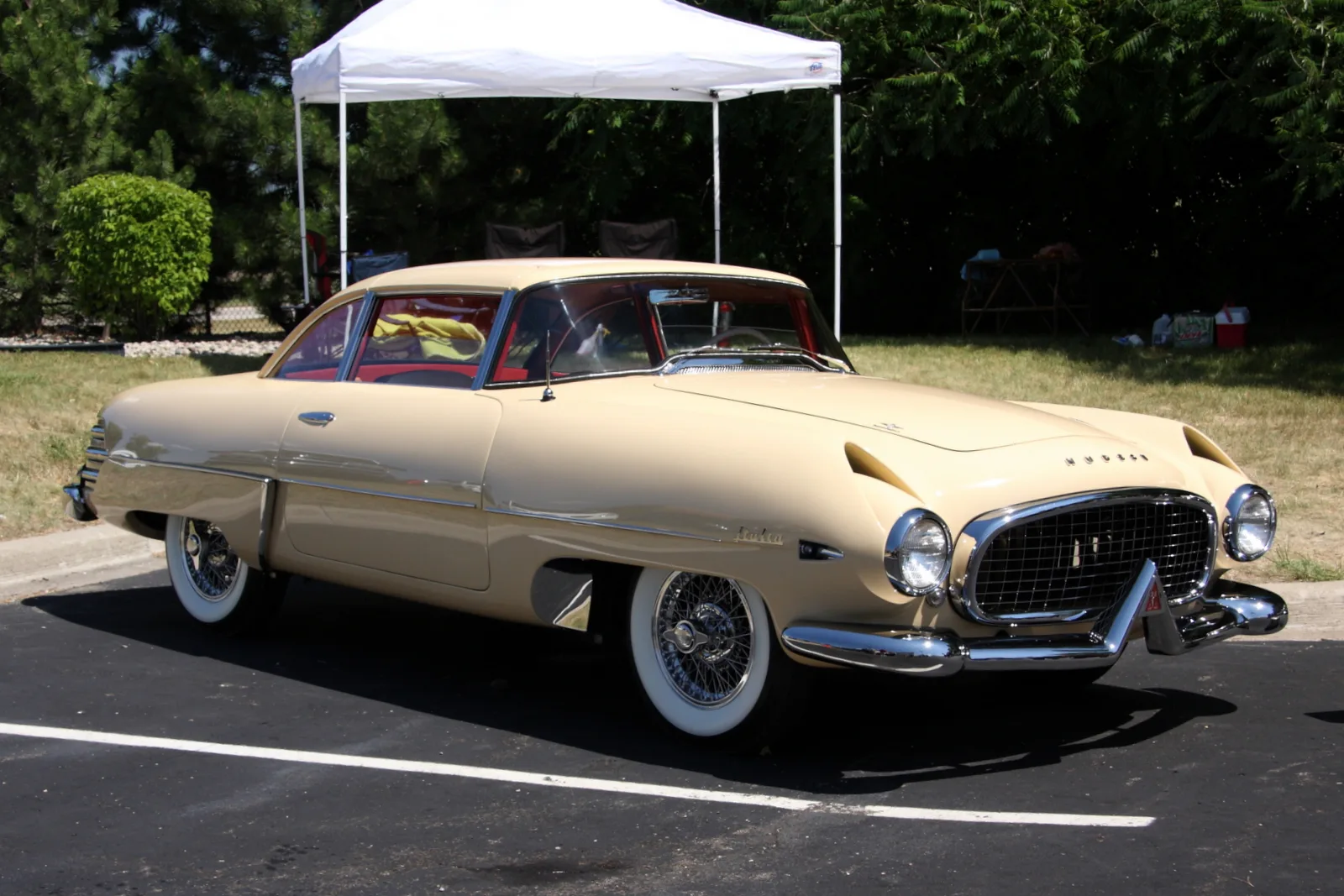
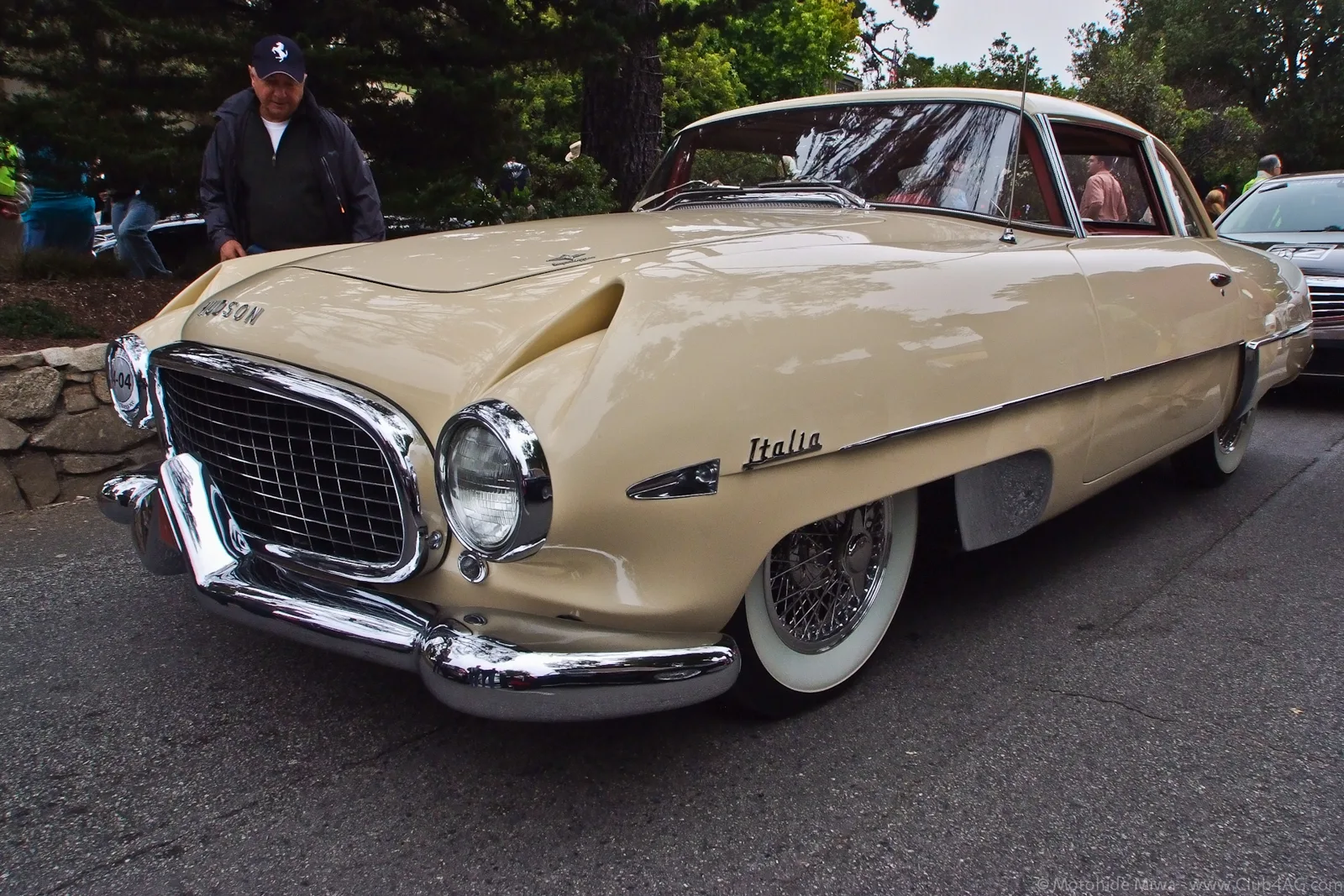
The Italia was lower than the Jet and far more dramatic than any previous Hudson. It had an aluminium body, a wraparound windshield, and doors that cut 14 inches (356 mm) into the roof, which were known as aircraft doors.
The front fenders carried V-shaped scoops over the headlights, although they only vented the underside of the fender. A large inverted Hudson triangle sat in the centre of the front bumper, and rear quarter scoops cooled the rear brakes.
At the back, three stacked chrome tubes per side carried the tail, directional and backup lamps. The prototype was first shown as the Super Jet and rode on Borrani chrome wire wheels.
What was inside the Italia?
The interior used red and white leather over bucket seats made from foam rubber of three densities. The dash was finished in red, with red carpet set against an Italian Cream exterior.
Air spaces between the seat cushions were designed to let the seats breathe as occupants moved. The car also had red leather seat belts, a radio, which was not yet standard even on Cadillacs, and flow-through ventilation through a cowl vent.
What powered the Hudson Italia?
The Italia used Hudson's Twin H 202 cu in (3.3 L) L-head straight six, with 8:1 compression and dual one-barrel downdraft carburettors. It produced 114 hp (85 kW; 116 PS) and fed a three-speed manual gearbox with a column-mounted shifter. The trunk could be opened only from inside the car.
The car had drum brakes front and rear. The prototype carried an overdrive unit, which was deleted for production, along with a new instrument panel and a mix of leather and vinyl upholstery.
How many Hudson Italias were built?
Figures differ. Carrozzeria Touring is believed to have built 50 cars in total, while the count of confirmed production cars points to about 25 plus one prototype.
Twenty-one of the 26 Italias have been accounted for, and most were bought in Southern California. The five missing cars carry serial numbers 5, 6, 8, 9 and 10, and contemporary reports indicated that early cars were sold in Europe.
Serial 7 was shown at the 1954 Paris Auto Show and stayed in Sweden until 1999. Serial 24 was bought by Trevor James Constable, who later fitted a Chevrolet V8.
Why did the merger hurt the Italia?
Hudson and Nash-Kelvinator announced a merger on 14 January 1954 to form American Motors Corporation. Hudson was fully consolidated under AMC by May 1954, and the new managers had no plans to expand marketing for the Italia.
Demand was weak from the start. Dealers began taking orders on 23 September 1953, but they recorded only 18 or 19 firm orders, citing the high price and the lack of the Hornet engine.
Carrozzeria Touring then refused to supply spare body and trim parts. Roy D. Chapin Jr., the sales manager for the Italia programme, was left to clear the remaining stock, and AMC committed to only another 15 Italias.
How much did the Italia cost?
The hand-built car was priced at US$4,350 at the New York port of entry, or $4,800 FOB Detroit according to Hudson's letter to dealers. That was more than a Cadillac Sixty-Two Coupe de Ville, which started at $3,995.
Rival prices were lower still. The Nash-Healey cost $4,721, the Kaiser Darrin $3,668 and the Chevrolet Corvette $3,523, which made the Italia hard to justify on price alone.
What was the X-161?
The X-161 was a single four-door sedan prototype with the Hornet engine. It was Spring's 161st experimental prototype and was built in Italy by Carrozzeria Touring.
Unlike the compact Jet-based Italia, the X-161 was based on the full-sized Hornet. It was built as a prototype for replacing Hudson's step-down models, and it is often described as the last real Hudson.
How is the Italia remembered?
The Italia is remembered as Hudson's last gasp for an image-building smash hit. Its large grille design was later adapted for the 1956 Hudson, which arrived after the merger.
Looking back, the Italia was one of the disasters for the automaker, although it reflected typical product development in the car industry at the time. Collector Gordon Apker compared its look to Flash Gordon and Italian drama on an American platform.
Italias still appear at prestigious events, including the Pebble Beach Concours d'Elegance, where they regularly win special awards.
What are Hudson Italias worth today?
Prices have climbed. Car number 21 sold for $396,000 with no reserve at the 2013 Barrett-Jackson auction in Scottsdale, and serial 003 was priced at $500,000 in 2013.
A Best Preserved Post-War Car award came at the 2014 Concorso d'Eleganza Villa d'Este, and that example was priced at EUR 575,000. The first production car, serial IT-10001, toured the United States and Canada as a show car.
That car sold for $495,000 after 2023, having had only three owners up to that point.