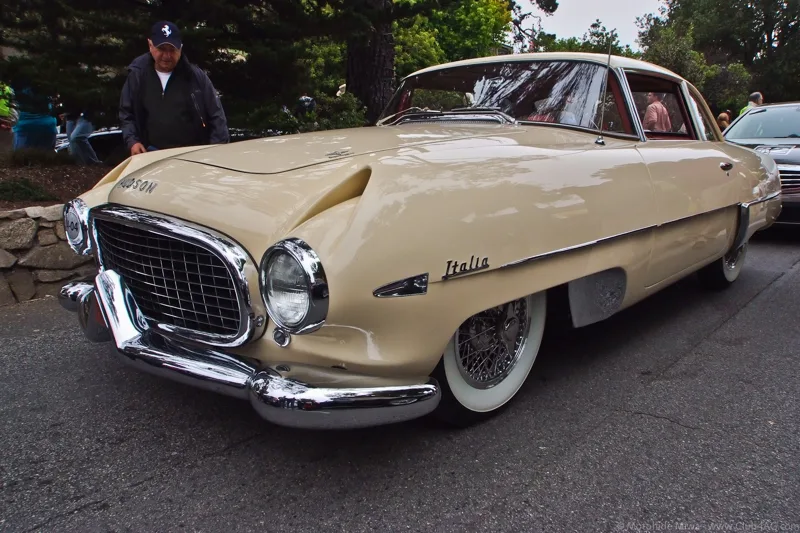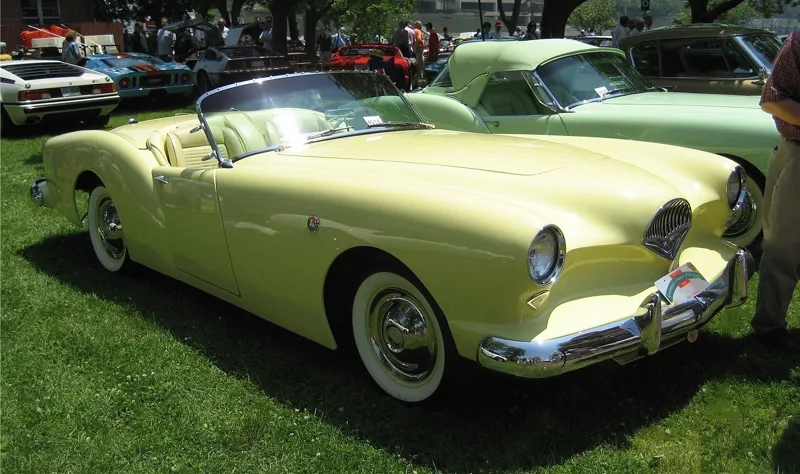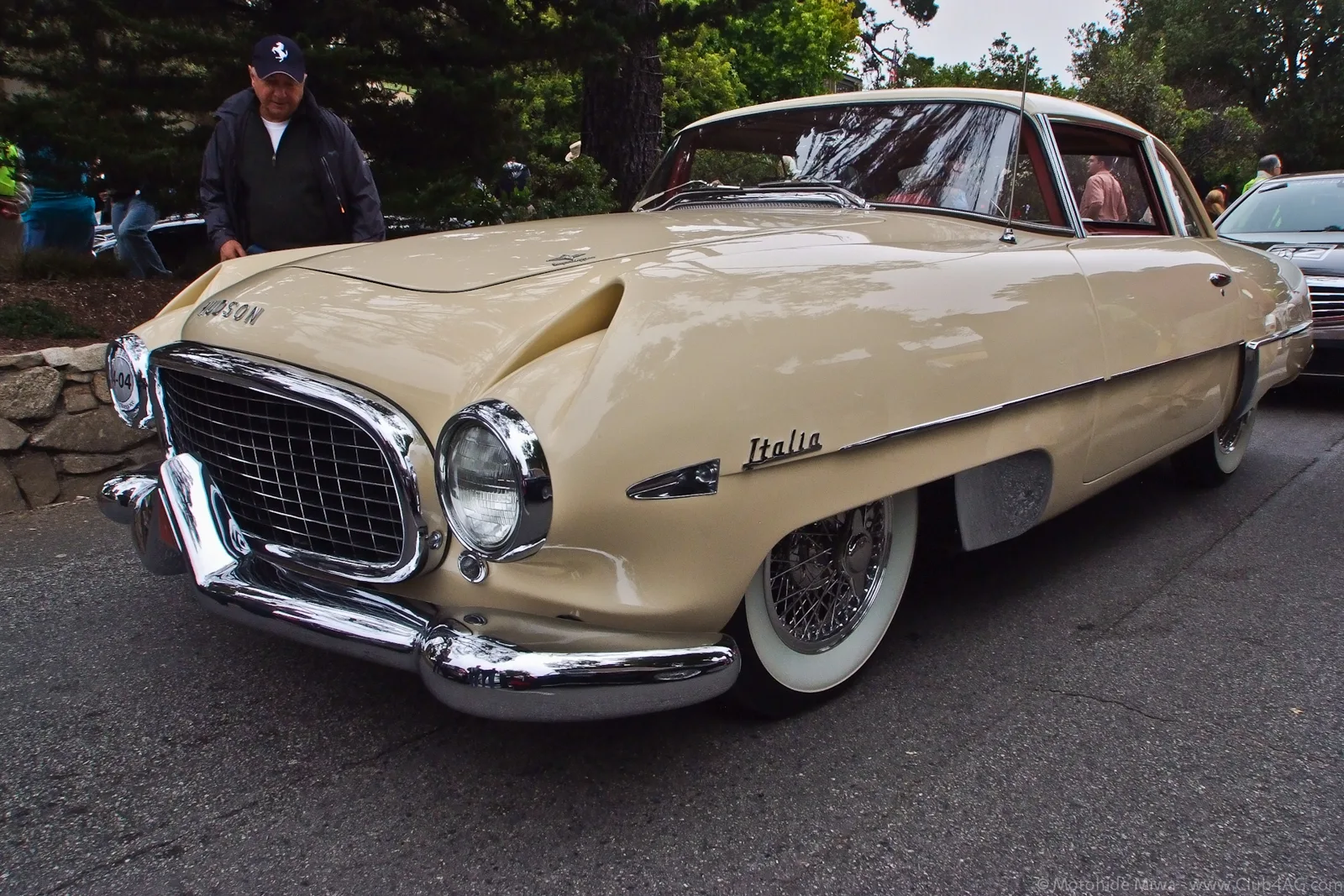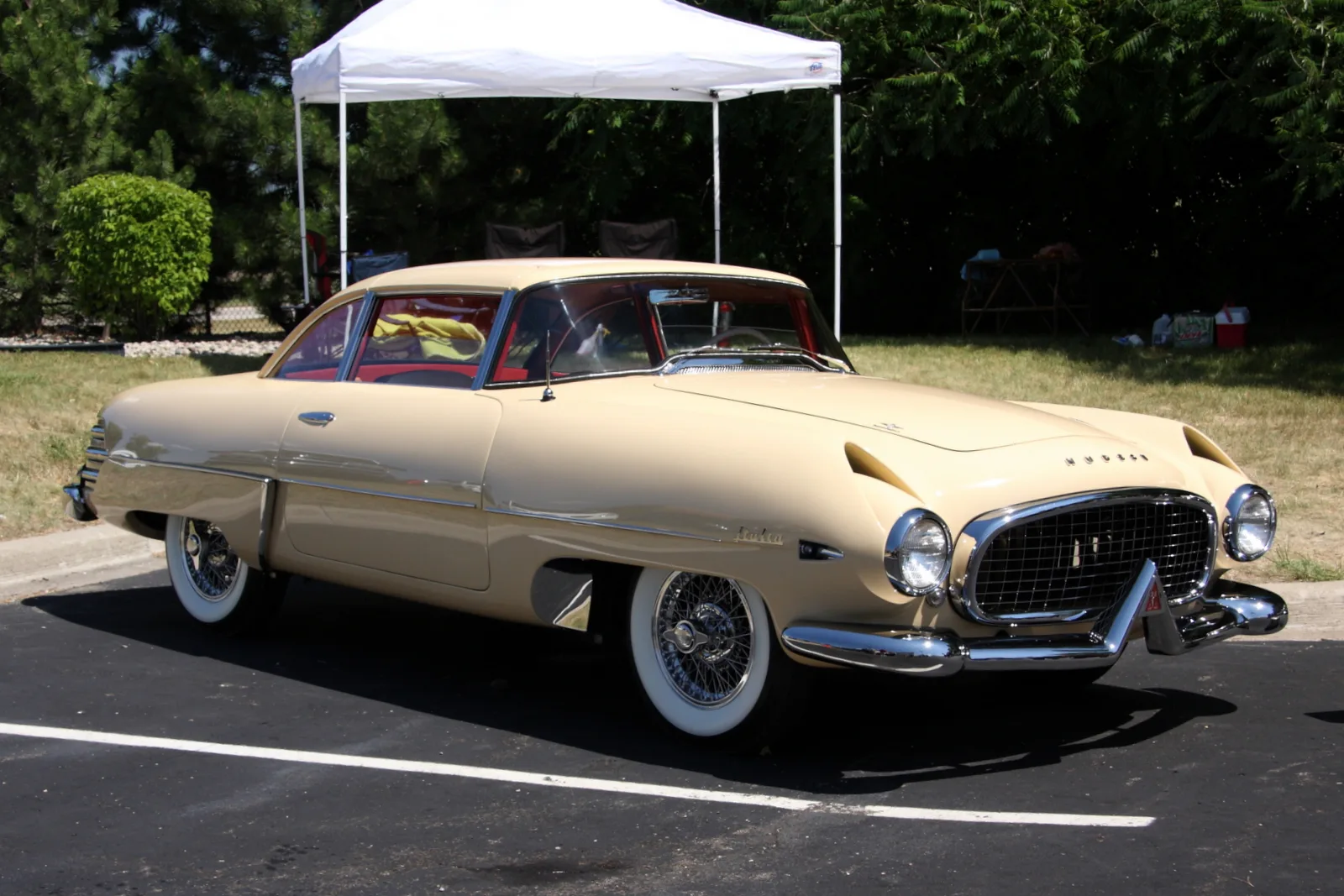
Both were low-volume American sports cars from the same moment, one built in Milan on a Hudson Jet and the other a fiberglass roadster grown from a Henry J.
The Hudson Italia is a limited-production two-door compact coupe built by Hudson with Carrozzeria Touring of Italy in the 1954 and 1955 model years. The Kaiser Darrin is a fiberglass two-seat roadster with sliding doors, built by Kaiser Motors for 1954 on a Henry J chassis.
The Hudson Italia and the Kaiser Darrin were both American sports cars from 1954, and both were built in small numbers for buyers who wanted something different. The Italia was a two-door coupe that Hudson had Carrozzeria Touring build in Milan on a Jet chassis. The Darrin was a fiberglass roadster from the pen of Howard Dutch Darrin, built by Kaiser Motors on a Henry J base. Set side by side, they show two very different ways of answering the same question about what an American sports car should be.
Where did the Italia and Darrin come from?
The Italia came out of Hudson's frustration with its own Jet. Chief designer Frank Spring had seen his styling altered, and management allowed him to build an experimental sports car on Jet mechanicals. Hudson lacked the capital for a new model, so it shipped a complete Jet to Carrozzeria Touring in Milan, and the Italia was introduced on 14 January 1954.
The Darrin grew from a different source. Darrin had been a coachbuilder since 1923, and he had worked with Kaiser-Frazer before resigning twice. When the Henry J compact was styled in a conventional way, Darrin felt it deserved a better body. He built a two-seat roadster on his own funds, without telling Kaiser, and Bill Tritt produced its fiberglass body, which was mated to a Henry J chassis.
A Milan-built Hudson coupe and a fiberglass Kaiser roadster with sliding doors, two American sports car ideas from the same year.
Why did Kaiser change its mind about the Darrin?
Kaiser was angry when he first saw the car. He said the company was not in the sports car business, and Darrin replied that he had paid for the car himself and would build it alone if Kaiser refused. Kaiser's younger wife, who had come to the shop, told her husband it was the most beautiful thing she had ever seen, and he changed his mind.
By the end of the viewing, Kaiser had green-lighted the car and also approved a four-door version, which shows how far his view had shifted. The sports car was then named the Kaiser Darrin, in appreciation of the effort. At that moment Ford and General Motors were also working on two-seat roadsters, so the Darrin arrived at a moment of rising interest. Darrin's work had in fact begun before both of those projects.
How did the two cars' bodies differ?
The Italia's body was an aluminium superleggera design, formed over a steel tubular frame. It sat 229 mm (9 in) lower than the Jet, and its doors cut 356 mm (14 in) into the roof in an aircraft-style entry. The front carried a large inverted Hudson triangle, and the rear lamps sat in chrome tubes that emerged from scalloped cutouts.
The Darrin's signature was its doors, which ran on tracks into the front wings instead of swinging outward. Darrin had patented the sliding door idea in 1946, and the car had no side windows in the doors. Its body was fiberglass, which was lightweight and did not rot, and it used a three-position Landau top. Moulds for fiberglass cost far less than the tooling needed to shape steel, which made the material attractive to a small maker such as Kaiser. The high, shell-shaped grille was the one flaw that critics noticed.
What did the two cars' interiors offer?
The Italia's seats were form-fitting buckets in red and white leather, with foam rubber of three densities and reclining backrests made of two contoured bolsters. A radio was fitted, which was rare even on expensive cars, and the cabin had flow-through ventilation from a cowl vent.
The Darrin's interior was simpler in keeping with its roadster brief, and it was a two-seat layout with a folding top. Its appeal lay in the shape and the sliding doors rather than in luxury fittings.
Side-by-side specifications
| Specification | Hudson Italia (1954 to 1955) | Kaiser Darrin (1954) |
|---|---|---|
| Maker | Hudson, built by Carrozzeria Touring in Milan | Kaiser Motors, designed by Howard Dutch Darrin |
| Body | Two-door compact coupe, aluminium superleggera | Two-seat roadster, fiberglass |
| Platform | Hudson Jet platform and running gear | Henry J compact chassis |
| Engine | 3.3-litre Twin H straight six, 114 hp (85 kW; 116 PS) | No figure given; some cars were supercharged |
| Gearbox | Three-speed manual, column-mounted | No figure given |
| Brakes | Drum brakes front and rear | No figure given |
| Doors | Aircraft-style doors cutting into the roof | Doors that run into the front wings |
| Price | US$4,350 landed in New York | $3,668 |
| Production | About 25 cars plus a prototype | 435 cars plus six prototypes |
How did the two cars sell?
A hand-built car from Milan was expensive to bring into the market, and orphan-branded cars were hard to sell once their maker was absorbed. Dealers took only 18 or 19 firm orders for the Italia, and the merger that created American Motors left the car stranded. The new company committed to only 15 more cars, and most Italias went to buyers in Southern California. The price was well above the Darrin's, and above a Cadillac Sixty-Two Coupe de Ville, which started at $3,995.
The Darrin sold in greater numbers, with 435 production cars built, at $3,668 in a market where the Italia's price looked steep. Then a freak snowstorm reportedly ruined 50 cars, and Darrin bought those damaged cars and whatever else Kaiser had left in storage. He sold them from his Hollywood showroom, and many had their engines fitted with superchargers or multiple carburettors.
Which engines did the two cars have?
The Italia used Hudson's Twin H six, which measured 202 cu in, with 8:1 compression and dual one-barrel carburettors. It produced 114 hp (85 kW; 116 PS), and dealers were disappointed that the Hornet's more powerful engine was not offered.
The Darrin was considered underpowered, even though it performed well overall. It did not measure up to the Nash-Healey or the Triumph TR2 in the market, and it was said that six cars were rumoured to have Cadillac Eldorado V8 engines, although none of them survived. A V8-powered example went racing at Tory Pines in November 1954.
Who designed the two cars?
Frank Spring was Hudson's chief designer, and his Jet sketches formed the Italia's body with Carrozzeria Touring. Stuart Baits, a Hudson vice-president, joined Spring in overseeing the project. The Italia was Touring's only contract with an American maker.
Howard Dutch Darrin had coachbuilt in Paris from 1923, and he had worked with Packard on the Packard 120 and the Clipper. His trademark was a sweeping fender line, a shape that carried over to the Darrin's body.
How did Darrin's career shape the car?
Darrin began coachbuilding in Paris in 1923 with Thomas L. Hibbard. Their partnership ended in 1931, when Hibbard joined General Motors' design department under Harley Earl. Darrin returned to the United States in 1937, set up his own coachworks in Hollywood and worked with Packard on several models. His trademark was a sweeping fender line that dipped at the rear.
Darrin came to Kaiser-Frazer as a consultant after his own postwar plan stalled. He resigned in 1946 after the company's designers altered his work, and he returned two years later for the 1951 Kaiser, only to resign again when a more staid design was chosen for the Henry J.
How did Kaiser's car business reach the Henry J?
Henry J. Kaiser built a huge industrial empire, and by 1943 his shipyards employed more than 300,000 people. He turned to cars after the war, forming Kaiser-Frazer with Joseph Frazer on July 25, 1945 and leasing the Willow Run plant near Detroit. Frazer later left, and the company became Kaiser Motors under Edgar Kaiser in 1949, when sales slumped.
The Henry J was the family's answer to that slump. A $44 million loan from the Reconstruction Finance Corporation in 1948 supported it, and its 100-inch wheelbase came from the 1951 sedan. Testers such as Tom McCahill and Floyd Clymer praised its performance while criticising its assembly.
How did the Darrin's doors work?
Rather than hinging outward, the Darrin's entry doors ran on tracks into the front wings, behind the wheels. Darrin disliked conventional doors, and he had patented the sliding design in 1946. To keep the assembly simple, the doors carried no side windows. The body itself was molded in two sections, without the deck lid, doors and hood, and the Henry J frame rails carried it.
The design attracted attention from critics, who regarded its proportions as beautiful. The grille was the one feature they disliked, and one writer said the car seemed to want to give you a kiss.
Which buyer suits each car?
The Italia suits a buyer who wants a rare, Italian-built coupe with an aluminium body and a strong sense of style, and who accepts its limited parts support. The Darrin suits a buyer who wants a fiberglass roadster with sliding doors and a distinctive shape.
Neither car is shown here as the better buy, because the figures do not settle the question. Kaiser's initial anger proved short-lived once he had seen the car, and he moved quickly to approve production. Collectors weigh them differently today: the Italia's Milan craftsmanship and rarity draw the higher interest, while the Darrin's fiberglass and sliding doors give it a distinct design identity. Both were low-volume experiments, and both are valued today for their rarity and design.
What did each car leave behind?
The Italia left a grille design that was adapted on the 1956 Hudson, and a four-door X-161 prototype built on the Hornet. A car from the series sold for $396,000 at a 2013 auction, and one example won a class award at Pebble Beach in 2011.
The Darrin's legacy is its design identity, which rests on being an early American fiberglass sports car built in a short 1954 run. Darrin's sliding door patent remains its most distinctive feature. The Darrin left its sliding doors, and it has a place in the story of American fiberglass bodies, since it was the second American car with such a body after the 1953 Corvette. Its designer's patent on sliding doors dates from 1946.