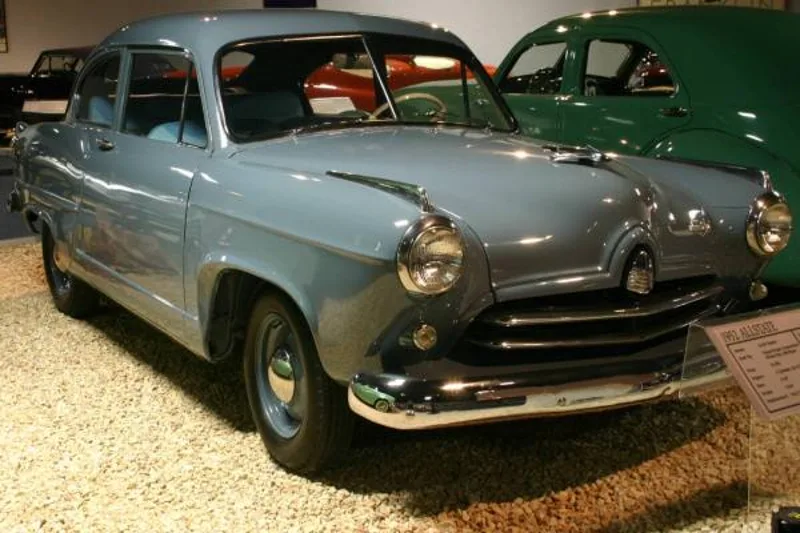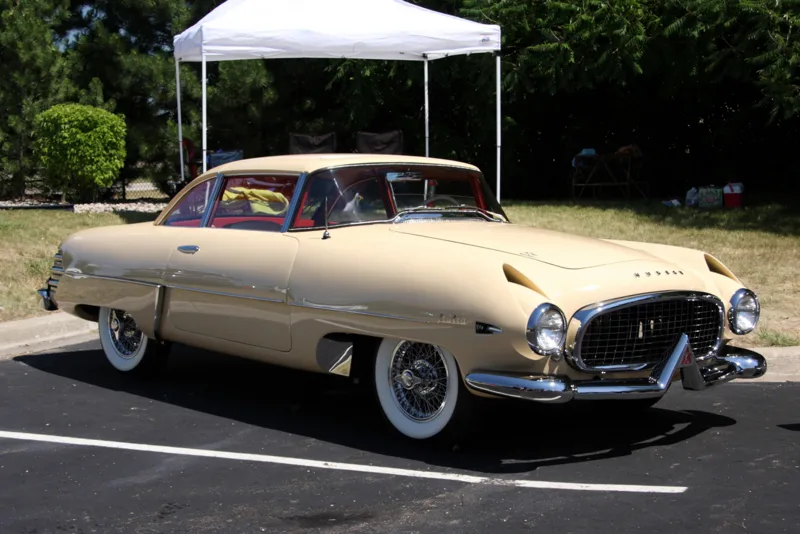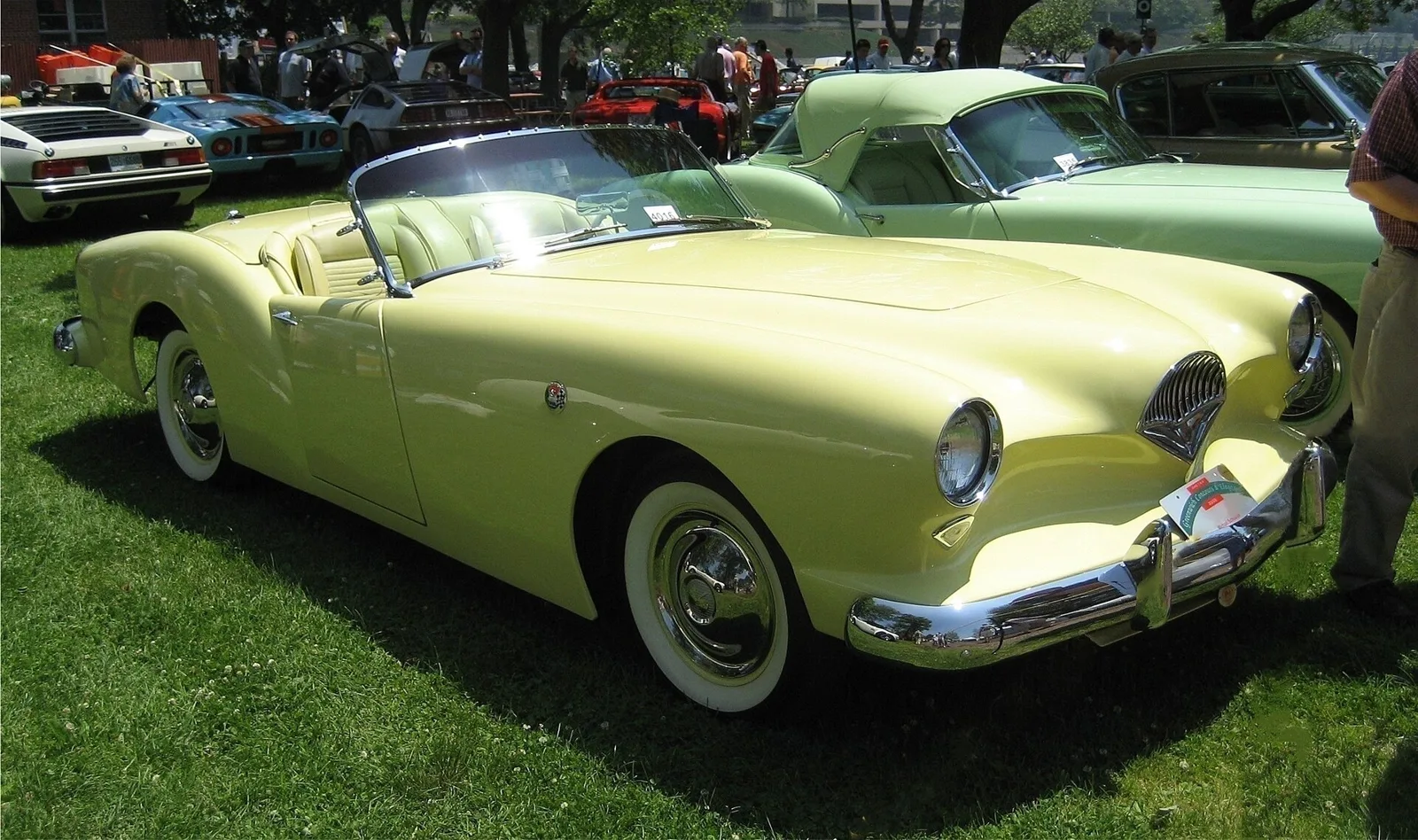
Designed by Howard Dutch Darrin on the Henry J compact, the 1954 Kaiser Darrin combined a fiberglass body with doors that disappeared into the front fenders.
The Kaiser Darrin was a two-seat American sports car built by Kaiser Motors for the 1954 model year. Designed by Howard Darrin on the Henry J chassis, it had a fiberglass body and sliding doors, but high prices, weak performance and design problems limited production to 435 cars.
Built on the Henry J compact, the Darrin wore a fiberglass body and doors that slid into the front fenders. Only 435 production examples were built before the programme ended in 1954, making it a short-lived effort despite its striking design. Its later life as a Cadillac-engined special gave it a second reputation.
Where did the Kaiser Darrin come from?
The Darrin grew out of Kaiser's postwar search for a cheap car and the ambitions of its designer. Howard Darrin had worked on Kaiser-Frazer designs before leaving, and he returned as a consultant. When the company later preferred a plainer body, he resigned for a second time and built a roadster on his own time and money.
Kaiser had begun to consider cars in 1942, when wartime rules halted civilian production. Henry J. Kaiser assembled a team of idea men to conceive an affordable compact. By 1945 that work had produced the K-85 prototype, which had front-wheel drive, unibody construction and a torsion-bar arrangement called Torsionetic Suspension.
Kaiser-Frazer was formed on July 25, 1945, and leased the Willow Run factory near Detroit. Building cars proved harder than designing them. A shortage of capital split the founders, Joseph Frazer stepped down in early 1949, and the firm was renamed Kaiser Motors.
A fiberglass roadster with sliding doors that a snowstorm nearly ended and a designer rescued.
Who was Henry J. Kaiser?
Henry J. Kaiser built an industrial empire of more than 100 companies, from cement and construction to shipbuilding and health care. He started with a cement business in Vancouver, British Columbia, and by 1943 he employed more than 300,000 people in seven shipyards.
Kaiser entered shipbuilding in 1939 with no experience and ultimately built 1,490 Liberty ships during World War II. He tended to bulldoze through problems, building a foundry or substituting aluminum when steel ran short. Writer Aaron Severson summed up the flaw: Kaiser rarely recognised his own limits.
His construction career began with a 1927 contract to build roads in Cuba, followed by work on the Hoover and Grand Coulee dams. That record of getting big things built fast is the background to the Darrin's story, because Kaiser expected problems to yield to effort.
How did Darrin's career lead to the Darrin?
Howard Darrin began coachbuilding in Paris in 1923 with Thomas L. Hibbard, under the name Hibbard and Darrin. He returned to the United States in 1937 and opened his own coachworks in Hollywood. His trademark was a sweeping fender line that dipped at the head of the rear fender, and that line would carry into the Darrin.
The partnership with Hibbard ended in 1931, when Hibbard joined General Motors's design department under Harley Earl. Darrin stayed in France for a time, forming Fernandez and Darrin with a South American banker, and later worked with Packard on models such as the Packard 120 and Packard Clipper.
Darrin's postwar plan for a car of his own stalled over raw material shortages. Investment banker Charles Schwartz introduced him to Joseph Frazer, who commissioned a design for the Graham-Paige firm. Once Kaiser-Frazer was incorporated, that design became the first 1947 Frazer.
Why did Darrin leave Kaiser-Frazer twice?
Darrin's relationship with Kaiser-Frazer was stormy. His designs were often replaced by more conventional ones, and he resigned in 1946 after the company's designers changed his sedan. He came back to work on the 1951 Kaiser two years later, but when the company chose a plainer design for the Henry J, he resigned again.
Darrin could be mercurial and cantankerous, and he believed the company was shutting him out as Frazer's influence faded. The Kaisers had hired him for his reputation, but neither Henry nor Edgar Kaiser regretted seeing him go.
Why did the Henry J need a new body?
The Henry J was Henry Kaiser's affordable car for the average working man. It carried a $44 million loan from the Reconstruction Finance Corporation in 1948, on condition that it reached the market by the summer of 1950. Its 100 inch wheelbase came from the 1951 sedan, a sound but conventional design.
Reviewers including Tom McCahill, writing for Mechanix Illustrated, and Floyd Clymer of Popular Mechanics criticised the quality of assembly but praised the car's performance. Severson described its roadability as a pleasant mix of ride comfort and manoeuvrability, although the engine was lively rather than fast.
Darrin felt the Henry J deserved better than its boxy body. Using his own funds and without telling Kaiser, he drew a two-seat roadster in clay during the first half of 1952. He then asked Bill Tritt, a pioneer of fiberglass sports car bodies, to build a prototype, and the finished body was fitted to a Henry J chassis at his Santa Monica shop.
How did Kaiser react to the prototype?
Kaiser was upset when he saw the car, and he scolded Darrin for building it without permission. Darrin replied that he had paid for it himself and would build the car on his own if Kaiser refused. Then Kaiser's younger wife praised the roadster, and Kaiser changed his mind.
Kaiser not only embraced the roadster but also approved development of a four-door version. Months later he showed his appreciation by naming the sports car after Darrin.
The roadster arrived while a rush was underway. Ford was developing the first Thunderbird and General Motors was working on the Corvette, yet Darrin's work came earlier than both projects.
What made the Darrin's design distinctive?
The most unusual feature was the door. Instead of hinging outward, the doors slid on tracks into the front fender wells behind the front wheels, and they had no side windows. Darrin had patented the sliding door concept in 1946. The car also carried a three-position Landau top and his sweeping fender line.
Critics found the body beautifully proportioned. The flaw was a high, shell-shaped grille that one writer found faintly comical. Fiberglass suited a small maker because it did not rot or corrode, it was light, and its tooling cost far less than steel.
The body was molded in two sections, without the deck lid, doors and hood. Glasspar, Tritt's firm, was commissioned for production bodies but made only a handful, and Kaiser built the other 435 in-house. Glasspar still supplied the deck lids and doors. Lacquer paint was specified because fiberglass could not take the temperatures needed to bake enamel.
Several production changes were required. Two angered Darrin but were needed for state vehicle rules: the headlights rose four inches and turn signals went beneath them. The trunk and top well received separate lids, the windscreen became one piece, and the instruments were clustered ahead of the steering wheel.
What powered the Darrin?
The prototype used a standard Henry J drivetrain, but Kaiser knew a sports car needed more power. The company had designed an overhead-valve V8 without the money to build it, and Oldsmobile's 303-cubic-inch Rocket V8 became too expensive when Olds raised its price mid-negotiation. Engineers modified a Henry J engine instead.
That modification used a high compression aluminum head, a hotter camshaft and three carburetors. It added 25 horsepower, but it also increased valve and piston damage and hurt drivability. The March 1953 merger with Willys-Overland brought another option, the F-head Willys Hurricane six.
The Hurricane produced just six horsepower extra over the Kaiser unit, but it was built more strongly and held up better under supercharging. A labour strike at Willow Run then stalled the engine supply, and pilot production did not begin until August 1953. Full production started that December at the Willys plant in Toledo, Ohio.
Why did sales of the Darrin stay low?
The Darrin was expensive for what it offered. Its price of $3668 sat above the Cadillac 62 and Lincoln Capri, and its 90 bhp Hurricane six gave a top speed of 95 miles per hour (153 km/h) and 0 to 60 miles per hour (97 km/h) in roughly 15 seconds. Buyers had little reason to choose it.
It was faster than the inexpensive MG TF but slower than the Alfa Romeo Giulietta Spider and Triumph TR2, and it was outclassed by the Corvette, Nash-Healey and Jaguar XK120. The steering was quick but understeered in brisk corners. The ride was comfortable for a sports car, and the brakes, borrowed from the heavier Kaiser Manhattan, were excellent.
Design issues added to the problem. The sliding doors were awkward to enter, early examples tended to jam, and the folding top and side curtains leaked. The heater was inadequate, and Kaiser dealers were reluctant to order cars.
How did Darrin production come to an end?
Kaiser had set a target of 1,000 Darrins a year, but output never reached half that. By early 1954 many Kaiser franchises had switched brands or closed, and buyers doubted the company's future. Kaiser stopped production in August 1954, as the lease on the Jackson, Michigan plant neared its end.
In July the company cut the wholesale price by about five percent, and sales manager Roy Abernethy offered dealer incentives, including a $700 trade-in allowance on any Darrin. Neither move revived demand, and the factory stayed backed up with unsold cars.
A freak snowstorm hit Toledo in the winter of 1953-54. Fifty Darrins stored in the yard of the Kaiser-Willys plant stayed buried for several months, and when they were dug out, their fiberglass bodies were judged too deteriorated to sell as new. Kaiser ordered them scrapped.
Darrin stepped in. He still held the design rights, which Kaiser had built under license, so Kaiser offered him the cars at a token price. He bought them and had them shipped to Santa Monica.
What happened to the Darrin after Kaiser left the car business?
Kaiser exited the US consumer car market in 1955 and still held a number of Darrins in storage. Darrin gathered as many as he could, added the 50 snow-damaged cars, and sold them from his Hollywood showroom. He fitted several with McCulloch superchargers and multiple carburetors to improve performance.
He also swapped the engines in six cars for V-8 units rated at 305 bhp, the same family General Motors used in its Cadillac Eldorado. Those cars were sold as Kaiser-Darrin Specials at $4350 each. Tests on the supercharged factory cars showed 0 to 60 miles per hour in around 10 seconds and a top speed over 100 miles per hour (160 km/h).
Martyn L. Schorr, an automotive author, described the Cadillac-engined Specials as a mix of a stylish sports car and a hot rod. Their top speed topped 145 miles per hour (233 km/h), and some raced in SCCA events in the hands of owners including Laura Maxine Elmer, later the second wife of Briggs Cunningham, race driver Lance Reventlow and Ray Sinatra. The last roadsters had been sold by 1957.
Darrin also pitched a four-door version to Studebaker-Packard. He built a single hardtop mock-up with an extended wheelbase and front and rear sliding doors, but the ailing company passed on it, and the mock-up's whereabouts are unknown.
Was the Darrin really a failure?
Conventional wisdom calls the Darrin a marketing failure, but Severson argues that it did not do badly against its sports car rivals. The Nash-Healey sold only around 500 vehicles from 1951 to 1954, Allard never built more than 150 or so a year, and fiberglass kit cars such as the Glasspar G2 sold in the dozens.
The Corvette was built in far greater numbers, yet hundreds of unsold Corvettes remained at the end of 1954, and it did not become profitable until it gained a V8 and roll-up windows. Against that background, Severson concludes that the number of Darrins Kaiser sold was somewhat remarkable.
A stronger Kaiser might not have sold many more. Lower prices, better performance and effective weatherproofing could have helped, but the company would probably have made little money on the car. By the time production cars arrived, Severson suggests, Kaiser needed a miracle more than a traffic builder.
Kaiser Darrin specifications at a glance
| Specification | Detail |
|---|---|
| Model year | 1954 |
| Body | Two-seat roadster, fiberglass, sliding doors, Landau top |
| Chassis | Henry J, 100 inch (2.5 m) wheelbase |
| Standard engine | Willys Hurricane F-head six, 90 bhp |
| Top speed (standard) | 95 miles per hour (153 km/h) |
| 0 to 60 miles per hour (standard) | Around 15 seconds (97 km/h) |
| Price | $3668 |
| Production | 435 production cars and six prototypes |
| Production stopped | August 1954 |
| Cadillac-engined Specials | V-8 rated 305 bhp; $4350 each; top speed over 145 miles per hour (233 km/h) |