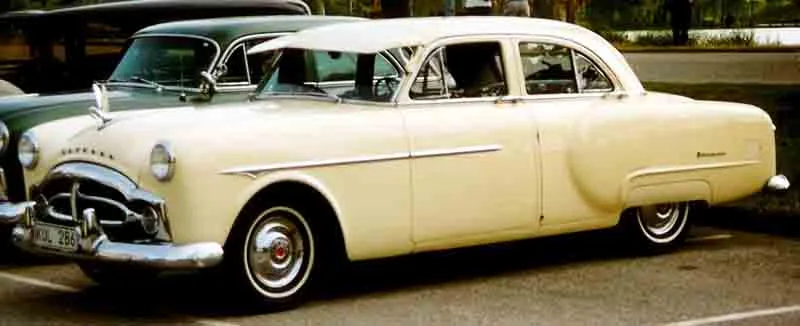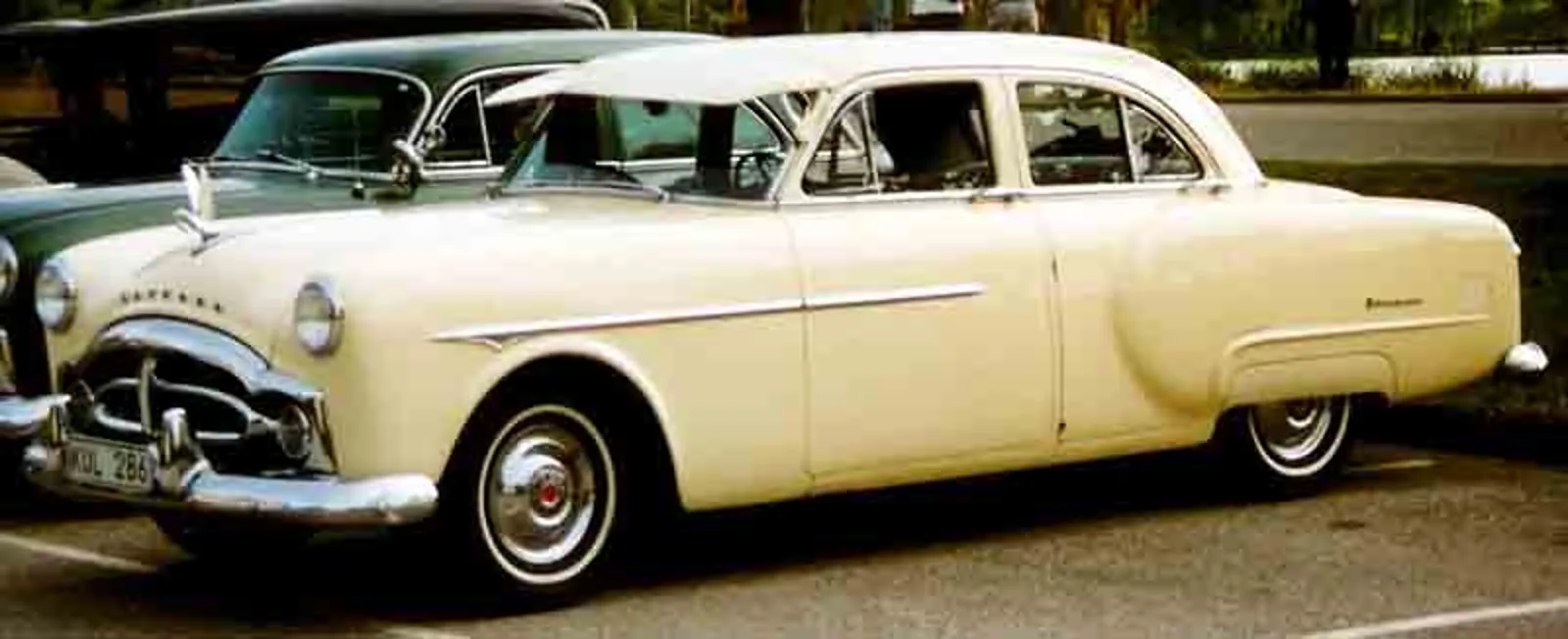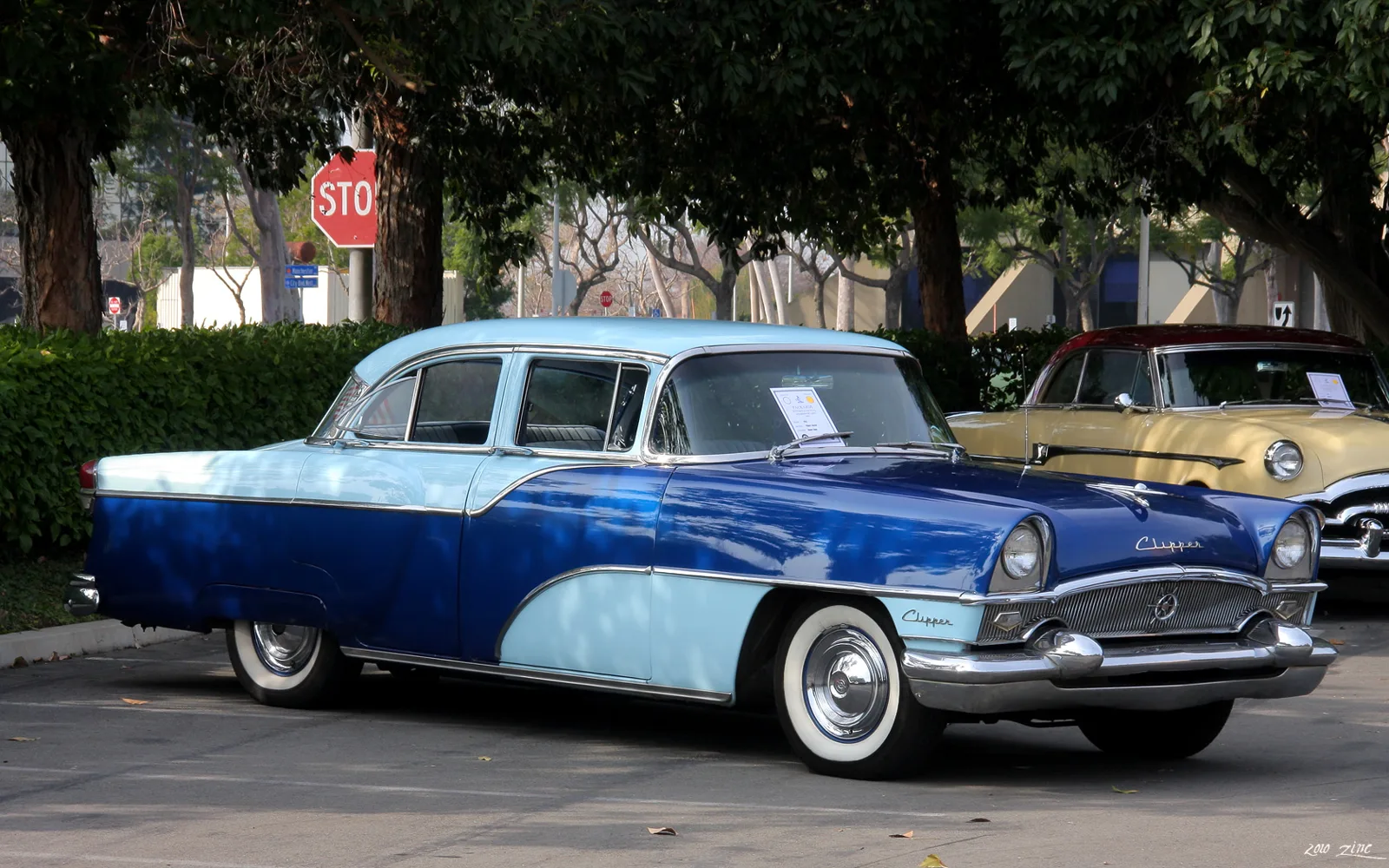
A sleek mid-1941 sedan that the war cut short, and a name that kept coming back until 1957.
The Packard Clipper was a car series from Packard, later built by Studebaker-Packard, for the model years 1941-1942, 1946-1947 and 1953-1957. Introduced in April 1941, it was a sleek sedan that the war cut short. Its styling carried the Packard identity, and the name returned in 1953 and again in 1957.
The Packard Clipper was a car line sold under that name in 1941 and 1942, from 1946 to 1947, and again from 1953 to 1957. It took its name from a sailing ship type and was meant to lift Packard out of a difficult stretch. Its story is one of a good design undone by timing, cost and a run of marketing decisions. Its styling still carried the Packard identity, with the same hallmarks that had defined the marque before it.
What was the Packard Clipper?
The Packard Clipper was a series built by Packard Motor Car Company and later by Studebaker-Packard Corporation. Its model years were 1941-1942, 1946-1947 and 1953-1957, and its name comes from a type of sailing ship called a clipper. It was offered only as a four-door sedan at first.
The debut car arrived in April 1941 as a mid-model-year entry. It was aimed at the Buick Roadmaster, the Cadillac Model 62, the Chrysler Saratoga and New Yorker, and the Lincoln Zephyr, all of which sat in the upper-medium price field.
The name returned in 1953 for the lowest-priced Packard lineup. By 1955 Clippers were seen as diluting Packard's luxury image, and the car became a stand-alone marque for the 1956 model year.
The Clipper was also assembled in Australia from CKD kits, circa 1955, so the model travelled well beyond its Detroit origins.
A sleek 1941 sedan that the war cut short, and a name that kept coming back.
Why did Packard need a new car?
Packard needed something radically new at the end of the 1930s. Its calendar 1939 sales of 76,000 were barely at break-even, and profit for the year was only half-million dollars. President Max M. Gilman was the man who had to find the answer, and the One-Twenty of 1935 had already helped save the company once.
The Clipper arrived eight months before the attack on Pearl Harbor, which left very little time to make the car a success. The timing could hardly have been worse, since the new model had barely started selling when the country changed its priorities.
How was the 1941 Clipper styled?
The body is credited to Howard Dutch Darrin, who said he produced the original concept after a ten-day deadline. Packard offered him a thousand dollars a day to meet that deadline, and his sweeping fender line gave the car much of its character.
Packard did not keep the full design, though. Darrin's sweeping front fender line was meant to run through the doors, but the company shortened it to fade away at mid-door, because nobody knew whether buyers would accept the longer version.
Ed Macauley was chief stylist and vice-president for design, and John Reinhart wanted to keep and sweeten the Clipper's lines. Reithard's symmetrical dashboard held a full set of instruments, so the interior was as carefully arranged as the outside.
The 1941 Clipper was the widest production car in the industry, and it was a foot wider than it was tall. Its body from cowl to deck was a single piece of steel, and the Packard hallmarks stayed in place: the cormorant mascot, red hexagon hubs and arrowheads.
What engineering did the first Clipper have?
The first Clipper rode a 127-inch (3,200 mm) wheelbase and used a 282-cubic-inch (4,620 cc) straight eight producing 125 bhp. That was five more than the One Twenty, although the engine itself was a familiar unit. It was an ambitious package for a mid-year debut.
A double-drop frame let the floor sit lower without losing road clearance. Buyers could add an Electro-Matic vacuum clutch and Aerodrive overdrive, plus air conditioning for $275. The air conditioning option was a Packard first, already offered on the 1940 eight-cylinder cars.
The Ventalarm whistle warned the driver when the tank was within a gallon of full, which was a small but practical touch on a car that was otherwise full of new ideas.
Which engine powered the bigger Clippers?
The One Sixty and One Eighty Clippers used a 356-cubic-inch (5,830 cc) straight eight with a 104-pound (47 kg) nine-main-bearing crankshaft. It was the most powerful engine in the industry through 1948, and it topped Cadillac's V8 by 15 horsepower (11 kW).
A 4,000-pound (1,800 kg) car could go past 100 mph on the proving ground. The 1942 160/180 Clipper was also 9.5 inches (240 mm) longer and 140 pounds (64 kg) heavier than the 1941 model, which gave it a more substantial feel.
Junior Clippers used a 245-cubic-inch six instead, so the range offered two very different kinds of engine under one name. The engine choice mattered because the senior cars were the ones competing with Cadillac and Lincoln.
Sales in the early years show the split. The junior cars were the volume models, while the larger One Sixty and One Eighty carried the luxury reputation that Packard wanted to keep.
Why did Clipper production end so suddenly?
Clipper production stopped on February 9, 1942. By then about 16,600 cars of the 1941 model had been made, along with about 34,000 of the 1942 models, at an annual rate of around 80,000 cars. Those figures show how quickly the car was cut short.
Only about 40 club coupes were built before February 1942, and that was the one body style added before the war. The timing was poor, because the Clipper had been on sale for less than a year when car output stopped.
How did postwar Clippers compare with Cadillac?
Packard built 82,000 cars in its first two postwar model years, against 91,000 Cadillacs. Postwar Clipper Sixes and Eights were priced from $1,700 to $2,200, so most of Packard's output sat in the cheaper segment. The gap was mainly a matter of product mix, with most Packard output in the junior range.
The 1946-47 range had Sixes and Eights on a 120-inch (3,000 mm) wheelbase, with Supers and Custom Supers on a 127-inch (3,200 mm) wheelbase. Seven-passenger sedans and limousines rode a 148-inch (3,800 mm) wheelbase, and only about 3,100 finished factory cars were made for 1946-47 combined.
Pricing shows the gap in focus. The Clipper Eight sold for $1,800, the Clipper Super for $2,300 and the Custom Super for $2,900. A 1946 Cadillac Series 62 started around $2,300, and the Sixty Special cost $3,100.
Fortune recorded a consensus of a 12 to 14 million car market in 1946. In 1941 32 million American families owned 29,600,000 cars, and cars in use fell to 22 million as 1946 began.
Why did the 1948 facelift go wrong?
The 1948 facelift was dubbed the upside-down bathtub and broke the design continuity the Clipper had offered. Critics mocked it, and the journalist Tom McCahill was among the harshest. Packard's bathtub styling was short-lived, and the company moved on from it.
A 1949 Mercury Eight cost $2,000 new and was worth $430 five years later. A 1949 Packard Eight cost $2,200 new and was worth $375 after the same five years, which shows how quickly the look aged.
Reinhart had argued for keeping the Clipper's lines, which made the facelift harder to justify. The bulbous design was judged against newer rivals, and it lost ground.
How did the Clipper return in 1953?
The 1953 revival put the name on Packard's cheapest cars, with Special and Deluxe trims offered as two-door and four-door sedans. A 1953 Clipper went from 0 to 60 mph in 17.6 seconds in one road test. The hardtop was part of the Custom range in its first year.
Packard's lower-priced cars were now sold under the Clipper badge, and by 1955 that was seen as diluting Packard's luxury image. The 1955 Clipper Custom had a 320 CID V8 and torsion-bar suspension, which set it apart from the rest of the range.
The 1955 split of production shows where buyers went. The Custom was the most numerous trim that year, ahead of the Super, while the Deluxe was the smallest of the three.
The Clipper Constellation was a two-door hardtop in 1955, and the Panama was a hardtop in the Super range in 1956. Output for 1955 was 8,039 Deluxe, 14,995 Super and 15,380 Custom cars.
Did the Clipper become a separate marque?
Yes. Under Studebaker-Packard the Clipper gained its own marque status for 1956, and that year's output was 18,572 cars. That figure included 5,715 Deluxe sedans, 5,173 Super sedans, 3,999 Panamas and 2,219 Custom sedans. Packard dealers were not all happy with the arrangement, but the marque stayed separate for that year.
The 1956 mix tells its own story. The Deluxe sedan was the largest single line at 5,715 cars, ahead of the Super sedan at 5,173, which kept the cheaper end of the range busy.
Studebaker-Packard was in financial trouble by summer 1956, and the Detroit factory had closed that year. The last cars left the plant in late July, which ended production of both Packards and Clippers at that site.
What were the 1957 Clippers?
The 1957 Clippers were built at Studebaker's South Bend, Indiana plant as the Town Sedan and Country Sedan station wagon. About 4,800 sold for the year, and 869 of them were station wagons, so the cars were a small part of the Packard story.
Only 869 of the roughly 4,800 cars sold in 1957 were station wagons, which means the wagon was a niche within a niche.
The 1957 Clipper's only engine was a supercharged 289 cubic-inch Studebaker V8. Many people nicknamed the cars Packardbakers because of their obvious Studebaker origins.
For 1958 the Clipper name was discontinued, and the remaining Packards were sold under the marque name alone. The Packard Hawk was the only exception that year.
What were the Clipper specifications?
| Model year | Body styles | Engine | Built or sold | Price or note |
|---|---|---|---|---|
| 1941 | Four-door sedan | 282-cubic-inch straight eight, 125 bhp | 16,600 built | Around $1,400 |
| 1942 | Sedans, club coupe, 160 and 180 Clippers | 282 and 356-cubic-inch straight eights | About 34,000 built | One Sixty Clipper $1,688 |
| 1946-1947 | Sixes, Eights, Supers, Custom Supers, limousines | Not recorded | About 3,100 finished cars combined | Clipper Eight $1,800 |
| 1953 | Special and Deluxe two-door and four-door sedans | Not recorded | Not recorded | 0 to 60 mph in 17.6 seconds |
| 1955 | Deluxe, Super and Custom sedans, Constellation | 320 CID V8 | 8,039 Deluxe, 14,995 Super, 15,380 Custom | Not recorded |
| 1956 | Sedans and Panama hardtop | V8, enlarged for 1956 | 18,572 built | Not recorded |
| 1957 | Town Sedan and Country Sedan | Supercharged 289 cubic-inch Studebaker V8 | About 4,800 sold | Not recorded |