A V12 given to Stalin, a senior Eight that led luxury sales, and a mid-priced One-Twenty that built 24,995 cars in its first year.
The Packard Twelve was a V12 luxury range built in 1916 to 1923 and 1933 to 1939. The Packard Eight, from 1924, was the senior car, while the mid-priced One-Twenty of 1935 to 1941 brought independent front suspension and strong sales, with 175,027 built.
Franklin D. Roosevelt handed Joseph Stalin an armoured Packard Twelve in October 1935, and for many years it was the Soviet leader's favourite car. The Twelve was a car for people who wanted the biggest engine Packard could build. That same year Packard launched a model designed for the opposite buyer: the One-Twenty, a mid-priced eight that built 24,995 cars in its first year against 7,000 of all other Packards combined.
Between those two cars sat the Packard Eight, the senior Packard of the 1920s and 1930s. Together, the Twelve, Eight and One-Twenty tell the story of a luxury marque that moved down the price ladder to stay alive.
Packard Twelve and the Twin Six
The Packard Twelve was a range of V12 luxury cars built in Detroit, Michigan, from model year 1916 to 1923 and again from 1933 to 1939. Packard launched the original Twin Six to keep pace with Marmon, Pierce-Arrow, Rolls-Royce, Renault and other luxury names, and Cadillac and Lincoln began selling large luxury cars from the late 1910s.
Big engines delivered the horsepower and torque buyers wanted, and with low-quality petrol of the time and low compression ratios, 50 bhp was ample. Early gasoline is estimated at 40 to 60 octane, with "High-Test" fuel averaging perhaps 50 to 65.
First generation, 1915 to 1923
The first Packard-built twelve-cylinder, the Twin Six of 1916, came in wheelbases of 125 in (3,200 mm) and 135 in (3,400 mm), called 1-25 and 1-35. It was Packard's only product for four years until the Single Six returned in 1921. Open cars were painted Packard blue with cream yellow striping, with black underbody, radiator, fenders and running gear and cream wheels with black stripes. Nickel brightwork, a Warner speedometer and a Waltham clock came as standard, and customers could pick from a huge range of colours.
Ten body styles were offered on either wheelbase, except that the coupe and runabout used only the 125-inch chassis. The engine was a 60-degree L-head V12 of 424.1 cu in (6,950 cc) producing 88 hp (66 kW) at 2600 rpm. Cylinder heads became detachable and radiators grew in 1916, and the gear lever and brake lever moved to the centre in 1917.
The range ran in three series from May 1915 to June 1923, with 30,941 cars built. Prices started at US$3,050 and reached US$5,150 for the Imperial Limousine. A 1919 Third Series 3-25 Runabout paced the 1919 Indianapolis 500.
Second generation, 1933 to 1939
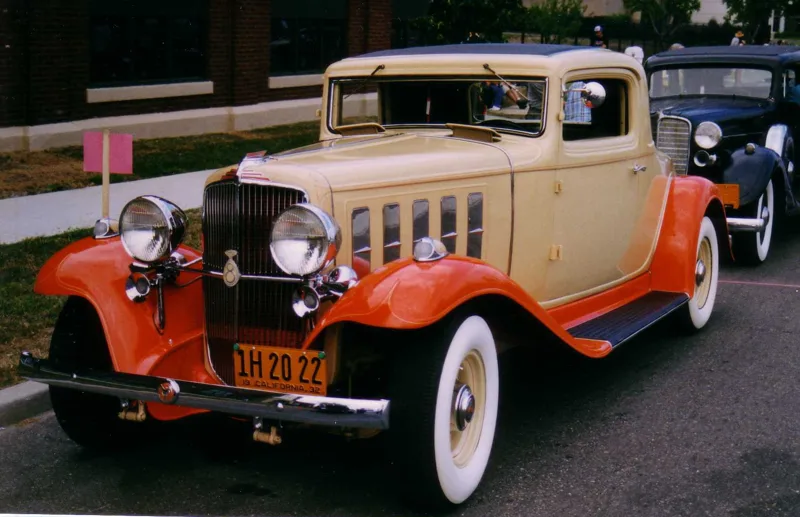
For 1933 Packard brought back a twelve, first still called Twin Six and then renamed Packard Twelve to match the rest of the line. This was the 10th Series, in two models, the 1005 and 1006, on wheelbases of 142 in and 147 in. The Twin Six double-drop frame gave way to a tapered design, and convertibles and roadsters reused ninth series bodies, which had a smaller radiator.
The V12 itself changed little. The cylinder banks sat at 67 degrees, with a bore of 3 7/16 in and a stroke of 4 in (87.3 and 101.6 mm), for 445.5 cu in (7,300 cc) and 160 hp (119 kW) at 3200 rpm. Packard improved the cooling, added a Bendix-Stromberg EE-3 carburettor with automatic choke, and replaced the twin-plate clutch with a single dry plate, behind a floor-shifted three-speed gearbox and a one-piece driveshaft. The mechanical brakes were kept.
The short-wheelbase 1005 came in at least ten body styles, running from a two-seat Coupe Roadster up to a five-seat Formal Sedan. The long 1006 was standard as a Sedan or Sedan Limousine, in five or seven seats, plus custom bodies mainly by Dietrich and LeBaron. The Super Eight long chassis was no longer offered, so custom coachwork was restricted to the Twelve. It competed with the Cadillac V-16, Duesenberg J, Lincoln K and Rolls-Royce Phantom II, as well as the Hispano-Suiza J12, Bentley 8 Litre, Mercedes-Benz 770, Isotta Fraschini Tipo 8B and Pierce-Arrow Model 53.
As times changed, most second-generation Twelves got standard bodies, as custom coachwork lost favour. Many apparent customs were really semi-customs, in which Dietrich finished Packard's own bodies with a few special touches.
Year by year
The 11th Series of 1934 added a third, shorter version on the 135 in Super Eight chassis. It offered an in-house Aero Sport Coupe and a LeBaron Runabout Speedster, of which around ten were made. Ed Macauley guided the almond-shaped Aero Sport Coupe, but Count Alexis de Sakhnoffsky, a consultant at Packard, did the design work, and only four were built. It was the last car to be "Custom Made by Packard". Packard built 960 Twelves in 1934, the year a radio first became a factory option.
For the 12th Series of 1935, the engine gained aluminium heads and a stroke longer by a quarter inch, taking it to 473.3 cu in (7,756 cc). Power rose to 175 hp (130 kW) at 3200 rpm, with a high-compression option of 180 hp (134 kW). The gearbox was fully synchronised, and the clutch and mechanical brakes gained vacuum assist. The 14th Series of 1936 was largely unchanged (there was no 13th), apart from a radiator angled five more degrees, a redesigned oil temperature regulator and the loss of the shortest wheelbase.
Hydraulic brakes came for the 15th Series in 1937, two years after the One-Twenty got them, and front-hinged doors replaced suicide doors. With 1300 built, 1937 was the Twelve's best year, and Dietrich offered six custom coachwork options. The 16th Series of 1938 had shorter wheelbases still, and only 566 were built, followed by 446 of the 17th Series, the last Twelves. Total production was 5262, topped by the Brunn All Weather Cabriolet at US$8,510. For 1940 Packard's top model became the Custom Super Eight.
Hydraulic brakes reached the Twelve in 1937, two years after the One-Twenty had them.
Packard Eight: the senior Packard
The Packard Eight ran from 1924 to 1936 and returned for one last year in 1938. Its all-new platform displaced the Twin Six at the top and remained the senior Packard until the Super Eight and Custom Super Eight arrived in the 1940s.
The first eight-cylinder was the Single Eight, offered on 136 in and 143 in wheelbases and named to match the junior Single Six. From 1928 came the Standard Eight and the more opulent Custom Eight, and the De Luxe Eight followed in 1929. In 1930 Packard added the Speedster. Packard ads boasted that the engine "floated" on new rubber mounts. Power rose to 110 hp (82 kW) in 1932 and 120 hp (89 kW) in 1933.
The 1930 Speedster Eight, Model 734, was a performance model for that year only, built on a modified Standard Eight chassis with narrower, lower coachwork. Its engine derived from the Custom Eight's but had revised valves and manifolds, a Detroit Lubricator dual updraft carburettor, a vacuum booster pump and a ribbed exhaust manifold. It made 145 hp at 3400 rpm, against 106 hp for the 740, with no change to the 3 1/2 by 5 in bore and stroke. It had a four-speed gearbox and a choice of rear axle ratios at no cost. Prices began at US$5,200, rising to US$6,000 for the Victoria and Sedan Speedsters. Only 113 were built.
Other Eights offered a four-speed synchromesh gearbox as a no-cost option, Ride Control, a dash-adjustable hydraulic shock absorber system, automatic chassis lubrication and "shatterproof" glass. A very rare swivel accelerator pedal was patented by Pat Au in the early 1900s. Body styles ran from roadsters and phaetons to town cars and limousines, including a two-door convertible Victoria that was new for 1932.
Prices varied widely. In 1930 the Eight was priced from US$2425 for the cheapest Standard Eight to US$5350 at the top of the range. In 1932 a Standard Eight cost between US$2250 and US$3250, and the De Luxe Eight started at US$3150. In 1933 the Standard Eight started at US$2150. De Luxe Eight output was under ten a day, in eleven body styles.
The five-passenger sedan was the best seller for years, and it helped Packard become the best-selling luxury brand from 1924 to 1930, and exporting almost twice as many cars as any other make priced over US$2000. For 1938 the Eight took the One-Twenty's 282.1 cu in (4.6 L; 4,622 cc) engine, with 120 hp (89 kW) at 3,800 rpm, on a wheelbase stretched 7 in with a wider body. When Packard reintroduced the Eight after the war, it added the Station Sedan with "woodie" styling from 1948, followed by ponton-style bodywork.
Packard One-Twenty: the mid-priced eight
The Packard One-Twenty was built from 1935 to 1937 and again from 1939 through the 1941 model years, and its name came from the wheelbase. It was the first time Packard had entered the fiercely contested mid-priced eight-cylinder market. Packard enthusiasts see it and the Six and One-Ten as the beginning of the end for Packard as America's premier luxury marque. GM's LaSalle, the Chrysler Airstream and the Lincoln-Zephyr followed a similar strategy, and the move came after Rolls-Royce launched the Twenty.
It was necessary to keep Packard in business through the closing years of the Great Depression, following the earlier Light Eight. Putting the Packard name on the car gave buyers the cachet of owning one. Packard may have avoided a separate brand because of its single production line at the Grand Boulevard plant, or the cost of launching a new name. It also launched a new style of advertising, with a jingle called "When Heaven Was at the Corner of Sycamore and Main".
Safe-T-Flex suspension
The One-Twenty brought independent front suspension to Packard. Its Safe-T-Flex layout used unequal upper and lower A-arms, with the lower one built from two parts bolted together at a right angle. A heavy forged steel support arm carried the load and held the coil spring. A lighter tubular torque arm, bolted on inboard and anchored near the dashboard by a rubber ball joint, took the acceleration and braking forces. The upper A-arm controlled camber, with a horizontal shock absorber between it and the frame. The claimed advantages were better wheel alignment, a fixed caster angle and more braking force reaching the frame through the torque arm.
First generation, 1935 to 1937
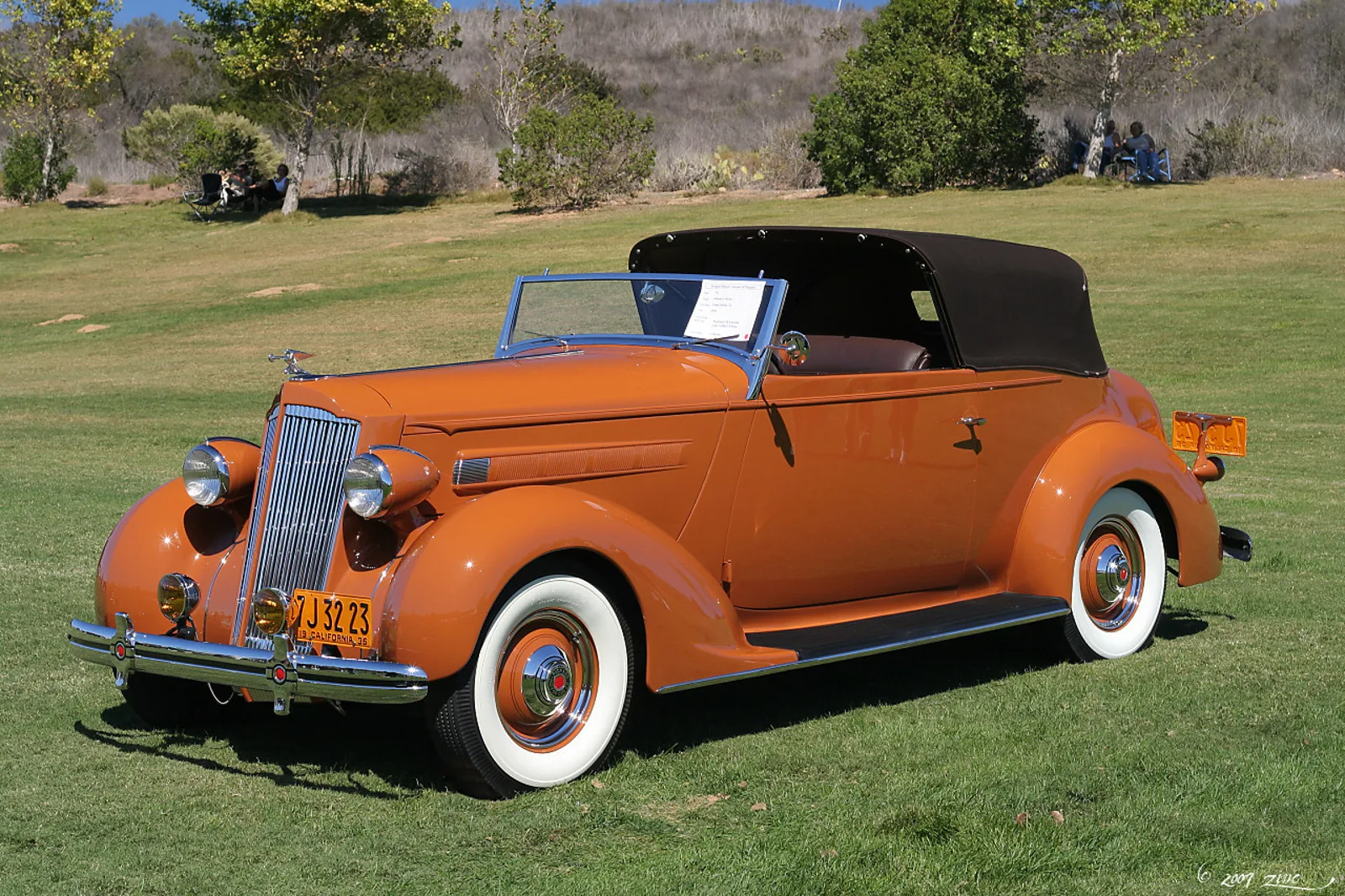
Introduced in January 1935, the One-Twenty came as two- and four-door sedans, a convertible and a Club Coupe. It weighed 3,688 lb (1,673 kg) and used a new aluminium-head L-head straight eight making 110 bhp (82 kW) at 3850 rpm. Prices ran from US$980 for the three-passenger business coupe to US$1,095 for the Touring Sedan. Consumers snapped it up: Packard built 24,995 against 7,000 of all other Packards that year.
For 1936 displacement and output rose, to 120 bhp (89 kW), enough for an 85 mph (137 km/h) top speed. A four-door convertible sedan was the dearest model at US$1,395, and 55,042 cars were built, the model's best year. A built-in radio cost US$59.50. In 1937 the One-Twenty moved upmarket as Packard introduced the Packard Six, its first six in ten years. It added "C" and "CD" trims, plus a wood-bodied station wagon, Touring Sedan and limousine on a 138 in wheelbase, all under US$2,000. Series production, begun in September 1936, was 50,100. For 1938 the name was dropped and the model folded into the Eight range.
Second generation, 1939 to 1941
The One-Twenty came back for 1939 in body styles from coupe to Touring Limousine at US$1,099 to US$1,856. Column shifting, called Handishift, replaced the floor lever. A total of 17,647 were built from September 1938. Packard added a fifth, transverse shock absorber, the Unimesh three-speed synchromesh gearbox as in the Twelve, and an Econo-Drive overdrive that claimed to cut engine speed by 27.8 percent and could be engaged at any speed above 30 mph (48 km/h).
The name was hyphenated officially for 1940. Body styles included a semi-custom Convertible Victoria by Howard "Dutch" Darrin, and model year output was 28,138 from August 1939. In its final year, it lost several body styles to the larger One-Ten line, and production dropped to 17,100. For 1942 the One-Ten and One-Twenty names disappeared into the Packard Six and Eight. Packard counts total One-Twenty production at 175,027.
On 29 August 1935, King Leopold III of the Belgians crashed a One-Twenty convertible in Kussnacht, Switzerland, killing his wife, Queen Astrid.
Packard engines compared
| Model | Engine | Output |
|---|---|---|
| Twin Six, 1916 | 424.1 cu in (6,950 cc) V12 | 88 hp (66 kW) |
| Speedster Eight 734, 1930 | Straight eight | 145 hp |
| Twelve, 1933 | 445.5 cu in (7,300 cc) V12 | 160 hp (119 kW) |
| Twelve, 1935 | 473.3 cu in (7,756 cc) V12 | 175 hp (130 kW) |
| One-Twenty, 1935 | Aluminium-head L-head straight eight | 110 bhp (82 kW) |
| One-Twenty, 1936 | Enlarged straight eight | 120 bhp (89 kW) |
| Eight, 1938 | 282.1 cu in (4.6 L) straight eight | 120 hp (89 kW) |