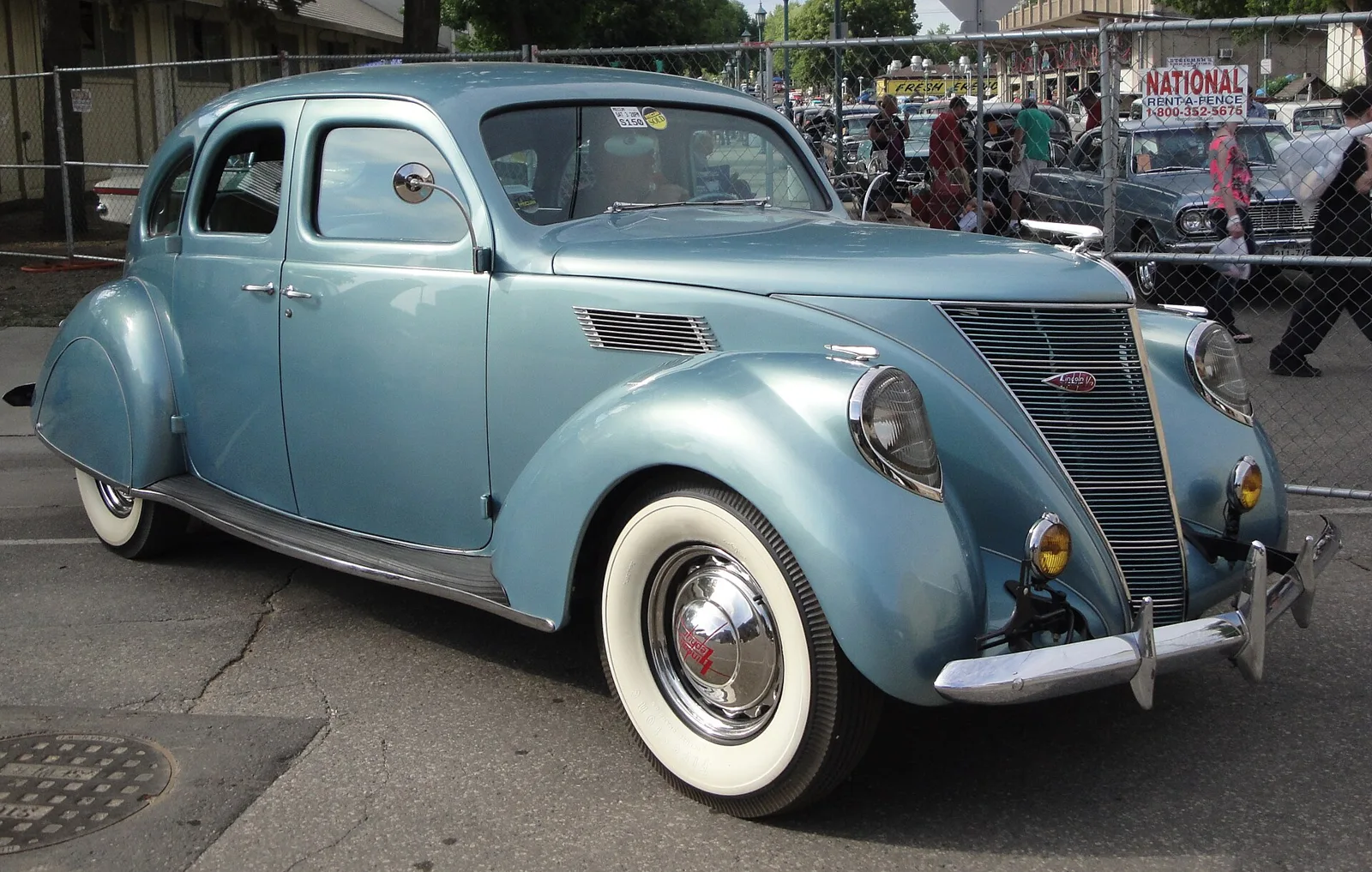
One was a compact V12 that made up 80% of Lincoln's first-year sales; the other was a giant that cost the company over $60 million.
The Lincoln-Zephyr was a streamlined V12 luxury car that Lincoln built from 1936 to 1942 and which rescued its sales. The Lincoln Premiere was a top-trim full-size Lincoln of 1956 to 1960, growing into a giant unibody car whose development losses reached over $60 million.
In its first year the Lincoln-Zephyr sold 15,000 cars, and those cars made up 80% of everything Lincoln sold. Twenty years later Lincoln built the Premiere, a car so wide that its shoulder room is still a company record, and lost over $60 million on the range. Between them, the two cars tell the story of a luxury brand that swung from small and streamlined to vast.
What was the Lincoln-Zephyr?
The Lincoln-Zephyr was a line of luxury cars built by Ford's Lincoln division from 1936 to 1942. It slotted between the Ford V8 DeLuxe and the big Lincoln Model K in size and price, which gave Lincoln a second model line and put it up against the Chrysler Airflow, LaSalle and Packard One-Twenty.
Edsel Ford conceived the car and Eugene Turenne "Bob" Gregorie designed it, and workers in Detroit, Michigan, assembled it at the Lincoln Motor Company Plant. The car is also credited to John Tjaarda, who was fascinated with airplanes. Whichever pencil drew it, the result was a unibody with a drag coefficient of 0.45, light and rigid for its size, at 3,350 lb (1,520 kg).
The streamlined look of 1936
The Lincoln-Zephyr went on sale on 2 November 1935 as a 1936 model, and it looked startlingly modern: a low, raked windscreen, integrated fenders and a streamlined body. The name came from zephyrus, the Greek god of the west wind. It was among the first successful streamlined cars after the Chrysler Airflow met resistance in the market and the Pierce Silver Arrow concept failed to reach production. The Zephyr's drag coefficient was in fact lower than the Airflow's, partly thanks to a prow-like grille that echoed the craze for leisure speedboats such as the Chris-Craft.
The gamble worked. The Zephyr reignited sales in Lincoln showrooms in the late 1930s, and although annual production was never large, it made up a big share of the brand's sales. Buyers chose a two-door or four-door sedan, with export cars built for right-hand drive. The options list was short: an electric clock, leather upholstery and a matched Louis Vuitton luggage set. A two-door cost US$1,275 ($29,582 in 2025 dollars) and a four-door US$1,320 ($30,626 in 2025 dollars).
How the Zephyr range grew
For 1936 a locking glove box was standard and a radio was optional, and the turning radius was 22 feet (6.7 m). The 1937 range renamed the two-door the Coupe-Sedan, and added a three-window Coupe and a formal Town-Limousine. Convertibles, a Coupe and a Sedan, arrived for 1938. By 1940 a Club Coupe had replaced the Coupe-Sedan, the convertible sedan was dropped and there was more trunk space.
The 1940 Lincoln-Zephyr Continental was the first Lincoln to carry the Continental name, as a Zephyr model and not a separate line. Production began on 13 December 1939 with the Cabriolet, joined from June 1940 by a Club Coupe. The cars were partly hand-built because the dies for machine pressing were not made until 1941, and only 350 Cabriolets and 54 Club Coupes were built. The Continental became Lincoln's longest-running nameplate.
The engine and the engineering
While its rivals used V8 or straight-eight engines, the Zephyr had a V12. It was a compact flathead developed from Ford's flathead V8, with no relation to the bigger V12 in the K-series Lincolns. The valve-in-block layout was short enough to allow a low bonnet. The original engine made 110 hp (82 kW) and gave a top speed of 90 mph (145 km/h).
Like the Ford V8s of the time, the Zephyr V12 was prone to hot spots, because exhaust passages ran through the cylinder block, and the earliest cars suffered poor oil pressure that led to a better oil pump. From 1936 to 1939 the V12 displaced 267 cubic inches (4.4 L), gaining hydraulic lifters in 1938. The 1940 and 1941 cars used a larger 292 cubic inches (4.8 L), the 1942 and early 1946 cars a 306 cubic inch (5.0 L) unit with lower compression because of its iron heads, and late 1946 to 1948 Lincolns went back to the 292.
Beneath the modern body, some of the chassis was already old. The suspension used transverse springs front and rear, in the Henry Ford tradition, with a dead front axle and a torque-tube rear, all quite outdated when the car appeared. Brakes were cable-operated until 1938 and hydraulic from 1939. That year the three-speed transmission gained synchromesh, and it was the last year for a floor-mounted shift lever, which moved to the steering column in 1940. The Zephyr was also the first Ford product with an all-steel roof, apart from the late-1931 Model AA truck.
A V12 streamliner that rescued Lincoln, and a unibody giant that cost it over $60 million.
How did the Zephyr become simply a Lincoln?
Gradually, then all at once. The last K-series V12 was delivered on 24 January 1940, and Lincoln Motor Company was about to become Lincoln Division, effective 1 May 1940. For 1941 the Zephyr was no longer a separate marque, and from that model year every Lincoln was Zephyr-based.
A Zephyr-based Lincoln Custom took the place of both the big K-series cars and the Zephyr Town-Limousine, with full instrumentation. The heritage models sold as Lincolns were the Zephyr V-12 for 1941 and 1942 in sedan, coupe, club coupe and convertible, the Custom sedan and limousine, and the Continental cabriolet and coupe, which ran from 1941 to 1948.
In 1942 the government stopped all American car production, and the last Zephyr was built on 10 February. After the war most makers restarted their prewar lines, and Lincoln did too, but without the Zephyr name. The 1946 to 1948 cars were simply Lincolns, known as the H-series and sold by body style: sedan, club coupe or convertible coupe. They looked much like the contemporary Continental and kept the 292 cubic inch 65-degree L-head V12. An electric clock was standard, and the four-door sedan with the Custom interior was listed at US$2,486 ($41,044 in 2025 dollars). The idea of a small luxury car had passed to the newly created Mercury in 1938.
Lincoln returned to the concept several times: the 1950 Lido, the 1977 Versailles, the 1982 Continental and the 2000 LS. The Zephyr name itself came back on a 2006 car, renamed the MKZ for model year 2007.
What was the Lincoln Premiere?
The Lincoln Premiere was a luxury car sold for the 1956 to 1960 model years. It sat below the Continental Mark II in 1956 and 1957 and above the Capri, with which it shared a chassis from 1956 to 1959, and it came as a two-door or four-door seating up to six. For a short time it was the largest, top-level four-door Lincoln, competing with Cadillac, Imperial and Packard.
It was never offered as an extended limousine. For 1958 it shared its chassis and mechanicals with the Continental Mark III to V sedans, until the 1961 Continental sedan replaced it. Lincoln has since revived the Premiere name as a trim level.
The Premiere of 1956 and 1957
The Premiere arrived in 1956 as an upmarket version of the Lincoln Capri. It had a 368 cubic inch (6.0 L) Lincoln Y-Block V8, measured about 223 in (5,700 mm) long and weighed 4,357 pounds (1,976 kg). The base price was $4,601 ($54,486 in 2025 dollars). Ford's separate Continental Motorcars division sold the Continental Mark II, which was far dearer and more conservative in style, while the Premiere took on the Cadillac Series 62, the Imperial Crown Coupe and the Packard Patrician.
To stress Lincoln's exclusivity, buyers could choose from 20 colours, and 34 two-tone exterior combinations for 1956. For 1957 that grew to 76 two-tone options and only 18 single colours. Production in 1956 amounted to 19,619 hardtop coupes, 19,465 four-door sedans and 2,447 convertibles.
The look owed a debt to two radical concept cars, the Mercury XM-800 and the Lincoln Futura, from an age fascinated by the Space Race and mid-century modern architecture. The exterior was stylish and the interior high-grade, and some features were unusual. Optional factory air conditioning ran through overhead ducts, as in an aircraft, with a pair of clear plastic ducts visible through the rear window carrying cool air to the roof. Four-way power seats were standard, and the independent front suspension had a stabilizer bar. For 1957 the driving light moved below the sealed-beam headlight, so the front seemed to have stacked dual headlights, which Lincoln marketed as Quadra-Lite.
The giant of 1958 to 1960
The 1958 to 1960 cars were the first Lincolns made at the new Wixom plant, and the first on a unibody platform since the Lincoln-Zephyr. Advertising claimed Continental was still a separate make, though the body was the same as that year's Lincoln. The Premiere sat in trim level between the Capri and the Continental, with a conventional roof instead of the Continental's reverse-angle power rear breezeway window, which retracted behind the back seat and appeared on the Mercury Turnpike Cruiser as well.
It was gigantic. The Premiere of these years was one of the largest cars ever made, bigger than the contemporary Cadillac Sixty-Special or Imperial Crown, and the longest Lincoln ever built without the 5 mph (8.0 km/h) bumpers later required by federal law. Shoulder room of 63.1 inches (1,603 mm) in front and 63.0 inches (1,600 mm) at the rear set a Lincoln record that still stands. FM radio was a rare option. Canted headlights and heavily scalloped fenders gave it styling regarded as excessive even in a decade full of excess.
The market would not pay for it. Lincoln lost over $60 million ($687,796,209 in 2025 dollars) between 1958 and 1960, a sum that reflects the cost of developing the largest unibody car built to that date and a poor reception. The 1958 full-size Lincoln struggled in every model, helped along by an American recession: just 10,275 were sold, at an average retail price of US$5,483 ($61,186 in 2025 dollars).
The people behind the styling
The excess reflected an abundance of styling talent. George W. Walker, known for the original Ford Thunderbird, was Ford's vice-president in charge of styling. Elwood Engel, who later led the design of the 1961 Lincoln Continental and became chief designer at Chrysler in the 1960s, was a staff stylist with the run of every design studio, and he worked closely with John Najjar on the 1958 car and its 1959 update. Najjar lost his post as Lincoln's chief stylist in 1957, became Engel's executive assistant and helped him develop the 1961 Continental, which won an award for its styling. Najjar later led the Ford Mustang I concept.
Don Delarossa succeeded Najjar as Lincoln's chief stylist and handled the 1960 Continental and Premiere update; he later headed design at Chrysler in the 1980s. Alex Tremulis, a chief stylist at Auburn-Cord-Duesenberg in the mid to late 1930s and the man behind the 1948 Tucker Sedan, ran Ford's Advanced Styling Studio. His La Tosca concept, with an oval crossed by an X, inspired the 1958 Lincoln's front end, and he went on to contribute to Joe Oros' bullet design for the 1961 Thunderbird.
How do the Zephyr and Premiere compare?
| Measure | Lincoln-Zephyr (1936) | Lincoln Premiere (1956) |
|---|---|---|
| Engine | 267 cubic inch (4.4 L) V12 | 368 cubic inch (6.0 L) Y-Block V8 |
| Weight | 3,350 lb (1,520 kg) | 4,357 pounds (1,976 kg) |
| Base price | US$1,275 (two-door sedan) | $4,601 |
| Bodies | Two-door and four-door sedan | Hardtop coupe, four-door sedan, convertible |
| Rivals | Chrysler Airflow, LaSalle, Packard One-Twenty | Cadillac Series 62, Imperial Crown Coupe, Packard Patrician |
Do the Zephyr and Premiere names still exist?
Both names have come back in some form. The Zephyr name returned on the 2006 Lincoln Zephyr, which was renamed the MKZ for model year 2007, and the Premiere name is now a trim level on Lincoln models.