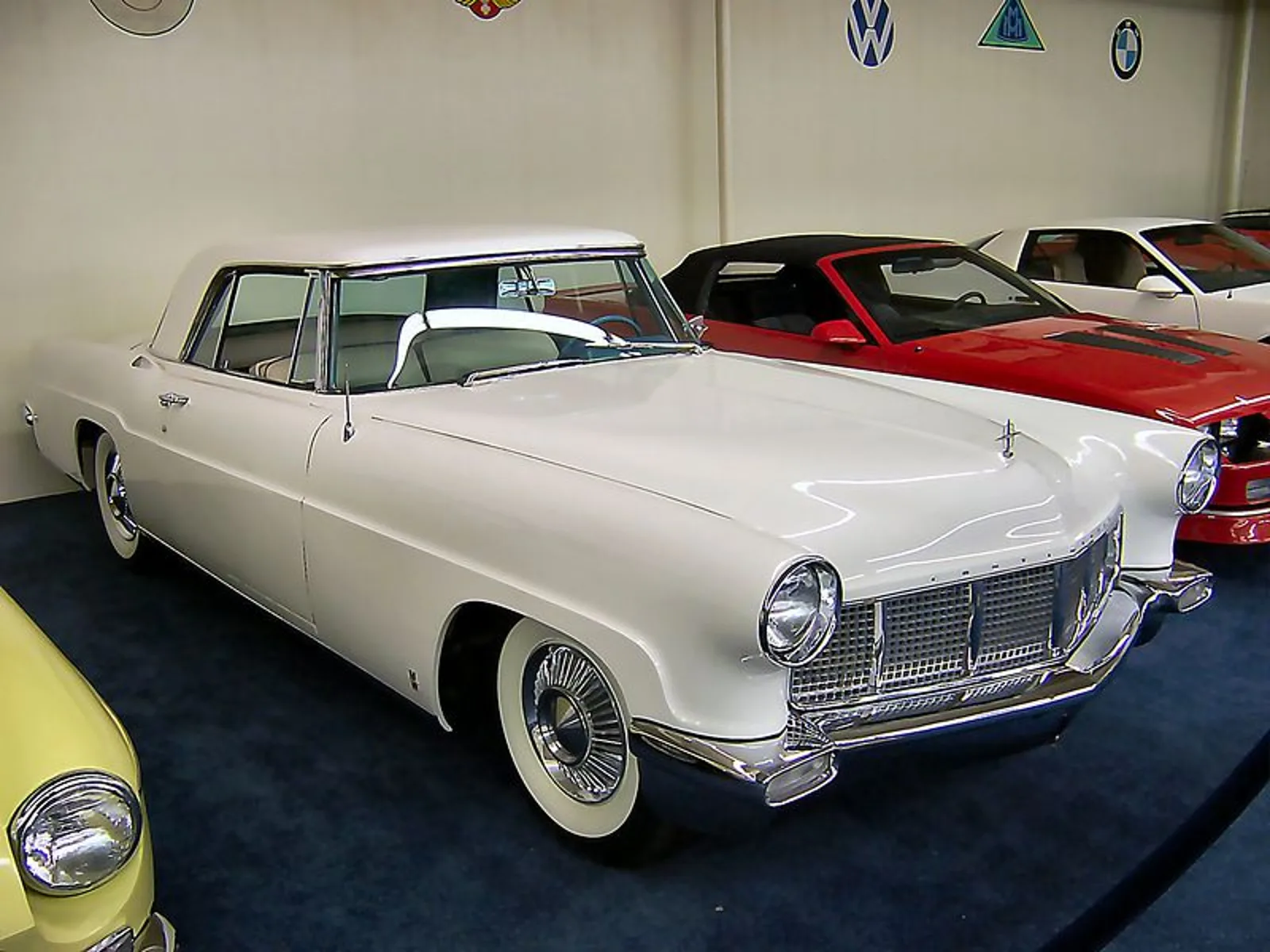
A hand-assembled two-door coupe from Ford's Continental Division, built for the 1956 and 1957 model years and marketed against the Rolls-Royce Silver Cloud.
The Continental Mark II was a hand-assembled Ford coupe sold from 1956 to 1957 and priced above any other American car. It used a Lincoln 368 cubic-inch V8, and the name it gave to the Mark series lasted until the 1998 Lincoln Mark VIII.
The Continental Mark II was an ultra-luxury coupe sold by Ford's Continental Division for the 1956 and 1957 model years. Built as Ford's worldwide flagship, it was hand-assembled in limited numbers, and its name gave the Mark series that ran through the 1998 Lincoln Mark VIII.
Where did the Continental Mark II name come from?
The Mark II succeeded the 1939 to 1948 Lincoln Continental, and its nameplate came from European practice, where a second generation of a model family carried the Roman numeral. Ford later used the same logic for its Mark series of flagship personal luxury cars.
It was the Continental brand's only product line, and it was developed as the worldwide flagship of Ford Motor Company. Rivals in its sights included the Rolls-Royce Silver Cloud and Bentley's Continental.
A hand-built Ford coupe that was too costly to make money on, and which gave the Mark series its name.
What made the Mark II the most expensive American car?
At US$9,966, the Mark II was the priciest American-built car on US roads at the time, roughly the equivalent of US$119,778 in 2025 money. Its only extra-cost option was a US$595 air conditioner, which cost about $7,200 in today's terms.
Ford estimated it lost nearly US$1,000 on every car, about $12,000 in today's money. The company wanted the car to set a standard rather than to earn a profit on each unit.
In 1956 Ford set out four design objectives: distinctive classic styling rather than modernistic innovation, useful technical features for comfort and safety, an overall height of no more than 58 in, and maximum interchangeability with Lincoln parts.
How was the Mark II built?
The Mark II was a two-door hardtop coupe, largely hand-built, with a 368 cubic-inch Lincoln Y-block V8 and a three-speed Turbo-Drive automatic. Engines produced 285 hp in 1956, rising to 300 hp for 1957.
The rear-wheel-drive car used a body-on-frame layout. A Y-shaped frame lowered the body and made room for dual exhausts, with a fully boxed crossmember under the front seats and six tube-style crossmembers elsewhere.
The suspension came largely from Lincoln, but the Mark II added speed-sensitive shock absorbers at the front to improve handling and ride in a car that weighed about 5,000 pounds.
Powertrain parts were taken from Lincoln and inspected under the division's quality-control programme. The engine had finned, cast-aluminium valve covers, and it sat lower than the Lincoln's, so it needed a special oil pan to supply oil on steep grades. A 1956 Popular Mechanics report recorded 16.7 mpg at 50 mph.
What did the body look like?
The Mark II shared a 126-inch wheelbase with the Lincoln line. Compared with the Lincoln Premiere and Capri, it was more than four inches shorter, about two inches narrower, and more than three inches lower. Chrome appeared only on bumpers, the grille, rocker panels and window trim.
There were no tailfins or pontoon fenders. A left taillamp that swung away revealed the fuel filler, and the spare tyre was moved inside the trunk, which created a tyre bulge in the trunklid so it could close.
The wraparound windshield sat 8 inches further back than in a Lincoln. The steering wheel was angled vertically, with a complete instrument set arranged behind it, which set the car apart from Lincoln and Mercury designs of the time.
Standard kit covered power steering and brakes, electric windows and seats, and full instrumentation, including a tachometer. Buyers could choose from nineteen exterior colours and 43 interior schemes with five fabrics, and two-tone paint was not offered.
How was quality controlled?
Ford tried to sell the Continental as America's highest-quality car rather than on style or speed. Each engine was taken from the Lincoln line and then factory-blueprinted, which meant it was disassembled and reassembled after several inspections.
The wheel covers were hand-assembled with individually fastened vanes, and each letter of the word Continental was bolted onto the trunklid by hand. This handwork followed the spirit of the coachbuilt cars of the 1930s.
The interior used Bridge of Weir leather from Scotland, though the hides were later dyed in the United States because Continental judged the result to wear better. The company also used lacquer-based paint, the first Ford-built car to use it, because metallic finishes raised durability concerns.
Ford's Special Products team set out the most stringent quality programme the American industry had seen, with seven major initiatives. It covered everyone at the plant, and a gate guard once had a transporter load of Mark IIs turned back over a single paint defect.
Why is the Continental name so confusing?
Continental had its own plant and operated as a separate division, yet its cars were sold and serviced through Lincoln-Mercury dealers because they shared mechanical parts with Lincolns. Ford folded the division into Lincoln in July 1956.
Who rivalled the Mark II?
General Motors answered the Mark II with the Cadillac Eldorado Brougham, a four-door hardtop costing US$13,074, more than US$3,000 above the Mark II. It took over as the most expensive American car, with coach doors hinged at the rear, a roof of stainless steel and self-levelling air suspension.
A second-generation Brougham ran from 1959 to 1960 at US$13,075, assembled in Italy by Pininfarina. It was more conservatively styled, and it previewed several design features of early 1960s Cadillacs, including smaller tailfins.
Its features included cooled air, automatic high beams and cruise control, and it shared more parts with the standard Eldorado.
What happened after the Mark II ended?
For 1958 the name returned on the Continental Mark III, meant to cut its price to US$6,000 and to compete with the Cadillac Sixty Special and Imperial LeBarons. It was one of the largest cars Ford had built, and it had to leave hand assembly and share the line with the Lincoln Premiere.
The Mark III became the Mark IV in 1959 with minor changes. In 1960 the Lincoln Continental Mark V appeared, and in 1961 Lincoln used a single Continental nameplate for its range.
How did the Mark series return in 1969?
Ford revived the Mark series in 1969 with the Continental Mark III, a much cheaper car than the original Mark II, built on the Thunderbird chassis and wheelbase. The design was treated as the true successor to the Mark II, which took the 1958 to 1960 cars out of the Mark series.
The Mark III had full power equipment, air conditioning, and one of the first optional sunroofs and anti-lock brakes. Its exterior ideas carried into the 1970 Lincoln Continental, and the 1972 Mark IV and 1977 Mark V used the 1972 Thunderbird chassis.
How did the Eldorado rivalry develop?
The Mark series and Cadillac's Eldorado competed directly in the marketplace from the late 1960s until Lincoln withdrew the Mark VIII in 1998, with the exception of the 1980 to 1983 Continental Mark VI. Motor Trend pitted generations of both cars against each other in its King of the Hill feature across the 1970s and early 1980s.
For 1967 GM rebuilt the Eldorado as a personal luxury car on the same front-drive chassis as the Oldsmobile Toronado. After the Mark III arrived in 1969, Ford and General Motors established an informal flagship rivalry, much as the Mustang and Camaro were rivals.
When did the Continental name end?
In 1986 Ford ended the Continental sub-brand, which had been sold through Lincoln-Mercury for 18 years, and the Mark Series became a Lincoln model line. The Mark VII switched to Lincoln badging and a Lincoln VIN.
How was the Mark II made at Allen Park?
The Mark II was produced at the Allen Park Body and Assembly facility in Allen Park, Michigan, which was set up as the Continental headquarters. Breaking with Ford practice, the plant largely did without a moving line for hand-built construction and inspection.
Each vehicle rode on a mobile carrier, and as each stage of assembly and inspection was completed, the car was moved by hand to the next station. After the Mark II ended in 1957 the plant became the headquarters of Edsel, and today the same site is the Ford Pilot Plant, where pre-production vehicles are still hand-assembled for testing.
Ford built 3,005 Continental Mark IIs in total, including three prototypes and 13 pre-production vehicles. Serial numbers ran from 975 to 3989, with numbers 986 to 998 left unused, and the first regular production car was number 1001.
Two 1956 Mark IIs were officially converted to convertibles, though a production convertible never reached the market. One conversion was done by Hess & Eisenhardt, and the other by Derham Body Company, which went to the wife of William Clay Ford.
Many cars went to prominent owners, including Barry Goldwater, Dwight Eisenhower, Frank Sinatra, Elvis Presley and Liz Taylor, each with a documented chassis number.
Where did the Mark II appear on screen?
The Mark II appeared in the 1956 film High Society, which starred Grace Kelly and Bing Crosby alongside a wider cast. The 1955 Lincoln Futura concept used a Mark II chassis and powertrain, and after a sale to George Barris it was turned into the Batmobile for the 1960s TV series.
What is the legacy of the Mark II?
The retractable-hardtop mechanism was never used on the Mark II itself, but it appeared on the 1957 to 1959 Ford Skyliner, and later on the Lincoln Continental and the Thunderbird. The integrated spare-tyre trunklid was also a Mark II first.
The Mark II started the Mark series, which ran through two successors in its model history. The four-point star emblem of Lincoln debuted on the Mark II and has been used on Lincoln vehicles since 1958.
Roughly half of the original 3,000 cars survive in various states of repair, and an active Mark II Forum keeps their history alive.
What are the Continental Mark II specifications?
| Specification | Detail |
|---|---|
| Model years | 1956 and 1957 |
| Engine | 368 cubic-inch Lincoln Y-block V8 |
| Power | 285 hp (1956); 300 hp (1957) |
| Transmission | 3-speed Turbo-Drive automatic |
| Wheelbase | 126 inches, shared with the Lincoln line |
| Height limit (design target) | 58 in |
| Base price | US$9,966 |
| Air conditioning (option) | US$595 |
| Fuel economy (1956 test) | 16.7 mpg at 50 mph |
| Production total | 3,005 cars |
| Eldorado Brougham (rival) | US$13,074 |
| Continental Mark III target price (1958) | US$6,000 |