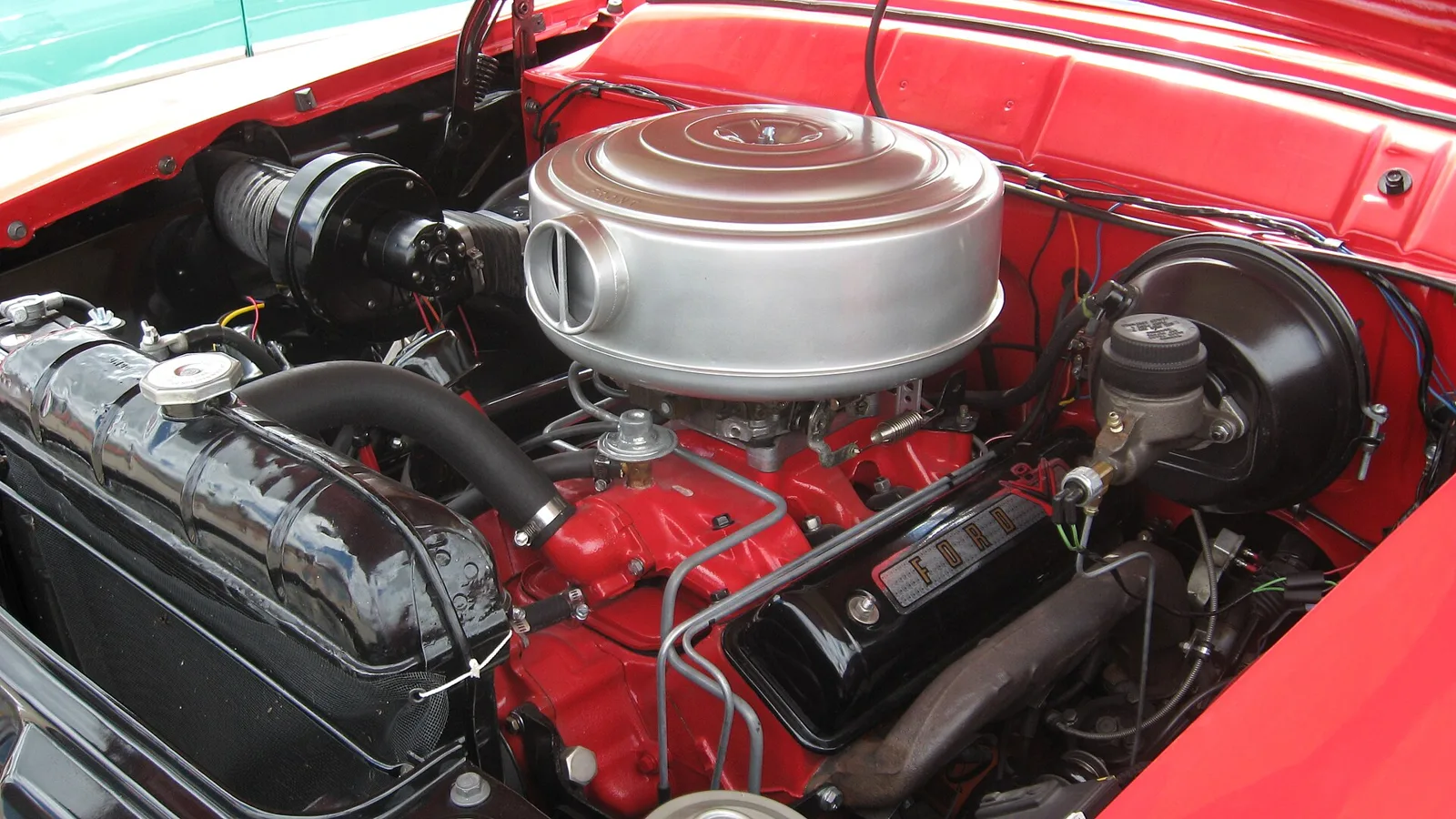
Introduced in 1954 with deep skirting and a Y-shaped block, the Ford Y-block grew from 239 cu in to 312 cu in and ran in cars and trucks until 1964.
The Ford Y-block was a small-block overhead-valve V8 introduced in 1954 to replace the Flathead. Named for its deep skirting, it grew from 239 cu in to 312 cu in and was used in cars and trucks until 1964.
Ford Motor Company built the Y-block as a small-block V8 with overhead valves. It took its name from its deep skirting, which gives the block the shape of a Y. Introduced in 1954 to replace the outdated side-valved Flathead V8, it was used in a variety of Ford vehicles through 1964.
Where did the Y-block come from?
By 1948 the famous Flathead V8 had reached the limit of its development, and by the early 1950s it was antiquated. Ford had been the most conservative of the major automakers, holding on to older designs for longer than General Motors or Chrysler, but market forces pushed it towards new engines in the 1950s.
Ford's management told its engineers to design a replacement with a future in mind. By 1952 Ford had a new 215 cu in (3.5 L) overhead-valve six, and Lincoln had a 317 cu in (5.2 L) overhead-valve V8. The Y-block was designed for a 1953 introduction, but a shortage of nickel caused by the Korean War's needs stopped the company making it in sufficient numbers, and the launch slipped to 1954.
The original Lincoln V8 was also known as a Y-block, but the two designs were unrelated. Lincoln introduced it in 1952 for large cars and Ford heavy-duty trucks, so the two should not be confused.
A deep-skirted overhead-valve V8 that replaced the Flathead, grew from 239 cu in to 312 cu in and gave way to the FE and Windsor families.
How did the Y-block compare with the Flathead?
The 1954 engine measured 239 cu in (3,910 cc), matching the Flathead it succeeded in capacity, but its bore grew while the stroke shortened. It made 130 bhp (97 kW) at 4,200 rpm, while the Flathead's final rating was 110 bhp (82 kW) at 3,800 rpm, an increase of 18 percent.
Torque also rose. The Y-block reached 214 lb-ft (290 N-m) at 1,800 rpm, where the Flathead had managed 196 lb-ft (266 N-m) at 2,000 rpm. The Y-block was widely regarded as a major advance over the older engine.
The 239 appeared in 1954 models with EBU casting numbers, and in late 1954 and 1955 with EBV castings. Its larger siblings, the 272 and 292, arrived in 1955. The 1955 EBV engine shares many parts with those later Y-blocks, while the 1954 EBU unit does not exchange parts with the 1955 engine and later Y-blocks.
What was the Y-block's oiling weakness?
The deep skirting made the block very rigid, which gave the bottom end added strength. The drawback was weight, since the extra metal made the cylinder block heavy.
Ford's first overhead-valve engine fed oil to the rocker arm shafts through a passage from the centre cam bearing. The oils of the period had low detergent content, so those passages often clogged, and the Y-block earned a reputation for poor lubrication at the top end.
Ford's stop-gap was an external tube that fed oil directly from the main oil gallery to the rocker shafts. That kept the top end supplied, although it was a workaround rather than a redesign of the feed.
Why were the Y-block heads called bad breathers?
The intake ports stacked vertically in pairs instead of lying side by side, and they made sharp turns around the head bolts. Enthusiasts therefore called the heads "bad breathers",.
Their flow could indeed be inferior to later designs, but the heads still allowed the engine to rev to 7,000 rpm and beyond.
The engines are easy to identify. The distributor sits at the back of the block, off to one side, and the valve covers are held on by two studs with washers and nuts through their domed tops.
How did the 256 Mercury differ from the 239?
The first Mercury version, a 1954 model, measured 256 cu in (4,194 cc). Mercury called it the V-161, and it used a 3.625 x 3.1 in bore and stroke, a 7.5:1 compression ratio and a Holley model 2140 four-barrel carburettor.
Its rated power was 161 hp (120 kW) at 4,400 rpm, and torque hit 238 lb-ft (323 N-m) at 2,200 rpm. Against the 125 bhp (93 kW) of the Mercury Flathead it replaced, that represented 29 percent more power from a similar capacity.
The 256 was built only for 1954 and was replaced by the 292 in 1955. Some F100 trucks used it in 1955, depending on the production plant, and it was also installed in law enforcement sedans.
What did the 272 bring in 1955?
By 1955 Chevrolet had introduced its own small-block V8 at 265 cu in, and Ford responded by increasing its displacement to 272 cu in (4,465 cc). The 272 used the same bore as the outgoing 256, with a longer 3.3 in stroke, making 3.625 x 3.3 in.
The standard 1955 U-code had a two-barrel Holley carburettor. It was rated at 162 bhp (121 kW) at 4,400 rpm, while torque arrived at 258 lb-ft (350 N-m) by 2,400 rpm. The optional M-code Power Pack used a four-barrel Holley and produced 182 bhp (136 kW) at 4,400 rpm.
In 1956 the U-code was revised to 173 bhp (129 kW) with a manual gearbox, or 176 bhp (131 kW) with an automatic. Torque rose to 260 lb-ft (353 N-m) in the first case and 264 lb-ft (358 N-m) in the second. That year the M-code 272 gave way to a four-barrel M-code 292.
A final 272 in the US arrived in 1957 as the B-code. Its two-barrel Holley delivered 190 bhp (142 kW) at 4,500 rpm, and its torque peaked at 270 lb-ft (366 N-m) at 2,700 rpm.
How did the Y-block travel overseas?
Ford Australia used the V8 as its only engine option in the four-door Customline sedan from 1955 to 1959. That car was based on the Canadian Meteor, and the coupe utility called the Mainline shared its styling. The V8 reached passenger cars in July 1955 and the redesigned trucks a month later.
Ford of Brazil also built the 272 and, from 1956, the 292, at its Sao Paulo plant, the Ipiranga facility. Brazilian President Juscelino Kubitschek opened the new building on November 21, 1958, which produced the first Ford engine built in South America.
The 272 served in Brazilian F-series trucks until 1977, and it powered the Brazilian Galaxie 500, which launched in April 1967.
What was the 292, and where was it used?
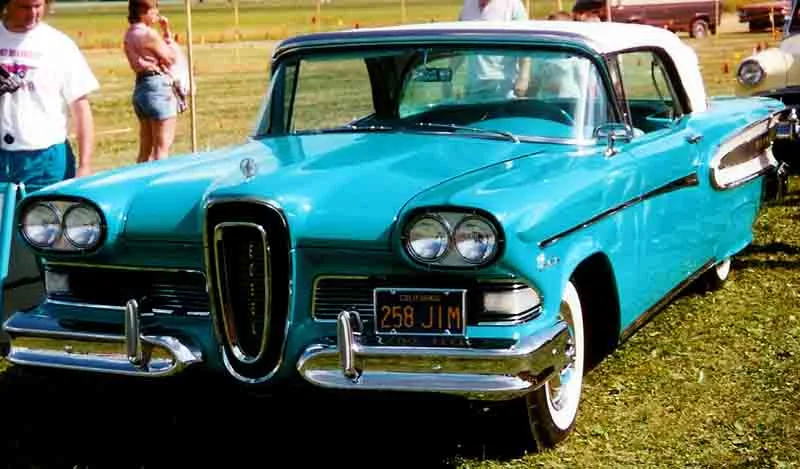
The 292 cu in (4,778 cc) Y-block arrived in 1955 with the 3.3 in (83.82 mm) stroke of the 272, but its 3.75 in (95.25 mm) bore was larger. It went into the Thunderbird, the 1959 to 1960 Edsel, Mercury models and certain upmarket Fords.
The Ford P-code Thunderbird V8 came in two guises. With a manual gearbox it had 8.1:1 compression and 193 bhp (144 kW) at 4,400 rpm, with torque of 280 lb-ft (380 N-m) at 2,600 rpm. Automatic cars ran 8.5:1 and were quoted at 198 bhp (148 kW) at 4,400 rpm, with 286 lb-ft (388 N-m) at 2,500 rpm.
Mercury offered two 292s in 1955. The standard engine ran 7.6:1 and was rated at 188 bhp (140 kW), while the top-of-range Montclair V8 reached 198 bhp (148 kW) at 4,400 rpm and 282 lb-ft (382 N-m) at 2,500 rpm. 1955 was the only year Mercury used the 292, and it was replaced by the larger 312 in 1956.
How did the 312 and the 1956 292 change?
In 1956 Ford replaced the P-code 292 with a fresh 312 cu in (5.1 L) unit, the Thunderbird Special V8, while the M-code 272 gave way to a new M-code 292. The M-code Thunderbird V8 became optional on all Fords.
With a manual gearbox the M-code 292 had 8.0:1 compression and produced 200 bhp (149 kW) at 4,600 rpm. The automatic option ran 8.4:1 and made 202 bhp (151 kW) at 4,600 rpm, while its torque of 289 lb-ft (392 N-m) arrived at 2,600 rpm.
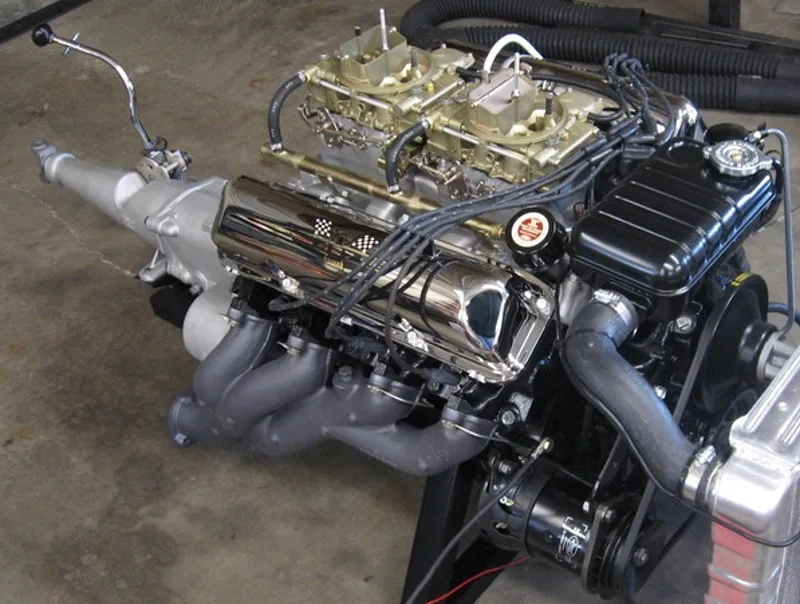
The 312 had a 3.80 x 3.44 in bore and stroke, equal to 96.5 mm by 87.4 mm. It came with a single two- or four-barrel Holley, or with two four-barrel carburettors, and a McCulloch (Paxton) supercharger was offered in 1957 only.
All 1956 Mercury models used the 312 with a four-barrel carburettor. Manual cars had 210 hp (213 PS; 157 kW) at 8.0:1, automatics had 225 hp (228 PS; 168 kW) at 8.4:1, and a later 235 hp (238 PS; 175 kW) version with 9.0:1 compression also appeared.
A dealer-installed M 260 kit, released in January 1956, lifted the 312 to 260 hp (264 PS; 194 kW). The kit combined a sharper camshaft, reworked heads and an intake manifold for two four-barrel carburettors.
The 312 was one of the strongest Y-blocks of its time, but it did not stay that way. Its last regular use in the US was in certain 1960 Mercury models, where it had been downgraded to an economy engine with low compression and a two-barrel carburettor.
How long did the 292 last?
The 292 was the longest-lived Y-block. It carried on until 1962 in US cars and until 1964 in US trucks, and Ford pickups used it as late as 1965.
The 1957 C-code 292 manual had 9.1:1 compression, 206 bhp (154 kW) at 4,500 rpm, while torque was 297 lb-ft (403 N-m) at 2,700 rpm. Its automatic partner was rated at 212 bhp (158 kW) at 4,500 rpm. The 1957 workshop manual gives no separate torque figure for the automatic, which seems unlikely given the power difference.
In Argentina the 292 was used in the F-100 pick-up well into the 1960s, where it was known as Fase I, or Phase I. In 1971 it received a new cylinder head with a different valve arrangement, new manifolds and the Fase II name, and it continued into the 1980s in the F-100.
The Argentine Ford Fairlane, built from 1969 to 1982, used the Fase II engine too. Argentine versions had a cast crankshaft rather than the forged type found in US heavy-duty engines.
In Brazil the 292 powered the LTD from 1969, and both the 272 and 292 were replaced there by the Windsor 302 starting with the 1976 model year.
Why was the Y-block replaced?
Even when it debuted, the Y-block's power was limited by its displacement. Its figures for 1955 to 1957 put Ford's V8s ahead of Chevrolet's, but larger V8s from Cadillac, Chrysler, Buick, Pontiac and Oldsmobile showed that its small-cubic-inch architecture would need revision.
Even with modern rods and stroker cranks, a Y-block tops out at about 348 cu in (5.7 L). Chevrolet's small block could be modified well beyond its factory limit of 400 cu in (6.6 L).
Ford's answer was the 332 cu in "big block" FE engine, introduced in 1958 and later grown to 428 cu in. In 1962 the Windsor engine began at 221 cu in (3.6 L) and replaced the Y-block fully, growing to 351 cu in (5.8 L).
| Version | Year | Displacement | Output | Torque |
|---|---|---|---|---|
| 239 (EBU) | 1954 | 239 cu in (3,910 cc) | 130 bhp (97 kW) at 4,200 rpm | 214 lb-ft (290 N-m) at 1,800 rpm |
| 256 Mercury | 1954 | 256 cu in (4,194 cc) | 161 hp (120 kW) at 4,400 rpm | 238 lb-ft (323 N-m) at 2,200 rpm |
| 272 U-code | 1955 | 272 cu in (4,465 cc) | 162 bhp (121 kW) at 4,400 rpm | 258 lb-ft (350 N-m) at 2,400 rpm |
| 272 B-code | 1957 | 272 cu in (4,465 cc) | 190 bhp (142 kW) at 4,500 rpm | 270 lb-ft (366 N-m) at 2,700 rpm |
| 292 P-code, manual | 1955 | 292 cu in (4,778 cc) | 193 bhp (144 kW) at 4,400 rpm | 280 lb-ft (380 N-m) at 2,600 rpm |
| 292 M-code, manual | 1956 | 292 cu in (4,778 cc) | 200 bhp (149 kW) at 4,600 rpm | 285 lb-ft (386 N-m) at 2,600 rpm |
| 292 C-code, manual | 1957 | 292 cu in (4,778 cc) | 206 bhp (154 kW) at 4,500 rpm | 297 lb-ft (403 N-m) at 2,700 rpm |
| 312 Mercury, 235 hp | 1956 | 312 cu in (5.1 L) | 235 hp (238 PS; 175 kW) | - |
What is the legacy of the Y-block?
As Ford's first overhead-valve engine, the Y-block moved the company away from the Flathead that had served it for years. Its deep skirting and rigid bottom end were its signature, even if the same design made the block heavy.
Its successors followed quickly. The FE and the Windsor families took over the work the Y-block had begun, and the Windsor eventually replaced it fully. The Y-block's limit was the reason the company designed them.
Among enthusiasts the Y-block is remembered for its quirks, including its oiling, its heads and its identifying features.