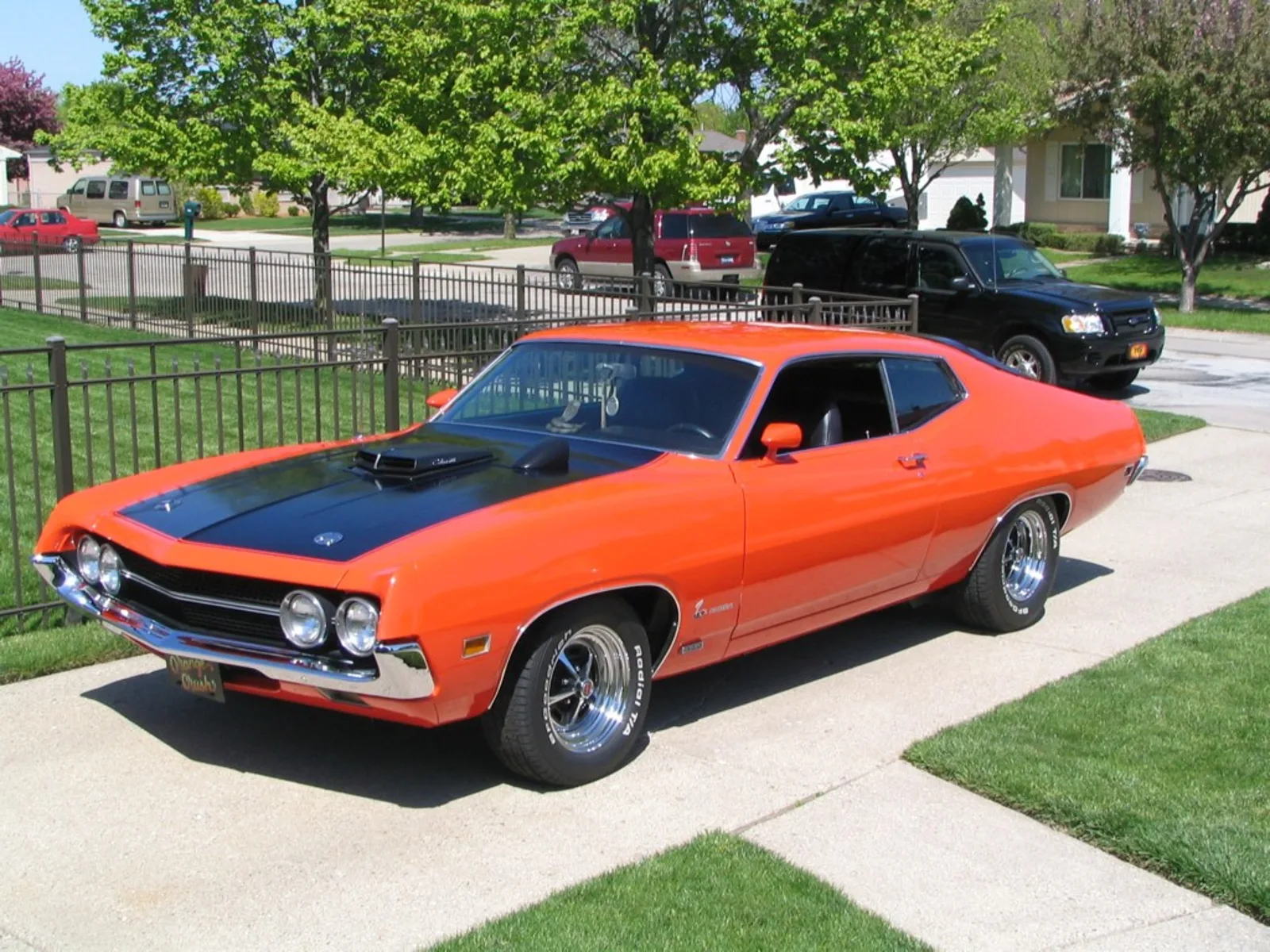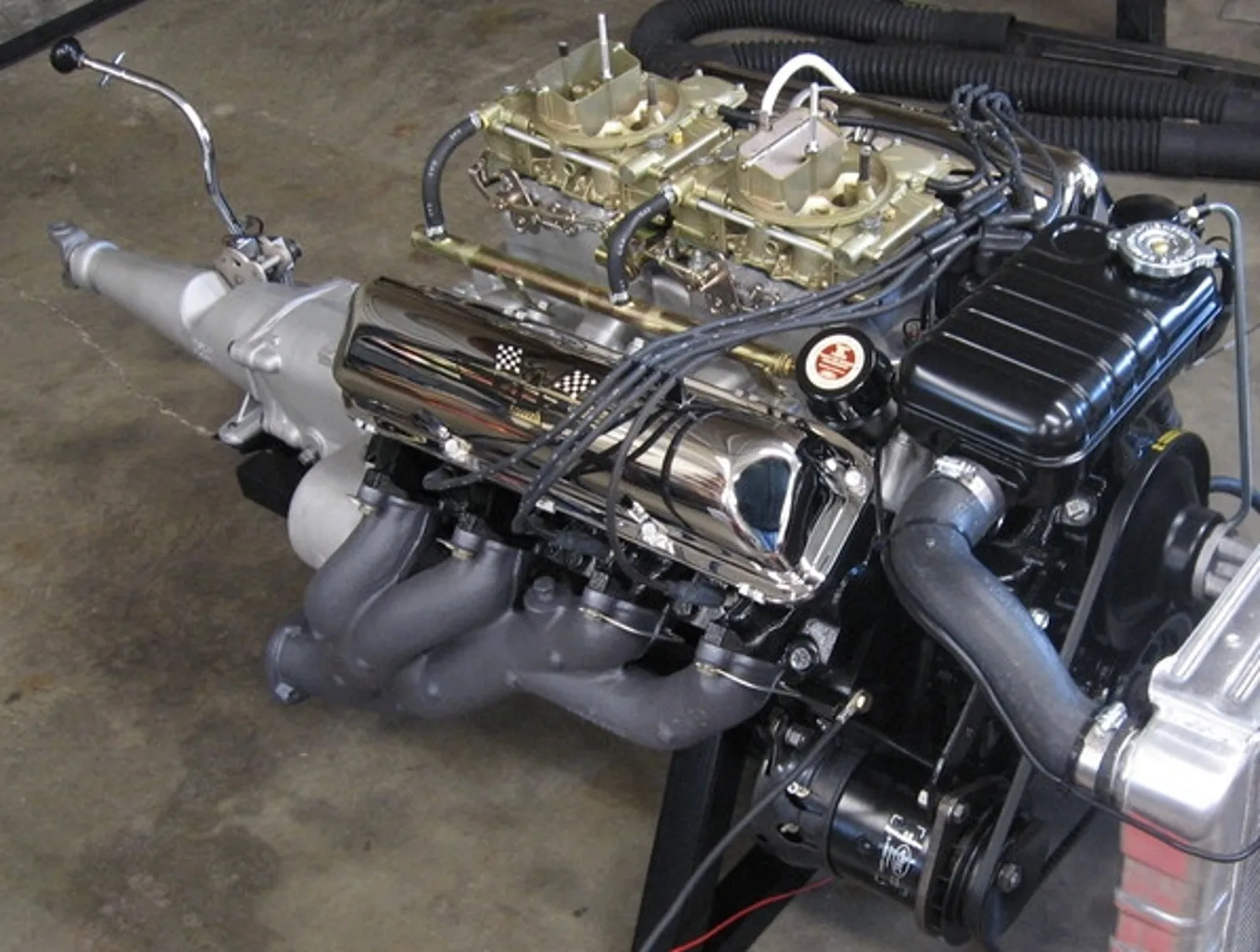
Ford's FE big-block, built from 1958 to 1976 in displacements from 332 to 428 cubic inches, and the racing, drag and road cars that made it famous.
From 1958 to 1976 Ford's FE family covered displacements from 332 to 428 cubic inches. It powered road cars and trucks as well as the racing machines that made the name, from the GT40 at Le Mans to the Cobra Jet drag cars.
The Ford FE was a big-block V8 built by the Ford Motor Company from 1958 to 1976 in displacements from 332 to 428 cubic inches. Its name stood for Ford-Edsel, and it went on to power the GT40 to its famous Le Mans results and the Cobra to a long racing career.
What was the Ford FE?
The FE was a big-block V8 used in vehicles sold in North America between 1958 and 1976. It was produced in several displacements over two generations, as a top-oiler and as a side-oiler, and it was designed with room to expand.
It was introduced only four years after the short-lived Y-block, which had become too small for the cars and trucks that Ford was building. Trucks and school buses also used a heavier version called the FT from 1964 to 1978.
A big-block that started as a Ford-Edsel engine and ended up winning Le Mans and setting drag records.
Where did the FE name and design come from?
The name was derived from Ford-Edsel. Ford engineers designed the block around thin-wall casting, working out how much metal was really needed and then re-engineering the casting process to give consistent dimensions. That mattered for an engine built in large numbers.
The result was light for its size, and the approach aimed at consistent dimensions from one casting to the next. A factory FE with all-iron components weighed 650 lb (295 kg), while comparable 7-litre engines from General Motors and Chrysler weighed more than 700 lb (318 kg). With an aluminium intake and water pump, a racing FE could drop below 600 lb (272 kg).
Competition builds of 406 and 427 cubic inches existed, and the 427 became famous through endurance racing. Its wide range of aftermarket parts later made it popular with tuners.
How was the FE block laid out?
The FE was a Y-block design, in which the casting extends below the crankshaft centreline and supports the main bearings. On the FE that extension reaches 3.625 in (92.1 mm) under the centreline, putting it more than an inch beneath the lowest point of the journals.
Two oiling layouts existed. The top-oiler fed the upper centre of the engine first, while the side-oiler started its oil supply through a lower passage on the side of the block.
All FE and FT engines shared a 4.630 in (117.6 mm) bore spacing and a deck height of 10.170 in (258.3 mm). Main journals measured 69.8 mm (2.749 in) across. Within the Ford engines of the period, the FE was neither the largest nor the smallest block.
Intake options ran through low-riser, mid-riser and high-riser patterns, plus tunnel-port and SOHC designs. The high-rise intake needed a bubble in the hood, and it lifted the carburettor roughly 152 mm (6 in), so the air-fuel mixture followed a straighter path.
What were the first-generation FEs?
The original FE was the 332, measuring 331.8 cu in (5.4 L). Its cylinders were 101.60 mm across, with a 83.82 mm stroke. The 332 powered Ford cars in 1958 and 1959, the Edsel in 1959 and export Edsels in 1958 and 1959, and its four-barrel version reached 265 bhp (197.6 kW).
The 352 arrived in 1958 within Ford's Interceptor range. Its 351.86 cu in (5.77 L) came from an 88.90 mm stroke and a bore of 101.60 mm (4 in), and it replaced the Lincoln Y-block. Output ranged from 208 bhp with a two-barrel carburettor to more than 300 bhp with four barrels.
The 1960 high-performance 352 used an aluminium intake, a Holley 4100 carburettor, cast-iron header-style exhaust manifolds and solid lifters, with a 10.5:1 compression ratio. It was rated at 360 horsepower.
The Edsel 361 was the first FE to be sold in any market, with a 4.0502 in (102.88 mm) bore. Edsel's 1958 range used it as standard equipment: the Ranger, Pacer, Villager, Roundup and Bermuda, where it carried the E400 label.
The 360 truck engine, introduced in 1968, shared the 390 block and was used in Ford F-Series trucks until 1976. At 4100 rpm, the first-year 360 delivered 215 bhp (160.3 kW), with 375 lb ft (508 Nm) of torque at 2600 rpm.
How did the 390 become the most common FE?
With a 102.88 mm bore and 96.14 mm stroke (3.785 in), the 390 displaced 390.04 cu in (6.4 L). The 390 became the most common FE in later applications and was the standard engine in many Ford cars, including the Thunderbird.
The two-barrel gave 265 bhp (197.6 kW) at 4100 rpm, and the four-barrel reached 320 bhp (238.6 kW). Certain 1967 and 1968 Mustangs had 4V engines rated at 335 horsepower.
A 1961 high-performance 390 had an aluminium four-barrel intake and solid lifters, and many of those cars came with a dealer-fitted intake in the trunk that raised output to 401 horsepower.
What did the 406, 410 and 427 bring?
The 406 arrived in 1962 and lasted to 1963, when it gave way to the 427. Its bore grew to 104.90 mm (4.13 in) while the stroke stayed at the 390's figure, giving 405.7 cu in (6.6 L). Testing led to cross-bolted main caps, with bolts entering from the sides as well as from below.
The 410 was used in 1966 and 1967 Mercurys. It combined the 390's bore with the 428's stroke, giving 410.1 cu in (6.7 L), and it used the standard 428 crankshaft with external balancing.
The 427 appeared in 1963 as a top-oiler and changed to a side-oiler in 1965. Measured accurately, the displacement came to 425.98 cu in (6,981 cc), built on a 96.14 mm stroke and a 107.49 mm bore (4.232 in). The block was cast iron with a thickened deck, and its cylinders were cast using cloverleaf moulds.
The 427 was produced in low-rise, medium-rise and high-rise forms, with single or double four-barrel carburettors. Its best-known road-going application was in the Shelby Cobra, and the side-oiler version was the one used in the GT40 Mk II cars at Le Mans.
What was the SOHC Cammer?
The 427 single overhead cam engine, known as the Cammer, arrived in 1964. It was built to counter the Chrysler 426 Hemi, and the FE block's bore spacing was closer to the smaller Chrysler 392 than to the 426. The engine used an idler shaft in place of the camshaft and a serpentine chain that drove both overhead camshafts.
With a single four-barrel carburettor the Cammer weighed 680 lb (308 kg) and was rated at 616 horsepower at 7,000 rpm. With dual four-barrels it made 657 horsepower at 7,500 rpm, and Ford sold the engines through its parts counter at a price of $2350.00 in October 1968.
The engine was banned from NASCAR and USAC stock car events on 17 December 1965, because it was not sold in a production car. It found its niche in drag racing, powering altered-wheelbase Mustangs and Top Fuel dragsters, and a Shelby Super Snake, using a supercharged SOHC 427, became the first NHRA entry to dip under six seconds in the quarter mile.
How did the 428 Cobra Jet develop?
For 1966 Ford combined the 4.13 in bore with a 3.98 in stroke to create the 428 cu in (7.0 L) engine, which relied on a nodular-iron crank cast from one piece and an external balancer. The Q-code 428 produced 345 horsepower and was standard in full-size Fords.
The 428 Cobra Jet was launched in April 1968. It used a 735 CFM Holley carburettor, heavier connecting rods and a nodular-iron crank casting, and it was rated at 335 bhp (250 kW) at 5200 rpm, while 440 lb ft (597 Nm) of torque arrived at 3400 rpm. Real-world figures suggest about 275 SAE net horsepower, and quarter miles from the low 14s to the very high 13s.
Drivers sponsored by Ford debuted the Cobra Jet at the 1968 NHRA Winternationals, where Al Joniec took the Super Stock Eliminator title. The Super Cobra Jet followed with a stronger crank and rods, and its Drag Pack began in November 1968.
Where did the FE race?
The FE dominated NASCAR in 1963. Factory 427 Galaxies took the first five places in the Daytona 500, and Ford won 23 races in 1963 to Plymouth's 19. In 1964 Ford totalled 35 wins with the 427, and Fred Lorenzen beat Dodge and Plymouth cars using the Hemi in six of seven races.
In 1965 NASCAR banned the high-riser intake, and Ford responded with the medium-riser head that fitted under stock hoods. Ned Jarrett won the 1965 Grand National championship, and Ford won the NASCAR crown that year.
The FE also powered the GT40 Mk II to a one-two-three result at Le Mans in 1966. The Shelby Cobra used the 427 side-oiler, and Cobra Mark III production started on 1 January 1965. Parnelli Jones won the 1967 Riverside 500 in a Holman-Moody Fairlane, and Mario Andretti won the Daytona 500 in a Fairlane that year.
In drag racing, the FE was a major venue. Ford made lightweight Galaxies from 1962 to 1964 and prepared ten 427 Mustangs for the 1965 season, and the 1964 Thunderbolt was a factory drag car with a bubble hood and air inlets for two four-barrel carburettors.
Where else was the FE used?
Beyond passenger cars, the FE found homes in trucks, buses and boats, and it also drove industrial pumps and generators. Ford produced it from 1958 to 1976, and aftermarket support continued long after production ended. Its uses were varied enough that the engine appeared in very different settings, from race tracks to working machinery.
The British land speed record for the flying kilometre, 207.6 mph (334.1 km/h), was set in 1970 by an FE-powered car, and it stood for more than 30 years. Custom builders used FEs too, and George Barris's Batmobiles for the 1966 television series ran them.
Marine use included Century boats with V-drive FEs, and from 1968 twin 427s powered the US Navy SEALs' Light SEAL Support Craft.
What replaced the FE?
By the mid-1970s Ford had developed the 335 and 385 series to take over from the FE. They covered sizes from 351 cu in (5.8 L) to 460 cu in (7.5 L), and a 429 cu in (7.0 L) version was among them. The final FE went into a production car in 1976.
The Dearborn plant that built the FE was retooled in the late 1970s for the 1.6-litre engine that arrived with the Ford Escort in 1981.
What were the main FE specifications?
| Version | Displacement | Bore and stroke | Output |
|---|---|---|---|
| 332 (1958) | 331.8 cu in (5.4 L) | 4.0 in bore, 3.3 in stroke | 265 bhp (197.6 kW), four-barrel |
| 352 (1958) | 351.86 cu in (5.77 L) | 4 in bore, 3.5 in stroke | 208 to 300 bhp |
| 390 (1961) | 390.04 cu in (6.4 L) | 4.0502 in bore, 3.785 in stroke | 265 to 320 bhp |
| 406 (1962) | 405.7 cu in (6.6 L) | 4.13 in bore, 3.785 in stroke | 385 hp (287 kW) at 5800 rpm |
| 427 (1963) | 425.98 cu in (6,981 cc) | 4.232 in bore, 3.785 in stroke | 410 hp (310 kW) at 5600 rpm |
| 428 Cobra Jet (1968) | 428 cu in (7.0 L) | 4.13 in bore, 3.98 in stroke | 335 bhp (250 kW) at 5200 rpm |
| Cammer (1964) | 427 cu in SOHC | Not recorded | 616 hp (459 kW) at 7000 rpm |