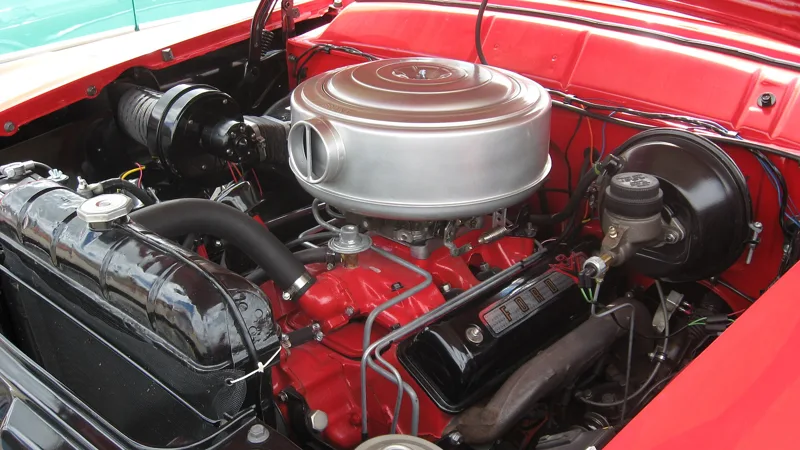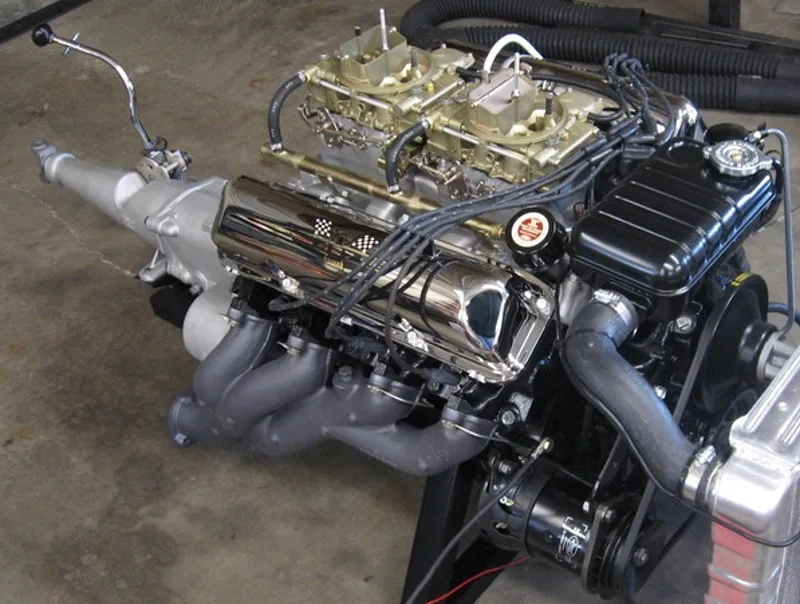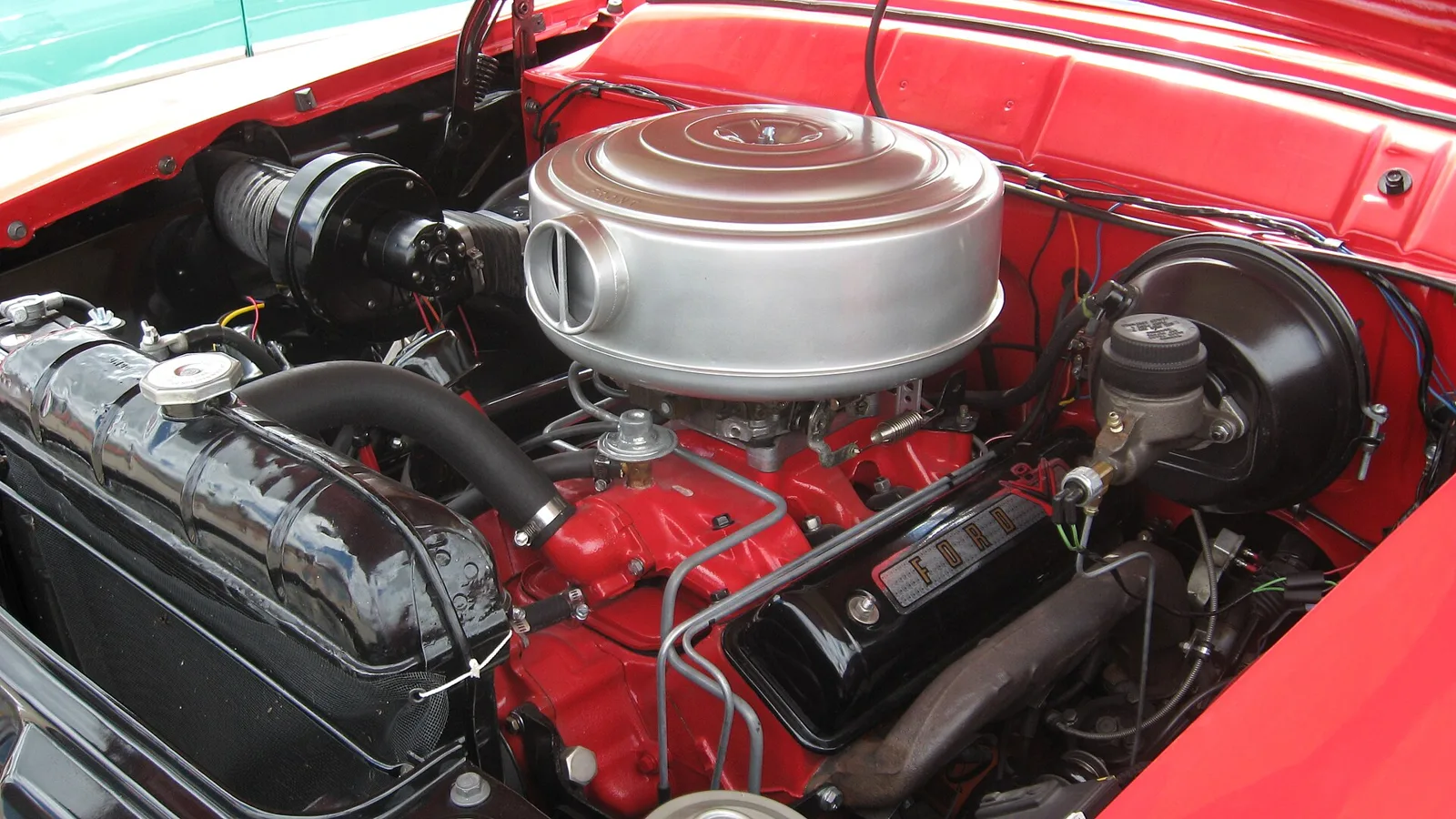
A pushrod big-block family built from 1968 to 1998, spanning the 370, 429 and 460, from Thunderbirds and Boss 429 Mustangs to F-Series trucks.
The Ford 385 engine was a big-block overhead-valve V8 family built from 1968 to 1998. It came in 370, 429 and 460 cubic-inch sizes and powered cars, muscle cars and heavy trucks.
The Ford 385 engine family was a series of big-block overhead-valve V8 engines designed and built by Ford Motor Company. Introduced in 1968, it served in cars until 1978 and in trucks until 1998, and it was the last big-block V8 that Ford designed in the 20th century.
Where did the 385 name come from?
Its name comes from the stroke of the 460: 3.85 inches, or 98 mm, on the V8 Ford launched in 1968. A 429 cubic-inch (7.0 L) version appeared the same year, and a 370 cubic-inch (6.1 L) variant followed in 1977.
The 385 engines replaced the MEL entirely, and they also took over from several medium-block FE engines.
Production took place at the Lima engine plant in Ohio. The family was the final big-block V8 that Ford designed and built during the 20th century, and that status gives it a distinct place in the company's history.
A pushrod big-block family that spanned Thunderbirds, Boss 429 Mustangs and F-Series trucks until 1998.
Which Ford models used the 385 family?
Across all three Ford divisions the engines appeared in big sedans, mid-size cars, luxury models, pony cars and muscle cars. The family covered a wide span of the American car lineup in its three decades of production.
In trucks, the 385 family took the place of the far bigger Super Duty family. It went into full-size trucks and vans, as well as medium-duty and heavy-duty trucks, which is where it lasted longest.
The engine was last used in intermediate cars in 1976. Ford phased it out of all its cars after 1978, as the full-size cars underwent downsizing, and in truck use it was later joined by diesel engines.
How did the 385 engines differ from their predecessors?
The engines were built in 370, 429 and 460 cubic-inch sizes, equal to 6.1 L, 7.0 L and 7.5 L. To reduce weight over earlier designs, they used thinwall casting methods and a skirtless block.
The engines are overhead-valve designs with two valves per cylinder. The "460-4V" label refers to venturi capacity in the carburettor rather than to a four-valve head.
What was the 370 engine?
The 370 was the smallest engine in the 385 family. It was introduced after the 429 and 460, replacing the 361 cubic-inch 360 Truck V8 in 1977. It shared its 3.59-inch stroke with the 429 but used a downsized 4.05-inch bore, the same bore as the earlier 390 V8 it followed.
In 1979 Ford switched the name to metric, making it the 6.1 L. The 370 was discontinued after 1991 production, with the 429 taking over its truck applications.
The 370 went into medium-duty F-Series trucks from 1977 to 1991, the B-Series from 1977 to 1989, and the C-Series from 1979 to 1987. The L-Series Louisville Line also used it from 1977 to 1985.
How did the 429 come about?
The 429 was introduced in 1968 alongside the 460, and the two engines were developed together to replace the three largest FE-series V8s, the 390, 427 and 428. Those earlier wedge-head engines shared a 4.36-inch bore, and the 429 was destroked to a 3.59-inch stroke.
The 429 first appeared in the Ford Thunderbird, so Thunderbird buyers had it a year before other Ford and Mercury models. From there it reached pony cars, intermediates and full-size models in both divisions.
It was replaced in Ford and Lincoln-Mercury cars in 1974 by the 460, and after the 1973 model year it was available only in medium-duty Ford trucks. In 1979 it was marketed in metric as the 7.0 L V8.
The 7.0 L first replaced the 401 Super Duty V8, and for 1982 it took over from the 477 and 534 Super Duty engines. After 1991 the 429 became the sole gasoline engine in medium and larger Ford trucks, while the 460 was limited to trucks with a payload under one and a half tons.
What were the Cobra Jet and Super Cobra Jet engines?
Between 1969 and 1971 Ford built two hot street versions of the wedge-head 429. The Cobra Jet and the Super Cobra Jet were higher-rated street versions of the engine, and each carried its own carburettor and camshaft choices.
The Cobra Jet, coded 429CJ, used a Rochester Quadrajet 715 cubic-feet-per-minute spreadbore four-barrel carburettor. Its special cylinder heads and canted valves produced an 11.3:1 compression ratio and 370 hp. Rear-axle ratios were 3.25:1, or 3.50:1 for Ram Air cars with a shaker hood scoop.
Its heads, coded DOOE-R, carried a 73.5 cc combustion chamber and canted valves, with pushrod guide plates. The intake valves measured 2.24 and the exhaust valves 1.74, and the engine ran non-adjustable hydraulic lifters.
The Super Cobra Jet, coded 429SCJ, used a Holley 780 cubic-feet-per-minute square-bore carburettor, a larger mechanical camshaft, forged pistons and forged rods. Output rose to 375 hp and 450 lb-ft of torque, and rear-axle ratios of 3.91:1 or 4.30:1 were offered.
The Cobra Jet also gained a four-bolt main block in 1971.
What was the Boss 429 engine?
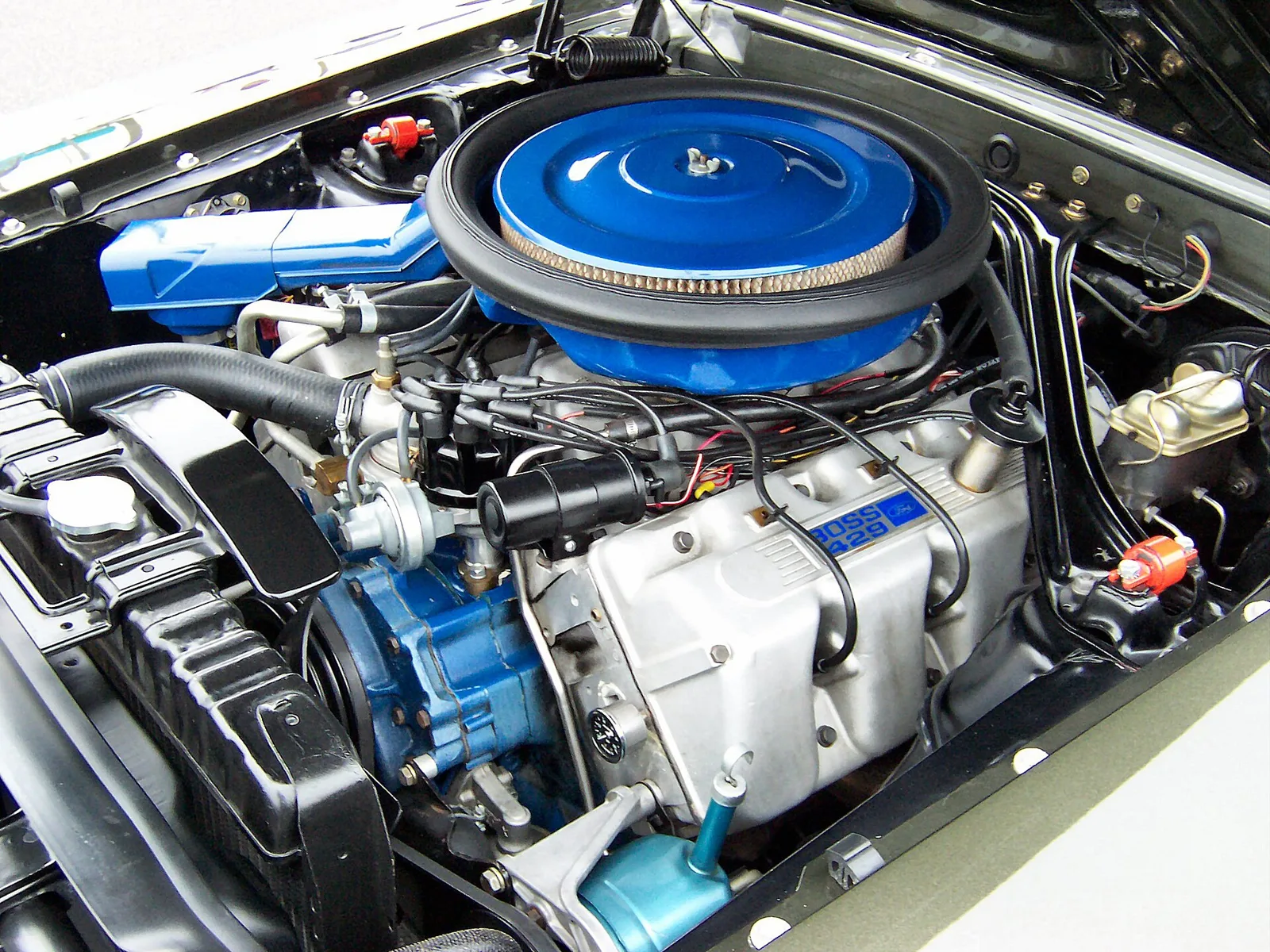
Built for NASCAR, the race-bred semi-hemi 429 was homologated in the Boss 429 Mustang. It was very different from the standard 429 and distinct from the two Cobra Jet versions.
Ford designed it to compete with the Chrysler 426 Hemi, then the most powerful street V8. It had aluminium heads and intake manifold, a stiffened block and internals upgraded for racing.
The Boss 429 Mustang and the Mercury Cyclone Spoiler II were its only street applications. It raced in NASCAR in several Ford and Mercury cars, and it took 26 winner's trophies in 1969 before factory support was curtailed.
How did the 460 develop?
The largest 385 engine was the 460, which succeeded the 462 MEL V8 and the 390 FE/FT V8. It shared the 4.36-inch bore of the 429 but had a 3.85-inch stroke. It first appeared in the 1968 Continental Mark III, and it was exclusive to Lincoln until 1971.
From 1972 the 460 entered the Thunderbird, Mercury Marquis and Colony Park. In 1973 it joined full-size Ford cars, the intermediates and F-Series trucks, and from 1975 it was offered on Econoline vans.
Ratings fell sharply in the 1970s. The 460 carried a 365 gross hp rating between 1968 and 1971. The 1972 switch to SAE net horsepower, with its real-world accessory and exhaust losses, lowered every engine's figures. A cut to 8.5:1 compression, along with camshaft changes for emissions rules, brought the output down to 212 hp (158 kW), and it dropped to 197 hp (147 kW) by 1977.
Fuel economy rules shaped the engine's later life. The 400 V8 became standard, while the 460 became an option, and it was removed from intermediate cars after 1976. Full-size Ford and Lincoln-Mercury models, the Continental Mark V among them, last used it in 1978.
What did the 460 do in its later years?
Between 1980 and 1982, the Econoline 350 van was the only home for the 460, while the 400 was the biggest engine in F-Series trucks. It returned to the F-Series in 1983, replacing the 400.
Fuel injection arrived in 1988, when power rose to 235 hp (175 kW) at 4100 rpm, and torque reached 395 lb-ft (536 N-m) at 2200 rpm. The engine was then marketed in metric as the 7.5 L.
Minor ECU and compression changes in 1994 added 10 hp and 15 lb-ft for the final three years of production. Those last models produced 245 hp (183 kW) at 4100 rpm and 410 lb-ft (556 N-m) at 2200 rpm.
The 460 went into chassis-cab F-Series trucks and cutaway E-Series vans, and into recreational vehicles and buses. Ford Motorsports sold it as a crate engine until 1997, when the 6.8 L V10 took over.
Which police versions of the 460 existed?
From 1973 to 1978 Ford offered two police engines based on the 460. The Police Cruiser was rated at 210 hp, and it was identified by engine code "A" in the vehicle's VIN and on the valve cover sticker. The Police Interceptor was designated "C".
The cruiser suited city and suburban use, while the Police Interceptor was built for highway patrol. It had a higher-lift camshaft, better-flowing heads, a special balanced crank, forged aluminium pistons and a low-restriction dual exhaust.
A high-flow electric fuel pump replaced the stock vacuum unit, because the stock pump would starve the engine above 100 mph (160 km/h). The Interceptor could exceed 133 mph (214 km/h) in certain vehicles.
What are the main specifications of the 385 family?
| Engine | Displacement | Bore and stroke | Notable output | Years |
|---|---|---|---|---|
| 370 | 6.1 L (370 cu in) | 4.05 in x 3.59 in | - | 1977-1991 |
| 429 | 7.0 L (429 cu in) | 4.360 in x 3.59 in | 370 hp in Cobra Jet form | 1968-1998 |
| 460 | 7.5 L (460 cu in) | 4.360 in x 3.85 in | 245 hp (183 kW) at 4100 rpm | 1968-1997 |
The 429 carries the performance reputation through the Cobra Jet and Boss versions, while the 370 stayed in the truck ranges.
Bore spacing across the family was 4.9 in (120 mm), and rods measured 6.605 in (167.8 mm) long. Early blocks had a deck height of 10.3 or 10.31 in (261.6 or 261.9 mm), while late D9TE blocks measured 10.322 in (262.2 mm).
Combustion chamber sizes varied by head. ThunderJet and passenger heads had the smaller chambers, while 429 Police Interceptor heads measured about 99 to 100 cc.
How did the 385 family end, and what came next?
In 1997 Ford introduced the Triton V10, an overhead-cam engine that replaced the 385 after the 1998 model year. It was the end of the pushrod big-block line that had run since 1968.
The next overhead-valve big-block V8 from Ford was the 7.3 L "Godzilla" V8, introduced for 2020. That engine marked a return to the pushrod layout, more than two decades after the 385 family ended.
Crate engines carried the name on. A 514 cubic-inch engine from Ford SVO was available from the mid-1990s until 2006, and a 572 cubic-inch engine introduced in 2016 remains in production. The 572 has a 4.5-inch bore and a 4.5-inch stroke.