How a family of overhead-cam V8s and V10s, born from a 1980s clean-sheet brief, powered everything from Lincoln Town Cars to the Shelby GT350.
The Ford Modular engine is an overhead-cam V8 and V10 family introduced in 1990 for the 1991 model year. The name describes shared tooling and casting stations, not a common design. It powered Ford, Lincoln and Mercury models for over three decades, evolving into the Coyote, Voodoo and Miami.
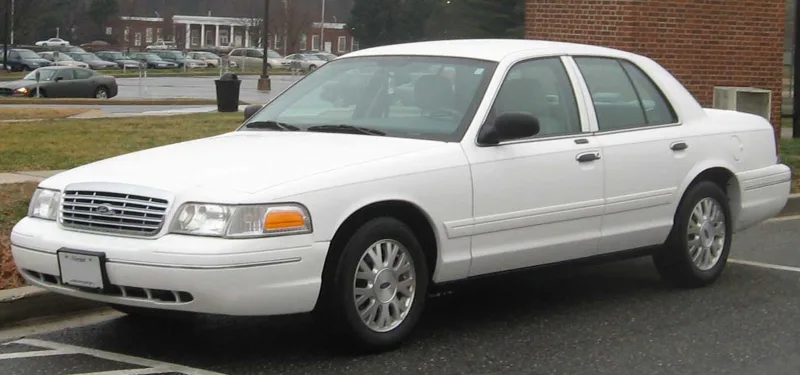
Ford's Modular family is a line of overhead-cam V8 and V10 small-block engines that arrived in 1990 for the 1991 model year. The first car to use one was the 1991 Lincoln Town Car, and the architecture eventually grew into the Coyote, Voodoo and supercharged Miami.
Why is it called Modular if the engines are not identical?
The word Modular describes the tooling and casting stations, not the engines themselves. Ford designed the family so different cylinder counts and head designs could move down shared production lines, which is why a 4.6 L two-valve and a 5.2 L flat-plane Voodoo can trace a common ancestry.
That distinction matters because enthusiasts often assume every Modular engine shares the same internals. They do not. What they share is a manufacturing philosophy, a common bore spacing of 3.937 in (100 mm), and a habit of appearing in almost every rear-drive Ford of the following three decades.
The Voodoo is the most exotic road-going Modular, a flat-plane 5.2 L V8 that revs to 8250 rpm.
The 1980s brief: power density and 100,000 miles
By the mid-1980s Ford knew its pushrod small block was running out of headroom. Donald Petersen challenged design chief Jack Telnack to push for new shapes, while engineer Jim Clarke was handed the task of developing a V8 that would surpass every earlier Ford V8. His team studied European and Japanese overhead-cam designs, then set a target that sounded almost radical at the time: a power-dense engine that needed no major service before 100,000 miles.
Getting there was not cheap. By 1987 Ford had invested $4 billion in design work and retooling, a figure that explains why the Modular programme was treated as a clean-sheet replacement rather than an update. The 4.6 L V8 that emerged was lighter and more powerful than the 5.0 L OHV engine it replaced, and the 1991 Town Car accelerated from 0 to 60 mph 1.5 seconds faster than the car before it.
How the Modular V8 is built
At its core the Modular is a 90-degree vee with a bore and stroke of 3.552 in x 3.543 in (90.2 mm x 90.0 mm). That near-square ratio was chosen deliberately to calm noise, vibration and harshness. The block is deep-skirted cast iron with cross-bolted main bearings, while the heads are aluminium alloy as standard. Accessories bolt directly to the block, which removes a whole layer of mounting brackets.
Camshafts are chain-driven, single overhead cam with roller finger followers in the earliest form. Tight tolerances allowed narrow piston rings, which reduced friction. The 4.6 L runs a deck height of 8.937 in and a rod length of 5.933 in, giving a rod-to-stroke ratio of 1.67:1. Firing order is 1-3-7-2-6-5-4-8, with the later Coyote and Voodoo engines switching to a different sequence.
What are the main Modular engine variants?
The family splits into the 4.6 L, the 5.0 L Coyote, the 5.2 L Voodoo and the supercharged Miami. The 4.6 L came in two-valve, three-valve and four-valve forms, while the Coyote has evolved through four generations with increasingly aggressive outputs.
| Variant | Displacement | Output | Notable application |
|---|---|---|---|
| Boss 302 | 5.0 L | 444 hp, 380 lb-ft | 2012 Mustang |
| Gen 3 Coyote | 5,035 cc | 460 hp, 420 lb-ft | 2018 Mustang GT |
| Gen 4 Coyote | 5.0 L | 480 hp, 415 lb-ft | 2024 Mustang GT |
| Voodoo | 5,163 cc | 526 hp at 7500 rpm, 429 lb-ft at 4750 rpm | Shelby GT350 |
Four-valve heads arrived in 1993 on the Lincoln Mark VIII. Between 1993 and 1998 those heads used split ports and a variable runner length intake; from 1999 they switched to tumble-style ports and a fixed runner design. Most four-valve blocks are aluminium, but the 2003 to 2004 SVT Cobra used cast iron. Aluminium blocks built in 1999 and earlier were cast in Italy by Teksid, and SVT Cobra four-valve engines were hand-built at the Romeo plant from 1996.
How did the Coyote change the Modular formula?
The Coyote brought the Modular into the modern era when it appeared in the 2011 Mustang GT. Its 4,951 cc displacement, 92.2 mm bore and 92.7 mm stroke gave a rod-to-stroke ratio of 1.62:1, and it revived the 5.0 designation for the first time since the pushrod engine retired. Compression sits at 11.0:1, yet it runs happily on 87 octane fuel.
Its cylinder heads use outboard camshafts and remote hydraulic lash adjusters. The intake port flows 4 percent more than the Ford GT's, which is a striking figure for a mass-production engine. Redline is 7000 rpm, and cam timing is handled by Twin Independent Variable Cam Timing. The block is reinforced with extra webbing rather than thicker walls, and the alternator moved to the side to clear the low intake plenum. Assembly happens at the Essex Engine Plant, and the Coyote shares its bore spacing, deck height and bell housing pattern with the 4.6 L.
Boss 302 and the Road Runner
The 2012 Boss 302 took a different route. Its CNC-ported 356 aluminium heads carry sodium-filled exhaust valves, and the bottom end uses forged pistons and powdered metal rods without piston-cooling jets. A high-mount intake plenum with shorter runners helps it breathe, pushing the redline to 7500 rpm and keeping it stable to 8400. Output is 444 hp and 380 lb-ft.
Gen 3 and Gen 4 Coyote
The 2018 update added direct and port injection and grew the bore to 93 mm, for 5,035 cc. In standard form it makes 460 hp and 420 lb-ft, while Bullitt and Mach 1 versions reach 480 hp and 420 lb-ft. The Gen 4 Coyote in the 2024 Mustang uses dual throttle bodies: the GT makes 480 hp and 415 lb-ft, rising to 486 hp and 418 lb-ft with Active Performance Exhaust, and the Dark Horse tops the range at 500 hp and 418 lb-ft.
Which trucks and Lincolns used the Modular V8?
Ford badged its truck Modular engines as Triton between 1997 and 2010, while Lincoln and Mercury used the InTech name for four-valve DOHC versions after 1995. The F-150 5.0 is deliberately torque-biased with lower compression: 360 hp at 5500 rpm and 380 lb-ft at 4250 rpm in its first form, then 385 hp at 5750 rpm and 387 lb-ft at 3850 rpm for 2015, and 395 hp at 5750 rpm with 400 lb-ft at 4500 rpm from 2018.
Where was the Modular engine built?
Romeo Engine Plant in Michigan was the primary home, with additional capacity at Windsor Engine Plant in Ontario. Essex Engine Plant, also in Windsor, Ontario, assembles the Coyote. The final 4.6 L engine was built in May 2014 for the E-Series van, closing a production run that started in 1991.
What about the V10, the Miami and the Voodoo?
The Modular family was never only a V8. The architecture supported V10 versions, and six-cylinder derivatives were explored but never built. The supercharged 5.0 L Miami was developed by Ford Performance Vehicles for the Australian Falcon GT and FGX XR8, with outputs of 422 hp and 402 lb-ft, 449 hp and 420 lb-ft, 463 hp and 471 hp, and ultimately 648 hp in the Premcar Holy Grail.
Among road-going Modular engines, none is more exotic than the Voodoo. This unit, which Shelby fitted to the GT350, has a capacity of 5,163 cc thanks to its 94 mm bore and 93 mm stroke, alongside a 12.0:1 compression ratio and a flat-plane crankshaft. Output figures are 526 hp at 7500 rpm, while torque stands at 429 lb-ft at 4750 rpm, and the redline is set at 8250 rpm. A crate motor version of the Coyote is also sold by Ford Racing, rated at 412 bhp.
Among Modular engines fitted to street-legal cars, none is more exotic than the Voodoo: a 5.2 L V8 with a flat-plane crank that spins to 8250 rpm.
Why does the Modular engine still matter?
Its reputation was built on consistency rather than one headline moment. The 4.6 L two-valve appeared on Ward's 10 Best Engines from 2005 to 2008 in three-valve form, the four-valve DOHC made the list in 1996 and 1997, the Coyote in 2011, 2012 and 2018, and the Voodoo in 2016. That spread across two decades tells you how adaptable the original brief turned out to be.
What began as a $4 billion bet on overhead cams, aluminium heads and long service intervals became the backbone of Ford's performance catalogue. From a Town Car to a flat-plane Shelby, the Modular family proved that shared tooling and genuine engineering ambition can coexist.